


 By
By For more than four decades, personal computing has been defined by a consistent, recognizable physical archetype: a motherboard hosting a CPU and GPU, connected to volatile system RAM, writing to local persistent storage, and presenting information across a rigid two-dimensional rectangular display controlled by a keyboard, a mouse, or a glass touchscreen.
That familiar form factor is reaching the end of its architectural dominance.
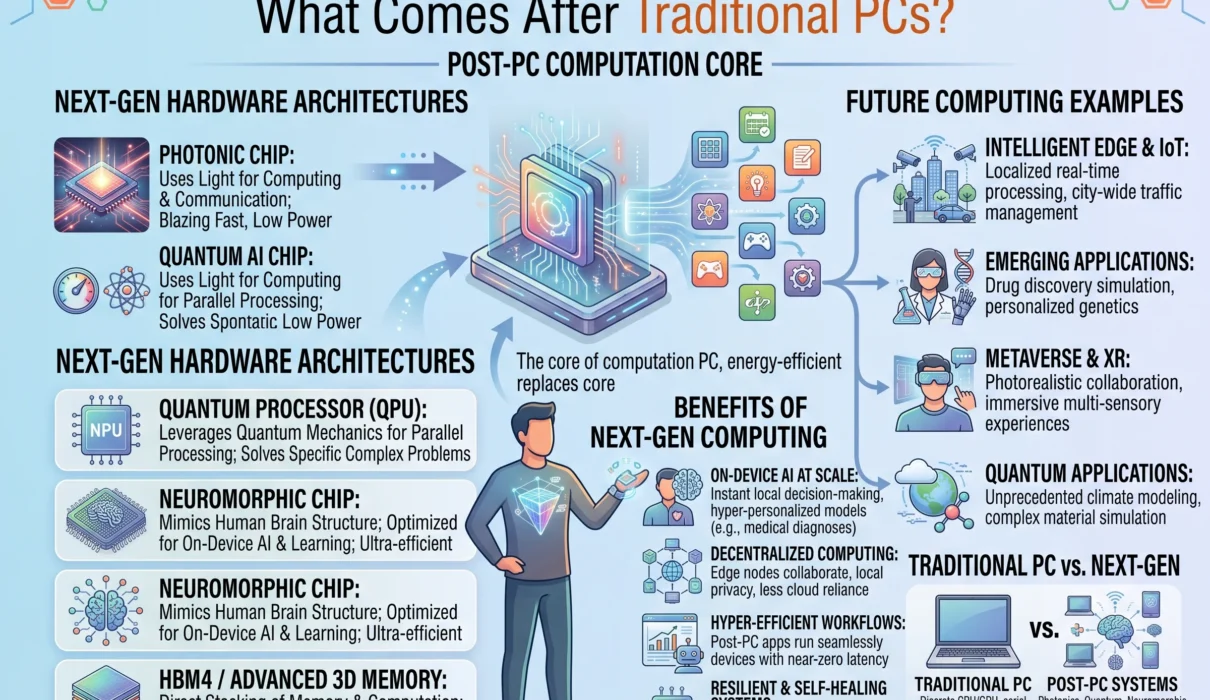
The physical limits of silicon photolithography, the exponential computational demands of artificial intelligence, and the convergence of high-speed wireless connectivity are forcing a complete reimagining of the future of computer hardware. As traditional form factors plateau, next generation PCs are dismantling the physical box entirely. Computing is transitioning from a localized, stationary activity into a distributed, ambient fabric woven through our physical environment, our clothing, our optical field of view, and the edge networks surrounding us.
Understanding what comes after traditional computers requires examining the hardware paradigms replacing them: the evolution of AI-native hardware, distributed edge topologies, wearable and ambient devices, spatial computing interfaces, and non-von Neumann silicon architectures designed to sustain computation when classic silicon hits its physical limits.
1. The Death of the Beige Box: Why the Traditional PC Paradigm Is Stalling
To understand the future computers being engineered in semiconductor labs today, we must first diagnose why the traditional PC design is stalling.
                    THE TRIPLE WALL OF TRADITIONAL COMPUTING

        Power / Thermal Wall                 Memory Bandwidth Wall
       ┌────────────────────────┐           ┌────────────────────────┐
       │ Dennard scaling dead.  │           │ Processing cores wait  │
       │ Clock speeds plateaued │ ────────► │ idle while DDR buses   │
       │ at 4–5 GHz due to heat.│           │ struggle to feed data. │
       └────────────────────────┘           └────────────────────────┘
                                 │
                                 ▼
                     Physical Lithography Wall
                    ┌────────────────────────────┐
                    │ Silicon gates approaching  │
                    │ sub-nanometer atomic       │
                    │ quantum tunneling limits.  │
                    └────────────────────────────┘
The desktop and clamshell laptop architectures we rely on today were shaped by three historical realities that no longer apply:
- Dennard Scaling and Moore’s Law Slowdown: For decades, shrinking transistor dimensions allowed chips to run faster without drawing more power per unit area. When Dennard scaling broke down in the mid-2000s, clock speeds hit a thermal barrier around 4 to 5 GHz. Today, shrinking transistors down to 2-nanometer and sub-nanometer angstrom scales yields diminishing performance returns while exponentially increasing fabrication costs and quantum tunneling leakage.
- The von Neumann Bottleneck: Traditional PCs physically separate the processing core (CPU/GPU) from system memory (DRAM). In modern data-intensive workloads—such as real-time computer vision and generative model execution—up to 80% of total system energy is wasted simply shuttling bits back and forth across copper traces between memory and logic.
- The Static Interface Ceiling: The keyboard, mouse, and flat monitor were brilliant inventions for processing text, spreadsheets, and windowed graphical interfaces. But they are poorly suited for high-dimensional spatial data, continuous multimodal AI interaction, and context-aware ambient computing.
As these physical and functional constraints collide, the computer is transforming from a self-contained desktop unit into a modular, heterogeneous, and ambient computing mesh.
2. Phase One: The Rise of AI PCs and Heterogeneous Client Silicon
The first phase of the post-traditional PC era does not discard the laptop overnight. Instead, it re-engineers its internal silicon architecture from the substrate up.
TRANSITION FROM MONOLITHIC TO HETEROGENEOUS CLIENT SILICON

Legacy PC Architecture:
[General-Purpose CPU] ──► [Discrete GPU (Optional)] ──► [DDR5 Bus] ──► Peripheral I/O

Next-Generation AI PC Architecture:
┌────────────────────────────────────────────────────────────────────────┐
│ HETEROGENEOUS SYSTEM-ON-CHIP (SoC) / ADVANCED PACKAGING                │
├────────────────────┬────────────────────┬──────────────────────────────┤
│ CPU Cores          │ GPU Compute Units  │ Neural Processing Unit (NPU) │
│ (Low-latency       │ (Parallel vector   │ (Dedicated matrix/tensor     │
│  orchestration)    │  shading & math)   │  array: 45–60+ TOPS)         │
├────────────────────┴────────────────────┴──────────────────────────────┤
│ UNIFIED MEMORY ARCHITECTURE (UMA) & ON-PACKAGE LPDDR5X/LPDDR6          │
│ Zero-copy, high-bandwidth memory shared across all processing tiles    │
└────────────────────────────────────────────────────────────────────────┘
The emergence of the modern AI PC marks the end of the CPU-dominated era. In next generation PCs, general-purpose x86 or Arm CPU cores occupy a shrinking percentage of the total silicon die area. The focal point has shifted to heterogeneous System-on-Chip (SoC) designs that combine three distinct computing engines alongside on-package unified memory:
- The Central Processing Unit (CPU): Relegated to system orchestration, operating system scheduling, legacy software execution, and low-latency single-threaded branches.
- The Graphics Processing Unit (GPU): Scaled for high-throughput parallel compute, dynamic graphics rasterization, ray tracing, and intensive batch mathematics.
- The Neural Processing Unit (NPU): Dedicated hardware accelerators delivering 45 to 60+ TOPS (Trillion Operations Per Second) of power-efficient matrix math. NPUs execute local small language models (SLMs), real-time computer vision, acoustic filtering, and background semantic indexing while drawing only 2 to 10 watts.
┌────────────────────────────────────────────────────────────────────────┐
│                   TRADITIONAL PC vs. NEXT-GEN AI PC                    │
├─────────────────────┬────────────────────┬─────────────────────────────┤
│ Dimension           │ Traditional PC     │ Next-Generation AI PC       │
├─────────────────────┼────────────────────┼─────────────────────────────┤
│ Silicon Topology    │ Socketed CPU +     │ Heterogeneous SoC /         │
│                     │ Discrete GPU card  │ Modular Chiplet Tiles       │
├─────────────────────┼────────────────────┼─────────────────────────────┤
│ Memory Subsystem    │ Swappable DDR DIMMs│ High-Bandwidth Unified      │
│                     │ (High latency)     │ Memory Architecture (Zero-  │
│                     │                    │ copy between CPU/GPU/NPU)   │
├─────────────────────┼────────────────────┼─────────────────────────────┤
│ Primary Input       │ Explicit: Key/Mouse│ Multimodal: Gaze, Voice,    │
│                     │ clicks and windows │ Ambient Intent, Visual Data │
├─────────────────────┼────────────────────┼─────────────────────────────┤
│ Software Execution  │ Deterministic code,│ Probabilistic reasoning,    │
│                     │ static binaries    │ continuous local inference  │
├─────────────────────┼────────────────────┼─────────────────────────────┤
│ Connectivity Role   │ Client-server web  │ Collaborative Edge-Cloud    │
│                     │ request pipeline   │ hybrid computing fabric     │
└─────────────────────┴────────────────────┴─────────────────────────────┘
By shifting from discrete socketed motherboards to tightly integrated, multi-chiplet packaging with unified zero-copy memory architectures (UMA), next generation PCs deliver workstation-class performance within fanless, ultrathin physical enclosures with all-day battery endurance.
3. Distributed Edge Computing: The Disaggregation of the PC
As network bandwidth multiplies and latency drops via Wi-Fi 7, 5G-Advanced, and emerging 6G protocols, the computational components that previously lived inside a computer tower are decoupling across space.
This disaggregation is powered by edge computing.
                     THE DISAGGREGATED COMPUTING FABRIC

   [Personal Edge Device]             [Local Micro-Edge]            [Hyperscale Cloud]
   (Smart Glasses, Watch, ──Wi-Fi 7──► (Home Media Hub,   ──Fiber──► (Gigawatt AI Training,
    Wearable Sensor Pod)      5G/6G    Private Micro-Datacenter)      Exabyte Data Stores)
   ──────────────────────             ────────────────────────      ───────────────────────
   • Display & Sensors                • Dense Local Storage         • Trillion-Param Models
   • Real-Time Audio / IMU            • High-Wattage GPU/TPU        • Massive Simulations
   • Sub-1W Local Reflex              • 50–150W Edge Inference      • Enterprise Archives
Instead of requiring every client device to pack an expensive, power-hungry, and thermally constrained processor, the hardware stack is fragmenting into three complementary tiers:
Tier 1: The Personal Capture Layer (Milliwatt Scale)
Lightweight wearables, sensor rings, smart glasses, and ambient microphones that capture biometric, visual, and acoustic input. These devices carry ultra-low-power microcontrollers (MCUs) and tiny NPUs capable of filtering sensor noise, recognizing wake-words, and running basic cryptographic handshakes locally.
Tier 2: The Local Micro-Edge Layer (Dozens-to-Hundreds of Watts)
A quiet, headless computing node tucked away in a closet, an office basement, or an automobile engine bay. This box contains dense banks of unified memory, high-wattage tensor accelerators, and terabytes of solid-state storage. It handles heavy local tasks—rendering real-time 3D environments, indexing personal document archives, running unquantized 70-billion-parameter language models, and executing multi-agent workflows—without any acoustic footprint or thermal constraints in your immediate workspace.
Tier 3: The Hyperscale Cloud Layer (Megawatt-to-Gigawatt Scale)
Remote data centers used exclusively for planetary-scale model training, massive multi-tenant database synchronization, and computational problems requiring warehouse-scale infrastructure.
In this distributed paradigm, the personal computer is no longer an object on your desk. It is a dynamic session hopping between client glass, local edge silicon, and hyperscale clusters.
4. Spatial Computing: Dissolving the Physical Monitor
For over half a century, visual computing has been trapped behind a piece of glass. Whether a 6-inch smartphone panel or a 34-inch curved ultra-wide monitor, traditional PCs force three-dimensional human minds to navigate digital information projected onto a flat 2D surface.
Spatial computing dismantles this interface ceiling.
Spatial computing merges physical and digital realities into a seamless, interactive workspace. Instead of buying physical plastic monitors, digital windows, 3D mechanical models, collaborative video feeds, and documents are anchored directly into physical room coordinates.
                     SPATIAL COMPUTING SENSOR & DISPLAY PIPELINE

  [Real-World Light / Photons]
                │
                ▼
  ┌────────────────────────────────────────────────────────┐
  │ SENSOR SUITE: Micro-OLEDs, LiDAR, Inside-Out Cameras   │
  ├────────────────────────────────────────────────────────┤
  │ REAL-TIME SPATIAL CO-PROCESSOR (e.g., Apple R1 Tier)   │
  │ • Processes 12+ camera streams, 5 sensors, 6 mics      │
  │ • Sub-12 millisecond photon-to-motion latency          │
  │ • Real-time 3D mesh reconstruction of physical space   │
  └──────────────────────────┬─────────────────────────────┘
                             │
                             ▼
  [Multimodal Control: High-Precision Eye Tracking + Micro-Gesture Recognition]
  No physical mice or gamepads required. Intention is parsed via foveated gaze.
The Hardware Enablers of Spatial Computing
Transforming spatial computing from bulky, uncomfortable virtual reality headsets into all-day wearable glasses requires dramatic hardware breakthroughs:
- Micro-OLED and MicroLED Silicon Backplanes: Traditional displays use glass substrates with limited pixel density. Spatial computing engines build displays directly onto silicon wafers (Micro-OLED and MicroLED), packing thousands of pixels per inch (PPI) to deliver true 4K-per-eye resolution, eliminating the pixelated “screen-door effect.”
- Dedicated Low-Latency Sensor Processors: Standard operating system graphics pipelines introduce 30 to 50 milliseconds of latency—enough to induce motion sickness in head-mounted displays. Modern spatial hardware pairs primary application processors with dedicated real-time sensor silicon (such as Apple’s R1 chip or specialized Snapdragon XR platforms) that processes multiple camera streams, LiDAR arrays, and inertial measurement units (IMUs) within 12 milliseconds from photon to display.
- Pancake Optics and Waveguide Displays: Replacing thick Fresnel lenses with folded catadioptric “pancake” optics and diffractive optical waveguides allows optical engines to shrink down to the profile of conventional eyeglasses, projecting sharp graphics directly onto the wearer’s retinas.
- Foveated Rendering Driven by Eye-Tracking: Human vision has high acuity only in the tiny central region of the retina (the fovea), while peripheral vision detects primarily motion and coarse shapes. Spatial hardware uses inward-facing infrared eye-tracking cameras to render the user’s exact point of gaze in photorealistic 8K fidelity, while rendering peripheral areas at lower resolutions. This cuts graphics rendering workloads by up to 75% without perceptible loss in visual quality.
The spatial computer makes physical computer monitors, multi-display desk mounts, and televisions obsolete. A user working in a cafe can instantly summon an infinite, multi-screen workspace floating in the air before them, anchored securely to the table.
5. Wearable Computers and Ambient Intelligence
Beyond head-mounted displays, personal computing is migrating onto the body and into the surrounding room environment through wearable computers and ambient hardware.
                           THE AMBIENT SENSING PERIMETER

   [Smart Eyewear]        ──► Outward Vision / HUD Overlays / Eye Direction
   [Audio Earbuds]        ──► Spatial Sound / Sub-Vocal Recognition / Biometrics
   [Smart Rings / Bands]  ──► Continuous Photoplethysmography (PPG) / Micro-Gestures
   [Ambient Room Anchors] ──► Environmental Microphones / Spatial UWB Radar
                                      │
                                      ▼
                        [Context-Aware Machine Perception]
        System anticipates intent without explicit user prompts or clicks.
1. Contextual Smart Audio and Hearables
Earbuds are transitioning from passive audio drivers into intelligent, always-on computational nodes. Equipped with directional beamforming microphones, inward-facing bone-conduction sensors, and low-power neural processors, smart hearables provide:
- Real-time conversational translation across dozens of spoken languages directly into the ear canal.
- Sub-vocal recognition, allowing users to issue silent verbal commands by detecting micro-movements in jaw muscles without speaking aloud.
- Acoustic transparency that isolates background noise while dynamically amplifying the voice of the person standing directly in front of the wearer.
2. Micro-Gestural Input: Rings, Wristbands, and Electromyography (EMG)
The mouse and keyboard are being augmented—and in many workflows replaced—by neural and micro-gestural interfaces.
Surface Electromyography (sEMG) wristbands detect the electrical motor-neuron signals traveling from the brain down the forearm to the fingers. The hardware can register a microscopic finger twitch—such as tapping your thumb and index finger together while resting your hand inside your pocket—translating that muscle activation into digital clicks, scrolling actions, or text selection with zero physical movement required.
3. Contextual Ambient Displays and Smart Fabrics
Display technology is no longer confined to rigid glass rectangles.
- Foldable, Rollable, and Stretchable Displays: Flexible OLED and micro-capsule e-ink panels allow screens to unfurl from compact cylinders, fold inside leather notebooks, or curve around architectural surfaces.
- Smart Fabrics: Conductive yarns and micro-scale capacitive threads woven directly into clothing turn sleeves into touch-sensitive control surfaces, letting users navigate interfaces, adjust audio volumes, or authenticate identity via woven biometric patterns.
Computing is ceasing to be an explicit destination you sit down at; it is becoming an invisible, contextual utility that accompanies your movements.
6. Revolutionary Computing Architectures: Beyond Classical Silicon
Even as form factors evolve, the semiconductor industry faces a fundamental physical crisis: classical complementary metal-oxide-semiconductor (CMOS) silicon scaling is approaching its physical limits.
When gate oxide layers shrink down to the thickness of single atoms, electrons jump across barriers via quantum tunneling, generating uncontrolled heat and data corruption. To sustain exponential performance leaps through the next half-century, computer scientists are engineering radically new computing technology architectures that discard the classical transistor model.
┌────────────────────────────────────────────────────────────────────────┐
│               NEXT-GENERATION COMPUTING ARCHITECTURES                  │
├────────────────────┬────────────────────┬──────────────────────────────┤
│ Architecture       │ Physical Primitive │ Primary Advantage            │
├────────────────────┼────────────────────┼──────────────────────────────┤
│ Neuromorphic       │ Artificial Spiking │ Consumes power only when an  │
│ Computing          │ Neurons & Synapses │ event occurs (100x efficiency│
│                    │ (Event-Driven)     │ for real-time edge sensory)  │
├────────────────────┼────────────────────┼──────────────────────────────┤
│ Optical / Photonic │ Photons & Optical  │ Light speeds at zero         │
│ Computing          │ Waveguides (Phase  │ electromagnetic crosstalk;   │
│                    │ Interference)      │ massive parallel throughput  │
├────────────────────┼────────────────────┼──────────────────────────────┤
│ In-Memory Analog   │ Memristor Arrays / │ Resolves von Neumann memory  │
│ Computing          │ ReRAM Crossbars    │ wall by running matrix math  │
│                    │ (Ohm's & Kirch.)   │ directly inside memory cells │
├────────────────────┼────────────────────┼──────────────────────────────┤
│ Quantum            │ Quantum Bits       │ Solves intractable combinatorial│
│ Computing          │ (Qubits: Superpos. │ optimization, cryptography,  │
│                    │ & Entanglement)    │ and molecular simulations    │
└────────────────────┴────────────────────┴──────────────────────────────┘
1. Neuromorphic Computing: Mimicking the Human Brain
The human brain is one of the most capable computing architectures in existence—processing language, three-dimensional vision, motor coordination, and spatial logic concurrently while drawing a modest 20 watts of power.
Conventional computers waste massive amounts of electricity because their clock generators tick continuously billions of times per second, executing instructions even when no new data has arrived.
Neuromorphic hardware (such as Intel’s Loihi architecture or SynSense processors) mirrors biological neurons:
- Event-Driven Spiking Neural Networks (SNNs): Neuromorphic chips do not use a global clock. A neuromorphic neuron processes information and consumes electrical power only when an incoming signal threshold is crossed (“spikes”).
- Collocated Compute and Memory: Synaptic weights and neuronal state values are stored together on the same physical circuit, eliminating the von Neumann bus entirely.
Neuromorphic silicon delivers unprecedented energy efficiency for continuous edge sensing—allowing micro-drones, prosthetic limbs, and ambient microphones to run real-time perception for months on single coin-cell batteries.
2. Optical and Photonic Computing: Processing at the Speed of Light
Copper wires struggle at multi-terabit bandwidths: they generate heat, suffer from electromagnetic crosstalk, and degrade signals over distances as short as a few centimeters.
Photonic computing replaces electrons moving through copper with photons traveling through microscopic optical waveguides etched directly onto silicon packaging:
- Passive Matrix Multiplication: Optical processors use arrays of Mach-Zehnder interferometers. By splitting light beams and adjusting phase shifts, matrix multiplication is calculated instantly as light waves interfere with one another—performing mathematical calculations at the speed of light with virtually zero heat generation.
- Optical Interconnects: Systems use co-packaged optics (CPO) to link multiple processor chiplets using laser pulses rather than metal wires, multiplying chip-to-chip bandwidth by orders of magnitude while slashing communication energy by 80%.
3. Quantum Computing: Tapping the Subatomic Realm
While classical and neuromorphic computers operate within the deterministic laws of classical physics, quantum computers operate using quantum mechanics:
- Qubits, Superposition, and Entanglement: A classical bit is deterministically either a 0 or a 1. A quantum bit (qubit) exists in a superposition of states, representing both 0 and 1 simultaneously until measured. When qubits are entangled, the state of one instantly dictates the state of another across distance, allowing quantum systems to evaluate vast combinatorial problem spaces in parallel.
- Not a PC Replacement, but an Oracle Accelerator: Quantum processors will not replace personal computers or run word processors. Maintaining fragile quantum coherence requires cryogenic cooling setups operating near absolute zero (-273.15°C) or highly complex laser-trapped ion vacuum chambers. Instead, quantum systems act as specialized cloud accelerators—solving computational challenges in materials science, room-temperature superconductor design, battery chemistry, complex logistics, and molecular drug discovery that would take classical supercomputers thousands of years to calculate.
7. The Evolutionary Timeline: What Comes Next?
The transition away from traditional personal computers is not an overnight disruption. It is a multi-decade transition unfolding across three distinct waves:
                      THE MULTI-DECADE HARDWARE HORIZON

  2024 – 2028: The Heterogeneous Bridge Era
  ├── Universal integration of 45+ TOPS NPUs in every laptop and phone
  ├── Emergence of early spatial computing glasses & MicroLED displays
  └── Disaggregation of processing via Wi-Fi 7 and low-latency edge nodes

  2029 – 2035: The Ambient & Spatial Era
  ├── Spatial glasses match the weight and form factor of traditional eyewear
  ├── Physical desktop monitors decline in enterprise offices
  └── sEMG wristbands and eye-tracking become primary interface paradigms

  2036 and Beyond: The Non-Von Neumann Era
  ├── Neuromorphic edge sensors enable ubiquitous, battery-free smart objects
  ├── Commercial optical computing accelerates hyperscale inference clusters
  └── Direct non-invasive neural interfaces begin augmenting physical control
2024 – 2028: The Heterogeneous Bridge Era
The traditional laptop and phone remain the primary physical chassis, but their internal operation transforms.
CPUs surrender significant die area to specialized NPUs. Operating systems shift from static file hierarchies to local semantic memory graphs. Advanced multi-chiplet packaging (2.5D/3D packaging like CoWoS) becomes the standard manufacturing methodology across both mobile and desktop processors.
2029 – 2035: The Ambient and Spatial Era
Spatial computing hardware achieves consumer comfort thresholds: lightweight, stylish glasses weighing under 60 grams project sharp, all-day augmented reality environments across the user’s field of view.
Enterprise offices dismantle physical desktop monitors, replacing them with virtual, customizable spatial workspaces. The primary computing hub in your home shifts from a noisy PC tower under a desk to a quiet, high-powered local micro-edge node connected to personal wearables via high-bandwidth wireless fabrics.
2036 and Beyond: The Non-Von Neumann Era
Silicon CMOS reaches its ultimate physical scaling limits. Commercial computing embraces in-memory analog memristor crossbars, neuromorphic event-driven processors, and integrated silicon photonics.
Human-computer interfaces begin moving past physical gestures to direct neural interfaces—using high-density non-invasive neuro-sensing bands that translate cognitive intent directly into digital execution.
8. Strategic Blueprint: How Organizations and Builders Must Prepare
The transition away from traditional PC hardware will disrupt software development, IT procurement, cybersecurity architectures, and enterprise workflows.
Organizations that plan solely around traditional desktop environments risk building infrastructure for an obsolete paradigm.
┌────────────────────────────────────────────────────────────────────────┐
│                   POST-PC PREPARATION FRAMEWORK                       │
├─────────────────────┬──────────────────────────────────────────────────┤
│ Strategic Domain    │ Tactical Priority & Implementation               │
├─────────────────────┼──────────────────────────────────────────────────┤
│ Software UI/UX      │ Redesign applications for Multimodal Interaction:│
│ Engineering         │ voice, gaze tracking, micro-gestures, and 3D     │
│                     │ spatial canvases alongside traditional touch/keys│
├─────────────────────┼──────────────────────────────────────────────────┤
│ Infrastructure &    │ Shift from monolithic server fleets to Multi-Tier│
│ Network Topology    │ Compute Meshes: on-device NPU + local edge micro-│
│                     │ nodes + secure hyperscale private cloud enclaves │
├─────────────────────┼──────────────────────────────────────────────────┤
│ Cybersecurity &     │ Implement Zero-Trust Biometric & Spatial Security│
│ Data Sovereignty    │ architectures for continuous camera/mic streams, │
│                     │ moving authentication onto secured local silicon │
├─────────────────────┼──────────────────────────────────────────────────┤
│ Enterprise Hardware │ Stop purchasing standalone static displays;      │
│ Procurement         │ pilot enterprise spatial headsets and NPU-native │
│                     │ client hardware with unified memory architectures│
└─────────────────────┴──────────────────────────────────────────────────┘
- Shift UI/UX Paradigms to Spatial and Multimodal Input: Software engineering teams must stop designing exclusively for 1080p and 4K rectangular windows. Start building application layers that support 3D scene graphs, spatial audio positioning, natural voice interaction, and gaze-driven selection.
- Architect for Heterogeneous, Tiered Compute: Decouple your backend services. Instead of building monolithic client-server architectures, design software that evaluates execution context dynamically: running latency-sensitive, privacy-critical micro-tasks on the local client NPU, heavy rendering on local edge nodes, and large-scale data aggregation on cloud infrastructure.
- Pioneer Zero-Trust Spatial and Wearable Security: Wearable cameras, spatial tracking sensors, and ambient microphones introduce unprecedented privacy challenges. Organizations must enforce strict “Privacy-by-Design” standards: raw sensor data must be processed locally on-device within isolated secure enclaves, ensuring that video feeds and biometric indicators never leave the user’s personal hardware perimeter unencrypted.
- Prepare for the Post-Quantum Cryptographic Transition: As quantum computing architectures scale toward cryptographic relevance, legacy public-key encryption schemes (such as RSA-2048 and ECC) will become vulnerable. IT leadership must begin auditing cryptographic infrastructure and transitioning enterprise security to Post-Quantum Cryptography (PQC) standards (such as ML-KEM and ML-DSA).
Beyond the Screen
The personal computer was never meant to be a permanent, immutable physical object.
The keyboard, the desktop monitor, and the computer tower were ingenious, temporary compromises—mechanical stepping stones engineered to bridge the gap between human imagination and early semiconductor capabilities.
As specialized AI hardware, high-bandwidth edge topologies, spatial computing displays, and radical semiconductor architectures mature, that mechanical friction is dissolving.
The future of computer hardware is not about building bigger towers, faster clock speeds, or wider desktop monitors. It is about setting computing free from the desk entirely: transforming it into an invisible, contextually aware, and infinitely expandable digital fabric that enhances human capability wherever we go.
The personal computer is not dying—it is simply outgrowing the box.
