


 By
By For decades, the mechanics of booking and experiencing travel remained stubbornly fragmented. A standard vacation demanded hours of manual research across dozens of open browser tabs, cross-referencing rigid airline schedules, reading through conflicting hotel reviews, wrestling with language barriers, and waiting on hold with customer support during flight cancellations.
That legacy model is undergoing an irreversible structural reset.
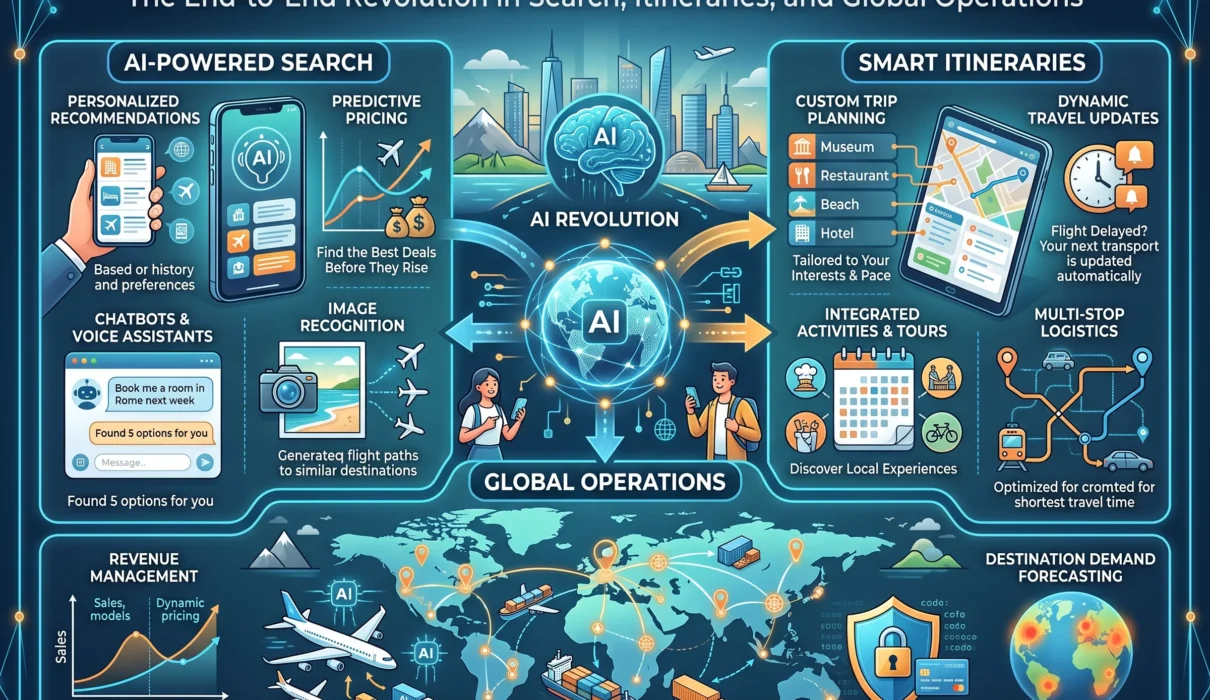
The catalyst is the integration of modern AI in travel. Moving beyond simple rule-based chatbots and static search filters, artificial intelligence travel systems are transforming into proactive, hyper-personalized cognitive engines. Today, machine learning models, autonomous agents, neural machine translation, and predictive analytics are reshaping every link in the global tourism supply chain.
From generative AI trip planning and multimodal translation tools to algorithmic revenue management and automated airline disruption dispatchers, modern travel technology is turning an unpredictable, friction-heavy industry into a seamless, responsive ecosystem.
Whether you are an industry executive, software architect, hospitality operator, or frequent traveler, understanding how artificial intelligence is rewriting the rules of tourism is vital. This comprehensive guide deconstructs the transformation of global travel across six operational dimensions: intelligent search and discovery, dynamic itinerary planning, autonomous customer support, real-time cross-cultural translation, hyper-personalization, and predictive back-end operations.
1. The Core Paradigm Shift: From Fragmented Search to Conversational Intent
To understand the scale of this technological transformation, one must examine how consumer search and booking behaviors have evolved over the past thirty years.
THE EVOLUTION OF TRAVEL DISCOVERY & BOOKING:

THE DIRECTORY ERA (1990–2005):
[ Physical Travel Agent / Paper Brochures ] ──► [ Global Distribution Systems (GDS: Sabre/Amadeus) ]
• Manual ticketing, rigid packaged itineraries, high human booking commissions

THE AGGREGATOR OTA ERA (2005–2023):
[ User Types: "NYC to PAR, Oct 12-19" ] ──► [ Metadata Aggregators (Expedia, Booking, Kayak) ]
• 30+ browser tabs open simultaneously, cognitive overload, rigid form-fill dropdowns

THE CONVERSATIONAL AGENTIC ERA (Current Era):
[ Natural Language Intent Prompt ] ──► [ Multimodal LLM + Real-Time GDS / Tool Calling ]
• Complex constraint handling: "Find a quiet 4-star boutique hotel in Kyoto near public transit
  with a traditional onsen under $220/night, and book a connecting rail pass."
• Executes transactions, manages live flight re-routing, and updates bookings autonomously
The Death of the “30-Tab” Planning Nightmare
Historically, Online Travel Agencies (OTAs) forced users to act as their own database query builders. You were constrained by rigid drop-down menus: origin, destination, departure date, return date, and number of guests.
If you had nuanced qualitative constraints—such as wanting a family-friendly coastal village with reliable pedestrian access, vegan dining options, and a quiet working desk—traditional search engines failed. You had to read travel blogs, browse digital maps, inspect individual hotel photo galleries, and aggregate everything in a separate spreadsheet.
Modern conversational travel discovery inverts this workflow. Powered by Large Language Models (LLMs) connected directly to live Global Distribution Systems via APIs, travelers can express complex, multi-variable intent in plain conversational prose:
“Plan a 10-day itinerary through Northern Spain in late September for two adults who love architecture and seafood. Avoid commercial mega-resorts, keep intercity drives under two hours, and ensure every hotel has secure on-site parking.”
In seconds, the system synthesizes a geographically coherent route, cross-references live room inventories, evaluates historic regional weather patterns, and presents an interactive booking framework.
2. Generative Itinerary Planning: Dynamic, Self-Healing Routes
Early algorithmic itinerary generators were notoriously brittle. They stitched together the top five attractions from tourist review sites, frequently generating geographically nonsensical schedules—such as directing a tourist to visit Tokyo’s Senso-ji Temple at 9:00 AM, cross the city to Shibuya for lunch, and return across the metropolis to Asakusa for an afternoon museum.
Modern AI trip planning architectures use advanced spatial optimization algorithms, reinforcement learning, and semantic contextual reasoning.
THE DYNAMIC ITINERARY ENGINE WORKFLOW:

[ USER INTENT & PREFERENCE VECTOR ]
(Budget, pacing, mobility profile, culinary preferences, dates)
                    │
                    ▼
[ GEOSPATIAL CLUSTERING & GRAPH ROUTING ]
• Calculates real-world transit times via road/rail networks
• Clusters attractions by geographic proximity to minimize transit fatigue
• Checks live opening hours, religious holidays, and scheduled maintenance closures
                    │
                    ▼
[ REAL-TIME CONTEXTUAL OPTIMIZATION ENGINE ]
• Integrates live weather forecasts (e.g., shifts outdoor hikes to clear days)
• Monitors pedestrian crowd heatmaps (e.g., schedules iconic museum at low-traffic hours)
                    │
                    ▼
[ SELF-HEALING DISRUPTION LOOP ]
(Flight delay or sudden thunderstorm triggers automatic itinerary re-balancing)
Geospatial Clustering and Opening-Hour Validation
Modern itinerary generation solves complex combinatorial mathematics (the classic Traveling Salesperson Problem):
- Geographic Proximity Grouping: Instead of ping-ponging across a city, the AI clusters attractions by neighborhood walking zones, calculating walking gradients, elevation changes, and urban transit schedules.
- Dynamic Schedule Alignment: The system reads structured operational metadata: identifying that a specific palace is closed on Mondays, that an iconic cathedral requires pre-booked morning timed-entry tickets, or that an outdoor street market only runs on Thursday mornings.
- The “Self-Healing” Itinerary: If an airline delays a flight by four hours or a severe storm closes a mountain gondola, the autonomous itinerary agent adjusts in real time. It automatically notifies the downstream hotel of late check-in, reschedules restaurant bookings, cancels affected museum reservations, and proposes an indoor afternoon alternative without requiring human panic.
3. Autonomous Customer Service and Agentic Disruption Management
Customer service in the travel industry is characterized by sharp, unpredictable volume surges. When an air traffic control outage, hurricane, or volcanic ash cloud grounds hundreds of flights, call centers are overwhelmed. Historically, travelers faced 6-hour phone wait times sitting on airport floors.
Modern conversational AI and autonomous agent frameworks are transforming customer support from a bottleneck into a competitive advantage.
+---------------------------+-----------------------------------+------------------------------------------+
| Support Generation        | Technological Mechanism           | Operational Capability                   |
+---------------------------+-----------------------------------+------------------------------------------+
| **Legacy Chatbots**       | Keyword matching, rigid decision  | Answers 5 basic FAQs ("What is baggage   |
| (2015–2022)               | trees, scripted form routing      | weight limit?"); fails instantly on nuance|
+---------------------------+-----------------------------------+------------------------------------------+
| **Conversational AI**     | Transformer-based natural language| Interprets intent, handles sentiment,    |
| (LLMs / SLMs)             | understanding, multi-turn context | processes complex flight cancellation Q&A|
+---------------------------+-----------------------------------+------------------------------------------+
| **Autonomous AI Agents**  | ReAct cognitive loops, function   | Rebooks flights, updates seat assignments,|
| (Current Architecture)    | calling, direct API authorization | transfers luggage, and issues vouchers  |
+---------------------------+-----------------------------------+------------------------------------------+
The Autonomous Action Engine: Beyond Answering Questions
The critical difference between an ordinary conversational bot and an AI agent is transactional capability. An LLM alone can only draft a comforting message explaining that your flight was canceled. An agentic system possesses verified API credentials to solve the problem:
ANATOMY OF AN AUTONOMOUS AGENT DISRUPTION INTERVENTION:

[ AIRLINE TELEMETRY ALERT: FLIGHT AC-842 CANCELLED DUE TO ENGINE SENSOR ]
                                      │
                                      ▼
[ AGENTIC DISRUPTION RUNTIME INITIALIZED ]
• Identifies affected passenger: Gold Loyalty Tier, connecting to cruise in Miami
• Ingests passenger preference graph: Prefers aisle seats, Star Alliance carriers
                                      │
                                      ▼
[ MULTI-SYSTEM API EXECUTION ]
1. Tool Invocation: `gds_query_alternate_routes(origin="ORD", dest="MIA", max_delay="4h")`
2. Tool Invocation: `airline_reserve_seat(flight="UA-1104", seat="12C", class="Y")`
3. Tool Invocation: `baggage_transfer_reroute(bag_tag="0014892301", new_flight="UA-1104")`
4. Tool Invocation: `digital_wallet_issue_voucher(type="Meal", amount="$35.00")`
                                      │
                                      ▼
[ PASSENGER SMARTPHONE PUSH NOTIFICATION SENT (< 45 SECONDS TOTAL) ]
"Flight AC-842 was canceled. We have automatically rebooked you on United 1104
 departing Gate B8 at 4:15 PM. Your luggage has been rerouted, and a $35 meal voucher
 has been deposited into your mobile boarding pass wallet. Tap here to accept or change."
By resolving routine re-bookings, seat changes, and schedule shifts instantly and automatically, the system protects travelers from stress while freeing human customer service agents to focus on complex, high-empathy edge cases.
4. Real-Time Neural Translation and Multimodal Communication
Language barriers have historically been one of the primary sources of friction and anxiety for international travelers. Navigating transportation hubs, deciphering foreign food allergies, and managing medical emergencies in destinations where you cannot read the local script can lead to significant misunderstandings.
Advances in neural machine translation (NMT) and multimodal vision-language models have eliminated the communication divide.
THE MULTIMODAL TRANSLATION ECOSYSTEM:

[ VISUAL SENSORY INGESTION ]  ──► Camera extracts street signs, menus, pharmacy packaging
               │
[ REAL-TIME ACOUSTIC NMT ]    ──► On-device speech recognition transcribes foreign phonemes
               │
[ SEMANTIC CONTEXT ENGINE ]   ──► Translates cultural idioms, dietary alerts, and formal grammar
               │
[ NATURAL SYNTHETIC SPEECH ]  ──► Dual-earbud audio translation in natural conversational cadence
1. Zero-Latency Natural Speech Translation
Traditional mobile translation apps required clumsy turn-taking: one person pressed a button, spoke a sentence, waited three seconds for processing, and then held the phone out while an unnatural synthetic voice spoke.
Modern on-device translation models running on dedicated Neural Processing Units (NPUs) enable continuous, streaming conversational translation:
- Two individuals wear low-latency wireless earbuds paired with a smartphone.
- The system performs continuous automatic speech recognition (ASR), translates the semantic grammar in real time, and synthesizes speech directly into each listener’s ear with a delay of less than 500 milliseconds.
- The conversation flows naturally, matching human speech cadences and capturing emotional prosody.
2. Contextual Computer Vision: Augmented Menus and Packaging
Translating a culinary menu is rarely a matter of swapping words. Literal word-for-word translations often result in incomprehensible descriptions (such as translating traditional idiomatic names for pasta dishes or regional street food).
- Modern multimodal vision models do not merely translate the words printed on a paper menu; they explain the culinary context.
- When pointing a smartphone camera at an unfamiliar menu in Tokyo, Athens, or Bangkok, the system translates the script, identifies the cooking method, flags common hidden allergens (such as peanut oils, shellfish, or gluten), and overlays historical photographs of the dish directly onto the live camera viewfinder.
5. Hyper-Personalization: The End of Generic Recommendations
The travel industry has historically relied on broad demographic segmentation: assuming all “solo travelers in their 20s” want budget hostels, or that all “couples over 60” want bus tours and formal dining.
Modern AI in travel enables true individual personalization, predicting preferences before explicit search queries are executed.
+---------------------------+-----------------------------------+------------------------------------------+
| Personalization Vector    | Data Streams Ingested             | Real-World Experience Delivered          |
+---------------------------+-----------------------------------+------------------------------------------+
| **Room Environment**      | Smart-room telemetry, past stay   | Room pre-cooled to 19°C; lighting set to |
|                           | preferences, wearable health apps | warm amber; preferred foam pillow waiting|
+---------------------------+-----------------------------------+------------------------------------------+
| **Gastronomic Mapping**   | Past dining receipts, dietary     | Recommends independent neighborhood cafes|
|                           | restrictions, walking routes      | matching precise roast and bean tastes   |
+---------------------------+-----------------------------------+------------------------------------------+
| **Activity Pacing**       | Biometric recovery data, step     | Adjusts daily schedule: suggests relaxed |
|                           | velocity, historical energy dips  | boat cruise instead of museum stairs     |
+---------------------------+-----------------------------------+------------------------------------------+
| **Dynamic In-Room Audio** | Streaming history, circadian time | Plays ambient acoustic focus tracks by day|
|                           | zone displacement metrics         | and delta-wave sleep tracks at bedtime   |
+---------------------------+-----------------------------------+------------------------------------------+
The Micro-Preference Graph
Behind every traveler sits an evolving preference graph. By integrating past trip histories, loyalty signals, booking velocity, and interaction telemetry, algorithms understand subtle traveler nuances:
- Does the traveler consistently book boutique properties with mid-century modern design over traditional luxury towers?
- Do they prioritize morning espresso within 300 meters of their hotel?
- Do they prefer morning flight departures despite a slightly higher fare?
Hotels utilizing predictive guest-experience AI adjust physical environments before arrival: setting customized digital artwork on smart displays, adjusting room temperatures to match circadian sleep profiles, and personalizing local neighborhood guides that highlight hidden independent record shops or local architectural walks rather than generic tourist gift kiosks.
6. Airline, Hospitality, and Airport Operations: The Invisible Engine
While passenger-facing interfaces grab headlines, the most significant economic impact of artificial intelligence occurs behind the scenes in travel operations. Airlines, hotel conglomerates, and international transport hubs are complex logistics machines where minor optimizations save millions of dollars and prevent systemic cascading delays.
THE PREDICTIVE TRAVEL OPERATIONS STACK:

[ 1. PREDICTIVE FLEET MAINTENANCE ] ──► Ingests in-flight sensor streams to replace parts before failure
                  │
[ 2. DYNAMIC PRICING & REVENUE ]    ──► Adjusts fares by the minute based on booking velocity and weather
                  │
[ 3. COMPUTER VISION TURNAROUND ]   ──► Monitors aircraft ramp servicing to eliminate tarmac delays
                  │
[ 4. AI-OPTIMIZED FLIGHT PATHS ]    ──► Calculates high-altitude wind currents to cut fuel and emissions
1. Predictive Aviation Maintenance
When an airliner suffers an unexpected mechanical failure at a departure gate, the disruption ripples across the airline’s entire global network: downstream flight crews time out, gates become congested, and thousands of passenger connections fail.
- Modern jet airliners (such as the Airbus A350 and Boeing 787) feature tens of thousands of IoT sensors broadcasting continuous telemetry on hydraulic pressure, turbine blade vibration, exhaust gas temperatures, and fuel pump harmonics.
- Machine learning models parse these massive real-time datasets, identifying subtle mechanical degradation patterns dozens of operating hours before an actual component failure occurs.
- Ground maintenance teams are alerted to replace the affected valve or actuator during routine overnight hangar downtime, eliminating gate delays and cancellations.
2. Flight Trajectory and Fuel Optimization
Commercial aviation produces roughly 2.5% of global carbon emissions. Fuel represents an airline’s largest and most volatile operating expense.
- Traditional flight paths follow static, pre-planned airway corridors designed decades ago.
- AI-driven flight planning platforms (such as those developed with predictive atmospheric neural nets) evaluate live satellite weather data, high-altitude jetstream wind speeds, atmospheric turbulence, and aircraft weight distribution.
- The system computes optimal, dynamic 4D flight trajectories that harvest tailwinds and avoid headwinds, shaving 2% to 4% off total fuel burn per flight and preventing atmospheric contrail formation that contributes to global warming.
3. Real-Time Dynamic Pricing in Hospitality and Aviation
Static seasonal pricing tables (e.g., “Summer Peak Rate vs. Winter Low Rate”) are obsolete. Contemporary revenue management systems operate on continuous machine learning algorithms:
- Systems track booking velocity, competitor occupancy rates, macroeconomic exchange rates, local concert and sporting event schedules, and long-range weather projections.
- Hotel room rates and airline seat classes adjust dynamically by the minute, optimizing occupancy probability and RevPAR (Revenue Per Available Room) while offering travelers fair market rates based on real-time demand curves.
+---------------------------+-----------------------------------+------------------------------------------+
| Operational Sector        | AI Engineering System             | Concrete Business & Environmental Impact |
+---------------------------+-----------------------------------+------------------------------------------+
| **Turnaround Dispatch**   | Computer vision cameras           | Reduces aircraft ground idle time        |
|                           | tracking ground baggage & fuel    | by 8–12 minutes per arrival cycle        |
+---------------------------+-----------------------------------+------------------------------------------+
| **Crew Scheduling**       | Multi-agent constraint solvers    | Eliminates crew-timeout cancellations    |
|                           | optimizing fatigue and duty limits| during widespread thunderstorm delays    |
+---------------------------+-----------------------------------+------------------------------------------+
| **Food Waste Reduction**  | Predictive kitchen inventory      | Drops hotel buffet food waste by 30%–45% |
|                           | models tracking breakfast habits  | via accurate daily consumption forecasts |
+---------------------------+-----------------------------------+------------------------------------------+
| **Luggage Tracking**      | Computer vision barcode & RFID    | Flags misrouted bags before departure;   |
|                           | tag sorting on automated belts    | reduces lost-luggage rates by over 50%   |
+---------------------------+-----------------------------------+------------------------------------------+
7. Critical Industry Challenges: Ethics, Privacy, and Hallucinations
The rapid integration of artificial intelligence into travel brings notable security, ethical, and societal challenges that platform architects and travelers must confront.
THE TRIAD OF AI TRAVEL IMPLEMENTATION CHALLENGES:

[ 1. ALGORITHMIC HALLUCINATIONS ]
• Language models inventing non-existent flights, closed restaurants, or wrong visa rules
• Risk of travelers arriving at remote borders without mandatory electronic documentation

[ 2. SURVEILLANCE & BIOMETRIC DATA PRIVACY ]
• Centralized databases storing facial biometric scans and real-time physical movement logs
• Cross-border data compliance friction between GDPR, CCPA, and national security mandates

[ 3. OVERTOURISM AMPLIFICATION ]
• Social and recommendation algorithms funneling thousands of tourists to fragile ecosystems
• Creating sudden localized congestion in previously peaceful, unequipped rural towns
1. The High Stakes of Algorithmic Hallucination
In creative writing, an AI hallucination is an entertaining curiosity; in travel, it is an expensive operational failure.
- If a generative trip planner suggests an enchanting ferry crossing that stopped operating three years ago, or provides incorrect tourist visa transit regulations, travelers can find themselves stranded at foreign immigration checkpoints facing deportation.
- The Solution (RAG and Verification): Reliable travel platforms do not allow raw LLMs to answer factual travel queries. They deploy Retrieval-Augmented Generation (RAG), forcing the model to cite and verify every route, schedule, and visa rule against authoritative live databases (such as IATA Timatic and official transit authority GTFS feeds) before rendering output to the user.
2. Biometric Tracking and Privacy
Biometric airport corridors (such as facial recognition boarding gates) streamline transit, but they raise significant civil liberty questions:
- Where are high-resolution facial geometry vectors stored, and who holds the cryptographic encryption keys?
- Travelers must retain the absolute legal right to opt out of biometric facial scans in favor of physical human passport inspections without facing punitive delays or discrimination.
3. Overtourism by Algorithm
Recommendation algorithms naturally optimize for visual impact and high engagement scores. When an algorithm surfaces an undiscovered, tranquil canyon or picturesque alpine village to millions of users simultaneously, the destination can be overwhelmed overnight.
- Local infrastructure fails, housing costs soar for residents, and fragile natural habitats suffer erosion.
- Forward-thinking travel AI platforms are incorporating destination stewardship metrics into their recommendation models: actively dispersing tourist traffic away from congested hotspots toward charming, under-visited secondary towns that welcome economic revitalization.
8. Strategic Playbook: How Modern Travelers Can Harness AI Today
To maximize travel experiences while avoiding common technical pitfalls, modern explorers should adopt a structured four-stage methodology:
1.Use Conversational AI for Unstructured Ideation :Phase 1: Broad Discovery & Inspiration.
Start your planning by providing an LLM with your deep qualitative constraints rather than rigid dates: “Act as an expert travel curator. Suggest three alternative regions in Europe that mirror the dramatic coastal cliffs of the Amalfi Coast, but feature half the tourist density, walkable villages, and great local train access.”
2.Verify Every Schedule Against Primary Data Sources :Phase 2: Validation & Grounding.
Never treat an AI-generated itinerary as an unchangeable master schedule. Verify all generated opening hours, museum admission days, and transit connections directly against official municipal websites and transport operators. Never rely on an AI for visa and passport validity requirements; verify through official embassy portals.
3.Deploy Offline Neural Translation and eSIM Tech :Phase 3: Digital Setup.
Prior to departure, download offline language packs in Google Translate or DeepL to ensure uninterrupted camera and speech translation when subterranean metro systems drop cellular signals. Install a digital regional eSIM profile (via Airalo or Nomad) to guarantee high-speed connectivity the moment your plane lands.
4.Let AI Manage Disruption While You Enjoy the Journey :Phase 4: Real-Time Adaptation.
During transit, rely on airline and travel apps powered by real-time notification engines. If a flight is delayed, check your automated rebooking options on your mobile app before joining a physical line of panicked travelers at the airport service counter.
The Horizon: What the Next Decade of Intelligent Travel Looks Like
The travel industry is crossing a threshold where artificial intelligence ceases to be an external feature; it is becoming the invisible foundation of the entire global hospitality infrastructure.
THE NEXT DECADE IN INTELLIGENT TRAVEL:

1. THE COMPLETE AMBIENT JOURNEY
   • Travel without tickets, boarding passes, physical passports, or check-in desks
   • Biometric facial identification and edge wearables clear security and open hotel suites

2. PERSISTENT PERSONAL TRAVEL CONCIERGES
   • A personal AI agent that knows your health metrics, circadian sleep needs, and taste
   • Negotiates directly with airline and hotel autonomous agents to curate every minute

3. AUTONOMOUS ELECTRIC FLEETS & REGIONAL AIR MOBILITY
   • AI-coordinated electric vertical takeoff and landing (eVTOL) air taxis
   • Frictionless airport-to-resort transfers bypassing urban traffic gridlocks entirely
The future of travel is not about replacing the human soul of hospitality; it is about eliminating mechanical friction.
When the anxiety of flight cancellations, language barriers, complex booking logistics, and navigation errors is solved by intelligent software, travelers are liberated to focus on what genuinely matters: immersing themselves in new cultures, forging human connections across borders, admiring breathtaking natural wonders, and returning home restored.
Artificial intelligence is not diminishing the magic of travel—it is giving us the freedom to experience the world with curiosity, clarity, and complete confidence.

1 Comment