


 By
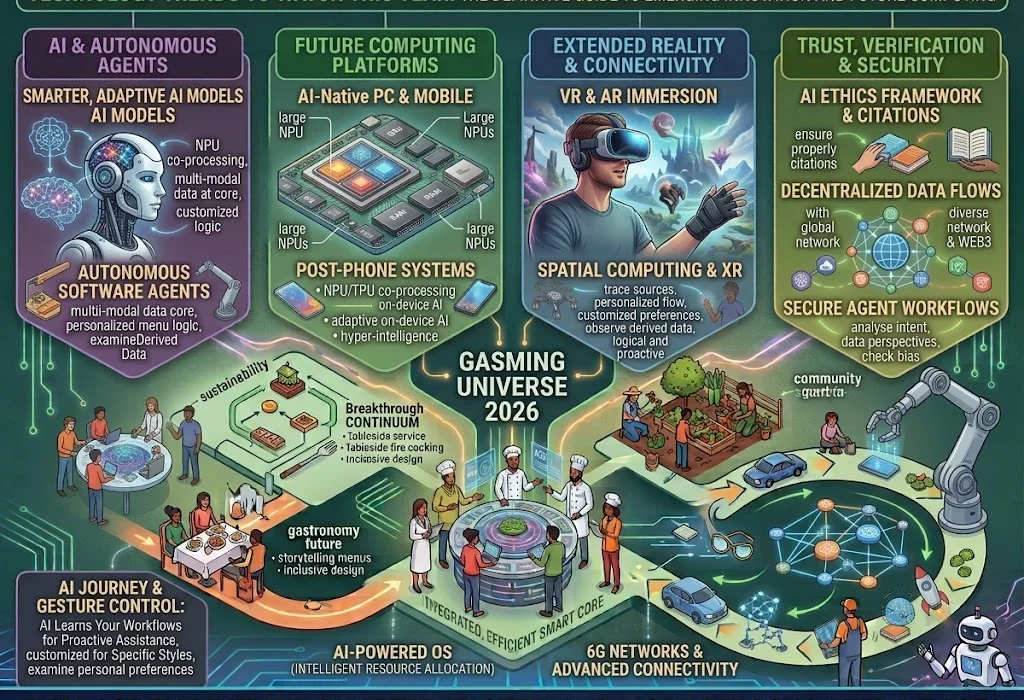
By The global technological infrastructure is undergoing a structural realignment. Over the past several decades, the tech industry advanced through predictable, sequential upgrade cycles: shrink the transistor, double the core density, accelerate broadband speeds, and migrate physical workflows into centralized cloud data centers.
Today, that linear trajectory has fractured.
The industry faces physical constraints: Dennard scaling has ended, thermal dissipation boundaries in silicon are reaching thermodynamic limits, centralized data centers are straining regional municipal power grids, and legacy cybersecurity protocols are becoming vulnerable to post-quantum decryption algorithms.
In response, the defining technology trends of this year are characterized by decentralization, hardware specialization, and autonomous intelligence.
Instead of routing all computing through distant hyperscale servers, emerging technology is moving computation to local silicon via edge Neural Processing Units (NPUs). Instead of passive software waiting for human keystrokes, autonomous multi-agent systems are self-compiling, debugging, and executing mission-critical tasks. Simultaneously, future technology like embodied humanoid robotics, post-quantum cryptography (PQC), optical interconnects, and non-terrestrial satellite networks are stepping out of theoretical research labs into industrial reality.
Whether evaluating strategic investments, architectural enterprise designs, or product roadmaps, understanding the latest technology trends is essential for engineers, executives, and technologists.
This comprehensive guide analyzes the primary technological developments across seven foundational sectors: Artificial Intelligence, Next-Generation Computing Architectures, Embodied Robotics, Cybersecurity, Telecommunications and Networking, Modern Software Systems, and Advanced Physical Hardware.
1. The Macro Technological Landscape: The Forces Accelerating Convergence
Before dissecting specific technological verticals, one must examine the systemic drivers compelling this industry-wide transformation:
THE SYSTEMIC CATALYSTS OF THE MODERN TECH ERA:

[ THE THERMAL & ENERGY WALL ]  ──► Hyperscale data centers require gigawatt-scale microgrids
                 │
[ THE EDGE SOVEREIGNTY PUSH ]  ──► Sub-watt NPU silicon handling inference locally on-device
                 │
[ POST-QUANTUM COMPUTING RUN ] ──► NIST-mandated replacement of RSA & Elliptic-Curve crypto
                 │
[ EMBODIED MULTIMODAL AI ]     ──► Neural networks moving from text boxes into physical actuators
- The Energy and Water Wall: Advanced deep learning clusters consume vast amounts of electrical power and cooling resources. The race to train trillion-parameter models has created localized energy crunches, forcing chip designers to prioritize energy efficiency (performance-per-watt) above raw peak clock speeds.
- The Shift to Heterogeneous Edge Silicon: General-purpose CPUs can no longer keep pace with specialized mathematical workloads. Modern System-on-Chip (SoC) architectures deploy heterogeneous combinations of scalar CPUs, vector GPUs, parallel NPUs, and custom cryptographic security enclaves.
- The Post-Quantum Migration Mandate: With quantum testbeds scaling qubit counts, the mathematical foundations of classical asymmetric cryptography (RSA and ECC) face theoretical obsolescence. The transition toward quantum-resistant algorithms is driving a complete overhaul of global security standards.
- The Fusion of Code and Physical Action: AI is transitioning from passive digital assistants into embodied artificial intelligence—powering articulated robotic limbs, autonomous industrial machinery, and spatial computing headsets that physically sense and manipulate real environments.
2. Artificial Intelligence: Autonomous Agentic Swarms, Reasoning Models, and Small Language Models
Artificial intelligence has evolved past the phase of conversational chatbots and simple generative text novelties. The contemporary focus centers on autonomy, structured reasoning, computational efficiency, and multi-agent coordination.
THE AI MODEL EVOLUTION:

EARLY GENERATIVE PHASE (2022–2024):
[ User Text Prompt ] ──► [ Monolithic Dense LLM ] ──► [ Single-Turn Text Output ]
• Passive, prompt-dependent, prone to hallucinations, lacks deterministic tool access

MODERN AGENTIC REASONING PARADIGM (Current Era):
[ High-Level Objective ] ──► [ Test-Time Compute / Chain-of-Thought Decomposition ]
                                          │
       ┌──────────────────────────────────┼──────────────────────────────────┐
       ▼                                  ▼                                  ▼
[ Specialized Agent A ]         [ Specialized Agent B ]         [ Specialized Agent C ]
(Database / Tool Worker)        (Security & Linter Auditor)     (Deterministic Execution)
       │                                  │                                  │
       └──────────────────────────────────┼──────────────────────────────────┘
                                          ▼
[ Self-Correcting Execution: Synthesizes, verifies, debugs, and outputs verified result ]
From Next-Token Prediction to Test-Time Compute and Reasoning Models
First-generation Large Language Models (LLMs) operated on purely causal, autoregressive token prediction: they emitted tokens sequentially with fixed computation per token, regardless of problem complexity.
Modern reasoning architectures allocate dynamic computational power during inference (test-time compute):
- Inference-Time Search: When faced with complex mathematical, scientific, or algorithmic logic, the model generates internal thoughts and branches, evaluating multiple candidate reasoning paths via search algorithms (such as Monte Carlo Tree Search or beam search).
- Self-Verification and Error Correction: If an internal deduction fails a logical consistency check or unit test, the model backtracks, explores an alternative hypothesis, and refines its deduction before presenting a final answer. This drastically reduces hallucinations in high-stakes fields like pharmacology, finance, and software verification.
Small Language Models (SLMs) and On-Device Edge Inference
While monolithic frontier models require massive data-center clusters, an architectural trend is the rise of Small Language Models (SLMs) ranging from 1 billion to 8 billion parameters:
- Deep Distillation: High-performance SLMs are trained on synthetic, highly curated datasets generated by larger frontier models, packing significant reasoning capability into tiny parameter footprints.
- Low-Bit Quantization (INT4 / FP4): Techniques like 4-bit integer quantization compress model weights to under 4 gigabytes of memory.
- Local Sub-Watt Deployment: These models run natively on modern smartphone and laptop NPUs without sending data across an internet connection, providing sub-30ms latency, zero cloud API costs, and total data privacy.
+---------------------------+-----------------------------------+------------------------------------------+
| AI Development Tier       | Technical Architecture            | Primary Enterprise Impact                |
+---------------------------+-----------------------------------+------------------------------------------+
| **Reasoning Models**      | Test-time compute scaling, tree-  | High-accuracy scientific synthesis,      |
|                           | of-thought search, backtracking   | formal code verification, complex math   |
+---------------------------+-----------------------------------+------------------------------------------+
| **Autonomous Agents**     | Multi-agent orchestration, tool   | Replaces manual workflow steps; executes |
|                           | calling, dynamic task graphs      | multi-day research and dev projects      |
+---------------------------+-----------------------------------+------------------------------------------+
| **Edge SLMs**             | Distilled small weights, INT4/FP4 | Runs local AI on smartphones, laptops,   |
|                           | quantization, local NPU runtime   | and IoT devices with zero cloud latency  |
+---------------------------+-----------------------------------+------------------------------------------+
| **Multimodal Real-Time**  | Unified audio/visual/text tokens; | Delivers natural conversational speech,   |
|                           | end-to-end neural streaming       | visual understanding, and spatial vision |
+---------------------------+-----------------------------------+------------------------------------------+
3. Next-Generation Computing Architectures: Silicon Specialization, Neuromorphic Chips, and Quantum Progress
The computing industry can no longer rely on Moore’s Law to deliver effortless performance gains. Increasing clock frequencies above 5 GHz on traditional monolithic silicon creates unsustainable heat and power leakage. To push computing forward, hardware engineers are redesigning processor topologies from the silicon substrate up.
THE EVOLUTION OF SILICON TOPOLOGY:

TRADITIONAL MONOLITHIC DIE:
┌────────────────────────────────────────────────────────┐
│ CPU Cores  •  Cache  •  Memory Controller  •  PCIe I/O  │ ──► Low yields on sub-3nm nodes;
│ All printed on a single, expensive continuous die       │     entire chip discarded if one core fails
└────────────────────────────────────────────────────────┘

MODERN 3D CHIPLET & ADVANCED PACKAGING:
┌──────────────────┐  ┌──────────────────┐
│  Compute Tile A  │  │  Compute Tile B  │  <── Specialized process nodes
│  (3nm Logic)     │  │  (3nm Logic)     │      (Logic on 3nm, I/O on 6nm)
└────────┬─────────┘  └────────┬─────────┘
         │                     │
         ▼                     ▼
┌────────────────────────────────────────────────────────┐
│   SILICON INTERPOSER / CO-PACKAGED OPTICAL FABRIC      │  <── Direct copper-to-copper bonds
└──────────────────────────┬─────────────────────────────┘      or optical waveguides
                           ▼
┌────────────────────────────────────────────────────────┐
│        BASE I/O & HIGH-BANDWIDTH MEMORY (HBM3e/4)      │
└────────────────────────────────────────────────────────┘
Chiplets and 3D Advanced Packaging
Rather than manufacturing a massive, monolithic processor on a single wafer—which results in high defect rates and surging fabrication costs at 3nm and below—semiconductor designers deploy chiplet architectures:
- Disaggregated Modular Tiles: The CPU cores, GPU execution units, neural engines, and I/O controllers are fabricated as distinct, modular silicon tiles, often utilizing different semiconductor nodes optimized for their specific tasks.
- Hybrid Bonding Interconnects: Microscopic copper-to-copper micro-bumps and dielectric bonds link these tiles on a silicon interposer with connection pitches down to a few microns, allowing chiplets to communicate with the latency and bandwidth of a single continuous piece of silicon.
- Cost and Yield Advantages: If a single compute core is defective, only that tiny chiplet is discarded, dramatically lowering fabrication costs and accelerating the deployment of massive multi-tile processors.
Co-Packaged Optics (CPO) and Optical Interconnects
In modern AI supercomputers, moving electrical data across traditional copper traces between processors and memory consumes vast amounts of energy and generates extreme heat.
- Co-Packaged Optics: Replaces electrical copper traces with optical silicon waveguides directly inside the processor package.
- Photonic Data Transmission: Data is converted from electrons to photons using micro-lasers, transmitting data at the speed of light with a fraction of the thermal resistance and energy consumption of copper wires. This removes the bandwidth bottleneck between processors and High-Bandwidth Memory (HBM).
Neuromorphic Computing: Mimicking the Human Brain
While standard von Neumann architectures continually move data back and forth between a separate CPU and RAM—a process known as the von Neumann bottleneck—neuromorphic processors (such as Intel’s Loihi architecture) mimic biological neural structures:
- Spiking Neural Networks (SNNs): Instead of continuous matrix math, neuromorphic chips process information through temporal asynchronous electrical “spikes.”
- Colocated Memory and Compute: Neurons and synapses are integrated directly together on the silicon. If there is no incoming sensory data, the chip consumes virtually zero standby electricity, enabling ultra-low-power edge perception in drones, industrial sensors, and autonomous vehicles.
4. Embodied AI and Advanced Robotics: The Humanoid and Autonomous Frontier
Robotics is transitioning from fixed industrial arms bolted to automotive assembly lines toward versatile, spatially aware, and physically articulated machines designed to operate alongside humans.
+---------------------------+-----------------------------------+------------------------------------------+
| Robotic Domain            | Core Technology Enabler           | Real-World Operational Impact            |
+---------------------------+-----------------------------------+------------------------------------------+
| **Bipedal Humanoids**     | High-torque planetary actuators,  | Operates inside existing human facilities|
|                           | Vision-Language-Action (VLA) models| (climbing stairs, moving pallets, boxes) |
+---------------------------+-----------------------------------+------------------------------------------+
| **Autonomous Mobile**     | Solid-state LiDAR, Real-Time SLAM,| Navigates chaotic warehouses and factory |
| **Robots (AMRs)**         | 3D Time-of-Flight depth sensors   | floors dynamically without floor markings|
+---------------------------+-----------------------------------+------------------------------------------+
| **Bionic Soft Robotics**  | Pneumatic elastomer grippers,     | Handles delicate agricultural produce,   |
|                           | tactile capacitive skin arrays    | glassware, and surgical tissue safely    |
+---------------------------+-----------------------------------+------------------------------------------+
Vision-Language-Action (VLA) Models
Historically, an industrial robot required thousands of lines of precise, handcrafted code to move an arm to exact XYZ coordinates. If an item on a conveyor belt shifted two inches, the robot grabbed empty air.
Modern robotics leverages Vision-Language-Action (VLA) neural networks:
$$\text{Sensory Input: } \{\text{Visual Frame}, \text{Natural Language Command}\} \xrightarrow{\text{VLA Model}} \text{Joint Motor Torques } \{\tau_1, \tau_2, \dots, \tau_n\}$$
- The robot observes its environment through stereo depth cameras.
- It receives a generalized human instruction: “Clear the empty soda cans off the assembly table and place them in the blue recycling bin.”
- The VLA model translates high-level spatial and semantic understanding directly into continuous motor commands (joint rotations, wrist torques, and gripper forces), dynamically adjusting its grip if an object slips or tilts.
The Rise of General-Purpose Humanoid Platforms
Companies across manufacturing, logistics, and automotive sectors are piloting general-purpose humanoid robots (such as Figure 02, Boston Dynamics’ electric Atlas, and Tesla Optimus):
- Why the Humanoid Form Factor Matters: Modern factories, warehouses, stairs, doorways, and toolsets were designed specifically for human bodies. Rather than spending billions redesigning a factory to accommodate specialized tracks, a humanoid robot can navigate standard stairs, fit through narrow aisles, and use the same physical hand tools that human workers use.
- Actuator and Power Engineering: Early hydraulic humanoids were loud, heavy, and prone to messy oil leaks. Modern platforms use custom high-torque-density electric actuators, permanent magnet brushless motors, cycloidal gearboxes, and high-discharge lithium-ion battery packs to achieve human-like articulation and multi-hour work shifts.
5. Cybersecurity: Zero Trust, Post-Quantum Cryptography, and AI-Augmented Defense
The cybersecurity landscape has transformed into an automated battleground. Traditional perimeter-based security (“castle-and-moat”)—which assumes that anyone inside an internal corporate network is trustworthy—is obsolete in an era of distributed remote workforces and multi-cloud environments.
THE MODERN ZERO TRUST DEFENSE ARCHITECTURE:

[ ACCESS REQUEST (User, Device, API) ]
                   │
                   ▼
┌────────────────────────────────────────────────────────────────────────┐
│                 CONTINUOUS VERIFICATION POLICY ENGINE                  │
│                                                                        │
│  • Cryptographic Identity Check (FIDO2 / Hardware Passkeys)            │
│  • Device Health Telemetry (OS patch level, EDR status, secure boot)   │
│  • Contextual Risk Score (Geolocation, behavioral cadence, time)       │
└──────────────────────────────────┬─────────────────────────────────────┘
                                   │
       ┌───────────────────────────┴───────────────────────────┐
       ▼                                                       ▼
[ ACCESS GRANTED ]                                      [ ACCESS DENIED ]
Micro-segmented, least-privilege, short-lived session   Continuous quarantine & automated SOC alert
The Post-Quantum Cryptography (PQC) Migration
Quantum computers leverage the principles of superposition and entanglement to solve specific mathematical problems exponentially faster than classical computers.
- The Quantum Threat to Encryption: Algorithms like Shor’s Algorithm prove that a sufficiently scaled, fault-tolerant quantum computer could break classical asymmetric encryption standards (such as RSA-2048 and Elliptic Curve Cryptography / ECC) in minutes. These standards protect global banking ledgers, military communications, and internet HTTPS traffic.
- “Harvest Now, Decrypt Later” (HNDL): Adversarial state actors are intercepting and storing massive volumes of encrypted diplomatic and corporate network traffic today. Even though they cannot decrypt it now, they intend to decrypt it retroactively once quantum hardware matures.
- NIST-Standardized PQC Algorithms: The US National Institute of Standards and Technology (NIST) has finalized the first standardized post-quantum cryptographic algorithms:
- ML-KEM (Module-Lattice-Based Key-Encapsulation Mechanism, formerly CRYSTALS-Kyber): For general public-key encryption and secure internet handshakes.
- ML-DSA (CRYSTALS-Dilithium) & SLH-DSA (SPHINCS+): For digital signatures and identity verification.
- Enterprises and cloud providers are actively upgrading their TLS/SSL termination proxies and PKI architectures to support these lattice-based cryptographic algorithms.
Autonomous AI-Driven Security Operations Centers (SOCs)
Modern enterprise networks generate millions of telemetry log events every second. Human security analysts cannot review thousands of alerts manually, resulting in severe alert fatigue.
- AI Security Orchestration: Machine learning platforms analyze network flows, identity logs, and endpoint detections concurrently.
- Automated Threat Containment: When an anomalous behavior indicates a lateral ransomware breach, the system acts in milliseconds: severing affected endpoint network interfaces, revoking Active Directory session tokens, and isolating vulnerable virtual machines before malicious payloads propagate across the enterprise.
6. Telecommunications & Networking: Wi-Fi 7, 5G-Advanced, and Direct-to-Cell Satellite Networks
Connectivity is evolving to eliminate physical dead zones and deliver deterministic, low-latency performance across both urban centers and isolated wilderness.
+---------------------------+-----------------------------------+------------------------------------------+
| Networking Standard       | Core Technical Specification      | Everyday Real-World Impact               |
+---------------------------+-----------------------------------+------------------------------------------+
| **Wi-Fi 7 (802.11be)**    | 320 MHz channels, 4096-QAM,       | Delivers multi-gigabit wireless speeds;  |
|                           | Multi-Link Operation (MLO)        | eliminates VR/gaming network stutter     |
+---------------------------+-----------------------------------+------------------------------------------+
| **5G-Advanced (5.5G)**    | Sidelink communication, L4S,      | Supports real-time vehicle-to-everything |
|                           | RedCap (Reduced Capability) IoT   | (V2X) and ultra-low-power smart devices  |
+---------------------------+-----------------------------------+------------------------------------------+
| **Direct-to-Cell LEO**    | 3GPP Rel-17/18 Satellite Links    | Global cellular coverage directly to     |
| (Satellite Connectivity)  | over standard mid-band spectrum   | unmodified smartphones with no towers    |
+---------------------------+-----------------------------------+------------------------------------------+
Wi-Fi 7 and Multi-Link Operation (MLO)
While past Wi-Fi updates simply boosted theoretical peak speeds, Wi-Fi 7 (802.11be) re-engineers reliability:
- Multi-Link Operation (MLO): Historically, a device connected to a single Wi-Fi band (either 2.4 GHz, 5 GHz, or 6 GHz). Wi-Fi 7 devices transmit and receive data across multiple bands simultaneously. If interference interrupts the 6 GHz band, packets route instantaneously over the 5 GHz band without dropping connections or lagging.
- 320 MHz Channel Width: Doubles the channel highway width, delivering raw wireless throughputs exceeding 40 Gbps for high-bandwidth local media production, augmented reality headsets, and dense enterprise offices.
Direct-to-Cell Satellite Megaconstellations
One of the most consequential telecommunications breakthroughs is the deployment of direct-to-cell satellite technology:
- Low-Earth-Orbit (LEO) satellite constellations (such as Starlink Direct-to-Cell and AST SpaceMobile) deploy phased-array antennas that operate as orbiting cellular towers.
- Rather than requiring specialized, bulky satellite phones, these satellites communicate directly with standard, unmodified LTE/5G smartphones using standard cellular spectrum bands.
- This technology eliminates cellular dead zones across oceans, mountain ranges, and rural deserts, providing universal emergency SOS messaging, voice communication, and data services worldwide.
7. Software Engineering: Local-First Systems, CRDTs, and WebAssembly
The software development paradigm is moving away from fragile, cloud-dependent architectures toward resilient, high-performance systems that prioritize user ownership of data.
THE EVOLUTION OF SOFTWARE ARCHITECTURES:

THE CLOUD-CENTRIC MODEL:
[ User Device / Browser ] ──► Internet Latency (150ms - 500ms) ──► [ Centralized Cloud Database ]
• Keystrokes freeze during network dropouts
• Data is trapped behind proprietary corporate vendor paywalls

THE LOCAL-FIRST ARCHITECTURE:
[ Local In-Memory DB (SQLite/WASM) ] ──► Instant UI Update (< 5ms)
                 │
                 ▼ (Asynchronous Background Sync via CRDTs)
[ Peer-to-Peer / Cloud Relay Fabric ] ──► Deterministic conflict resolution across all devices
Local-First Architecture and CRDTs
For over a decade, cloud SaaS forced every keystroke across remote network round trips. Modern applications are embracing Local-First software architecture:
- Instant Local Read/Write: Data is written instantaneously to a local, embedded database on the user’s physical machine (such as SQLite compiled to WebAssembly). The user interface updates in sub-millisecond time with zero loading spinners, whether connected to the internet or completely offline.
- Conflict-Free Replicated Data Types (CRDTs): When network access is restored, CRDT algorithms merge changes made concurrently across multiple devices mathematically, resolving collaborative merge conflicts deterministically without overwriting user data.
WebAssembly (WASM) Outside the Browser
WebAssembly originally allowed high-performance C++, Rust, and Go code to execute securely inside web browsers. Now, WASM has moved to the server side and edge runtimes:
- Near-Instant Cold Starts: Unlike traditional Docker containers that take seconds to initialize an operating system, WASM modules spin up in microseconds.
- Sandboxed Security Isolation: Code executes inside a lightweight, mathematically secure memory sandbox, allowing cloud providers and edge nodes to run untrusted multi-tenant code with minimal CPU overhead.
8. Physical Hardware: Silicon-Carbon Batteries and Spatial Micro-OLEDs
Consumer and industrial hardware continues to overcome material boundaries through electrochemical innovations and advanced optical displays.
+---------------------------+-----------------------------------+------------------------------------------+
| Hardware Breakthrough     | Material Innovation               | Practical Consumer Impact                |
+---------------------------+-----------------------------------+------------------------------------------+
| **Silicon-Carbon (Si/C)** | Nano-porous silicon matrices      | Packs 6,000mAh to 7,500mAh into ultra-   |
| **Battery Anodes**        | replacing traditional graphite    | thin smartphones; enables 2-day battery  |
+---------------------------+-----------------------------------+------------------------------------------+
| **Silicon Micro-OLEDs**   | Ultra-dense OLED pixels printed   | Delivers 4K per-eye resolution inside    |
|                           | directly on silicon wafers        | lightweight sunglasses-style AR displays |
+---------------------------+-----------------------------------+------------------------------------------+
| **Solid-State Thermal**   | Piezoelectric micro-fans & vapor  | Replaces bulky, noisy rotary cooling fans|
| **Cooling (AirJet)**      | chambers on thin chips            | inside ultra-thin laptops and tablets    |
+---------------------------+-----------------------------------+------------------------------------------+
The Silicon-Carbon (Si/C) Battery Revolution
For decades, lithium-ion battery density was bottlenecked by conventional graphite anodes, hitting a volumetric ceiling around 700 Wh/L.
- The Science: Silicon can theoretically store significantly more lithium ions than graphite. Historically, pure silicon expanded by over 300% during charging cycles, causing internal electrodes to crack.
- The Breakthrough: Modern battery cells integrate nano-porous silicon-carbon composite structures with elastic polymer binders.
- The Impact: Volumetric energy density exceeds 850 to 900 Wh/L. Manufacturers can pack 6,000mAh to 7,500mAh batteries into ultra-thin devices that previously topped out at 5,000mAh, delivering genuine two-day battery life and enhanced performance in freezing temperatures.
Micro-OLED and Retinal Spatial Displays
Spatial computing headsets and lightweight augmented reality (AR) glasses require high pixel densities to eliminate the “screen-door effect” (visible grid lines between pixels):
- Silicon Backplanes: Rather than printing OLED pixels on glass substrates, Micro-OLED displays print organic light-emitting diodes directly onto single-crystal silicon wafers.
- Extreme Pixel Density: Achieves pixel densities exceeding 3,000 to 4,000 pixels per inch (PPI) with pixel pitches of only a few microns. This delivers sharp 4K resolution per eye inside optical engines smaller than a postage stamp, enabling lightweight eyewear that projects sharp virtual screens into the user’s field of view.
Strategic Technology Adoption Matrix: How to Plan for What’s Next
To navigate this landscape without chasing short-lived novelties, enterprise leaders, developers, and technology enthusiasts can utilize this structured evaluation matrix:
THE TECHNOLOGY HORIZON ADOPTION MATRIX:

               High Practical Utility / Immediate ROI
                                 ▲
     [ DEPLOY NOW (0–12 Mos) ]   │   [ PILOT & VALIDATE (1–3 Yrs) ]
     • Local-First Software (CRDTs)│ • Post-Quantum Cryptography (PQC)
     • Edge Small Language Models│ • Co-Packaged Optics & Chiplets
     • Wi-Fi 7 Multi-Link Ops    │ • Direct-to-Cell Satellite Tech
     • Silicon-Carbon Batteries  │ • Humanoid Logistics Robotics
                                 │
 ────────────────────────────────┼────────────────────────────────► High Technical
                                 │                                  Complexity
     [ MONITOR & WAIT (3–5 Yrs) ]│   [ RESEARCH HORIZONS (5–10 Yrs) ]
     • General Consumer AR Headsets│• Room-Temperature Superconductors
     • Autonomous Vehicle Robotaxis│• Fault-Tolerant Quantum Compute
     • Neuromorphic Visual Sensors│ • Brain-Computer Interfaces (BCI)
                                 │
               Low Immediate Deployment Readiness
Conclusion: The Era of Intelligent, Resilient Technology
The primary technology trends unfolding today demonstrate that the future of computing is not defined by a single breakthrough or a single company. Instead, it is an interconnected ecosystem where advancements in one discipline accelerate breakthroughs across another:
- AI models are designing specialized chiplet architectures and discovering novel battery electrolytes.
- Advanced silicon packaging is enabling on-device neural execution without cloud latency.
- Resilient direct-to-cell satellite networks and post-quantum cryptography are safeguarding distributed communication channels across the planet.
- Embodied robotics is translating machine intelligence into physical action, solving labor bottlenecks and reshaping physical manufacturing.
We have moved beyond the era of passive digital tools into an era of collaborative, autonomous, and resilient technology. The organizations, software engineers, and individuals who thrive in the coming decade will be those who look beyond individual buzzwords, understand the underlying engineering foundations, and harness these converging tools to build systems of enduring scale, security, and human value.
