


 By
By Until recently, computers were exclusively analytical and organizational machines. They could sort vast relational databases, calculate trajectories for orbital spacecraft, filter email spam, and defeat grandmasters in chess. Yet, despite their computational speed, computers remained fundamentally limited: they could analyze and categorize existing information, but they could not author an original sentence, compose a melody, paint a surreal landscape, or write a software application from a plain-English request.
That historical boundary has dissolved.
The catalyst is generative AI—a revolutionary branch of machine learning that moves beyond passive data classification into active, original synthesis.
Instead of merely labeling an image as a “dog” or flagging an email as “promotional,” generative artificial intelligence synthesizes realistic written essays, renders photorealistic 8K imagery, composes multi-instrumental orchestral audio, animates cinematic video sequences, and authors production-grade code in seconds.
For beginners, students, professionals, and curious observers, the speed of this transformation can feel bewildering. Is generative AI genuinely thinking? Does it understand the words and pixels it generates? How do these algorithms create something out of nothing?
This comprehensive guide breaks down modern AI models and AI tools from first principles: how computers learn creative patterns, the step-by-step mechanics behind generating diverse media formats, real-world practical applications, and the critical limitations, ethical challenges, and hallucinations that define current machine intelligence.
1. What Is Generative AI? The Core Definition
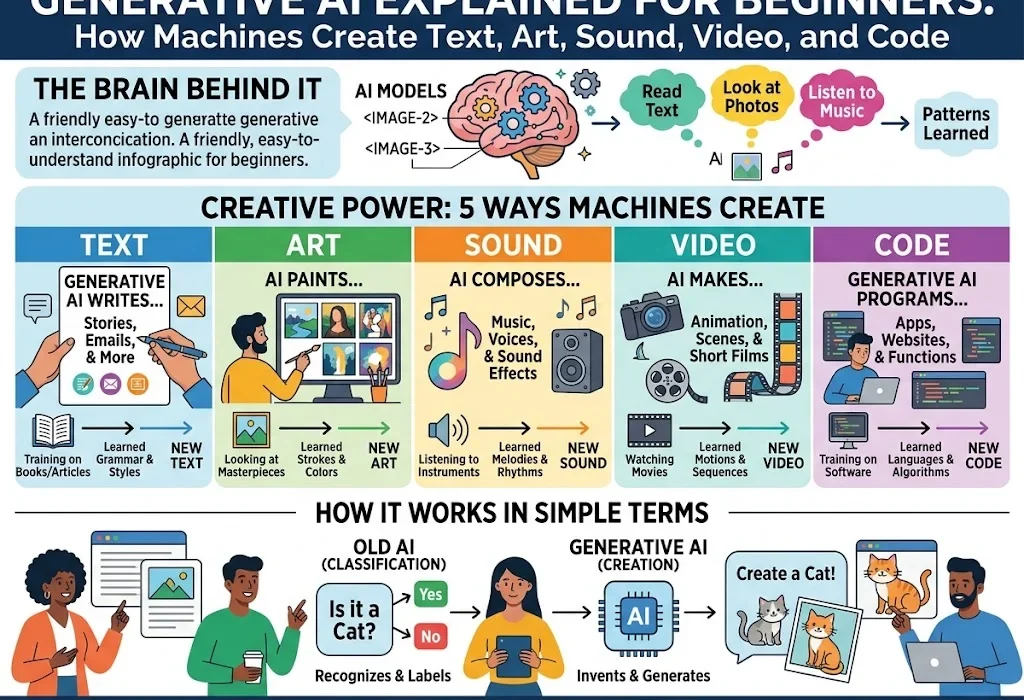
Generative AI is a category of artificial intelligence systems capable of generating new, original content—including text, images, audio, synthetic voices, video, 3D assets, and computer code—in response to simple human prompts.
TRADITIONAL (DISCRIMINATIVE) AI VS. GENERATIVE AI:

DISCRIMINATIVE / PREDICTIVE AI:
[ Raw Input Data: Photo of an Animal ] ──► [ Mathematical Classifier ] ──► [ Label: "Cat" (98% probability) ]
• Goal: Categorize, classify, detect anomalies, predict numeric trends
• Question: "What category does this existing data belong to?"

GENERATIVE AI:
[ Text Prompt: "A cat floating in space, oil painting style" ] ──► [ Generative Model ] ──► [ Brand-New Synthetic Image ]
• Goal: Create novel data instances that resemble the training distribution
• Question: "Generate a realistic new sample that fits this description."
The Difference Between Predictive and Generative Systems
- Discriminative / Predictive AI: Analyzes existing data and draws decision boundaries. It evaluates data points to make a classification or numerical prediction. For example, your bank’s fraud detection algorithm uses discriminative AI: it analyzes your credit card transaction and decides whether it is “Legitimate” or “Fraudulent.”
- Generative AI: Models the underlying probability distribution of data. It learns the statistical patterns, relationships, textures, and structures across billions of training examples. Once trained, it uses that knowledge to assemble completely original content that has never existed before, but conforms to the rules and styles of what it learned.
Is Generative AI Actually “Thinking”?
The short answer is no. A generative AI system does not possess consciousness, human-like intent, biological self-awareness, or emotional understanding.
At its mathematical heart, generative AI operates on probabilistic pattern completion. When an AI writes a paragraph or paints a digital portrait, it is calculating which words, pixels, or audio frequencies are statistically most likely to follow the prompt you provided, based on patterns extracted from massive training datasets.
Yet, because human language and art follow structural patterns, this statistical synthesis mimics genuine human creativity with startling fidelity.
2. How Generative AI Works: From Data to Neural Weights
To understand how an AI tool creates content, you must look at how artificial neural networks process, store, and generate information.
THE THREE-STAGE GENERATIVE AI PIPELINE:

[ STAGE 1: MASSIVE DATA INGESTION & PRE-PROCESSING ]
• Billions of web pages, digitized books, open-source code repositories, images, and audio tracks
• Raw data is cleaned, filtered, normalized, and converted into mathematical tokens
                        │
                        ▼
[ STAGE 2: NEURAL ARCHITECTURE TRAINING (Learning Patterns) ]
• Mathematical loss functions calculate errors; backpropagation adjusts billions of weights
• Transformers (for text/code) & Diffusion Models (for images/video) map latent feature spaces
                        │
                        ▼
[ STAGE 3: RUNTIME INFERENCE (Prompt to Generation) ]
• User types a natural language prompt
• Model traverses its learned probability space to synthesize novel content in real time
Tokens: The Atomic Currency of AI
Computers cannot read human letters or understand visual concepts directly; they only compute numbers. Before an AI model can interact with text, images, or audio, the data must be broken down into discrete numerical units called tokens.
- Text Tokens: In text models, a token can be a single character, a syllable, a whole word, or part of a word. On average, 1,000 tokens equal approximately 750 English words. For example, the sentence “Generative AI is revolutionary” might be broken into four distinct tokens:
["Gen", "erative", " AI", " is", " revolutionary"]. Each token is assigned a unique integer ID. - Image Patches and Latent Tokens: In computer vision, images are divided into small pixel grids (such as 16×16 pixel patches), which are mathematically compressed into numerical representations.
Vector Embeddings and High-Dimensional Space
Once data is tokenized, it is converted into vector embeddings—long lists of floating-point numbers that place concepts into an imaginary multidimensional geometric space.
CONCEPTUAL VECTOR EMBEDDING MAP (Simplified to 2D):

   [ Abstract / Royal ]
            ▲
            │         (King) ──────────────► (Queen)
            │           │                       │
            │           │  (Subtract Male,      │
            │           │   Add Female vector)  │
            │           ▼                       ▼
            │         (Man)  ──────────────► (Woman)
            │
            │                   (Apple) ────► (Banana) [Fruit Cluster]
            └───────────────────────────────────────────────► [ Physical / Everyday ]
In this vector space:
- Words with similar meanings cluster close together (e.g., “feline”, “kitten”, and “cat”).
- Mathematical vectors capture relationships across concepts: if you take the vector for “King”, subtract the vector for “Man”, and add the vector for “Woman”, the resulting mathematical coordinates land remarkably close to the vector for “Queen”.
- These geometric mappings allow the AI to understand nuance, synonyms, metaphors, and cross-lingual concepts.
3. The Architecture Engine: Transformers and Diffusion Models
Different media formats rely on specialized neural network architectures designed to process specific types of data. The modern generative revolution is powered by two foundational breakthroughs: Transformers and Diffusion Models.
+---------------------------+-----------------------------------+------------------------------------------+
| Architecture Type         | Core Mechanism                    | Primary Media Generated                  |
+---------------------------+-----------------------------------+------------------------------------------+
| **Transformers**          | Self-Attention mechanism,         | Text, programming code, conversational   |
|                           | causal sequence-to-sequence math  | dialogue, mathematical proofs            |
+---------------------------+-----------------------------------+------------------------------------------+
| **Diffusion Models**      | Latent space noise addition and   | Photorealistic images, 3D meshes,        |
|                           | iterative reverse denoising       | high-definition cinematic video          |
+---------------------------+-----------------------------------+------------------------------------------+
| **Autoregressive Audio**  | Neural acoustic codecs, flow-     | Cloned speech, singing, multi-layer      |
|                           | matching, spectrogram synthesis   | musical compositions, ambient foley SFX  |
+---------------------------+-----------------------------------+------------------------------------------+
4. How Generative AI Creates Text: Large Language Models (LLMs)
When you interact with text-based AI tools (such as ChatGPT, Claude, or Google Gemini), you are conversing with a Large Language Model (LLM). These models are built upon the Transformer architecture, introduced in 2017.
THE TRANSFORMER SELF-ATTENTION PROCESS:

"The bank manager approved the loan because it was low risk."
                                         ▲
                                         │ (Self-Attention Layer)
"it" connects mathematically to ─────────┴──► "loan" (Weight: 0.88)
"it" does NOT connect to ───────────────────► "bank manager" (Weight: 0.12)
The Power of Self-Attention
Before Transformers, natural language models processed sentences sequentially, one word at a time. By the time an older model reached the tenth word in a paragraph, it struggled to retain context from the first word.
Transformers introduced Self-Attention:
- Instead of reading sequentially, the Transformer analyzes all words in a sentence simultaneously.
- It calculates mathematical attention weights between every word and every other word, determining which terms provide context for each other.
- In the sentence “The trophy did not fit in the suitcase because it was too large,” the model determines that “it” refers to the trophy. If you change the sentence to “because it was too small,” the self-attention weights shift, linking “it” to the suitcase.
Next-Token Prediction: The Hall of Mirrors
Once a Large Language Model understands the context of your prompt, it generates a response via autoregressive generation:
- It analyzes the entire prompt you provided.
- It calculates a probability distribution across its entire vocabulary (often 50,000 to 100,000 potential tokens), determining which token is most likely to come next:
$$\text{Context: “The capital of France is”} \longrightarrow P(\text{“Paris”}) = 0.94, \quad P(\text{“Lyon”}) = 0.02, \quad P(\text{“a”}) = 0.01$$
- It selects the winning token (e.g., “Paris”), appends “Paris” to the conversation, and then runs the calculation again to predict the word that should follow “Paris”.
- This cycle repeats dozens of times per second, building sentences, paragraphs, and complete analytical essays word by word.
5. How Generative AI Creates Images: The Physics of Diffusion
The way computers generate images underwent a revolution with the invention of Diffusion Models (the technology powering tools like Midjourney, Stable Diffusion, and DALL-E).
Earlier image generators—such as Generative Adversarial Networks (GANs)—pitted two neural networks against each other: a Generator trying to create fake images, and a Discriminator trying to catch fakes. While groundbreaking, GANs were notoriously unstable and prone to “mode collapse,” producing distorted faces and surreal artifacts.
Diffusion models took inspiration from non-equilibrium thermodynamics—specifically, how gas molecules diffuse outward into a room.
THE DIFFUSION GENERATION CYCLE:

[ FORWARD PROCESS: TRAINING (Adding Noise) ]
[ Clear Image of a Dog ] ──► Add Gaussian Noise ──► More Noise ──► [ Pure Static Screen (Chaos) ]
                                                                             │
 ════════════════════════════════════════════════════════════════════════════╪════════════════════
                                                                             ▼
[ REVERSE PROCESS: GENERATION (Removing Noise Guided by Text) ]
[ Text Prompt: "A golden retriever sitting in rain" ]
                               │
                               ▼
[ Pure Random Noise ] ──► Step 50: Faint Shapes ──► Step 20: Dog Outline ──► [ Step 0: Crisp 8K Image ]
The Forward Process (Destroying Information)
During training, the engineers take millions of real photographs paired with descriptive text captions:
- The software takes a clear photograph (e.g., a photo of a red sports car) and adds a tiny layer of random mathematical static (Gaussian noise).
- It repeats this process over hundreds of steps, gradually degrading the image until the original photograph is completely destroyed, replaced by an unrecognizable field of pure random static.
- At each step, a neural network (typically a U-Net or Diffusion Transformer) is asked a simple question: “What noise was added in this step, and how can we subtract it?”
- Over billions of training cycles, the network becomes an expert at predicting and removing noise.
The Reverse Process (Creating Order from Chaos)
When you type a prompt into an image generator:
- The AI generates a canvas of pure, random static noise (like television snow).
- It uses your text prompt as an anchor (using a text encoder like CLIP or T5) to guide its adjustments.
- Over 20 to 50 progressive steps, the model inspects the static, subtracts the noise it predicts does not belong, and brings structure into focus: first broad compositions and colors, then silhouettes, and finally fine details like skin pores, water droplets, and fabric threads.
- Out of total randomness, a brand-new, photorealistic image emerges.
6. How Generative AI Creates Video, Audio, and Synthetic Voices
The principles behind text and image generation extend into temporal and acoustic dimensions: video, sound, and the spoken human voice.
+---------------------------+-----------------------------------+------------------------------------------+
| Media Domain              | Generation Architecture           | Practical Consumer Capabilities          |
+---------------------------+-----------------------------------+------------------------------------------+
| **Text-to-Video**         | 3D Diffusion Transformers (DiT),  | Generates high-definition cinematic      |
|                           | spatio-temporal latent blocks     | 60-second video clips with physics flow  |
+---------------------------+-----------------------------------+------------------------------------------+
| **Voice Cloning & TTS**   | Neural vocoders, flow-matching,   | Clones a human voice from 3 seconds of   |
|                           | zero-shot speech synthesis        | audio; reads scripts with human emotion  |
+---------------------------+-----------------------------------+------------------------------------------+
| **Music Generation**      | Autoregressive audio tokens,      | Generates complete 3-minute songs with   |
|                           | latent spectrogram diffusion      | vocals, lyrics, basslines, and drums     |
+---------------------------+-----------------------------------+------------------------------------------+
Generative Video: Adding the Temporal Dimension
Generating video is significantly more complex than generating a static image. A video is not merely a collection of isolated images; it requires temporal consistency. If a character walks behind a tree in Frame 15, they must reappear on the other side in Frame 30 wearing the exact same clothes, moving with realistic physical momentum.
Modern video generators (such as Sora, Runway Gen-3, and Luma Dream Machine) use Spatio-Temporal Diffusion Transformers (DiTs):
- They treat video not as a series of 2D frames, but as a continuous three-dimensional cube of visual information (spatio-temporal spacetime patches), where height, width, and time are processed simultaneously.
- The model learns real-world physical simulations: how gravity pulls falling water, how sunlight reflects off a moving automobile hood, and how cloth ripples in the wind.
Generative Audio and Music Synthesis
Audio generation operates across two primary paradigms:
- Spectrogram Generation: The AI converts sound into visual images called spectrograms (which plot audio frequencies over time). It uses standard image diffusion techniques to generate the spectrogram, and then uses an algorithm called a neural vocoder to convert the visual frequencies back into audible sound waves.
- Discrete Audio Tokenization: Tools like Suno and Udio tokenize raw audio into discrete units representing pitch, timber, rhythmic cadence, and instrumental layers. The system authors music much like an LLM writes text: predicting which musical notes, harmonies, and drum hits should follow the preceding bars.
7. How Generative AI Writes Software Code
One of the most economically disruptive applications of generative AI is code generation. Platforms like GitHub Copilot, Cursor, and specialized coding models have fundamentally altered software development workflows.
THE CODE GENERATION PIPELINE:

[ Developer Prompt / Comment: "Write a Python script to scrape product prices from an API" ]
                                       │
                                       ▼
[ Context Retrieval: Ingests adjacent project files, imports, and schema definitions ]
                                       │
                                       ▼
[ Code-Trained LLM (e.g., Claude, GPT-4o, DeepSeek-Coder) ]
• Understands programming grammar, API contracts, algorithmic complexity, and syntax rules
                                       │
                                       ▼
[ Synthesized Production Code Output ]
import requests
import json

def fetch_product_prices(api_url: str) -> dict:
    try:
        response = requests.get(api_url, timeout=10)
        response.raise_for_status()
        data = response.json()
        return {item['id']: item['price'] for item in data.get('products', [])}
    except requests.exceptions.RequestException as e:
        print(f"Error fetching data: {e}")
        return {}
Why Generative AI Excels at Programming
Programming languages (such as Python, JavaScript, C++, and Go) are far more structured, logical, and unambiguous than human languages:
- A human language like English is full of slang, idioms, contextual cultural humor, and structural ambiguity.
- Programming languages possess strict, deterministic syntax rules: every function must open and close brackets properly, variables must follow type rules, and errors trigger immediate compiler flags.
- Because millions of public code repositories exist on platforms like GitHub—complete with documentation, bug fixes, and unit tests—generative models easily learn common algorithmic patterns, API configurations, and standard architectural designs.
8. Everyday Real-World Applications Across Industries
Generative AI is no longer a theoretical research topic; it is an active production tool deployed across every major sector of the global economy:
+---------------------------+-----------------------------------+------------------------------------------+
| Industry Vertical         | Generative AI Deployment          | Practical Operational Impact             |
+---------------------------+-----------------------------------+------------------------------------------+
| **Marketing & Copywriting**| Automated social copy, SEO drafts,| Reduces campaign preparation from weeks  |
|                           | personalized email variations     | to hours; enables continuous A/B testing |
+---------------------------+-----------------------------------+------------------------------------------+
| **Software Development**  | Boilerplate generation, bug triage| Accelerates developer velocity by 30–50%;|
|                           | synthetic unit test matrices      | translates obsolete legacy frameworks    |
+---------------------------+-----------------------------------+------------------------------------------+
| **Film & Game Design**    | Concept art mood boards, dynamic  | Allows indie studios to produce visual   |
|                           | textures, procedural NPC dialogue | fidelity matching historical AAA budgets |
+---------------------------+-----------------------------------+------------------------------------------+
| **Biomedicine & Science** | De novo molecular synthesis,      | Predicts 3D protein structures; designs  |
|                           | synthetic genetic sequencing      | targeted drug inhibitor compounds        |
+---------------------------+-----------------------------------+------------------------------------------+
| **Education & Tutoring**  | Socratic dialogue tutors, adaptive| Provides individualized step-by-step math|
|                           | reading level translation         | explanations tailored to student pacing  |
+---------------------------+-----------------------------------+------------------------------------------+
9. Critical Limitations and the Problem of “Hallucinations”
Despite its extraordinary capabilities, generative AI has serious structural limitations that every user must understand. Treating an AI model as an infallible factual encyclopedia is a dangerous mistake.
THE CORE LIMITATIONS OF GENERATIVE AI:

[ 1. HALLUCINATIONS ] ──► Confidently stating plausible-sounding falsehoods as fact
            │
[ 2. ZERO CAUSALITY ] ──► Understands correlation and patterns, not physical cause-and-effect
            │
[ 3. CONTEXT DRIFT ]  ──► Forgets details or loses narrative coherence across massive prompts
            │
[ 4. SENSITIVITY ]    ──► Minor phrasing tweaks yield wildly divergent mathematical outputs
The Anatomy of an AI Hallucination
The most prominent failure mode of Large Language Models is hallucination—when an AI generates statements that sound completely authoritative, eloquent, and persuasive, but are factually incorrect or entirely fabricated.
- Why Hallucinations Happen: Remember that an LLM is a probabilistic engine trained to predict the next plausible token. It does not possess an internal database of verified objective truth. If you ask an LLM about an obscure legal precedent or an unstudied historical event, it does not stop and think, “I don’t know.” Instead, it generates words that match the linguistic style of legal citations or historical accounts, inventing court names, dates, case numbers, and book titles that never existed.
- The Solution (RAG): Enterprise applications mitigate hallucinations using Retrieval-Augmented Generation (RAG). Instead of allowing the AI to answer purely from its training memory, the system retrieves verified text excerpts from trusted private databases and commands the AI: “Answer the user’s question using ONLY the provided reference documents.”
The Lack of Common Sense and Physical Intuition
Generative models do not inhabit the physical world. They have never felt gravity, dropped a glass on a tile floor, or navigated an obstacle.
Consequently, models can make errors in spatial reasoning that a five-year-old child would avoid—such as depicting a person with six fingers on a hand, placing a reflection in a mirror at an impossible physics angle, or generating a recipe that instructs a cook to pour boiling oil into water.
10. Ethics, Copyright, and the Human Impact
The sudden arrival of machine-generated content has triggered intense legal, ethical, and sociological debates around the world.
THE ETHICAL AND LEGAL BATTLEGROUND:

[ INTELLECTUAL PROPERTY & TRAINING DATA ]
• Were models trained on copyrighted books, journalism, and artworks without consent?
• Do artists deserve financial compensation and opt-out registries?

[ DEEPFAKES & INFORMATION INTEGRITY ]
• High-fidelity synthetic voice clones used for financial fraud and phone scams
• Photorealistic fake imagery and video weaponized in political disinformation campaigns

[ WORKPLACE TRANSITION & LABOR IMPACT ]
• Automation of entry-level creative, legal, administrative, and engineering roles
• Need for educational curricula to focus on critical auditing rather than rote syntax
Copyright and Intellectual Property
Major lawsuits have been brought by authors, visual artists, newspapers, and record labels against artificial intelligence labs. The central legal questions include:
- Does scraping publicly accessible internet data to train a neural network constitute “Fair Use” under intellectual property law?
- If an AI generates an image or song in the distinct, recognizable artistic style of a living creator, does that infringe on the artist’s commercial livelihood?
- Courts, regulatory agencies, and legislatures worldwide are developing legal standards for licensing fees, transparency mandates, and automated watermarking protocols to protect human creators.
Deepfakes, Scams, and Identity Protection
As audio and video generation tools become accessible on consumer laptops:
- Malicious actors can clone a human voice using just three seconds of audio extracted from a social media post, using the fake voice to execute convincing family emergency scams or authorize corporate wire transfers.
- Photorealistic synthetic imagery can be used to generate non-consensual imagery or fabricate news events during delicate geopolitical crises.
- Mitigating these risks requires international adoption of cryptographic verification standards (such as C2PA / Content Credentials), which embed tamper-proof digital signatures and metadata directly into media files at the point of capture.
11. Beginner’s Playbook: How to Use Generative AI Tools Effectively
If you are just beginning to explore generative AI, following a few practical techniques will immediately elevate the quality of your results:
1.Provide Deep Context and Establish Personas :Rule 1: Context is King.
Never issue vague, single-sentence prompts like “Write an essay about leadership.” Instead, assign the model a specific role, define the target audience, and outline the exact tone: “Act as an executive leadership coach with 20 years of experience. Write a concise, 500-word memo to first-time tech managers explaining how to delegate technical tasks without micromanaging. Use an encouraging, direct tone.”
2.Provide Concrete Examples :Rule 2: Few-Shot Prompting.
Machine learning models respond exceptionally well to patterns. If you want the AI to format data or write in a specific style, provide two or three examples of your ideal output before asking your question. This is known as Few-Shot Prompting, and it dramatically reduces errors and formatting drift.
3.Enforce Chain-of-Thought Thinking :Rule 3: Step-by-Step Reasoning.
When asking an AI model to solve a mathematical problem, analyze financial numbers, or write code, include this simple instruction: “Think step-by-step and show your reasoning before presenting your final answer.” Forcing the model to output its intermediate deduction steps allows its attention mechanism to calculate complex relationships, drastically reducing logical mistakes.
4.Never Treat Outputs as Unquestioned Fact :Rule 4: Trust but Verify.
Treat generative AI like an extraordinarily fast, enthusiastic intern who occasionally makes things up with complete confidence. Always audit factual claims, verify citations, check mathematical outputs, and test generated software code in safe, isolated development environments before deploying it.
The Horizon: What Comes Next for Generative AI
We are only in the opening chapter of the generative era. As computational algorithms, edge silicon, and neural architectures advance, the technology is moving toward several defining frontiers:
THE FUTURE TRAJECTORY OF GENERATIVE AI:

1. INTERACTIVE REAL-TIME WORLDS
   • Video games and virtual simulations rendered dynamically in real time
   • Worlds where no two players encounter the exact same narrative or visual environment

2. ON-DEVICE SUB-WATT INTELLIGENCE
   • High-performance models executing entirely on smartphone and wearable NPUs
   • Total privacy, zero data leaving the device, and instant offline responsiveness

3. MULTI-AGENT AUTONOMOUS COLLABORATION
   • Specialized AI agents working in coordinated teams to solve scientific challenges
   • Synthesizing novel cancer therapies, designing materials, and managing microgrids
Generative AI is not a replacement for human imagination; it is an amplifier for it. Just as the camera expanded our visual vocabulary, the printing press democratized knowledge, and computers automated mathematics, generative artificial intelligence provides humanity with a versatile digital canvas.
By understanding how these systems learn, how they synthesize content, and where their limitations lie, you can harness these tools to build, write, design, and create with unprecedented clarity and speed.
