


 By
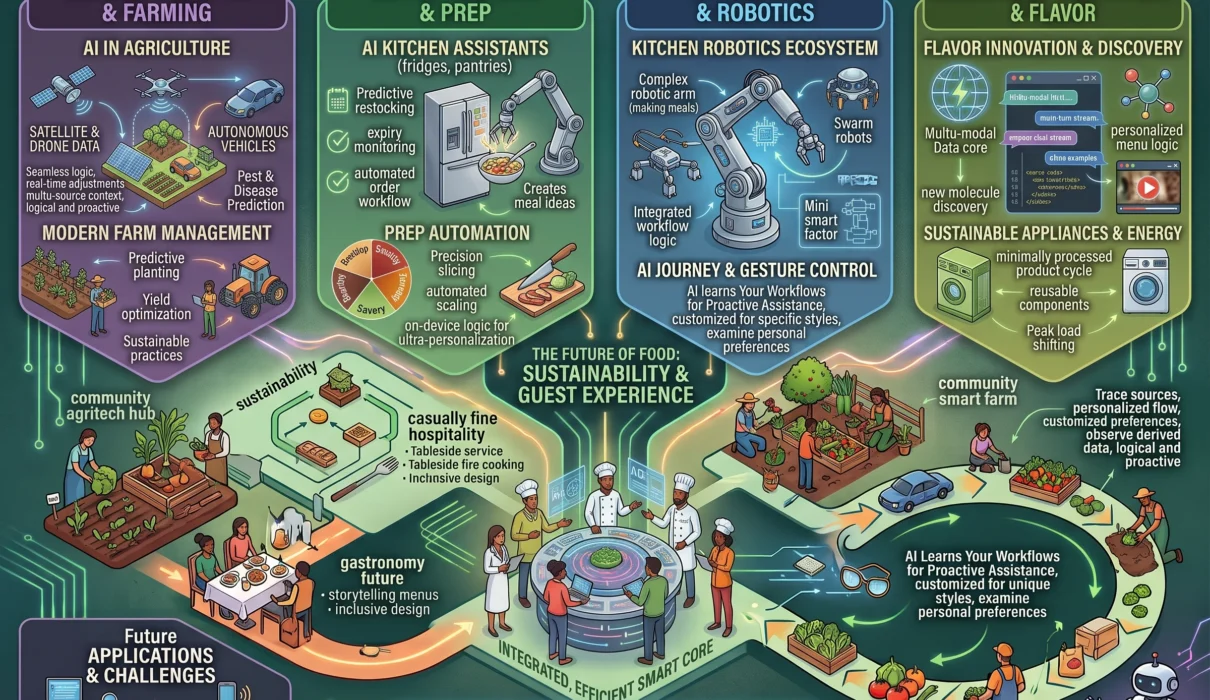
By The global food system is confronting an unprecedented convergence of pressures: population growth, climate volatility, supply chain fragmentation, shifting dietary demands, and labor shortages. In response to these existential operational challenges, the food sector has become one of the most dynamic frontiers for deep technology integration.
The deployment of AI in food industry operations is no longer limited to experimental pilot programs or speculative concepts. Across every link of the global farm-to-fork value chain, artificial intelligence in food is fundamentally restructuring how raw ingredients are cultivated, processed, distributed, cooked, and consumed.
From autonomous harvesters and computer-vision sorting lines to predictive logistics models, flavor profiling neural networks, and generative customer personalization, modern food technology is transforming food from an intuitive craft into a data-driven science.
This comprehensive guide examines how AI food technology is transforming agriculture, industrial food processing, logistics, commercial restaurant kitchens, generative recipe formulation, and the consumer dining experience.
1. Upstream Agritech: Precision Farming and Autonomous Cultivation
The application of AI in the food sector begins at the soil level. Traditional broad-acre agriculture has long relied on uniform treatments: spraying an entire field with the same volume of fertilizer, herbicide, and water regardless of localized soil conditions. Precision agriculture powered by machine learning (ML) replaces this blunt approach with single-plant intervention.
PRECISION AGRITECH PIPELINE:

[ Drone / Satellite Multispectral Imagery ]
                    │
                    ▼
[ Edge-AI Computer Vision & Deep Learning Models ]
                    │
       ┌────────────┴────────────┐
       ▼                         ▼
[ Targeted Micro-Spraying ]   [ Yield & Harvest Prediction ]
(Reduces chemical volume      (Optimizes cold-chain logistics
 by 70% - 90% per acre)        weeks before crop maturity)
Computer Vision and Autonomous Weeding
Modern agricultural machinery uses high-resolution cameras paired with convolutional neural networks (CNNs) trained on millions of plant images. As a tractor moves through a field at 12 miles per hour, edge-compute units classify every individual plant in real time:
- Distinguishing Weeds from Crops: Systems differentiate cash crops (such as soybeans, cotton, or lettuce) from invasive weeds in milliseconds under varying sunlight and wind conditions.
- Targeted Micro-Dosing: High-speed solenoid valves fire microscopic droplets of herbicide directly onto weed foliage rather than drenching the entire field. This reduces chemical pesticide and herbicide volumes by 70% to 90%, slashing input costs and curbing environmental runoff.
- Mechanical Laser Weeding: Advanced autonomous field rovers eliminate chemical herbicides entirely by targeting weed meristems with high-frequency carbon dioxide lasers, neutralizing hundreds of weeds per minute without disturbing soil microbiomes.
Predictive Crop Health and Multispectral Satellite Analytics
Satellite constellations and drone swarms equipped with multispectral and hyperspectral sensors capture vegetation reflectance metrics across non-visible light spectrums:
- Normalized Difference Vegetation Index (NDVI): Algorithms track chlorophyll absorption and near-infrared reflectance to detect nitrogen deficiencies, fungal infections, and water stress days before symptoms become visible to the human eye.
- Early Blight and Pest Identification: Deep learning models trained on plant pathology identify early localized outbreaks of diseases like powdery mildew, citrus greening, or armyworm infestations, enabling targeted quarantines before pathogens spread across entire acreage.
2. Food Processing and Industrial Manufacturing: Quality Assurance at Scale
Once raw agricultural commodities leave the farm, industrial processing plants transform them into ingredients and packaged goods. These high-volume manufacturing facilities handle extreme variability: natural produce arrives with differing sizes, moisture levels, sugar content, and blemishes. Machine vision and reinforcement learning maintain strict quality and safety standards.
+---------------------------+-----------------------------------+------------------------------------------+
| Processing Stage          | AI / ML Technology Deployed       | Industry Impact                          |
+---------------------------+-----------------------------------+------------------------------------------+
| **Optical Sorting**       | Hyperspectral imaging + Deep CNNs | Discards foreign objects, internal rot,  |
|                           |                                   | and defects at 40 tons per hour          |
+---------------------------+-----------------------------------+------------------------------------------+
| **Dynamic Thermal Baking**| Reinforcement learning + Infrared | Adjusts oven temperature/speed in real   |
|                           | pyrometers                        | time based on surface Maillard browning  |
+---------------------------+-----------------------------------+------------------------------------------+
| **Predictive Maintenance**| Acoustic vibration sensors +      | Detects bearing wear in extruders and    |
|                           | anomaly detection algorithms      | pumps weeks prior to catastrophic failure|
+---------------------------+-----------------------------------+------------------------------------------+
| **Safety Compliance**     | Machine vision sanitation monitors| Verifies sanitary washdown protocols and |
|                           |                                   | PPE compliance across processing floors  |
+---------------------------+-----------------------------------+------------------------------------------+
Hyperspectral Defect Detection
Traditional optical sorters rely on standard RGB cameras, which can struggle to detect foreign contaminants that share the same color as the food—such as green plastic fragments in chopped spinach or clear glass shards in sugar.
- Hyperspectral Analysis: Hyperspectral cameras analyze hundreds of narrow electromagnetic bands, capturing the distinct chemical “fingerprint” of materials.
- Internal Flesh Auditing: Systems scan whole fruits (such as apples, avocados, and citrus) to identify internal bruising, watercore defects, or seed rot through intact skin, sorting fruit into appropriate processing pipelines (table-grade, juice, or animal feed) without destructive testing.
Autonomous Thermal Processing and Extrusion Optimization
Industrial baking, roasting, and extrusion processes are susceptible to minor ambient humidity and raw-material variations.
- Rather than maintaining static oven settings, AI controllers ingest live telemetry from moisture sensors, product height gauges, and thermal imaging cameras.
- If a batch of raw dough contains 1.5% higher water content due to flour batch variation, the model automatically modulates convective fan speeds and zone temperatures to produce consistent crust browning, crumb texture, and shelf-life stability.
3. Supply Chain Optimization, Cold-Chain Integrity, and Food Waste Reduction
Roughly one-third of all food produced globally is lost or wasted between farm and fork. In perishable food supply chains, delays, temperature excursions, and inaccurate demand forecasting lead directly to spoilage. Artificial intelligence provides the end-to-end predictive visibility required to prevent these losses.
THE REAL-TIME COLD-CHAIN TELEMETRY LOOP:

[ IoT Temperature / Humidity / Gas Sensors in Transit ]
                          │
                          ▼
[ Continuous Cloud AI Ingestion & Thermal Degradation Modeling ]
                          │
       ┌──────────────────┴──────────────────┐
       ▼                                     ▼
[ Dynamic Rerouting ]                 [ Algorithmic Markdown ]
Reroutes refrigerated cargo to        Signals distribution hubs to adjust
closer distribution centers if        wholesale prices for rapid sell-through
shelf-life decays unexpectedly        before expiration
Predictive Demand Forecasting
Traditional retailers relied on retrospective historical sales data to forecast weekly grocery demand, often leading to over-ordering of perishables or out-of-stock essentials.
- Multi-Factor Demand Engines: Contemporary predictive algorithms ingest hundreds of dynamic external variables: hyper-local weather forecasts, regional holidays, school schedules, local sporting events, social media trend spikes, and macroeconomic inflation indices.
- Perishable Waste Reduction: Accurately predicting weekend barbecue demand based on an unexpected sunny forecast allows grocery distributors to order precise meat and produce volumes, preventing unsold surpluses from expiring on store shelves.
Real-Time Cold-Chain Monitoring and Dynamic Expiry Tracking
Fixed printed expiration dates (“Best By”) are blunt approximations that do not account for real-world transit conditions. A pallet of berries exposed to ambient heat on an airport tarmac for four hours loses days of shelf stability compared to a pallet maintained in an unbroken cold chain.
- IoT Sensor Telemetry: Battery-powered IoT data loggers track temperature, relative humidity, barometric pressure, and ethylene gas inside shipping containers.
- Dynamic Shelf-Life Recalculation: Cloud AI models use kinetic decay algorithms to continuously recalculate the true remaining shelf life of perishable shipments. If an unexpected reefer malfunction accelerates ripening, the logistics system automatically reroutes the shipment to a closer processing plant or alerts retailers to apply dynamic markdowns before spoilage occurs.
4. Intelligent Restaurants and Commercial Kitchen Automation
In commercial hospitality, margins are razor-thin, labor turnover is high, and diner expectations for speed and consistency are rising. Forward-thinking restaurant operators are implementing smart kitchen technologies to automate back-of-house production and streamline front-of-house operations.
+----------------------------+-----------------------------------+------------------------------------------+
| Kitchen Station            | Autonomous Hardware & AI          | Operational Benefit                      |
+----------------------------+-----------------------------------+------------------------------------------+
| **Fry Station**            | Robotic articulation arms +       | Consistent crispness; prevents oil fire; |
|                            | thermal vision classification     | calculates optimal oil filtration cycles |
+----------------------------+-----------------------------------+------------------------------------------+
| **Grill & Assembly Line**  | Automated burger flippers +       | Eliminates human burn risks; standardizes|
|                            | optical internal doneness probes  | cook temperatures across hundreds of units|
+----------------------------+-----------------------------------+------------------------------------------+
| **Drive-Thru Ordering**    | Natural Language Processing (NLP) | Accurately takes complex custom orders;  |
|                            | voice engines + acoustic filtering| suggests upsells based on weather/time   |
+----------------------------+-----------------------------------+------------------------------------------+
| **Inventory Depletion**    | Shelf load-cells + camera audits  | Real-time ingredient depletion tracking; |
|                            |                                   | automates vendor purchase orders         |
+----------------------------+-----------------------------------+------------------------------------------+
Robotic Fry and Grill Automation
Robotic arms equipped with computer vision, such as Miso Robotics’ Flippy, operate commercial fryers and flat-top grills:
- Thermal Vision Doneness: Infrared cameras track the surface and core thermal signatures of chicken tenders, fries, and burger patties, automatically shaking baskets to prevent sticking and pulling proteins the exact second food safety pasteurization is achieved.
- Oil Quality Optimization: Computer vision monitors cooking oil color, particle suspension, and smoking points, notifying kitchen managers when oil filtration or replacement is required, which maintains food quality and controls oil costs.
Conversational AI in the Drive-Thru
Drive-thru operations account for a major share of fast-food revenue. However, ambient highway noise, diesel engine rumble, and regional accents often lead to order errors.
- Specialized Speech Engines: Drive-thru conversational AI uses deep acoustic noise cancellation models to isolate driver voices from background traffic.
- Contextual Menu Optimization: Integrated natural language processing (NLP) handles complex conversational substitutions (“Can I get that burger with no onions, extra pickles, sub oat milk in the latte, and make that a large combo?”) while dynamically promoting inventory surpluses on digital outdoor menu boards.
5. Algorithmic Recipe Development and Molecular Flavor Profiling
One of the most creative applications of artificial intelligence in food occurs at the molecular level. Formulating a new consumer packaged good (CPG) product—such as a plant-based dairy alternative or a reduced-sugar beverage—traditionally required 18 to 36 months of trial-and-error culinary benchwork. Food scientists and flavor houses now use machine learning to accelerate this process.
THE MOLECULAR FLAVOR DISCOVERY CYCLE:

[ Mass Spectrometry & Gas Chromatography Data ]
                        │
                        ▼
[ Graph Neural Networks (Mapping 10,000+ Flavor Compounds) ]
                        │
                        ▼
[ Volatile Pairing Model (Identifies Unconventional Complementary Bonds) ]
                        │
       ┌────────────────┴────────────────┐
       ▼                                 ▼
[ Sugar/Sodium Replacement ]      [ Novel Flavor Synthesis ]
Replaces sugar bulk/mouthfeel     Pairs unconventional profiles
using complex plant extracts      (e.g., White Chocolate + Caviar)
without chemical aftertastes      based on shared volatile molecules
Mapping Flavor Geometries with Knowledge Graphs
Why do strawberries pair with basil, or dark chocolate with blue cheese? The answer lies in shared volatile aroma compounds.
- Chemoinformatics Databases: Platforms index the volatile chemical profiles of tens of thousands of agricultural ingredients, identifying aromatic compounds via gas chromatography-mass spectrometry (GC-MS).
- Graph Neural Networks (GNNs): AI models analyze the molecular intersections between disparate foods, predicting pairings that the human palate perceives as harmonious despite unconventional ingredient pairings.
Accelerating Sugar, Salt, and Fat Reduction
Consumer demand for healthier food profiles frequently conflicts with the physical properties of salt, sugar, and fat, which provide essential bulk, texture, viscosity, and mouthfeel in addition to taste.
- Receptor-Binding Simulations: Machine learning models simulate how various natural plant molecules bind to human sweet (T1R2/T1R3) and umami (T1R1/T1R3) taste receptors.
- Clean-Label Replication: Algorithms predict precise combinations of natural fibers, non-caloric plant extracts, and mushroom mycelium ferments that mimic the melting curve of dairy fat or the upfront sweetness curve of sucrose, eliminating the artificial aftertaste typical of first-generation diet products.
Plant-Based Meat and Dairy Engineering
Companies like NotCo utilize generative AI platforms (such as “Giuseppe”) to synthesize plant-based alternatives that closely mimic animal proteins:
- Microstructural Matching: The software analyzes target animal structures—such as cow’s milk or ground beef—at a microscopic and molecular level.
- Flora Database Mining: The system searches a database of hundreds of thousands of edible plants to construct recipes using unexpected ingredients (such as cabbage juice and pineapple concentrate in plant-based milk) that replicate the exact aroma, curdling behavior, and creamy viscosity of dairy when heated.
6. Personalization, Metabolic Nutrition, and the Modern Consumer Experience
The modern consumer expects products tailored to their unique biology, ethics, and lifestyle. AI makes personalized nutrition practical at commercial scale.
+-----------------------------+-----------------------------------+------------------------------------------+
| Application Area            | Core Data Inputs                  | Consumer Output                          |
+-----------------------------+-----------------------------------+------------------------------------------+
| **Metabolic Nutrition**     | Continuous Glucose Monitors (CGM),| Real-time meal recommendations that      |
|                             | gut microbiome DNA sequencing     | prevent individual blood-sugar spikes    |
+-----------------------------+-----------------------------------+------------------------------------------+
| **Hyper-Personalized Menus**| Past order history, dietary flags,| Dynamic ordering interfaces that filter  |
|                             | real-time biometric metrics       | out allergens and highlight nutrition    |
+-----------------------------+-----------------------------------+------------------------------------------+
| **Smart Kitchen Synthesis** | Refrigerator internal vision,     | On-demand recipes generated specifically |
|                             | household expiration calendars    | to use expiring items in the fridge      |
+-----------------------------+-----------------------------------+------------------------------------------+
Microbiome and Glucose-Responsive Dining
Identical foods produce divergent metabolic responses across different bodies; an individual may experience a sharp blood-sugar spike from white rice but maintain stable glucose after consuming an identical portion of sourdough bread.
- Biometric-Tuned Nutrition: Machine learning models ingest continuous glucose monitor (CGM) readings, gut microbiome metagenomic sequencing, and wearable sleep/stress telemetry.
- Dynamic Meal Composition: These platforms recommend precise macronutrient ratios, fiber pre-loads, and optimal meal timings to keep blood glucose stable and optimize daytime energy.
Generative Pantry Cooking and Kitchen Assistants
Multimodal language models integrated into smart home appliances help reduce household food waste:
- Optical Pantry Auditing: Built-in refrigerator cameras detect on-hand staples and expiring produce.
- Instant Custom Recipes: The system generates practical recipes tailored to those ingredients, accommodating personal dietary preferences (e.g., high-protein, dairy-free) while using up perishables before they spoil.
7. Challenges, Ethics, and the Road Ahead
While the integration of AI across the food system offers major efficiencies, it also introduces operational vulnerabilities and ethical considerations that industry leaders must navigate carefully.
CRITICAL IMPLEMENTATION CHALLENGES:

[ Data Silos & Proprietary Formats ] ---> Hinders cross-supply chain visibility
                   │
[ Edge Hardware Durability ]         ---> Sensors must survive grease, heat, washdowns
                   │
[ Algorithmic Bias in Sourcing ]     ---> Risk of marginalizing small heritage farms
                   │
[ Workforce Displacement & Training ]---> Transitioning kitchen labor to system management
1. Hardware Durability in Demanding Environments
Industrial food processing and restaurant kitchens are harsh environments for sensitive electronic components:
- High-pressure, caustic sanitation washdowns, extreme steam, grease vapor, and thermal swings from -40°F blast chillers to 500°F ovens can degrade delicate sensors.
- AI deployments require ruggedized, IP69K-sealed edge hardware capable of local processing without intermittent cloud dropouts.
2. Supply Chain Interoperability and Data Fragmentation
The food supply chain involves millions of independent operators: smallholder farmers, local packing sheds, ocean shipping lines, third-party logistics warehouses, regional distributors, and independent grocery stores.
- Much of this infrastructure still relies on legacy ERP software, paper manifests, and incompatible data formats.
- Unlocking end-to-end predictive logistics requires industry-wide adoption of open standards (such as GS1 digital link standards) to enable secure data exchange without compromising proprietary commercial data.
3. Labor Transitions and Culinary Authenticity
As autonomous cooking equipment and algorithmic ordering become more common, entry-level food prep roles are shifting toward system monitoring, hardware maintenance, and quality control. At the same time, the industry must preserve culinary authenticity—ensuring that efficiency does not erase regional culinary heritage or the human warmth of shared hospitality.
Strategic Implementation Playbook for Food Businesses
For operators across the food and beverage industry, adopting AI successfully requires a phased, practical roadmap:
- Start with Waste Audits: Implement machine-vision food waste monitors over kitchen waste bins or processing lines. Quantifying what is discarded, when, and why produces immediate, actionable operational data that yields measurable ROI within weeks.
- Consolidate Operational Data Streams: Unify fragmented point-of-sale (POS) data, distributor invoices, inventory counts, and reservation logs into a centralized analytics platform before investing in predictive modeling tools.
- Automate High-Friction Chores First: Focus robotic automation and algorithmic systems on dull, dirty, or dangerous tasks—such as overnight floor sanitation, fryer management, and repetitive heavy lifting—where turnover is highest.
- Demand Open Interoperability: When acquiring smart ovens, sorting machinery, or warehouse inventory management systems, choose vendors that provide open, well-documented REST APIs and support modern communication standards.
The Future of Food: Computational Precision Meets Human Culture
Artificial intelligence is not replacing the cultural richness, creative spirit, or sensory joy of food; it is providing the operational infrastructure needed to feed a growing planet sustainably.
By eliminating waste in agricultural fields, improving efficiency across shipping networks, ensuring quality in processing facilities, and giving chefs powerful tools for recipe innovation, AI food technology is laying the foundation for a more resilient, accessible, and delicious future.
