

 By
By The software engineering profession is experiencing its most dramatic structural realignment since the migration from punch cards and assembly instructions to high-level compiled languages. For decades, the craft of programming demanded that engineers memorize dense syntax, parse arcane compiler flags, write repetitive boilerplate infrastructure, and manually chase elusive memory leaks through terminal print statements.
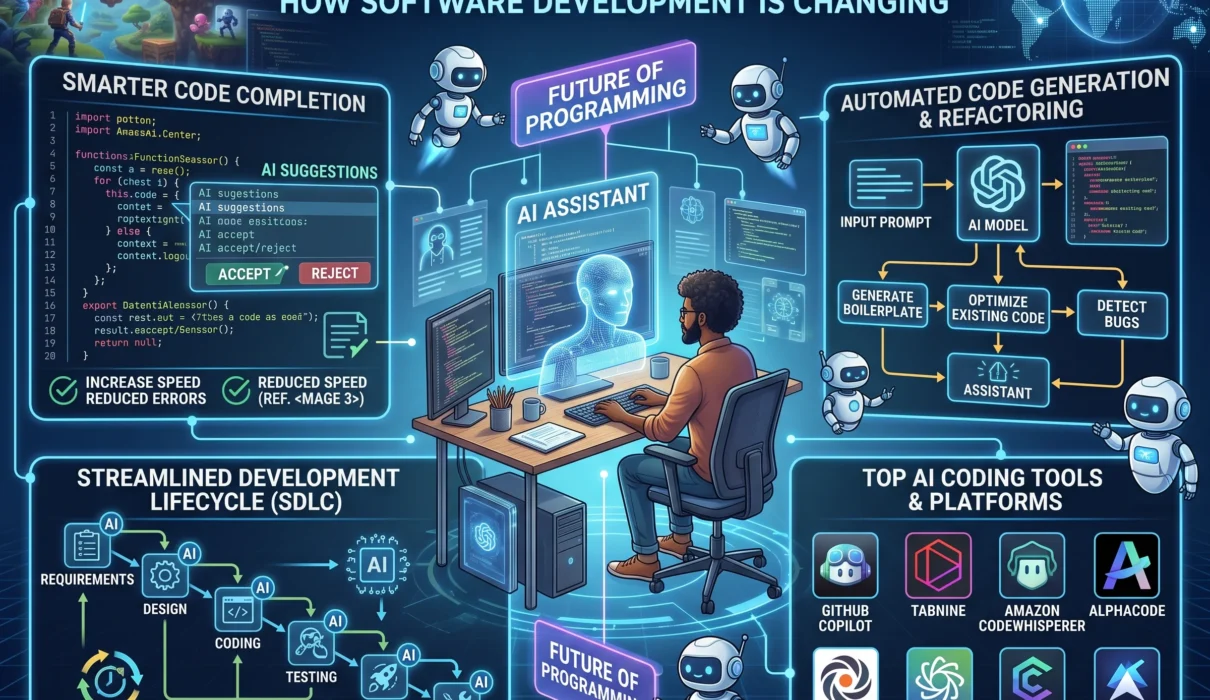
Today, that operational baseline is being redrawn by the rapid maturation of AI coding tools.
What began as rudimentary inline tab-autocomplete features has expanded into full-context cognitive development environments. Modern AI programming frameworks, agentic IDEs, and specialized coding assistants do not merely guess the next five tokens of a function declaration; they index entire multi-repository architectures, generate complex full-stack feature branches, autonomously isolate runtime race conditions, synthesize comprehensive unit and integration test matrices, and translate legacy codebases across tech stacks.
Far from rendering human software engineers obsolete, modern AI developer tools elevate the engineer’s role from manual syntax writer to systems architect, code auditor, and operational director.
Navigating this new era requires understanding the foundational technology under the hood, how intelligent assistants alter day-to-day developer workflows, the concrete advantages across each stage of the Software Development Life Cycle (SDLC), and the critical security, architectural, and intellectual property limitations that engineering teams must navigate.
1. The Architectural Shift: How AI Coding Tools Actually Work
To deploy modern coding assistants effectively—and avoid their failure modes—engineers must understand the mechanics separating legacy static analysis from neural code generation.
THE EVOLUTION OF CODE COMPLETION & ASSISTANCE:

THE DETERMINISTIC ERA (LSP / AST Analysis):
[ Keystroke Input ] ──► [ Language Server Protocol (LSP) ] ──► [ Abstract Syntax Tree (AST) ]
• Scope: Strictly local lexical scope (intellisense, type checking, method signature hints)
• Capability: Deterministic, exact, zero hallucination; cannot generate novel business logic

THE PROBABILISTIC LLM ERA (Modern AI Coding Assistants):
[ Repository Files + Git Diffs ] ──► [ Local Vector Embedding Engine ]
                                                   │
                                                   ▼ (Semantic Context Injection)
[ User Intent Prompt / Keystroke ] ──► [ Dense Attention Transformers / Causal Code Models ]
                                                   │
                                                   ▼
[ Output: Multi-File Code Synthesis, Synthetic Unit Tests, or Diagnostic Fixes ]
• Scope: Cross-repository semantic awareness, multi-token lookahead, natural language compilation
• Capability: Probabilistic synthesis; requires human verification and compilation gates
From Language Server Protocol (LSP) to Transformer Attention
Historically, tools like Visual Studio IntelliSense relied on the Language Server Protocol (LSP) and compiler-generated Abstract Syntax Trees (ASTs). When you typed user., the IDE checked the static type definitions of the User class and surfaced its public methods (getName(), setEmail()). While fast and mathematically deterministic, it could never anticipate business logic or synthesize a new algorithm from scratch.
Modern AI coding tools utilize Autoregressive Large Language Models (LLMs) fine-tuned on billions of lines of permissively licensed, open-source code and public version-control histories:
- The Training Objective: The model is trained on causal language modeling—predicting the next logical token given an extensive prefix of preceding code, documentation comments, and imports.
- Code-Specific Tokenizers: Unlike standard conversational models that tokenize primarily on natural language words, code-optimized models utilize specialized tokenizers that represent programming constructs (indentation levels, whitespace characters, brackets, CamelCase, and snake_case variable names) efficiently.
- Fill-in-the-Middle (FIM) Architecture: Advanced coding models are trained using FIM techniques. Instead of merely predicting forward from left to right, the model ingests both the prefix (the code above the cursor) and the suffix (the code below the cursor). This allows the tool to insert missing parameters, complete interior loops, or update conditional logic while preserving the surrounding structural syntax.
2. The AI Coding Tool Landscape: Autocomplete vs. Chat vs. Agentic IDEs
The market for AI developer tools has diversified into three distinct tiers, each serving different operational needs within the engineering workflow:
+---------------------------+-----------------------------------+------------------------------------------+
| Tool Archetype            | Primary Mechanism                 | Representative Examples                  |
+---------------------------+-----------------------------------+------------------------------------------+
| **Inline Autocomplete**   | Low-latency, single-token or      | GitHub Copilot (Inline), Supermaven,     |
|                           | single-line predictive suggestions| Tabnine, Codeium                         |
+---------------------------+-----------------------------------+------------------------------------------+
| **Conversational Chat**   | Sidecar panel with code context;   | Claude Code, ChatGPT Plus, Cody,         |
|                           | Q&A, refactoring, and code review | Amazon Q Developer                       |
+---------------------------+-----------------------------------+------------------------------------------+
| **Agentic Native IDEs**   | Deep repo indexing, multi-file    | Cursor, Windsurf (Codeium), Zed AI,      |
|                           | generation, terminal orchestration| Aider (CLI Agent), Devin                 |
+---------------------------+-----------------------------------+------------------------------------------+
Tier 1: Inline Autocomplete (The Real-Time Copilot)
Operating directly inside conventional editors via extensions, inline autocomplete models prioritize latency over deep reasoning.
- The system must return code suggestions within 100 to 250 milliseconds to match the natural typing cadence of a human developer.
- If a suggestion takes two seconds to appear, the programmer has already typed the line manually.
- These tools excel at completing repetitive patterns, mapping boilerplate data structures, generating standard CRUD queries, and populating mock testing datasets.
Tier 2: Conversational Chat & Code Explanations
Living in a dedicated editor sidebar or browser window, conversational assistants handle complex questions requiring deeper reasoning:
- “Explain this legacy 800-line Fortran routine and rewrite it into modern Go with idiomatic concurrency.”
- “Why is this regular expression causing a catastrophic backtracking timeout on strings with trailing whitespace?”
- The model operates with an expanded reasoning budget, taking 5 to 15 seconds to synthesize architectural explanations, performance trade-offs, and step-by-step refactoring guides.
Tier 3: Agentic IDEs and Autonomous Workspaces
The newest and most disruptive category is the Agentic IDE (exemplified by tools like Cursor, Windsurf, and command-line agents like Aider). Rather than treating code as isolated text buffers, an agentic environment operates as an autonomous collaborator:
- Whole-Codebase Graph Indexing: The system creates a local, real-time vector database of every file, class definition, docstring, and git commit in your repository.
- Multi-File Mutation: You provide a natural-language directive (“Add a Stripe webhook endpoint to handle invoice disputes, update the Prisma database schema, write the database migration file, and create an admin UI notification component”). The agent decomposes the request, identifies the relevant files across your frontend and backend directories, and presents a coordinated, multi-file diff for human approval.
- Terminal and Linter Interception: The agent executes your build and test suites inside the local terminal. If a TypeScript linter error or Jest unit test fails, the agent intercepts the stack trace, identifies the line causing the failure, updates the code, and re-runs the test until the build compiles cleanly.
3. Core Software Lifecycle Impacts
Modern AI coding tools provide measurable operational leverage across every phase of the Software Development Life Cycle:
THE ACCELERATED AI SOFTWARE LIFECYCLE:

[ 1. REQUIREMENTS & SCAFFOLDING ] ──► Compiles natural language specs into project schemas
                 │
                 ▼
[ 2. CODE IMPLEMENTATION ]        ──► Auto-synthesizes boilerplate, APIs, and business logic
                 │
                 ▼
[ 3. DEBUGGING & ROOT CAUSE ]     ──► Ingests terminal stack traces; pinpoints memory leaks
                 │
                 ▼
[ 4. TEST MATRIX SYNTHESIS ]      ──► Generates edge-case unit, fuzz, and integration suites
                 │
                 ▼
[ 5. REFACTORING & MIGRATION ]    ──► Translates legacy frameworks across major versions
                 │
                 ▼
[ 6. DOCUMENTATION & AUDITING ]   ──► Auto-generates inline docstrings, API specs, and PR logs
4. Code Generation: From Natural Language to Production Syntax
Writing routine boilerplate code has historically consumed a vast proportion of a software developer’s working hours. Configuring Object-Relational Mappers (ORMs), building REST and GraphQL boilerplate controllers, crafting data validation schemas, and writing basic HTML/CSS components are largely solved architectural problems.
Eliminating the “Boilerplate Tax”
Consider the manual effort required to build a simple, secure input validation schema for an API endpoint using TypeScript and Zod:
TypeScript
// Prompt: "Create a strict Zod validation schema for a user registration endpoint
// requiring email, strong password, age >= 18, and optional marketing consent."

import { z } from "zod";

export const UserRegistrationSchema = z.object({
  email: z.string().email({ message: "Invalid email format" }),
  password: z
    .string()
    .min(8, { message: "Password must be at least 8 characters long" })
    .regex(/[A-Z]/, { message: "Must contain at least one uppercase letter" })
    .regex(/[a-z]/, { message: "Must contain at least one lowercase letter" })
    .regex(/[0-9]/, { message: "Must contain at least one number" })
    .regex(/[^A-Za-z0-9]/, { message: "Must contain at least one special character" }),
  age: z
    .number()
    .int()
    .min(18, { message: "User must be at least 18 years old" }),
  marketingConsent: z.boolean().default(false),
});

export type UserRegistrationInput = z.infer<typeof UserRegistrationSchema>;
Writing this by hand requires 5 to 10 minutes of manual typing, consulting regex syntax charts, and cross-referencing library documentation. An AI coding tool synthesizes this entire block in 3 seconds, allowing the developer to focus on downstream business logic: transaction handling, payment authorization, and event notifications.
Polyglot Translation and Cross-Language Porting
One of the most powerful applications of modern code LLMs is cross-compilation between programming languages. Organizations frequently sit on mission-critical legacy codebases—written in COBOL, Fortran, Objective-C, or Python 2—that few modern engineers understand or wish to maintain.
AI developer tools can parse the business logic of a legacy COBOL batch routine, explain its operations line by line, and convert the algorithms into idiomatic, performant modern Rust or Python 3. The models preserve edge-case handling, date manipulation quirks, and rounding constraints while eliminating obsolete pointer mechanisms.
5. Intelligent Debugging and Root-Cause Analysis
Debugging has traditionally been the most frustrating, time-consuming aspect of software engineering. Developers frequently spend hours setting breakpoints, reading log aggregations, and scanning lines of code to identify why a system behaves abnormally under specific inputs.
THE AI-DRIVEN DEBUGGING PIPELINE:

[ UNHANDLED EXCEPTION / TEST FAILURE ]
                   │
                   ▼ (Raw Stack Trace + Error Payload)
[ CONTEXT AGGREGATOR ]
• Captures failed test line & surrounding code
• Ingests local variable state from memory dump
• Cross-references recent Git commit history
                   │
                   ▼
[ CAUSAL INFERENCE ENGINE (Code LLM) ]
• Identifies logical race conditions, off-by-one errors, or type coercions
• Generates minimal, surgical code diff to patch the bug
                   │
                   ▼
[ VERIFICATION PASS ]
• Executes automated regression test suite to ensure the patch introduces zero regressions
Explaining the Unexplainable: Decrypting Cryptic Stack Traces
Every programmer has encountered cryptic compiler outputs: a multi-page C++ template substitution failure, an enigmatic Webpack bundling failure, or an opaque Rust borrow-checker conflict:
Plaintext
error[E0502]: cannot borrow `data` as mutable because it is also borrowed as immutable
  --> src/main.rs:24:9
   |
22 |     let ref_a = &data.items;
   |                 ----------- immutable borrow occurs here
23 |
24 |     data.clear();
   |     ^^^^^^^^^^^^ mutable borrow occurs here
25 |
26 |     println!("{:?}", ref_a);
   |                      ----- immutable borrow later used here
To a junior engineer, this error can stall work for hours. When fed into an AI coding assistant, the tool does not simply output a fix; it explains the underlying memory safety concept:
- Explains why
data.clear()invalidates the internal pointers held byref_a. - Explains the lifetime semantics of Rust’s borrow checker.
- Provides two architectural alternatives: scoping the immutable read using an explicit block, or cloning the necessary data if heap allocation is acceptable in that execution path.
6. Automated Testing, Test-Driven Development (TDD), and Quality Assurance
Writing automated software tests is universally acknowledged as a software engineering best practice, yet it is often the first activity cut when production deadlines loom. AI coding tools turn test synthesis into an effortless, default workflow.
+---------------------------+-----------------------------------+------------------------------------------+
| Testing Tier              | AI Generation Capability          | Quality Assurance Value                  |
+---------------------------+-----------------------------------+------------------------------------------+
| **Unit Testing**          | Generates parameterized test      | Exercises isolated functions across      |
|                           | suites (JUnit, pytest, Jest)      | boundary values and edge inputs          |
+---------------------------+-----------------------------------+------------------------------------------+
| **Fuzz & Chaos Testing**  | Synthesizes malformed payloads,   | Uncovers buffer overflows, unhandled null|
|                           | massive strings, and invalid dates| exceptions, and schema parsing crashes   |
+---------------------------+-----------------------------------+------------------------------------------+
| **Integration Testing**   | Scaffolds end-to-end API testing  | Validates multi-step transactions across |
|                           | scripts with mock external HTTP   | simulated database states and gateways   |
+---------------------------+-----------------------------------+------------------------------------------+
Generating Edge Cases and Boundary Conditions
Human engineers naturally design unit tests around the “happy path”—the expected inputs that cause a function to pass. AI coding tools excel at generating the “unhappy paths” that cause systems to fail in production:
- Numerical Boundaries: Zero values, negative numbers, maximum 64-bit integer limits ($2^{63}-1$), floating-point NaN (Not a Number), and infinity values.
- String Edge Cases: Empty strings, strings containing 10,000 characters, Unicode emoji characters, right-to-left language scripts, and dangerous SQL injection payloads (
'; DROP TABLE users; --). - Time and Temporal Flaws: Leap year dates (February 29), Daylight Saving Time transition hours, leap seconds, and timezone offset boundaries.
Python
# Generated by AI: Exhaustive unit test suite covering edge cases for a financial transfer function
import pytest
from decimal import Decimal
from banking_service import TransferService, InsufficientFundsError, InvalidAmountError

def test_transfer_negative_amount_raises_error():
    service = TransferService()
    with pytest.raises(InvalidAmountError, match="Transfer amount must be strictly positive"):
        service.transfer(from_account="ACC_001", to_account="ACC_002", amount=Decimal("-50.00"))

def test_transfer_exact_balance_depletion():
    service = TransferService()
    account_a = service.create_account(initial_balance=Decimal("100.00"))
    account_b = service.create_account(initial_balance=Decimal("0.00"))

    service.transfer(from_account=account_a.id, to_account=account_b.id, amount=Decimal("100.00"))

    assert service.get_balance(account_a.id) == Decimal("0.00")
    assert service.get_balance(account_b.id) == Decimal("100.00")

def test_transfer_concurrent_double_spend_lock():
    # Simulates thread contention to verify distributed Redis mutex lock
    ...
7. Automated Documentation and Codebase Onboarding
Software documentation is frequently outdated the moment it is merged into a repository. As codebases grow across years of development, institutional knowledge becomes concentrated in the heads of a few senior engineers. When those engineers leave the organization, teams face severe productivity bottlenecks trying to understand how legacy modules interact.
THE AI ONBOARDING & DOCUMENTATION ACCELERATOR:

[ RAW CODEBASE REPOSITORY (100,000+ Lines of Undocumented Code) ]
                               │
                               ▼ (Semantic Codebase Vectorization)
[ INTERACTIVE DEVELOPER CONVERSATIONAL AGENT ]
                               │
       ┌───────────────────────┼───────────────────────┐
       ▼                       ▼                       ▼
[ INLINE DOCSTRINGS ]   [ ARCHITECTURE DIAGRAMS] [ NATURAL LANGUAGE Q&A ]
Auto-generates clean,   Generates Mermaid.js     "Where in this repo do we
typed JSDoc, Sphinx,    graphs illustrating data handle Stripe chargeback
or Rustdoc annotations  flow across microservices events from webhooks?"
Self-Documenting Systems
Modern AI coding tools analyze repository structures to keep documentation synchronized with implementation details:
- Standardized Docstrings: Automatically writes JSDoc, Sphinx, or Go doc comments, detailing parameter types, thrown exceptions, side effects, and usage examples.
- Mermaid.js Architectural Diagrams: Parses multi-tier database and network topologies, outputting clean, version-controlled Mermaid diagrams that render visual flowcharts of data pipelines directly inside GitHub README files.
- Pull Request Summarization: Analyzes multi-file git diffs, extracting the high-level intent of changes, cataloging breaking API modifications, and drafting structured pull request descriptions for peer review.
8. Critical Limitations, Risks, and Security Vulnerabilities
Despite their capabilities, deploying AI coding tools indiscriminately without human oversight introduces severe engineering risks. An AI coding assistant is not an omniscient senior engineer; it is a probabilistic pattern completion engine.
+---------------------------+-----------------------------------+------------------------------------------+
| Risk Dimension            | Concrete Engineering Hazard       | Mandatory Mitigation Strategy            |
+---------------------------+-----------------------------------+------------------------------------------+
| **Security Hallucinations**| Auto-imports non-existent packages| Enforce package manager lockfile checks; |
|                           | (vulnerable to package hijacking) | run automated static dependency audits   |
+---------------------------+-----------------------------------+------------------------------------------+
| **Subtle Architectural**  | Generates code with unvetted      | Mandatory human code review; strict unit |
| **Logic Flaws**           | concurrency or memory leaks       | and integration testing compilation gates|
+---------------------------+-----------------------------------+------------------------------------------+
| **Intellectual Property** | Inadvertently replicates verbatim | Enable strict copyright/license matching |
|                           | proprietary or GPL copyleft code  | filters on all commercial AI platforms   |
+---------------------------+-----------------------------------+------------------------------------------+
| **Cognitive Atrophy**     | Junior engineers copying code     | Require engineers to explain generated   |
|                           | without understanding fundamentals| solutions during technical design reviews|
+---------------------------+-----------------------------------+------------------------------------------+
1. Hallucinated Dependencies (Package Squatting Vulnerabilities)
One of the most dangerous failure modes of code generation is dependency hallucination:
- When an LLM writes code requiring an external library, it occasionally invents a plausible-sounding package name that does not exist in public package registries (such as npm, PyPI, or Crates.io)—for example,
react-secure-jwt-validator. - Malicious threat actors monitor commonly hallucinated package names from major AI models.
- The attacker registers the non-existent package name on npm or PyPI, uploads a malicious Trojan payload, and waits for developers using AI assistants to auto-install the dependency without verifying its provenance.
2. Security Vulnerabilities and Anti-Patterns
Because AI models are trained on vast corpora of public code, they inherit decades of public security anti-patterns:
- Generating raw SQL queries vulnerable to SQL injection rather than parameterized statements.
- Hardcoding mock API keys, passwords, and private certificates directly into source code.
- Implementing weak cryptographic hashing algorithms (like MD5 or SHA-1) for sensitive passwords instead of modern key derivation functions like Argon2id or bcrypt.
- Missing permission and authorization checks (e.g., failing to verify if an authenticated user owns the specific document resource ID being updated).
3. The Threat of “Cognitive Atrophy” in Junior Engineers
Software engineering is mastered through the friction of solving difficult problems. When junior developers rely entirely on AI assistants to generate code without understanding the underlying computer science fundamentals:
- They struggle to debug complex system outages when the AI tool fails to provide an answer.
- They lack intuitive understanding of algorithmic complexity (Big O notation), memory management, and cache locality.
- Organizations risk developing teams of “glue engineers” who can assemble AI-generated prototypes rapidly but cannot evaluate their long-term security, maintainability, or architectural viability.
9. Developer Ergonomics: The New Best-Practice Workflow
To maximize developer velocity while safeguarding system stability, high-performing engineering teams adopt a structured four-stage workflow:
THE "ARCHITECT-IN-THE-LOOP" WORKFLOW:

[ 1. ARCHITECT & CONSTRAIN ]
• Human engineer writes interfaces, data contracts, and boundary types FIRST
• Establishes strict type signatures and expected input/output behaviors
                   │
                   ▼
[ 2. SYNTHESIZE & FILL ]
• AI coding assistant generates implementation details to satisfy the human-defined interface
• Fills repetitive algorithms, validation checks, and internal helper functions
                   │
                   ▼
[ 3. TEST & COMPILE ]
• Automated build suites run: TypeScript compilation, linting, security scans
• AI synthesizes negative-path edge-case tests to stress-test its own implementation
                   │
                   ▼
[ 4. AUDIT & SIGN-OFF ]
• Human engineer reviews the final diff line-by-line before merging to main
• Validates architectural sanity, security permissions, and long-term maintainability
Golden Rules for Engineering with AI:
- Never commit code you cannot explain line-by-line. If an AI assistant generates a complex regular expression or a mathematical routine you do not understand, treat it as unvetted third-party code. Demand that the model explain the logic, test it thoroughly, and verify every branch.
- Write types and interfaces first. AI models perform significantly better when given strong structural guardrails. If you define your TypeScript interfaces or Go structs with exact types before prompting the assistant, the model’s code generation accuracy increases dramatically.
- Use AI to test AI. When an assistant writes an implementation function, instruct it to write a comprehensive unit test suite to break that exact function. Models are remarkably effective at finding flaws in their own logic when explicitly prompted to adopt an adversarial posture.
10. The Horizon: Where Software Engineering Goes Next
The software development ecosystem is moving toward a future defined by autonomous systems collaboration:
THE FUTURE OF SOFTWARE CREATION:

1. AUTONOMOUS TRIAGE & SELF-HEALING CODE
   • Production monitoring tools detect runtime exceptions (e.g., Sentry alerts)
   • AI agents analyze the crash dump, spin up an isolated test branch, write a regression fix,
     and submit a fully tested Pull Request to the engineering team within 60 seconds

2. NATURAL LANGUAGE SPEC-TO-APPLICATION COMPILATION
   • High-level product specifications compile directly into production-ready software architectures
   • Engineers shift focus entirely to system boundaries, data contracts, and domain modeling

3. SPECULATIVE BACKGROUND PROGRAMMING
   • IDEs anticipate developer intent hours in advance, pre-compiling multiple architectural
     branches, test suites, and documentation before a developer explicitly asks
The Enduring Value of Human Engineering
Will artificial intelligence eliminate the need for human programmers? History provides a consistent answer.
When compilers replaced assembly language, people predicted the end of programming. When modern high-level languages like Python and web frameworks like Ruby on Rails emerged, observers predicted that software creation would become so trivial that developers would no longer be needed.
In every instance, lowering the friction of software development did not decrease the demand for engineers—it caused the demand for software to explode exponentially.
The world requires billions of lines of new, secure, resilient software: to automate renewable energy microgrids, to power autonomous medical devices, to coordinate quantum computing simulations, and to manage decentralized global logistics.
AI coding tools do not replace the human mind; they amplify it. The software engineers who thrive in the coming decades will not be those who resist these tools, nor those who blindly copy-paste their outputs. The future belongs to augmented developers—engineers who combine deep computer science fundamentals with the velocity of AI tools to build systems of unprecedented scale, elegance, and impact.