


 By
By The global travel landscape has entered a transformative period. For decades, leisure tourism adhered to a predictable, industrialized rhythm: peak summer migrations to crowded Mediterranean beaches, hurried weekend European city-breaks, packaged multi-country bus excursions, and standardized hospitality chains designed around predictable comfort.
That legacy framework has fractured under the weight of climate volatility, overtourism fatigue, geopolitical realignments, and profound shifts in human psychology.
Today’s travelers are no longer content with checklist tourism or superficial sightseeing. Instead, the defining travel trends of this year demonstrate a decisive transition toward purpose-driven exploration, deep cultural immersion, environmental stewardship, and radical flexibility.
Simultaneously, the structural mechanics of the travel industry are being re-engineered by autonomous AI booking engines, high-speed regional rail networks, biometric border terminals, and regenerative hospitality models.
Understanding these latest travel trends and macro tourism trends is essential for destinations, hotel brands, tour operators, and travelers seeking authentic, frictionless adventures.
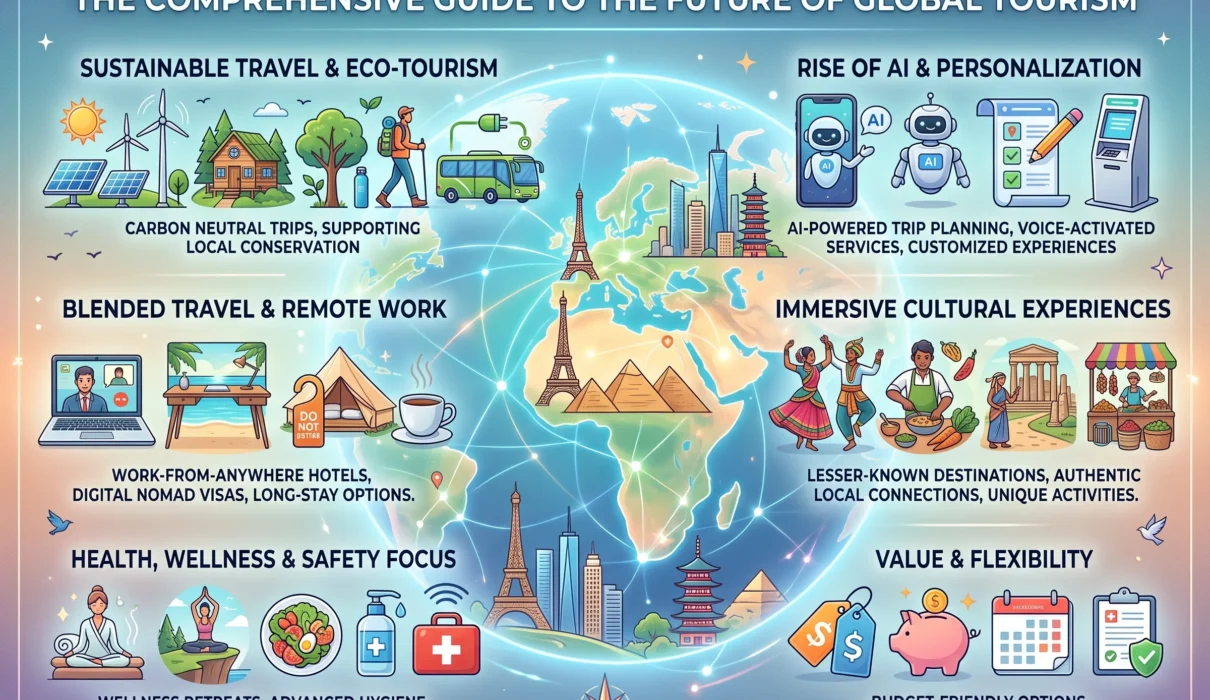
This comprehensive guide analyzes modern travel trends across six fundamental dimensions: shifting traveler motivations, cutting-edge travel technology, modern accommodation concepts, sustainable transportation revolutions, emerging experiential categories, and practical strategies to navigate the modern travel ecosystem.
1. The Macro Philosophy: Shifting from “Checklist Sightseeing” to “Intentional Immersion”
Before examining logistical details, one must examine the philosophical evolution of the modern traveler. The consumer mindset has shifted from transactional consumption to experiential transformation.
THE EVOLUTION OF TRAVELER PRIORITIES:

THE MASS EXTRACTION PARADIGM (Legacy Model):
[ 10 Cities in 12 Days ] ──► [ Superficial Photo Ops ] ──► [ Overtourism Hotspots ] ──► [ Post-Vacation Exhaustion ]
• Motivation: Status display, ticking destination boxes, chasing Instagram landmarks
• Seasonality: Frantic midsummer rushes, peak congestion, inflated surge pricing
• Economic Impact: Leakage to foreign booking conglomerates; zero local community benefit

THE INTENTIONAL IMMERSION PARADIGM (Modern Trends):
[ 1–2 Hubs for 2 Weeks ] ──► [ "Slowcations" & Deep Roots ] ──► [ Secondary & Tertiary Towns ] ──► [ Deep Restoration ]
• Motivation: Nervous system regulation, cultural exchange, somatic wellness, skill acquisition
• Seasonality: Shoulder-season ("Coolcationing"), off-peak dispersion, weather-adaptive
• Economic Impact: Direct-to-community spending, regenerative conservation, artisan preservation
The Death of the “Bucket List”
The traditional “bucket list”—a consumerist itinerary focused on collecting selfie backdrops in front of the Eiffel Tower, the Colosseum, or Venice’s Rialto Bridge—is increasingly viewed as exhausting and socially irresponsible. The physical reality of peak overtourism (three-hour queues in 40°C heat, restrictive municipal day-tripper fees, and local anti-tourist protests) has dismantled the romance of crowded landmarks.
Modern explorers are replacing checklist itineraries with slow travel:
- Choosing a single geographic base for two to three weeks rather than changing hotels every forty-eight hours.
- Renting apartments with kitchens to shop at neighborhood morning markets, establishing routines with local baristas, and learning conversational phrases.
- Measuring the success of a journey not by the number of monuments photographed, but by the depth of human connection forged and the degree of psychological renewal achieved.
2. Emerging Traveler Archetypes: Who Is Traveling and Why?
The demographic profiles of global travelers have diversified. Modern tourism is no longer dominated by conventional nuclear families and retirees on package holidays; distinct sub-cultures are setting the market agenda:
+---------------------------+-----------------------------------+------------------------------------------+
| Traveler Archetype        | Core Travel Motivation            | Dominant Booking Behavior                |
+---------------------------+-----------------------------------+------------------------------------------+
| **The "Coolcationer"**    | Evading extreme summer heatwaves; | Books Nordic, Baltic, Scottish, and      |
|                           | seeking crisp, temperate climates | alpine destinations between June & August|
+---------------------------+-----------------------------------+------------------------------------------+
| **The Solo Reclaimer**    | Autonomy, radical independence,   | Single-occupancy boutique stays; walking |
|                           | introspection, mental detox       | pilgrimages, solo dining friendly spaces |
+---------------------------+-----------------------------------+------------------------------------------+
| **The "Hush Tripper"**    | Blending asynchronous remote work | Stays 14–30 days; requires verified high-|
|                           | with covert travel exploration    | speed fiber internet & dedicated desks   |
+---------------------------+-----------------------------------+------------------------------------------+
| **The Circadian Seeker**  | Sleep architecture restoration,   | Stays at soundproof sleep retreats;      |
|                           | recovery from clinical burnout    | dark-sky reserves, circadian lighting    |
+---------------------------+-----------------------------------+------------------------------------------+
| **The Multi-Gen Explorer**| Rebuilding extended family bonds; | Private multi-room villas, heritage rail |
|                           | intergenerational knowledge share | charters, private guided wildlife lodges |
+---------------------------+-----------------------------------+------------------------------------------+
1. “Coolcationing”: The Climate-Driven Geographic Reversal
As summers in Southern Europe, the Mediterranean basin, and the American Southwest regularly break record heatwaves, tourist migration patterns are shifting:
- Travelers who historically vacationed along the Spanish Costas, the Amalfi Coast, or the Greek Islands are heading north.
- Destinations like Norway’s fjords, the Baltic coasts of Estonia and Latvia, Scotland’s Highlands, and the Swiss Alps are experiencing unprecedented summer surges.
- “Coolcationers” prioritize hiking in 20°C weather, wild swimming in alpine lakes, and breathing mountain air over enduring scorching 42°C city pavements and wildfire evacuation warnings.
2. The Rise of Unapologetic Solo Travel
Solo travel has decoupled from youthful backpacker stereotypes. Today’s solo travelers are established professionals, mid-career creatives, and active retirees:
- Demographic Shift: Over 65% of modern solo leisure travelers are women seeking personal space, cultural autonomy, and personal safety without compromise.
- Hospitality Adaptation: Boutique hotels and river cruise lines are abolishing the punitive “single supplement” fee (which historically forced solo travelers to pay double for hotel rooms). Restaurants are redesigning floor plans to feature welcoming chef’s counters and communal dining tables that celebrate solo diners rather than relegating them to back corners.
3. “Sleep Tourism” and Neurological Restoration
In a society characterized by chronic burnout, digital notification fatigue, and sleep deprivation, travel is being reimagined as a biological medicine cabinet:
- Hotels and dedicated wellness retreats are partnering with sleep neuroscientists to engineer optimum sleep environments.
- Rooms feature soundproof acoustic architecture, smart mattresses with biometric temperature controls (like Eight Sleep), ambient circadian lighting pods, pillow menus matching anatomical sleeping postures, and targeted binaural soundscapes.
- Rather than setting 6:00 AM tour alarms, guests participate in guided sleep coaching, evening magnesium tea rituals, and silent meditation, prioritizing deep REM recovery above active sightseeing.
3. Technology in the Travel Industry: From Conversational Concierges to Frictionless Borders
Technology was once a source of travel friction: printing boarding passes, navigating paper maps, waiting in international currency exchange queues, and translating physical train timetables. Today, cutting-edge travel technology is rendering logistics invisible.
THE DIGITAL TRANSFORMATION OF THE PASSENGER JOURNEY:

[ 1. DISCOVERY & HYPER-PERSONALIZED PLANNING ]
• Generative AI engines synthesize bespoke multi-modal itineraries based on real-time flight data
• Autonomous agents check hotel inventory and reserve verified table bookings
                   │
                   ▼
[ 2. ZERO-TOUCH AIRPORT TRANSIT ]
• Direct-to-Gate facial biometric identification replaces paper passports and boarding passes
• Computed Tomography (CT) 3D security scanners eliminate the 100ml liquid restriction
                   │
                   ▼
[ 3. FRICTIONLESS LOCAL MOBILITY ]
• Digital eSIMs activate automatically upon touchdown, connecting to local 5G bands
• Universal mobile wallets handle transit fares seamlessly across buses, ferries, and metros
                   │
                   ▼
[ 4. EMBEDDED SMART HOSPITALITY ]
• Keyless smartphone NFC room access bypasses check-in desks completely
• Room climate and circadian lighting adapt to the traveler's home timezone automatically
1. Autonomous AI Travel Agents: Moving Beyond Chatbots
Early travel-planning AI tools merely generated generic lists of tourist attractions. The modern era features autonomous travel agents:
- Real-Time Data Orchestration: Tools integrate directly with Global Distribution Systems (GDS like Amadeus and Sabre) and live flight APIs, booking complex open-jaw flight itineraries that balance cost against layover fatigue.
- Dynamic Itinerary Re-Routing: If a flight is delayed by weather, the autonomous agent rebooks downstream train tickets, updates the hotel’s late-arrival notification, and adjusts restaurant reservations automatically without human panic.
- Context-Aware Recommendations: An AI agent cross-references local weather forecasts, crowdsourcing heatmaps, and a traveler’s biometric recovery scores, suggesting: “Rain is forecast for tomorrow morning at the museum; visit the open-air market today at 3:00 PM when crowds drop by 40%.”
2. Biometric Borders and Frictionless Aviation
Airports are systematically phasing out physical travel documents:
- Facial Recognition Corridors: Advanced international hubs (such as Singapore Changi, Dubai International, and major European terminals) deploy unified biometric corridors. A passenger’s face acts as their boarding pass, bag-drop verification, and passport control clearance, reducing boarding times by over 30%.
- Next-Generation 3D CT Scanners: Airport security lanes are ditching legacy X-ray machines for medical-grade 3D Computed Tomography (CT) scanners. Passengers no longer unpack laptops or discard water bottles; liquids and electronics remain inside carry-on luggage, speeding up security screening queues.
3. Universal eSIMs and Instant Connectivity
The hassle of hunting for local airport SIM card kiosks, wrestling with plastic pins, and swapping physical cards is over:
- Digital eSIM applications (like Airalo, Holafly, and Nomad) allow travelers to purchase, download, and activate local or regional data plans in seconds.
- Travelers land in foreign destinations with active high-speed 5G data, enabling immediate translation, rideshare navigation, and maps without incurring roaming fees.
4. The Accommodation Revolution: Beyond the Standard Hotel Room
The lodging sector is undergoing a profound structural evolution. Travelers are turning away from cookie-cutter corporate hotel rooms and unregulated short-term apartment rentals in favor of character-rich, communal, and environmentally integrated spaces.
+---------------------------+-----------------------------------+------------------------------------------+
| Lodging Category          | Core Architectural Proposition    | Primary Consumer Appeal                  |
+---------------------------+-----------------------------------+------------------------------------------+
| **Regenerative Boutique** | Net-positive environmental impact;| Authentic sense of place, carbon-negative|
|                           | built with local stone & timber   | footprint, curated farm-to-table dining  |
+---------------------------+-----------------------------------+------------------------------------------+
| **Adaptive Heritage**     | Repurposed monasteries, historic  | Architectural preservation, deep cultural|
|                           | castles, and industrial rail yards| history paired with five-star luxury     |
+---------------------------+-----------------------------------+------------------------------------------+
| **Hybrid Co-Living**      | Blends private hotel suites with  | Solves remote worker loneliness; private |
|                           | coworking floors & shared kitchens| workspaces, verified enterprise Wi-Fi    |
+---------------------------+-----------------------------------+------------------------------------------+
| **Off-Grid Architecture** | Self-sustaining solar pods, tiny  | Unspoiled natural immersion without      |
|                           | luxury cabins in deep wilderness  | sacrificing hot showers or comfortable beds|
+---------------------------+-----------------------------------+------------------------------------------+
1. The Backlash Against Generic Short-Term Rentals
For a decade, peer-to-peer home-sharing platforms dominated leisure travel. However, consumer sentiment has cooled considerably:
- Hidden cleaning fees, chore lists demanding guests wash linens and take out trash, erratic lockbox check-ins, and concerns over housing displacement in historic cities have driven travelers back toward professionally managed hospitality.
- Travelers are choosing aparthotels and branded boutique suites that combine the amenities of a home (full kitchens, in-suite laundry, spacious living areas) with the security, cleanliness guarantees, luggage storage, and 24/7 service of a traditional luxury hotel.
2. Regenerative Hospitality: Leaving Places Better Than Found
“Sustainable hospitality” used to mean hanging your bath towels to save laundry water. Today’s standard is regenerative hospitality:
- Properties do not merely aim for “net zero”; they aim to be net positive.
- Eco-resorts and conservation lodges reforest surrounding native habitats, restore depleted coral reefs, generate surplus solar electricity for local villages, and source 100% of kitchen produce from regenerative permaculture gardens on site.
- Guests participate directly in conservation science: planting mangrove saplings, assisting marine biologists with sea turtle tagging, or supporting indigenous wildlife tracking initiatives.
5. Transportation Transformations: The High-Speed Rail Renaissance and Green Skies
How we move across the planet is being rewritten by the urgency of decarbonization, infrastructure investment, and travel comfort.
THE SUSTAINABLE TRANSPORTATION MATRIX:

                  ┌───────────────────────────────────────────────┐
                  │          JOURNEY DISTANCE EVALUATION          │
                  └───────────────────────┬───────────────────────┘
                                          │
                    ┌─────────────────────┴─────────────────────┐
                    ▼                                           ▼
         [ UNDER 800 KILOMETERS ]                    [ OVER 800 KILOMETERS ]
                    │                                           │
                    ▼                                           ▼
       [ HIGH-SPEED & NIGHT TRAINS ]               [ NEXT-GEN DECARBONIZED AVIATION ]
       • Center-to-center convenience              • Sustainable Aviation Fuel (SAF) mandates
       • Zero airport security queues              • Aerodynamic carbon-composite widebodies
       • Spacious dining cars & private berths     • Emerging electric/hydrogen regional hops
       • 90%+ lower carbon emissions               • Strict European short-haul flight bans
1. The Global High-Speed and Sleeper Train Boom
Across Europe, East Asia, and emerging corridors worldwide, railways are challenging short-haul commercial aviation:
- The Flight Ban Dynamic: Countries like France have banned short-haul domestic flights where an equivalent train journey takes under two and a half hours, encouraging travelers to ride the rails.
- The European Night Train Revival: Sleeper rail operators (such as Nightjet and European Sleeper) are connecting major capitals—linking Paris, Berlin, Vienna, Brussels, and Rome with modern, comfortable sleeper compartments.
- The Center-to-Center Advantage: Rail travel eliminates the hidden temporal and financial taxes of flying: traveling 45 minutes to an edge-of-city airport, arriving two hours early for security lines, and waiting at baggage carousels. A passenger boards a train in downtown Milan and steps off four hours later in the heart of Rome, enjoying continuous high-speed Wi-Fi, full cellular service, and generous luggage allowances.
2. Decarbonizing Commercial Aviation
While long-haul intercontinental travel still requires jet aviation, the aerospace sector is undergoing a quiet engineering transformation:
- Sustainable Aviation Fuels (SAF): Airlines are ramping up blends of SAF derived from non-fossil biological waste, used cooking oils, and captured carbon, reducing lifecycle greenhouse emissions by up to 80% compared to conventional fossil jet fuel.
- Composite Lightweight Airframes: Aircraft like the Airbus A350 and Boeing 787 Dreamliner utilize carbon-fiber composite materials that do not corrode, allowing cabins to be pressurized at lower, more comfortable altitudes (6,000 feet instead of 8,000 feet) with higher ambient humidity, drastically reducing traveler dehydration, headaches, and jet lag.
6. Emerging Experiential Frontiers: Where and How People Travel
The activities defining global itineraries reflect a desire for authenticity, culinary tradition, and astronomical wonder.
+---------------------------+-----------------------------------+------------------------------------------+
| Experiential Trend        | Core Cultural Driver              | Iconic Destination Examples              |
+---------------------------+-----------------------------------+------------------------------------------+
| **Astrotourism &**        | Escaping light-polluted cities;   | Atacama Desert (Chile), Dark Sky Parks   |
| **Dark-Sky Seeking**      | witnessing auroras & eclipses     | in Utah/Norway, Lake Tekapo (New Zealand)|
+---------------------------+-----------------------------------+------------------------------------------+
| **Hyper-Local Foodways**  | Bypassing Michelin-starred luxury | Basque Country cider houses, Oaxaca      |
|                           | for ancestral culinary traditions | market moles, Hokkaido coastal smokehouses|
+---------------------------+-----------------------------------+------------------------------------------+
| **Walking Pilgrimages**   | Unplugging from hyper-connectivity| Camino de Santiago (Spain), Kumano Kodo  |
|                           | through multi-day historic trails | (Japan), Lycian Way (Turkey)             |
+---------------------------+-----------------------------------+------------------------------------------+
| **"Set-Jetting"**         | Exploring locations made famous   | Sicily (*White Lotus*), Edinburgh        |
|                           | by prestige streaming series      | (*One Day*), New Zealand (*Rings of Power*)|
+---------------------------+-----------------------------------+------------------------------------------+
1. Astrotourism: Reclaiming the Night Sky
Over 80% of the world’s population lives under light-polluted skies, unable to see the Milky Way. This urban visual blackout has birthed astrotourism:
- Travelers are journeying to certified International Dark Sky Reserves (such as Chile’s Atacama Desert, New Zealand’s Mackenzie Basin, and remote corners of Utah and Namibia).
- Demand for astronomical phenomena—solar eclipses, planetary alignments, meteor showers, and high-intensity solar-maximum Auroral displays (Northern and Southern Lights)—has reached all-time highs.
- Stargazing lodges provide open-air skybeds, observatory-grade telescopes, and resident astrophysicists to guide nocturnal journeys.
2. Ancestral Culinary Immersion
Culinary tourism has outgrown white-tablecloth restaurants and generic city food tours:
- Modern culinary travelers prioritize ancestral, hyper-local food systems: foraging wild truffles in Piedmont with third-generation harvesters, learning centuries-old fermentation methods in rural South Korea, or pressing olive oil in traditional Greek stone mills.
- The focus is on heritage preservation, regenerative agriculture, and supporting hyper-local family farms rather than curated social-media tasting menus.
3. Walking Pilgrimages and Physical Rewilding
Multi-day walking journeys have surged across all age demographics:
- Historic pilgrimage routes—such as Japan’s ancient Kumano Kodo trail network or Europe’s Camino de Santiago—are reporting record foot traffic.
- Walking 15 to 25 kilometers a day between rural inns strips away digital overstimulation, restores physical resilience, and fosters camaraderie with fellow travelers across borders and generations.
7. Destination Stewardship: Managing Overtourism and Climate Realities
The rapid rebound of international tourism has brought acute growing pains. Popular historic cities and fragile natural ecosystems are implementing aggressive policies to protect local quality of life and preserve heritage assets.
THE DESTINATION PROTECTION TOOLKIT:

[ MUNICIPAL TAXES & DAY-TRIPPER ENTRY FEES ] ──► Implemented in Venice, Amsterdam, Bali
                     │
[ STRICT FLIGHT & CRUISE SHIP CAPS ]         ──► Dubrovnik, Santorini, Amsterdam harbor
                     │
[ RESERVATION TIMED-ENTRY PASSES ]           ──► Machu Picchu, Uffizi Gallery, US National Parks
                     │
[ DIVERSION TO "DUPE" DESTINATIONS ]         ──► Promoting secondary alternatives (e.g., Ljubljana over Venice)
The Rise of “Destination Dupes”
To escape crushing crowds and high prices, smart travelers and marketing boards are promoting “Destination Dupes”—high-character alternatives that capture the charm of famous destinations without the overtourism chaos:
| Famous Overtourism Hub | The Sustainable “Dupe” Alternative | Why It Works |
| Santorini, Greece | Naxos or Milos, Greece | Same volcanic Cycladic architecture and azure waters; half the price, zero cruise ship gridlock. |
| Venice, Italy | Treviso, Italy or Ljubljana, Slovenia | Picturesque canals, historic bridges, and vibrant cafe culture without the suffocating crowds. |
| Amsterdam, Netherlands | Utrecht or Haarlem, Netherlands | Intimate canal belts, world-class cycling infrastructure, rich art museums, and authentic neighborhood life. |
| Kyoto, Japan | Kanazawa, Japan | Historic geisha and samurai districts, traditional wooden tea houses, and exquisite regional seafood. |
| Amalfi Coast, Italy | The Cilento Coast, Italy | Dramatic Mediterranean cliffside highways and coastal villages just south of Salerno, untouched by mass bus tours. |
8. Strategic Traveler’s Playbook: How to Navigate Modern Travel
To maximize joy, protect budgets, and travel with minimal friction this year, adopt these strategic operational rules:
1.Master the ‘Shoulder Season’ Strategy :Rule 1: The Booking Window.
Avoid traveling during peak summer (July and August) and peak holiday weeks whenever possible. Target the shoulder seasons: May, June, September, and October. You will encounter temperate weather, half the tourist crowds, significantly lower flight and hotel rates, and warm hospitality from relaxed local hosts.
2.Embrace the One-Bag (Carry-On Only) Philosophy :Rule 2: Luggage Sovereignty.
Avoid lost luggage, delayed connections, and cobblestone maneuvering by traveling carry-on only. Invest in a lightweight 35L to 40L travel pack, utilize compression packing cubes, and pack versatile merino wool and technical linen garments that can be washed in a sink and dried overnight.
3.Deploy Frictionless Digital Travel Infrastructure :Rule 3: Tech Optimization.
Configure your smartphone before you leave home: download offline Google Maps for your destination regions, install an international eSIM data profile, upload digital backup copies of passports to secure cloud storage, and configure touch-free transit cards in your mobile wallet.
4.Adopt the ‘Leave No Trace’ and Direct-Spend Ethos :Rule 4: Cultural Reciprocity.
Make your travel dollars count. Avoid multi-national souvenir kiosks and international restaurant chains. Spend directly with independent family-run trattorias, hire certified local community guides, purchase handmade crafts directly from local artisans, and treat local residents and historic spaces with patience, dignity, and quiet respect.
Conclusion: The New Golden Age of Intentional Exploration
The modern era of travel is not defined by how far or fast you can fly. It is defined by how deeply you can connect.
By shedding the pressures of the checklist itinerary, embracing the efficiency of high-speed rail and biometric border technology, supporting regenerative accommodations, and traveling during restorative shoulder seasons, you can transform travel from an exhausting chore into a meaningful adventure.
Travel remains humanity’s most powerful bridge across cultural boundaries, historical understanding, and personal growth. As you plan your journeys this year, travel with curiosity, respect, and intention—the world is ready to welcome you with open arms.
