


 By
By For the first decade of the deep learning boom, artificial intelligence was confined behind glass. It inhabited cloud server racks and expressed itself through screens—predicting tokens, generating digital art, drafting legal briefs, and processing database queries. While these digital breakthroughs disrupted knowledge work, they shared an inherent limitation: their operational consequences were bounded by software runtimes. If an algorithm hallucinated, the error stayed trapped in memory buffers.
That barrier between computation and kinetic reality has broken down.
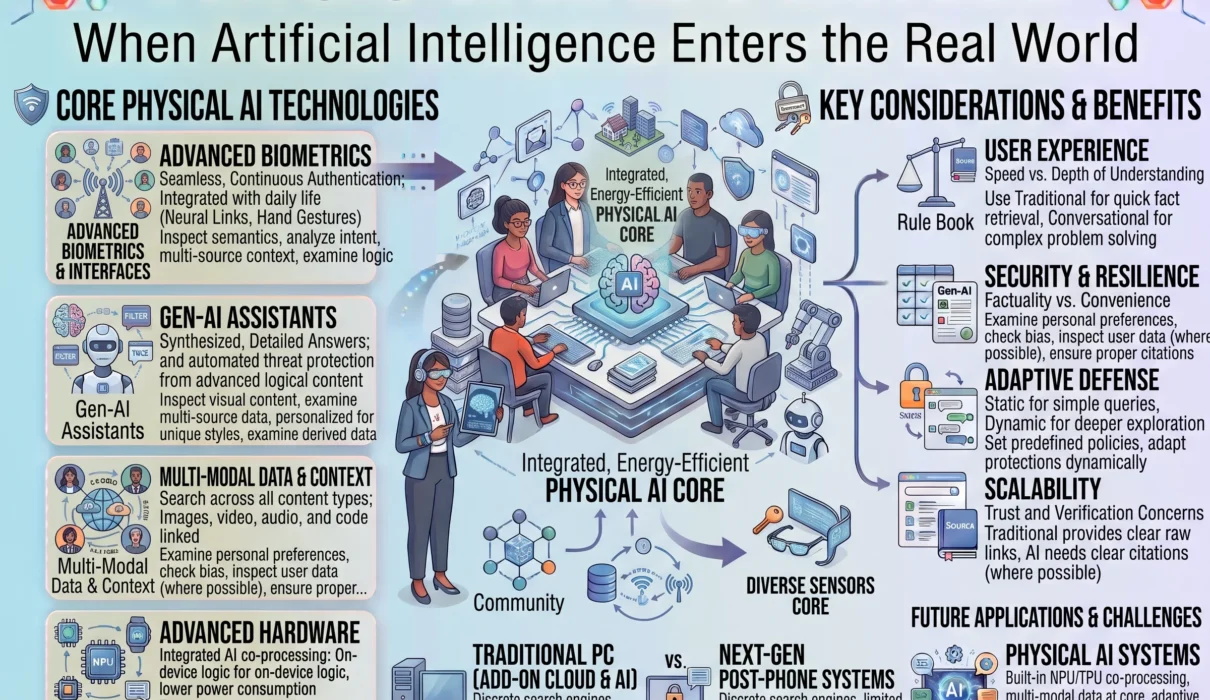
The next frontier of computing is physical AI—the fusion of foundation models, real-time computer vision, tactile sensing, high-density edge computing, and mechatronic control. In forward-looking industry roadmaps, major analysts have flagged physical AI and AI robotics as breakout inflection points. Intelligence is no longer satisfied with merely generating text; it is moving things, navigating dynamic three-dimensional terrain, manipulating physical objects, and managing industrial production loops.
Moving from digital models to embodied machines is an engineering challenge. When an algorithm operates in the physical world, it must respect classical mechanics, friction, gravity, thermal limits, and strict human safety boundaries.
Understanding physical AI requires unpacking how intelligent robots perceive space, how robotics technology bridges the gap between simulation and kinetic execution, and why this shift will reshape industry, manufacturing, and human labor.
                 THE EVOLUTION OF ARTIFICIAL INTELLIGENCE

  DISCRIMINATIVE AI (2012–2020)
  [Input Image / Text] ──► [Deep Neural Network] ──► [Category Label / Probability]
  * Analytical, passive, operates purely inside software tables.

  GENERATIVE AI (2020–2024)
  [User Prompt] ──► [Transformer Foundation Model] ──► [Digital Artifact: Text, Media, Code]
  * Synthesizes new virtual data; zero physical agency in the real world.

  PHYSICAL AI (Embodied Intelligence)
  [Multimodal Sensor Stream] ──► [Vision-Language-Action (VLA) Model] ──► [Kinetic Control]
  • LiDAR, Cameras, Tactile IMUs      • Physical-Law Grounding & Planning   • Torque, Actuators, Motors
  • Interacts with gravity, friction, material rigidity, and human environments in real time.
1. What Is Physical AI? Beyond Digital Foundation Models
At its core, physical AI (often termed embodied AI) refers to artificial intelligence systems that perceive, reason about, and physically act within the physical world in real time.
Unlike traditional machine learning models that optimize for software metrics like token loss or pixel accuracy, physical AI operates under the laws of physics. It combines multimodal perception with mechanical actuators, allowing autonomous machines to handle unpredictable, unstructured real-world environments without requiring human intervention.
┌────────────────────────────────────────────────────────────────────────┐
│                   DIGITAL AI vs. PHYSICAL (EMBODIED) AI                │
├─────────────────────┬────────────────────┬─────────────────────────────┤
│ System Dimension    │ Digital / Cloud AI │ Physical AI (Embodied)      │
├─────────────────────┼────────────────────┼─────────────────────────────┤
│ Operational Domain  │ Server RAM, Cloud  │ 3D Physical Space, Dynamic  │
│                     │ Databases, Web UIs │ Environments, Gravity & Wind│
├─────────────────────┼────────────────────┼─────────────────────────────┤
│ Input Data          │ Clean text strings,│ Multimodal sensor fusion:   │
│                     │ uploaded images/JPEGs│ LiDAR, RGB-D, IMUs, Torque│
├─────────────────────┼────────────────────┼─────────────────────────────┤
│ Execution Target    │ API endpoints, text│ Actuators, hydraulic valves,│
│                     │ tokens, JSON dumps │ brushless motors, solenoids│
├─────────────────────┼────────────────────┼─────────────────────────────┤
│ Latency Tolerance   │ 200ms to 2,000ms+  │ Sub-5ms to 20ms             │
│                     │ (Network tolerant) │ (Deterministic control loops)│
├─────────────────────┼────────────────────┼─────────────────────────────┤
│ Failure Mode Cost   │ Regurged bad data, │ Mechanical damage, property │
│                     │ software exception │ destruction, human injury  │
├─────────────────────┼────────────────────┼─────────────────────────────┤
│ Testing Paradigm    │ Unit tests, static │ Digital twins, hardware-in- │
│                     │ golden benchmarks  │ the-loop, physics sim-to-real│
└─────────────────────┴────────────────────┴─────────────────────────────┘
The contrast with traditional robotics is equally sharp. For half a century, industrial manufacturing utilized automated robot arms—welding car chassis, picking components, and stacking pallets.
However, those legacy machines were not intelligent; they were deterministic repeaters. If a stamping part shifted three millimeters out of its designated jig, a classical industrial arm slammed into the empty air or crushed the tooling. The machine had zero spatial perception and zero ability to adapt to changes.
Physical AI replaces hardcoded coordinate scripts with generalized environmental understanding. An intelligent robot perceives a dropped part, calculates an adjusted approach vector, estimates the object’s center of mass, modulates its gripper pressure based on tactile friction feedback, and completes the assembly task without missing a beat.
2. The Physical AI Technology Stack: From Silicon to Solenoid
Building a machine capable of interacting with the physical world requires an integrated engineering stack. Physical AI unites disciplines that previously operated in isolation: computer vision, edge-native microelectronics, continuous control theory, deep reinforcement learning, and advanced mechatronics.
┌────────────────────────────────────────────────────────────────────────┐
│                   THE PHYSICAL AI ARCHITECTURE STACK                   │
├────────────────────────────────────────────────────────────────────────┤
│ 1. SENSORY PERCEPTION & SENSOR FUSION                                  │
│    • Solid-State LiDAR, Time-of-Flight (ToF) Depth, Stereo Vision      │
│    • Micro-Electro-Mechanical IMUs, Wheel Odometry, Encoders           │
│    • Piezoresistive Tactile Arrays & Joint Torque Sensors              │
├────────────────────────────────────────────────────────────────────────┤
│ 2. REAL-TIME EDGE COMPUTE INFRASTRUCTURE                               │
│    • Heterogeneous Edge SoCs (NVIDIA Jetson, Qualcomm Robotics Platforms)│
│    • Real-Time Operating Systems (ROS 2, Real-Time Linux Kernels)        │
│    • Deterministic Fieldbus Interfaces (EtherCAT, CAN FD, TSN)         │
├────────────────────────────────────────────────────────────────────────┤
│ 3. COGNITIVE REASONING & VLA WORLD MODELS                              │
│    • Vision-Language-Action (VLA) Multimodal Foundation Architectures │
│    • Hierarchical Motion Planning & Trajectory Optimization Engines    │
│    • Physical Common Sense Inferences (Mass, Inertia, Friction Models) │
├────────────────────────────────────────────────────────────────────────┤
│ 4. KINETIC MECHATRONIC ACTUATION                                       │
│    • High-Torque-Density Brushless DC (BLDC) Motors & Harmonic Drives  │
│    • Quasi-Direct Drive (QDD) Actuators with Direct Force Back-Drivability│
│    • Multi-Fingered Dexterous End-Effectors with Haptic Arrays         │
└────────────────────────────────────────────────────────────────────────┘
1. Perception and Sensor Fusion: Grounding in Reality
A physical AI system cannot rely on a single camera stream. Optical cameras can be blinded by lens glare, obscured by steam, or degraded in shadow.
Modern robotics technology utilizes sensor fusion—combining complementary sensory modalities into a unified spatial representation:
- Solid-State LiDAR and Time-of-Flight (ToF): Emits pulsed laser light to generate dense, three-dimensional point clouds with millimeter accuracy, providing spatial maps regardless of ambient lighting conditions.
- Stereoscopic RGB-D Cameras: Deliver high-resolution color information alongside geometric depth estimation, allowing models to identify surface textures and read printed labels.
- Tactile Sensing (Electronic Skin): Piezoresistive and optical tactile sensors embedded inside robotic fingertips measure pressure distribution, shear force, and slip vectors. When picking up a delicate object—such as a ripe strawberry or a fragile glass vial—tactile feedback modulates grip force in milliseconds to prevent crushing or dropping.
- Inertial Measurement Units (IMUs): High-frequency gyroscopes and accelerometers track the physical balance, tilt, and trajectory of the robotic chassis across six degrees of freedom.
                     THE SENSOR FUSION ENGINE

  [LiDAR Point Cloud]  ──┐
  [Stereo RGB Cameras] ──┼─► [Kalman Filters / Neural Fusion] ──► Unified 3D Volumetric Mesh
  [Tactile Fingertips] ──┤                                        (Object Boundaries, Mass,
  [High-Frequency IMU] ──┘                                         Velocities, and Slip Vectors)
2. Vision-Language-Action (VLA) Models: The Cognitive Core
The bridge between digital language models and physical machinery is the Vision-Language-Action (VLA) model.
Traditional robotic planning was broken into rigid pipelines: one system classified the image, another built a geometric model, and an inverse-kinematics solver calculated joint angles.
VLA architectures (such as Google’s RT-2, open-source OpenVLA, and frontier robotic foundation models) unify this process into an end-to-end multimodal network:
- The model takes a high-level natural language instruction (“Wipe down the coffee spill with the sponge”) alongside visual frames from onboard cameras.
- It parses the semantic meaning of the words, locates the physical entities in 3D space, and outputs action tokens directly.
- These action tokens translate into physical trajectory vectors: 6-DoF end-effector poses, gripper open/close states, and rotational joint velocities executed directly by the motor controllers.
3. Edge Silicon and Real-Time Runtimes
Cloud servers cannot manage the real-time balance of a bipedal humanoid walking over loose gravel or an autonomous delivery drone navigating sudden air turbulence. Transmitting sensor data over 5G networks to remote data centers introduces round-trip latencies of 50 to 200 milliseconds—enough to cause a walking robot to lose its balance and crash to the floor.
Physical AI demands high-throughput, low-power edge silicon:
- Dedicated robotics System-on-Chips (such as NVIDIA Jetson Thor or Qualcomm robotics platforms) pack high-throughput tensor cores, CPU clusters, and hardware sensor decoders directly into the robot’s physical chassis.
- The software stack runs on Real-Time Operating Systems (RTOS)—such as ROS 2 (Robot Operating System) paired with real-time Linux kernels. In these runtimes, safety-critical motor control loops run at frequencies between 500 Hz and 1,000 Hz with deterministic timing guarantees. If a motor controller misses its 1-millisecond compute window, the control loop halts to prevent runaway hardware failures.
4. Mechatronics and Dynamic Actuation: The Muscle
An AI model can calculate an optimal movement path, but the system remains grounded by mechanical execution. A robot’s physical capability is dictated by its mechatronic hardware: actuators, reduction gears, and power storage.
Early robotics utilized high-ratio industrial gearboxes that made robot joints stiff, rigid, and dangerous to operate around humans.
Modern intelligent robots deploy Quasi-Direct Drive (QDD) actuators and Harmonic Strain-Wave Gears:
- High Torque Density: Compact brushless DC (BLDC) motors pack immense rotational force into lightweight, miniature packages.
- Back-Drivability: QDD joints are mechanically compliant. If a moving robotic arm bumps into a human coworker, the impact force pushes backward against the motor. The system detects the electrical current spike in the motor windings, instantly yielding to avoid causing physical harm.
3. The “Sim-to-Real” Revolution: How Robots Learn Without Breaking
The greatest hurdle facing physical AI is the data collection bottleneck.
Training digital language models is straightforward because the internet contains petabytes of digitized text, code, and video. But you cannot easily scrape the internet for physical training data. You cannot download five billion hours of a robotic hand learning how to balance an egg, insert a key into an unaligned lock, or walk across slick ice without destroying millions of dollars in prototype hardware.
To solve this, physical AI relies on Sim-to-Real learning powered by Digital Twins.
                     THE SIM-TO-REAL TRAINING PIPELINE

  [High-Fidelity Physics Engine (OpenUSD / Isaac Sim / MuJoCo)]
  ├── Spawns 10,000 virtual robots in parallel cloud instances
  ├── Domain Randomization: Adjusts friction, mass, lighting, and sensor noise
  └── Accelerated Time: Simulates 100 years of physical interaction in 48 hours
                           │
                           ▼
  [Reinforcement Learning Policy / Neural Weights]
                           │
                           ▼
  [Deployment to Physical Machine on Factory Floor]
  Robot handles real-world friction and surprises without training crashes.
Digital Twins and Physics Engines
Platforms built on universal scene description standards—such as NVIDIA Omniverse with Isaac Sim, MuJoCo, and Drake—create physically accurate virtual simulations.
These are not video games; they are rigorous mathematical environments:
- The simulator models Newtonian mechanics, fluid dynamics, elastic soft-body deformations, friction coefficients, mass moment of inertia, and real-time ray-traced optics.
- Instead of training a single physical robot in a laboratory, developers spawn tens of thousands of simulated robots running simultaneously in cloud GPU clusters.
- In this virtual environment, the policy trains at 1,000x real-world speed—accumulating millennia of trial-and-error physical experience in a couple of days.
Domain Randomization: Crossing the Reality Gap
Historically, policies trained in simulations failed when deployed on real hardware—a failure mode known as the Sim-to-Real Gap. A robot that learned to walk across a pristine virtual surface stumbled when it hit real-world carpet with uneven friction or minor sensor latency.
Engineers overcome this using Domain Randomization:
- During simulation training, algorithms alter environmental variables: dynamically changing floor friction, adjusting robot joint motor stiffness, simulating sensor noise, shifting center-of-mass positions, and varying lighting levels across every iteration.
- Because the model learns to succeed across a chaotic spectrum of simulated worlds, the real world simply feels like another variation of the simulation it has already mastered. When deployed onto physical hardware, the neural network adapts to unexpected real-world shifts without requiring dangerous physical retraining.
4. Real-World Applications: Where Physical AI Operates Today
The deployment of physical AI is not an experimental laboratory exercise. Driven by labor shortages, e-commerce volume, and precision manufacturing demands, autonomous machines are running production workflows across core economic sectors.
┌────────────────────────────────────────────────────────────────────────┐
│               PHYSICAL AI INDUSTRIAL DEPLOYMENT MATRIX                 │
├─────────────────────┬──────────────────────────────────────────────────┤
│ Economic Sector     │ Real-World Physical AI Deployment                │
├─────────────────────┼──────────────────────────────────────────────────┤
│ Smart Warehouses    │ Fleets of Autonomous Mobile Robots (AMRs)     │
│ & Logistics         │ coordinating dynamic sortation and palletizing   │
├─────────────────────┼──────────────────────────────────────────────────┤
│ Precision           │ Collaborative robots (Cobots) working alongside  │
│ Manufacturing       │ humans with adaptive visual quality inspection  │
├─────────────────────┼──────────────────────────────────────────────────┤
│ Commercial Mining   │ Autonomous haulage trucks and extraction drills  │
│ & Agriculture       │ operating continuously across unmapped terrain  │
├─────────────────────┼──────────────────────────────────────────────────┤
│ Healthcare &        │ AI-assisted microsurgical robotic platforms with │
│ Clinical Operations │ dynamic hand-tremor stabilization and depth lock │
└─────────────────────┴──────────────────────────────────────────────────┘
1. Smart Warehouses and Logistics: Autonomous Mobile Robots (AMRs)
First-generation warehouse automation used Automated Guided Vehicles (AGVs)—machines that followed magnetic tape strips glued to the concrete floor. If a pallet fell across the tape, the entire logistics line stopped.
Modern fulfillment centers (such as Amazon’s automated facilities and Ocado’s robotic fulfillment grids) deploy Autonomous Mobile Robots (AMRs):
- These machines navigate shared warehouse spaces dynamically, mapping real-time floor traffic, avoiding human workers, and replanning transit corridors on the fly.
- Mobile robotic arms equipped with suction and multi-finger grippers parse thousands of items of variable shapes, sizes, and packaging materials—picking, packing, and sorting packages with continuous reliability.
2. Manufacturing and Collaborative Robots (Cobots)
In automotive, electronics, and heavy machinery assembly, the industrial robot is leaving its safety cage.
Historically, high-speed robot arms were walled off behind interlocked steel cages: if a human stepped inside, the machine tripped an emergency-stop circuit to prevent fatal blunt-force accidents.
Collaborative robots (Cobots) operate in shared human workspaces:
- Using vision-based spatial zonation and integrated force/torque joint sensors, Cobots slow down when a human operator steps nearby and stop instantly upon contact.
- They assist human technicians with ergonomically punishing tasks: holding heavy structural panels in mid-air, applying adhesives with sub-millimeter precision, and running visual inspection routines to catch microscopic weld defects in real time.
3. Commercial Agriculture and Heavy Industrial Extraction
In agriculture, labor shortages and climate volatility have accelerated the adoption of self-directed field equipment:
- Autonomous Tractors and Harvesters: Systems from manufacturers like John Deere navigate muddy, irregular fields via GPS-denied visual SLAM, harvesting crops day and night without operators in the cab.
- Precision Chemical Weeding: Intelligent agricultural rigs drag high-speed cameras over crop rows. Edge vision models identify individual invasive weed species among healthy crops at 20 miles per hour, firing targeted micro-jets of herbicide directly onto the weed leaves—slashing chemical herbicide use by up to 80% to 90% while improving crop yields.
4. Healthcare and Surgical Robotics
In operating rooms, robotic assistance has transitioned from manual tele-operation to shared autonomy:
- Platforms like Intuitive Surgical’s da Vinci systems and orthopedic robots integrate physical AI algorithms that compensate for human surgeon hand tremors, maintain geometric boundaries (preventing instruments from straying into critical nerve bundles), and automate surgical suturing routines with sub-millimeter placement accuracy.
5. The Humanoid Robot Question: Practical Evolution or Over-Hyped Form Factor?
No discussion of physical AI captures public imagination quite like the general-purpose humanoid robot. Driven by high-profile projects—including Tesla Optimus, Boston Dynamics Atlas, Figure AI, Agility Robotics Digit, and Sanctuary AI—the industry is investing billions into bipedal, human-sized machines.
                  THE HUMANOID FORM FACTOR PARADOX

     THE ARCHITECTURAL PROMISE                 THE ENGINEERING REALITY
  ┌─────────────────────────────┐           ┌─────────────────────────────┐
  │ Built for Our Built World   │           │ Massive Mechatronic Friction│
  │ • Human spaces have stairs, │           │ • 20 to 40+ dynamic joints  │
  │   door handles, and narrow  │           │ • Continuous balance cost   │
  │   vertical shelving units.  │           │ • 2–4 hr battery endurance  │
  │ • Single universal chassis  │           │ • Extreme manufacturing cost│
  │   can replace any job.      │           │ • High maintenance overhead │
  └─────────────────────────────┘           └─────────────────────────────┘
The Logic Behind the Humanoid Chassis
The fundamental argument for humanoid robotics is simple: human beings built the modern world for the human form factor.
- Our factory floors, stairwells, retail aisles, doorways, vehicle cabs, and hand tools are designed around a bipedal creature standing between 5 and 6 feet tall, equipped with stereoscopic vision and two five-fingered hands.
- Deploying a specialized wheeled robot often requires rebuilding industrial infrastructure: installing ramps, widening corridors, and altering shelving heights.
- A functional humanoid robot can slot into an existing factory workstation designed for human beings—using standard drills, picking standard bin parts, and walking up standard stairs without requiring facility retrofits.
The Real-World Engineering Hurdles
Despite their conceptual appeal, general-purpose humanoid robots face severe physical constraints:
- The Energy Cost of Bipedal Locomotion: Rolling on wheels is mechanically efficient; keeping a 150-pound bipedal frame balanced against gravity requires continuous high-frequency torque adjustments across dozens of actuators simultaneously. Modern humanoid prototypes struggle with battery endurance, often draining their onboard packs in two to four hours of active work.
- The Dexterity Bottleneck: The human hand is an anatomical marvel containing 27 degrees of freedom, hundreds of nerve endings per square centimeter, and compliant tendons that absorb mechanical shocks. Replicating this dexterity in a mechanical hand that is durable, inexpensive to manufacture, and resistant to dust and impact remains an open mechatronic challenge.
- The Pragmatic Alternative: In real-world enterprise deployments, specialized form factors often deliver higher immediate returns on investment. Quadrupedal robots (like Boston Dynamics Spot) handle rough outdoor inspection terrain with far greater physical stability, while wheeled wheeled-quadrupeds and mobile manipulators execute warehouse sortation with superior energy efficiency and speed.
6. Critical Challenges: Safety, Ethics, and the Liability Gap
When software crashes, you restart the process or refresh the browser tab. When a 200-pound autonomous robot experiences a software bug, it can bend steel racks, crush property, or injure human bystanders.
The transition to physical AI introduces physical risks that cannot be addressed by traditional IT governance.
                     THE EMBODIED THREAT MATRIX

     Hallucinations with Kinetic Force           The Distributed Sim-to-Real Attack
    ┌───────────────────────────┐               ┌───────────────────────────┐
    │ A language model hallucinating│           │ Adversarial poisoning of  │
    │ causes bad text; a VLA    │ ────────────► │ simulation environments   │
    │ hallucinating drops heavy │               │ creates hidden behavioral │
    │ loads into work paths.   │               │ vulnerabilities in hardware.│
    └───────────────────────────┘               └───────────────────────────┘
                                 │
                                 ▼
                     The Unsettled Liability Chain
                    ┌────────────────────────────┐
                    │ When a self-directed robot │
                    │ causes damage, who pays?   │
                    │ The model builder, the OEM,│
                    │ or the site operator?     │
                    └────────────────────────────┘
1. The Cost of Hallucinations with Physical Agency
In a generative text model, probabilistic output is an asset that fuels creativity. In a physical AI system, stochastic unpredictability can be dangerous.
If an autonomous machine misinterprets a sensory input or experiences an out-of-distribution edge case, the resulting failure mode occurs in physical space:
- A robotic delivery rover mistaking a reflecting water puddle for an open road bed.
- A heavy autonomous excavator miscalculating a trench wall’s shear stability.
- A robotic arm swinging outside its intended working boundary.
Because neural networks are largely black-box probabilistic engines, creating deterministic safety guarantees is one of the most critical engineering disciplines in robotics.
Industry standards require hybrid safety architectures: wrapping probabilistic neural networks inside deterministic, hardcoded mathematical safety envelopes. If a neural model suggests a joint velocity or trajectory that exceeds physical safety envelopes, a deterministic supervisory controller intercepts the instruction at the hardware level, preventing the machine from moving outside safe thresholds.
2. Cybersecurity on the Kinetic Perimeter
Connecting dynamic, powerful machinery to enterprise networks creates physical attack surfaces:
- Adversarial Sensor Spoofing: Attackers can blind or deceive autonomous vehicles and industrial robots by shining targeted lasers at LiDAR sensors, projecting deceptive optical illusions onto roadways, or injecting ultrasonic noise into acoustic sensors.
- Firmware and Model Hijacking: A compromised API endpoint or a supply chain breach inside an OTA (Over-The-Air) model update pipeline can allow malicious actors to compromise robot fleets remotely, turning industrial machinery into kinetic threats.
3. The Liability Void: Who Is Accountable?
When an autonomous machine causes catastrophic property damage or workplace injury, modern legal frameworks struggle to assign accountability:
- Does liability fall on the software research firm that trained the foundational VLA model?
- Does it fall on the mechatronic Original Equipment Manufacturer (OEM) that built the physical chassis?
- Does it rest on the cloud platform that hosted the training simulation?
- Or is it the responsibility of the local site operator who deployed the robot without adequate physical perimeter buffers?
Resolving this liability gap is driving the adoption of comprehensive forensic telemetry: black-box flight recorders for physical AI that continuously log every raw sensor input, neural inference, and actuator torque output to provide immutable, audit-ready forensic trails.
7. Strategic Blueprint: Preparing for the Physical AI Era
The transition to physical AI will disrupt supply chains, factory operations, real estate design, and labor markets.
Organizations that wait for off-the-shelf, fully autonomous humanoid robots to arrive before formulating a strategy will find themselves outpaced by competitors who are mastering the foundational technology today.
┌────────────────────────────────────────────────────────────────────────┐
│                   PHYSICAL AI TRANSITION ROADMAP                       │
├─────────────────────┬──────────────────────────────────────────────────┤
│ Organizational Tier │ Key Strategic Execution Mandate                  │
├─────────────────────┼──────────────────────────────────────────────────┤
│ 1. Facility & Asset │ Digitize physical spaces; build high-fidelity    │
│    Readiness        │ OpenUSD digital twins of factories and docks.   │
├─────────────────────┼──────────────────────────────────────────────────┤
│ 2. Process Target   │ Target high-frequency, ergonomically hazardous,  │
│    Selection        │ and repetitive tasks with clear ROI horizons.   │
├─────────────────────┼──────────────────────────────────────────────────┤
│ 3. Workforce        │ Reskill floor technicians from manual operators  │
│    Orchestration    │ into robotic supervisors and fleet managers.     │
├─────────────────────┼──────────────────────────────────────────────────┤
│ 4. Safety & Kinetic │ Deploy layered physical e-stops alongside        │
│    Governance       │ deterministic software containment guardrails.   │
└─────────────────────┴──────────────────────────────────────────────────┘
- Start with High-Fidelity Simulation (Digital Twins): Before buying physical robots, invest in the digital simulation infrastructure. Build accurate 3D CAD and OpenUSD models of your warehouses, production lines, and physical facilities. Test automated workflows, fleet traffic patterns, and sensor configurations virtually to understand your operational bottlenecks without capital risk.
- Prioritize Targeted Automation Over General Autonomy: Avoid pursuing total, lights-out autonomy from day one. Identify single, high-friction, repetitive physical tasks: moving bulk pallets between two fixed loading docks, sorting irregularly shaped packages, or performing automated visual inspection on welded joints. Target operations where assistive physical AI delivers immediate labor relief and measurable payback.
- Prepare Infrastructure for Robot Density: Physical robots require physical infrastructure: robust 5G-Advanced and Wi-Fi 7 wireless meshes, localized high-amperage rapid-charging pads, polished and level concrete flooring, clear optical sightlines, and physical safety barriers. Modernize your facilities so intelligent machines can navigate, recharge, and communicate without systemic downtime.
- Transition Workers from Operators to Supervisors: The deployment of physical AI does not eliminate human labor; it alters its character. Successful organizations transition floor workers into fleet orchestrators: technicians who oversee robot fleets, diagnose mechanical exceptions, fine-tune simulation parameters, and handle non-standard edge cases that exceed current model capabilities.
Intelligence Takes Shape
The history of computing has moved across successive waves of abstraction: from electrical vacuum tubes to punch cards, from command lines to graphical windows, and from web browsers to conversational neural networks.
Yet throughout this history, an invisible divide remained intact: software was safe inside its virtual playground, while the messy, physical world operated on its own terms.
Physical AI bridges that final divide.
By uniting foundational models, real-time sensor fusion, high-density edge silicon, and advanced mechatronic control, artificial intelligence is stepping off the screen and into the real world.
It is navigating warehouses, harvesting crops, assembling infrastructure, assisting surgical procedures, and learning the universal rules of physical reality.
The future of technology will not be measured solely by how well an algorithm can manipulate tokens, synthesize video, or answer questions in a browser. It will be defined by how intelligently, safely, and gracefully machines can step into the physical world to help humans build a better reality.
