


 By
By The interactive entertainment industry has entered a critical transition phase. After years defined by surging production budgets, extended development cycles, and safe franchise sequels, structural realities are forcing a broad reinvention of how video games are engineered, distributed, and monetized.
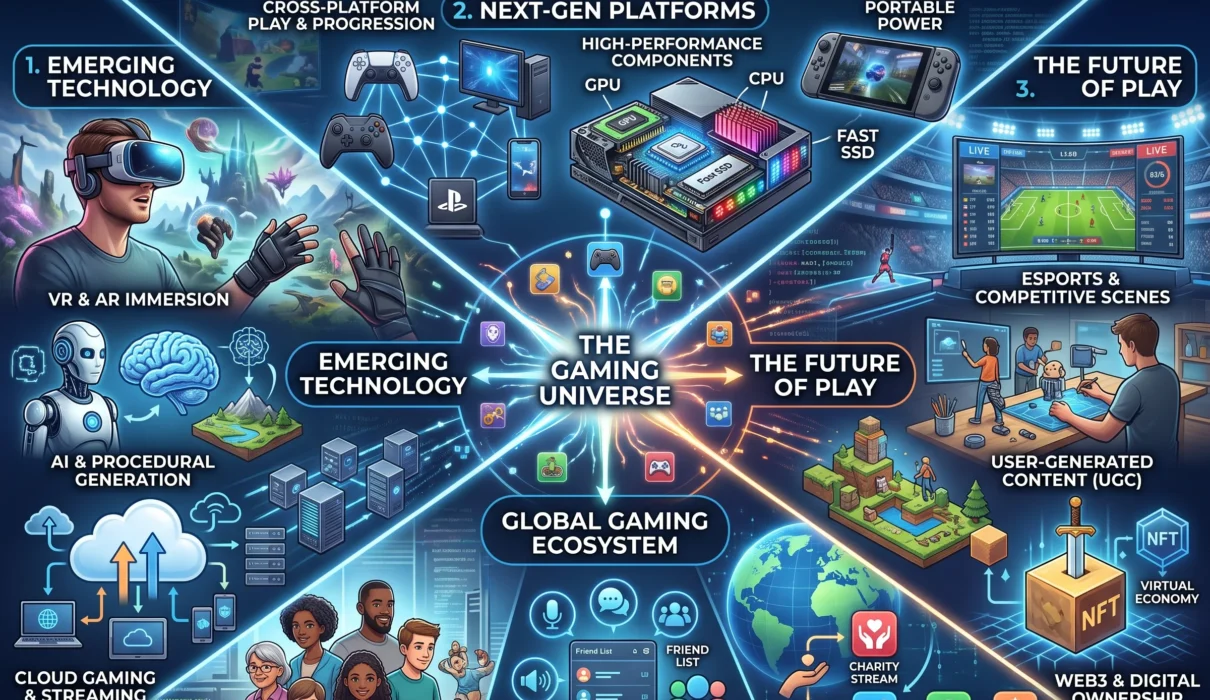
Today’s most influential gaming trends are not just about adding more pixels or launching another battle pass. They reflect a convergence of disruptive forces: generative AI pipelines that rewrite procedural generation; cross-platform, cloud-native infrastructures that dissolve hardware barriers; handheld PCs challenging traditional console cycles; and changing player expectations favoring community-driven creative economies over static single-player releases.
Understanding the modern gaming technology ecosystem and the broader future of gaming requires examining shifts across developer studios, silicon design, cloud architecture, and corporate monetization strategies.
This comprehensive guide analyzes the primary gaming industry trends shaping gaming today—from artificial intelligence and platform-agnostic models to hardware innovations, subscription economies, and player-centric design.
1. The Shifting Platform Paradigm: The Demise of Walled Gardens
For nearly four decades, the console industry was defined by walled gardens. Manufacturers competed in zero-sum console generations, spending hundreds of millions of dollars to secure exclusive platform titles designed to lock players into specific living-room hardware boxes.
That traditional model has largely unraveled. Ballooning AAA development budgets—frequently exceeding $200 million to $300 million per tentpole release—mean exclusive distribution on a single proprietary console rarely delivers a sufficient return on investment (ROI).
THE PLATFORM DISTRIBUTION TRANSITION:

HISTORICAL HARDWARE-LOCKED MODEL (2000–2020):
[ Exclusive Game Title ] ──► Available ONLY on [ Proprietary Living-Room Console ]
(High friction, platform locking, fragmented friend groups)

MODERN PLATFORM-AGNOSTIC ECOSYSTEM (Current Era):
                           ┌──► PC (Steam / Epic / Direct Web Launchers)
                           ├──► Native Home Consoles (Living Room TV)
[ Unified IP / Franchise ] ┼──► Dedicated Handheld PCs (Steam Deck / ROG Ally)
                           ├──► Cloud Streaming to Smartphones & Smart TVs
                           └──► Web Browsers & Direct-to-Consumer Portals
The Multi-Platform Publishing Mandate
Major platform holders have fundamentally adjusted their publishing strategies:
- Simultaneous or Windowed PC Releases: First-party console exclusives now routinely arrive on PC either day-and-date or within a compressed release window. This provides developers access to an active global audience of PC players while keeping digital storefront revenue streams open.
- Direct-to-Consumer Distribution: Developers are increasingly driving players directly to their own storefronts and account portals, bypassing traditional 30% platform cuts and App Store fees.
- Universal Cross-Play and Cross-Progression: Isolated multiplayer matchmaking pools are obsolete. Players expect unified friend lists, shared voice chat across Discord integrations, and synchronized progression that allows them to start a match on a PC, continue on a handheld in bed, and finish on a home console without losing unlocked items.
2. Artificial Intelligence in Game Design and Runtime Mechanics
Artificial intelligence has evolved from an academic prototyping tool into an active engineering component of game production, automated quality assurance, and dynamic runtime gameplay.
+---------------------------+-----------------------------------+------------------------------------------+
| Application Area          | AI / ML Technology Deployed       | Real-World Player Impact                 |
+---------------------------+-----------------------------------+------------------------------------------+
| **Dynamic NPC Behavior**  | On-device Small Language Models   | Characters converse unscripted, recall   |
|                           | (SLMs) + contextual memory graphs | past interactions, and adapt tone        |
+---------------------------+-----------------------------------+------------------------------------------+
| **Neural Rendering**      | Temporal supersampling, optical   | Multiplies effective framerates 2x–3x;   |
|                           | flow field generation (DLSS/FSR)  | reconstructs 4K ray tracing from 1080p   |
+---------------------------+-----------------------------------+------------------------------------------+
| **Automated Testing**     | Reinforcement learning bots &     | Simulates millions of player playthroughs|
|                           | telemetry anomaly detectors       | to identify map exploits and game bugs   |
+---------------------------+-----------------------------------+------------------------------------------+
| **Procedural World-Gen**  | Diffusion models & neural assets  | Synthesizes vast, high-fidelity terrain, |
|                           | synthesis algorithms              | unique foliage, and custom ambient audio |
+---------------------------+-----------------------------------+------------------------------------------+
Unscripted, Cognitively Aware Non-Player Characters (NPCs)
Historically, non-player characters were governed by deterministic state machines and pre-recorded dialogue trees. If a player exhausted the dialogue tree, the character fell silent or repeated static lines.
Modern game engines integrate low-latency Small Language Models (SLMs) and contextual lore databases directly into NPC runtime architectures:
- Persistent Memory Enclaves: NPCs track player choices across tens of hours of gameplay. If you steal an item from a merchant or abandon an ally in a firefight, the character’s future attitude, tone of voice, and willingness to assist adapt organically.
- Voice Synthesis and Lip-Sync: Neural voice synthesis engines generate emotional vocal performances on the fly, matching facial geometry in real time across any spoken language without requiring thousands of studio recording hours.
Neural Rendering and Deep Learning Reconstruction
Modern high-fidelity visuals rely heavily on machine-learning-driven rendering pipelines:
- Temporal Frame Generation: Rather than rasterizing every native frame sequentially, GPUs generate high-resolution frames using motion vectors, optical flow analyzers, and deep neural networks.
- Neural Radiance Caching: Algorithms predict how indirect light bounces off reflective surfaces, providing ray-traced reflections and global illumination with a fraction of the computational performance cost of traditional brute-force ray tracing.
3. Cloud Gaming: From Gimmick to Practical Infrastructure
Early cloud gaming services struggled with network infrastructure limitations, high input latency, and restrictive business models. Today, cloud gaming has matured into a reliable distribution channel.
THE CLOUD STREAMING LATENCY REDUCTION PIPELINE:

[ Remote Cloud Server Engine ]
  • High-end GPU renders game frame at 120 FPS / 240 FPS
  • Hardware encoder compresses frame (AV1 / HEVC) in < 4ms
                  │
                  ▼ (Low-latency 5G / Fiber UDP stream)
[ Edge Network Node / ISP Peering Point ]
                  │
                  ▼
[ Client Device (Phone, Smart TV, Handheld) ]
  • Hardware decoder unpacks video frame in < 2ms
  • Predictive input smoothing eliminates perceived stick latency
Edge Computing and Sub-50ms Input Latency
The viability of cloud gaming hinges entirely on glass-to-glass latency: the time it takes for a button press on a controller to travel to a remote server, execute in the game engine, render the resulting frame, and stream the video back to the player’s display.
- High-Efficiency Codecs (AV1 & HEVC): Modern streaming protocols utilize hardware-accelerated AV1 encoding. This reduces required bandwidth by up to 30% compared to legacy H.264 video streams, preserving fine shadow details and high-contrast particle effects over typical broadband connections.
- Distributed Edge Deployments: Cloud providers place GPU rendering clusters directly inside municipal internet service provider (ISP) data hubs rather than relying on centralized continental facilities. This keeps network travel times under 15 to 20 milliseconds, making fast-paced action titles and driving simulators playable without disruptive input lag.
The Rise of Native Smart TV and Browser Gaming
By packaging cloud client software into native apps for smart TVs, streaming sticks, and mobile web browsers, publishers can reach billions of players who do not own a dedicated $500 console or a $1,500 gaming PC. A player can pair a Bluetooth controller directly to an inexpensive television, launch an application, and stream high-end titles at 4K 60FPS within seconds.
4. Hardware Evolution: The Handheld PC Boom and Modern Displays
While cloud gaming expands access, dedicated gaming hardware continues to evolve with a focus on portability and display innovation.
+--------------------------+-------------------------------------+------------------------------------------+
| Hardware Category        | Technical Benchmark                 | Modern Market Impact                     |
+--------------------------+-------------------------------------+------------------------------------------+
| **Handheld Gaming PCs**  | 15W–30W APUs, RDNA/Xe graphics,     | Disrupts traditional home consoles;      |
|                          | unified LPDDR5X memory, Linux OS    | makes full PC libraries fully portable   |
+--------------------------+-------------------------------------+------------------------------------------+
| **OLED Gaming Displays** | QD-OLED & WOLED panels, 240Hz–480Hz | Delivers instantaneous 0.03ms pixel      |
|                          | refresh, sub-0.03ms GtG response    | response and pure, uncrushed black levels|
+--------------------------+-------------------------------------+------------------------------------------+
| **Hall-Effect Controls** | Contactless magnetic sensors in     | Eliminates potentiometer stick drift;     |
|                          | analog sticks and triggers          | provides precision input longevity       |
+--------------------------+-------------------------------------+------------------------------------------+
The Rise of Handheld Gaming PCs
Pioneered by the Steam Deck and accelerated by devices like the ASUS ROG Ally, Lenovo Legion Go, and Ayaneo series, the handheld PC has carved out a permanent hardware category.
- Low-Power Architectural Efficiency: Modern mobile Accelerated Processing Units (APUs) pack high-efficiency CPU cores and modern graphics architectures into power envelopes running between 10 and 25 watts.
- Operating System Optimization: Handheld-tailored Linux platforms (such as SteamOS) feature quick-suspend and resume functions, custom thermal wattage limits, and dynamic frame-rate limiters, bringing console-like simplicity to the open PC gaming ecosystem.
OLED Displays and Motion Clarity
Competitive and enthusiast PC gaming has shifted away from traditional IPS and VA LCD panels toward QD-OLED (Quantum Dot OLED) and WOLED:
- Sub-Millisecond Response Times: Unlike LCD crystals that take several milliseconds to twist and change color (causing ghosting behind fast-moving targets), OLED pixels switch color states in 0.03 milliseconds, producing sharp motion clarity at 240Hz, 360Hz, and 480Hz.
- True HDR Gaming: Per-pixel self-emissive lighting delivers infinite contrast ratios, allowing bright neon explosions and muzzle flashes to pop against pure, deep black shadows without backlight blooming.
5. Monetization Models: Windowing, Subscriptions, and Tiered Pricing
The business models funding video game production are shifting away from flat-rate transactions toward varied monetization strategies.
THE THREE DOMINANT MONETIZATION PILLARS:

[ TIERED PREMIUM PRICING ] ──► $70 Base / $100 Deluxe Editions / Early Access Windows
            │
[ SUBSCRIPTION LIBRARIES ] ──► Xbox Game Pass, PlayStation Plus, EA Play, Ubisoft+
            │
[ LIVE-SERVICE & UGC ]     ──► Free-to-play base, seasonal battle passes, creator payouts
The Return of Tiered Pricing and Windowing
Publishers are adopting release strategies that mirror the film industry’s historical theatrical-to-home-video windowing model:
- Premium Launch Window: Hardcore enthusiasts pay a premium ($70 to $100+) for early access editions that unlock three to seven days prior to public launch, paired with cosmetic digital bonuses.
- Standard Retail Window: The base title sells at full retail price to capture mainstream seasonal sales over the first six to nine months.
- Subscription & Deep Discount Long-Tail: After initial sales taper off, titles transition to subscription libraries (like Xbox Game Pass or PlayStation Plus) or receive 50%+ discounts on digital storefronts, generating recurring revenue and introducing new players to in-game microtransactions.
The Creator Economy: Roblox and Fortnite as Digital Ecosystems
User-generated content (UGC) platforms have turned video games into creative networks. Platforms like Fortnite (Unreal Editor for Fortnite / UEFN) and Roblox operate as developer economies:
- Tens of thousands of independent developers build custom games, social hubs, and narrative experiences inside these host engines.
- Annual developer payouts exceed hundreds of millions of dollars, incentivizing creators to build live games inside these persistent platforms rather than launching standalone indie titles.
6. Player Experience: Community, UGC, and the Death of the “Average Gamer”
Market research from leading gaming analysts reveals a crucial demographic reality: the generic “average gamer” no longer exists.
CONTEMPORARY PLAYER ARCHETYPES:

[ THE FOREVER-GAME SPECIALIST ] ──► Spends 90%+ of gaming time in 1–2 live-service worlds
                                    (e.g., League of Legends, Counter-Strike 2, Apex Legends)
                 │
[ THE CREATIVE SOCIALIZER ]     ──► Treats games as digital third places to hang out with friends
                                    (e.g., Roblox, Fortnite creative, Minecraft, VRChat)
                 │
[ THE PRESTIGE CURATOR ]        ──► Prioritizes tightly written, focused 15–30 hour AA/AAA titles
                                    (e.g., Clair Obscur: Expedition 33, Elden Ring, Hades II)
The Dominance of “Forever Games”
A substantial share of global player engagement is concentrated in a handful of persistent titles that have operated for five to ten years. These games function as digital “third places” where players socialize, compete, and consume virtual concerts and media crossovers.
For developers, launching a successful new live-service game has become an uphill battle. A new multiplayer title is not just competing with other new releases; it is competing with the thousands of hours, friend networks, and cosmetic investments players have already anchored in established live games.
The Rise of Focused “AA” and Indie Triumphs
In reaction to bloated AAA release cycles—where games often feature repetitive open-world checklists to justify $70 price tags—players are embracing focused, distinctive AA and indie experiences:
- Titles produced with mid-range budgets ($10 million to $40 million) focus on mechanical depth, distinct artistic direction, and polished pacing.
- Selling at accessible price points ($30 to $50), these games deliver creative gameplay that resonates strongly with players fatigued by live-service battle passes.
7. What Lies Ahead: The Next Frontier of Interactive Entertainment
As we look toward the next era of interactive entertainment, several emerging technical trends are poised to enter mainstream consumer hands:
- Neural Audio Profiling: Advanced HRTF (Head-Related Transfer Function) spatial audio algorithms that scan individual ear anatomy using smartphone cameras, producing binaural 3D audio that allows players to pinpoint footstep distances purely by ear.
- Direct Cross-Media Adaptations: The relationship between gaming, film, and television has evolved. Rather than releasing cheap video game tie-in movies, major studios are treating game franchises with the critical prestige of cinematic universes (exemplified by high-production adaptations of Fallout, The Last of Us, and Arcane), driving massive secondary player spikes back into the original game franchises.
- Local Hybrid Ray-Tracing Silicon: Mobile and console chipsets that use hardware BVH traversal units to run real-time dynamic path tracing without thermal throttling.
The Landscape in Perspective
The gaming industry is transitioning toward an era characterized by open accessibility, creative flexibility, and hybrid processing. The rigid boundaries that once separated consoles, PCs, and mobile devices have softened into a cohesive digital continuum.
Whether you are streaming high-fidelity games to an inexpensive television over a low-latency edge network, playing complex indie adventures on an open-source handheld PC, or exploring dynamic open worlds populated by responsive, intelligent NPCs, the future of gaming is delivering experiences that are more social, accessible, and immersive than ever before.
