


 By
By The Paradox of Modern Dressing
Open your closet doors right now. What do you see?
For most people, the answer is a visual assault of sensory overload: tightly packed hangers, impulse buys with tags still attached, outdated trend items, ill-fitting denim, and mismatched colors. Yet, despite having a wardrobe bursting at the seams, millions of people stand in front of their closets every single morning and experience the exact same paralyzing thought:
“I have completely full closets, but I have nothing to wear.”
This frustrating phenomenon is known in behavioral psychology as the Paradox of Choice (popularized by psychologist Barry Schwartz). When presented with an overwhelming array of disparate, uncoordinated options, our cognitive faculties freeze. Decision fatigue sets in before we even leave the bedroom. We grab the same worn-out sweatshirt or default pair of pants, feeling uninspired, disorganized, and subtly stressed.
Enter the capsule wardrobe.
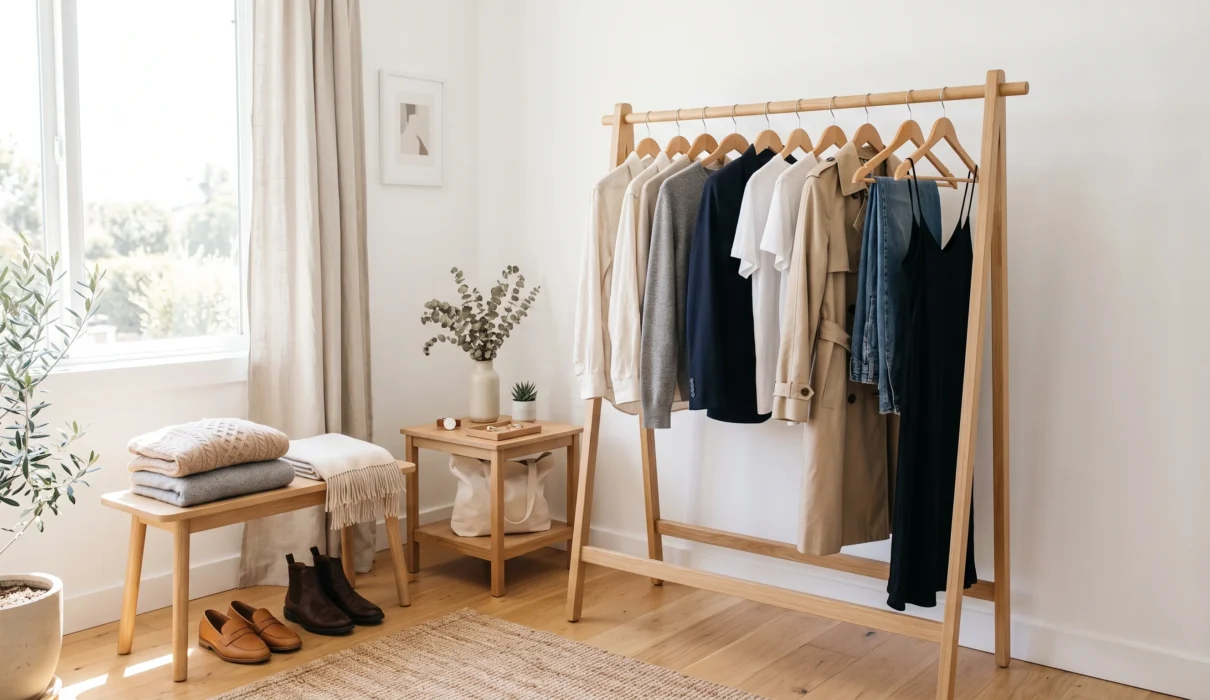
A capsule wardrobe is not a restrictive prison of boring, identical clothing. It is not about living out of a solitary suitcase or wearing black turtlenecks seven days a week. Instead, it is an intentional, liberating system of curated, versatile garments that work harmoniously together. It replaces chaotic impulse buying with cohesive styling, giving you more outfits from fewer pieces.
In this definitive capsule wardrobe guide, we will deconstruct the philosophy, history, and exact step-by-step roadmap required to transform your closet. You will learn how to audit what you already own, establish a personalized color palette, select enduring wardrobe essentials, and master the mathematical mixing formulas that yield dozens of chic looks from a handful of high-quality items.
1. What Is a Capsule Wardrobe? Origins, Philosophy, and True Utility
Defining the Concept
A capsule wardrobe is a deliberately edited collection of interchangeable, functional, and timeless clothing items that can be combined in myriad ways to create complete outfits for any occasion within a specific season or lifestyle framework.
Rather than focusing on sheer quantity or fleeting micro-trends, a minimalist wardrobe emphasizes:
- Versatility: Every item pairs with multiple other items in the collection.
- Cohesion: A unified color palette, consistent proportions, and complementary textures.
- Quality over Quantity: Durable, comfortable fabrics that endure years of wear rather than degrading after two laundry cycles.
- Personal Alignment: Clothes tailored to your actual daily reality—not a fictional, aspirational lifestyle.
                      THE CAPSULE WARDROBE CORE EQUATION
  ┌─────────────────────────────────────────────────────────────────────────┐
  │ High Interchangeability  +  Unified Color Story  +  Flawless Fit         │
  │ = Maximum Outfits from Minimal Footprint (Zero Decision Fatigue)       │
  └─────────────────────────────────────────────────────────────────────────┘
A Brief History: From Susie Faux to Donna Karan
While the term feels modern, the concept has rich historical roots:
- Susie Faux (1970s): The term “capsule wardrobe” was coined by Susie Faux, owner of the London boutique Wardrobe in the 1970s. Faux’s premise was simple yet radical for retail: a woman could master chic dressing by investing in a small collection of essential, high-quality, interchangeable garments—skirts, trousers, jackets—that could be refreshed with seasonal accessories.
- Donna Karan’s “Seven Easy Pieces” (1985): American designer Donna Karan launched her solo label with a legendary runway show demonstrating that a career woman could conquer the workweek with just seven black, interchangeable basics anchored by a bodysuit, tailored jacket, skirt, and trousers.
- The Modern Revival: In the 2010s, minimalists like Courtney Carver launched the Project 333 challenge (wearing just 33 items for three months), and Caroline Rector of Unfancy popularized the seasonal 37-piece capsule on the early visual web.
Today, building a capsule wardrobe is no longer just a minimalist subculture trend; it has become an essential life hack for anyone seeking sustainability, fiscal wellness, and effortless everyday elegance.
2. The Proven Benefits: Why You Should Downsize Your Closet
Before throwing open your wardrobe doors, it helps to understand the practical return on investment you will gain. Downsizing to a curated closet impacts your mental health, finances, and environmental footprint:
                      THE MULTI-BENEFIT CAPSULE IMPACT
                                     │
     ┌───────────────────────────────┼───────────────────────────────┐
     ▼                               ▼                               ▼
Cognitive Clarity               Financial Freedom              Ecological Grace
Eliminates daily decision       Curbs impulse buying; lowers   Rejects disposable fast
fatigue; saves 15–20 minutes    cost-per-wear; redirects       fashion; lowers textile
every morning.                  capital to investments.        waste & microplastics.
1. Eliminating Morning Decision Fatigue
The human brain makes roughly 35,000 decisions every single day. Every micro-choice—from checking email notifications to choosing what to wear—consumes glucose and mental energy. Starting your morning struggling through a messy closet drains your willpower before your day even begins. A cohesive capsule streamlines dressing into a 90-second process: because every piece matches, you cannot make a styling mistake.
2. Drastically Lowering Cost-Per-Wear (CPW)
Fast fashion relies on an illusion of affordability. A $25 polyester shirt that pills, shrinks, or goes out of style after two wears costs $12.50 per wear. Conversely, a well-tailored $180 wool blazer worn 60 times a year over three years costs a mere $1.00 per wear. A capsule wardrobe redirects your budget away from cheap, disposable items toward heirloom-quality natural fibers that last.
Cost Per Wear (CPW)=Total Number of Times WornTotal Purchase Price+Maintenance Costs
3. Sustainable, Mindful Living
The fashion industry accounts for up to 10% of global carbon emissions and produces millions of tons of landfill textile waste annually. Embracing a minimalist wardrobe is one of the single most impactful individual steps you can take toward environmental stewardship. Buying less, choosing natural single-origin fibers, and wearing items for years breaks the destructive cycle of fast-fashion production.
3. Phase 1: The Closet Detox and Honest Audit
Building a dream wardrobe does not start at the shopping mall or on an e-commerce checkout page. It begins with an honest, thorough audit of your current closet.
Step 1: The Empty-Bed Evacuation
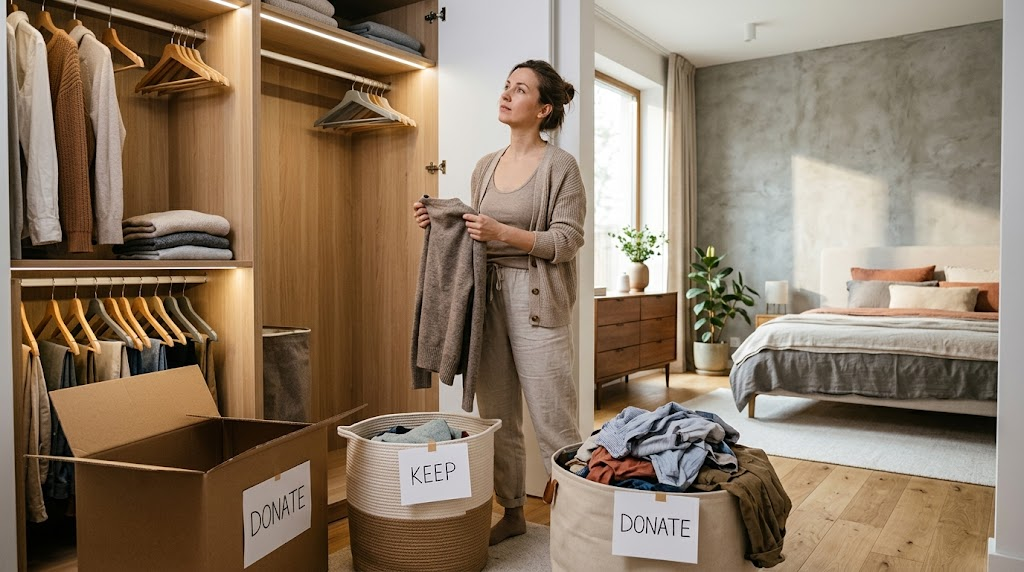
Do not attempt to audit your clothes while they are still hanging on the rod. Set aside a dedicated three-hour block on a weekend morning. Strip your closet down to bare hangers. Lay every dress, coat, sweater, pair of trousers, and pair of shoes onto your bed.
Seeing the sheer volume of your possessions stacked together creates immediate psychological clarity about your consumption patterns.
Step 2: The Four-Pile Sorting Method
Pick up each garment individually and sort it into one of four distinct categories without rationalizing or procrastinating:
+-------------------------------------------------------------------------------------------------------+
| Category               | Strict Sorting Criteria                             | Action Plan            |
+-------------------------------------------------------------------------------------------------------+
| 1. The Core Keepers    | Fits your current body perfectly today; in great    | Hang immediately in a  |
|                        | repair; worn and loved within the last 60 days.     | dedicated primary zone.|
+-------------------------------------------------------------------------------------------------------+
| 2. The "Maybe" Box     | High emotional hesitation; fits strangely; you      | Seal inside a plastic  |
|                        | love the piece in theory, but rarely reach for it.  | tub; store for 90 days.|
+-------------------------------------------------------------------------------------------------------+
| 3. Alter / Repair      | Quality pieces needing minor tailoring (hemming,    | Place in a tote bag by |
|                        | taking in waist, replacing buttons, depilling).     | the door for the tailor|
+-------------------------------------------------------------------------------------------------------+
| 4. Donate / Sell       | Unflattering; poor fabric; duplicates; outgrown;    | Bag for local charity  |
|                        | uncomfortable; items unpicked for over 12 months.   | or resale platforms.   |
+-------------------------------------------------------------------------------------------------------+
The “Maybe Box” Psychological Safety Valve
The hardest part of a closet purge is the guilt associated with past spending: “I spent $150 on this dress, I can’t just give it away!”
The Maybe Box solves this emotional hurdle:
- Put all your uncertain items inside a box.
- Write a calendar date 90 days in the future on the lid and tape it shut.
- Place the box in a storage closet, attic, or under the bed.
- If you find yourself hunting for a specific piece during those three months, retrieve it and welcome it back into your rotation.
- If 90 days pass and you never opened the box or thought about those clothes, your life did not miss them. Donate or sell the contents without reopening the lid.
4. Phase 2: Lifestyle Mapping and Personal Style Identification
A capsule wardrobe fails when it is built for a fantasy life instead of your daily reality.
If your daily life consists of remote software engineering from a home office, parenting toddlers, and weekend hiking, buying five structured corporate pantsuits because an online influencer recommended them will result in an unused closet.
                      THE LIFESTYLE COMPASS EXERCISE
  ┌─────────────────────────────────────────────────────────────────────────┐
  │ Map your weekly hours across these major categories:                    │
  │ • Professional / Office / Remote Desk Work:      _____ % of time       │
  │ • Casual Everyday / Errands / Parenting:         _____ % of time       │
  │ • Active / Fitness / Outdoor Recreation:         _____ % of time       │
  │ • Social / Dining Out / Cultural Events:         _____ % of time       │
  │ • Formal / Galas / Special Occasions:            _____ % of time       │
  └─────────────────────────────────────────────────────────────────────────┘
  Your capsule wardrobe garment count must directly mirror these percentages!
Identifying Your Personal Style Anchors
Before spending money on new pieces, define your stylistic north star. A helpful framework is Allison Bornstein’s popular Three-Word Method:
- Word One (The Reality): What words describe the practical clothes you instinctively wear all the time? (e.g., Casual, Structured, Tailored, Oversized, Minimal).
- Word Two (The Aspiration): How do you want to feel in your clothes? What is your dream mood? (e.g., Refined, Edgy, Romantic, Architectural, Bohemian).
- Word Three (The Emotional Spark): An unusual, distinctive juxtaposition that makes your style unique (e.g., Nostalgic, Sporty, French-chic, Utilitarian, Eclectic).
Example: A style anchor composed of “Tailored, Relaxed, and Edgy” immediately guides purchasing decisions. A flowy floral peasant blouse doesn’t fit that formula; a sharp black oversized double-breasted blazer over raw-hem denim fits it like a glove.
5. Phase 3: The Chromatic Architecture of a Cohesive Wardrobe
The secret to why a true capsule wardrobe can generate 50+ unique outfits from fewer than 30 garments lies in chromatic discipline.
If every shirt is a bold, competing print and every pair of pants is an unpredictable pastel, pairing options shrink exponentially. When you construct a balanced color system, every top naturally complements every bottom.
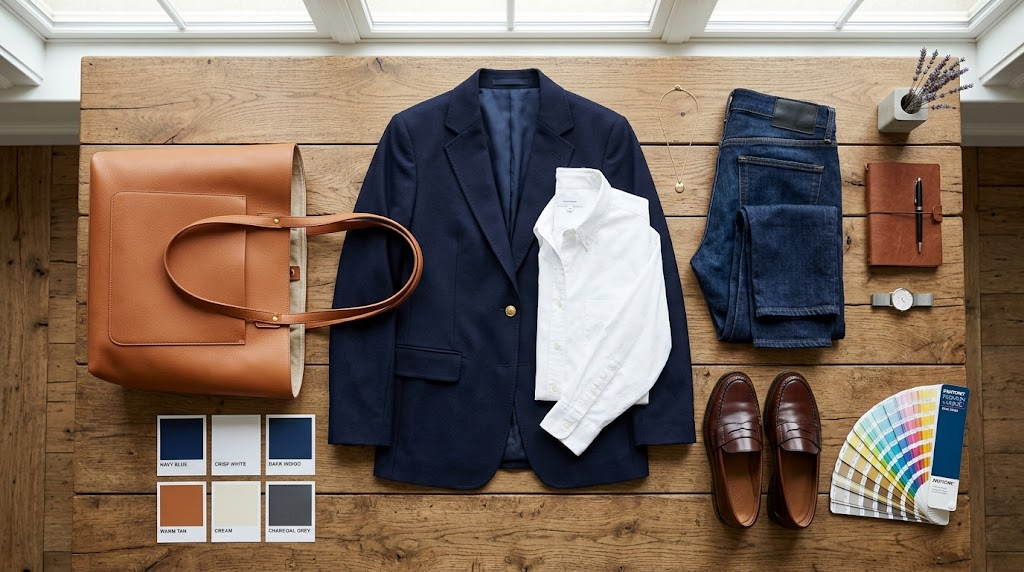
                       THE CAPSULE COLOR WHEEL MATRIX
  ┌─────────────────────────────────────────────────────────────────────────┐
  │ 1. Core Primary Neutrals (60% of Capsule)                               │
  │    Choose ONE or TWO: Black, Deep Charcoal, Midnight Navy, or Espresso   │
  │    Applied to: Tailored outerwear, pants, boots, bags, heavy knitwear.  │
  ├─────────────────────────────────────────────────────────────────────────┤
  │ 2. Soft Secondary Neutrals (30% of Capsule)                             │
  │    Choose TWO: Crisp White, Soft Cream/Ecru, Light Grey, Camel, Oat    │
  │    Applied to: Shirting, t-shirts, light knits, cardigans, trench coats.│
  ├─────────────────────────────────────────────────────────────────────────┤
  │ 3. Intentional Accent Hues (10% of Capsule)                             │
  │    Choose ONE or TWO: Sage Green, French Blue, Burgundy, Butter Yellow   │
  │    Applied to: Scarves, statement sweaters, accessories, silk tops.     │
  └─────────────────────────────────────────────────────────────────────────┘
Choosing Warm vs. Cool Color Harmonies
Identify your personal skin undertones to ensure your wardrobe brings natural radiance to your complexion:
- Cool Undertones (Silver jewelry flatters; veins appear bluish):
- Core Neutrals: True Black, Inky Navy, Slate Grey, Crisp Pure White.
- Accents: Cobalt Blue, Emerald Green, Icy Lilac, Rich Burgundy.
- Warm Undertones (Gold jewelry flatters; veins appear greenish):
- Core Neutrals: Deep Espresso Brown, Warm Camel, Creamy Alabaster, Olive.
- Accents: Terracotta, Butter Yellow, Rust, Warm Sage, Warm Coral.
6. The Core Wardrobe Essentials: The Definitive 30-Piece Checklist
While individual lifestyles differ, a versatile four-season foundational capsule can easily be constructed around 30 carefully selected garments.
Below is an all-season architectural master template designed to cover smart-casual workplaces, weekend errands, business dinners, and casual social outings:
+---------------------------------------------------------------------------------------+
|                       THE 30-PIECE FOUNDATIONAL CAPSULE CHECKLIST                     |
+---------------------------------------------------------------------------------------+
| Structured Outerwear (4 pieces)                                                       |
| [ ] 1. The Classic Tailored Blazer (Oversized or relaxed cut in charcoal, black, taupe)|
| [ ] 2. The All-Weather Trench Coat (Double-breasted gabardine in khaki or deep olive) |
| [ ] 3. The Casual Outer Layer (Suede overshirt, denim trucker, or leather biker jacket)|
| [ ] 4. The Longline Wool Overcoat (Heavy winter duster in camel, black, or espresso)  |
|                                                                                       |
| Core Tops & Layering Knits (9 pieces)                                                 |
| [ ] 5. The Crisp White Poplin Button-Down (Relaxed boyfriend cut)                     |
| [ ] 6. The Striped Oxford or Silk Blouse (Blue/white stripe or neutral washed silk)   |
| [ ] 7. The Heavyweight Cotton Crewneck Tee (Pure White)                               |
| [ ] 8. The Heavyweight Cotton Crewneck Tee (Deep Black or Charcoal)                   |
| [ ] 9. The Fine-Gauge Ribbed Tank (High neckline; excellent for under-blazer layering)|
| [ ] 10. The Cashmere or Merino Crewneck Sweater (Soft camel or oatmeal)              |
| [ ] 11. The Chunky Fisherman / Cable Knit Sweater (Cream or heather grey)             |
| [ ] 12. The Refined Cardigan (V-neck with horn buttons; wearable as a standalone top) |
| [ ] 13. The Long-Sleeve Cotton / Modal Breton Striped Shirt                           |
|                                                                                       |
| Versatile Bottoms & Dresses (9 pieces)                                                |
| [ ] 14. High-Waisted Wide-Leg Tailored Trousers (Charcoal, taupe, or black)          |
| [ ] 15. Classic Straight-Leg Denim (Rigid mid-blue wash, zero distressing)           |
| [ ] 16. Dark Wash / Clean Black Denim (Versatile for evening smart-casual wear)      |
| [ ] 17. Relaxed Linen or Chino Trouser (Ecru, bone, or olive for warmer months)       |
| [ ] 18. The Modern Column Skirt (Satin slip or structured denim maxi skirt)           |
| [ ] 19. The Tailored Walking Shorts or Culottes (Pleated silhouette)                 |
| [ ] 20. The "Day-to-Night" Little Black Dress (Slip dress or high-neck knit column)  |
| [ ] 21. The Versatile Shirt Dress (Belted linen or poplin midi)                       |
| [ ] 22. The Relaxed Lounge Trouser (Heavy drapey ponte or tailored knit)             |
|                                                                                       |
| Footwear (5 pairs)                                                                    |
| [ ] 23. Sleek Low-Profile Leather Sneakers (Minimal white or gum-sole retro runner)   |
| [ ] 24. Classic Leather Penny Loafers (Dark chocolate or black with chiseled toe)     |
| [ ] 25. Elegant Pointed-Toe Ballet Flats or Slingbacks (Elongates leg profile)        |
| [ ] 26. Clean Ankle Boot (Low block heel in leather or water-resistant suede)         |
| [ ] 27. Versatile Minimalist Sandal or Slide (Warm weather anchor)                   |
|                                                                                       |
| Anchor Accessories (3 pieces)                                                         |
| [ ] 28. Structured Leather Day Tote (Fits a laptop, notebook, and water bottle)       |
| [ ] 29. Compact Crossbody / Shoulder Evening Bag (Sleek hardware detailing)           |
| [ ] 30. Reversible Leather Belt with Polished Metal Buckle                            |
+---------------------------------------------------------------------------------------+
(Note: Undergarments, dedicated workout athletic gear, sleepwear, and specialized technical outdoor gear are kept separate from your everyday lifestyle capsule count.)
7. Outfit Formulas: The Mathematical Mixing Blueprint
The real magic of a capsule wardrobe is how easily pieces combine. With just 9 tops, 9 bottoms/dresses, and 4 outerwear layers, you have hundreds of possible combinations.
To make morning styling effortless, rely on these four proven outfit formulas:
                      THE 4 PLUG-AND-PLAY OUTFIT FORMULAS
  ┌────────────────────────────────────────────────────────────────────────┐
  │ 1. The Elevated Casual (The Modern Off-Duty Standard)                  │
  │    White Crew Tee + Straight-Leg Denim + Tailored Blazer +              │
  │    Leather Loafers + Structured Tote                                   │
  ├────────────────────────────────────────────────────────────────────────┤
  │ 2. The Executive Minimalist (Comfort Meets Professionalism)            │
  │    White Poplin Button-Down + Wide-Leg Pleated Trousers +              │
  │    Pointed Slingbacks + Leather Belt + Gold Accents                    │
  ├────────────────────────────────────────────────────────────────────────┤
  │ 3. The Cozy Sculptural (Texture-Forward Weekend Dressing)              │
  │    Chunky Cable Knit Sweater + Satin Column Maxi Skirt +               │
  │    Low-Profile White Sneakers + Crossbody Bag                          │
  ├────────────────────────────────────────────────────────────────────────┤
  │ 4. The Evening Chameleon (Effortless Sophistication)                   │
  │    Slip Midi Dress + Suede/Leather Jacket draped over shoulders +       │
  │    Pointed Ankle Boots + Sculptural Jewelry                            │
  └────────────────────────────────────────────────────────────────────────┘
The “Sandwich Rule” of Visual Balance
A classic styling trick used by personal shoppers is the Sandwich Rule. Balance the visual weight of your top and bottom halves:
- If you wear a heavy dark boot on your feet, balance it with a dark jacket or dark sweater on top, sandwiching lighter trousers in between.
- If you wear relaxed, voluminous wide-leg pants on your lower half, pair them with a fitted, structured top to create balanced proportions.
Sandwich Styling Balance:
┌──────────────────────────┐
│   Espresso Knit Top      │  ◄── Tone 1: Dark / Heavy
├──────────────────────────┤
│   Cream Tailored Pants   │  ◄── Tone 2: Light / Bright
├──────────────────────────┤
│   Espresso Leather Boots │  ◄── Tone 1: Dark / Heavy (Grounding Anchor)
└──────────────────────────┘
8. Fabric and Material Integrity: Investing in Longevity
A minimalist wardrobe places high demands on its individual garments. Because you will be wearing these pieces on repeat, poor-quality synthetic materials will quickly show wear through pilling, fraying, and fading.
Becoming literate in fabric tags is a core skill for building a capsule that lasts:
+-------------------------------------------------------------------------------------------------------+
| Fabric Type          | Unique Strengths & Sensory Experience        | Recommended Capsule Items       |
+-------------------------------------------------------------------------------------------------------+
| 100% Merino Wool     | Odor-resistant, temperature-regulating,      | Sweaters, fine base layers,     |
|                      | wrinkle-resistant, breathable all-season drape| tailored trousers, blazers      |
+-------------------------------------------------------------------------------------------------------+
| Organic Long-Staple  | Breathable, highly durable, softens with     | Everyday t-shirts, poplin       |
| Cotton               | washing, zero synthetic static electricity   | button-downs, casual shirting   |
+-------------------------------------------------------------------------------------------------------+
| Mulberry / Raw Silk  | Thermoregulating, luxurious drape, smooth on  | Button-down shirts, slip skirts,|
|                      | skin, excellent natural luster               | dresses, layering camisoles     |
+-------------------------------------------------------------------------------------------------------+
| Pure Flax Linen      | Maximum summer breathability, dries rapidly, | Summer trousers, camp shirts,   |
|                      | develops beautiful lived-in texture          | warm-weather duster coats       |
+-------------------------------------------------------------------------------------------------------+
| Full-Grain Leather   | Develops rich patina over time, highly       | Everyday boots, penny loafers,  |
| & Suede              | durable, easily conditioned & repaired       | structured totes, belts         |
+-------------------------------------------------------------------------------------------------------+
Warning Signs of Fast-Fashion Construction
Before purchasing an item for your capsule, check for these red flags:
- Plastic Blends: Avoid garments with high percentages of polyester, acrylic, or polyamide blended with natural fibers (e.g., “70% acrylic, 30% wool”). These pill quickly and trap body heat.
- Single Stitching: Check hem and seam construction. Flimsy, loose single-thread stitching pulls apart easily; look for tight double stitching or clean French seams.
- Unlined Suiting: Quality tailored blazers and wool coats should feature smooth internal linings (cupro, viscose, or silk) to ensure they slide easily over knitwear without friction.
9. Seasonal Adaptations: The Four-Season Capsule Rotation
A common misconception is that a capsule wardrobe must serve all twelve months from a single clothing rack. If you live in a region with distinct four-season weather shifts, trying to wear the same items in freezing winter and humid midsummer is impractical.
The solution is the Seasonal Transition Model:
                      THE SEASONAL TRANSITION WHEEL
                                   ▲
                                   │
              Spring Capsule ◄─────┼─────► Summer Capsule
              (Light layers,       │       (Linen, lightweight
               trench coats)       │        cotton, open shoes)
                                   ┼
              Autumn Capsule ◄─────┼─────► Winter Capsule
              (Suede, cozy knits,  │       (Heavy wool coats,
               warm earth tones)   │        cashmere, storm boots)
                                   ▼
The 80/20 Seasonal Rotation System
- The Permanent Core (80%): About 20 to 24 of your items stay in your closet year-round: straight-leg denim, white button-downs, leather loafers, everyday tees, slip skirts, and blazers.
- The Seasonal Swap (20%): Rotate a small set of 6 to 8 specialized seasonal pieces twice a year:
- In warm weather, bring out linen shorts, summer dresses, and breathable sandals, storing heavy winter gear.
- In cold weather, pack away light linens and bring out heavy wool dusters, chunky knitwear, and winter boots.
Store off-season garments in breathable, zippered canvas under-bed storage containers with cedar blocks to protect against dust and moths. When the seasons change, unpacking those items feels like shopping your own private boutique for free.
10. Common Capsule Wardrobe Mistakes and Pitfalls
Avoid these common traps that cause beginners to abandon their capsule wardrobes:
| The Common Pitfall | Why It Causes Failure | The Strategic Fix |
|---|---|---|
| Buying a Brand-New Capsule Overnight | Buying an entire new wardrobe at once leads to expensive mistakes and repeats old shopping habits. | Build slowly. Audit first, wear what you own for 30 days, identify gaps, and buy deliberately. |
| Ignoring Your Real Lifestyle | Building a formal business capsule when you work remotely results in an unworn, stressful closet. | Map your actual weekly hours and make sure your capsule pieces match where you spend your time. |
| Enforcing Extreme Monotony | Limiting yourself entirely to beige and black can drain personal expression and lead to boredom. | Introduce rich textures (leather, suede, knitwear), subtle patterns, and comfortable accent colors. |
| Chasing Fleeting Micro-Trends | Buying trending social media items breaks the visual harmony of your capsule. | Use the “30-Wears Rule”: only buy pieces you can realistically see yourself wearing for years. |
| Skipping the Tailor | Off-the-rack clothes rarely fit anyone’s proportions perfectly straight from the store. | Build a relationship with a good tailor. Hemming trousers and adjusting sleeves makes affordable pieces look bespoke. |
11. Maintenance and Wardrobe Care: Making Clothes Last Decades
Because your capsule wardrobe relies on fewer pieces worn more frequently, mindful garment care is essential. Proper maintenance preserves fabric integrity, keeps colors vibrant, and extends the life of your wardrobe.
                      HEIRLOOM GARMENT CARE ARSENAL
  ┌─────────────────────────────────────────────────────────────────────────┐
  │ 1. Wooden or Broad Padded Hangers: Prevents shoulder bumps & stretching │
  ├─────────────────────────────────────────────────────────────────────────┤
  │ 2. The Fabric Depilling Shaver: Renews tired knitwear in 60 seconds     │
  ├─────────────────────────────────────────────────────────────────────────┤
  │ 3. The Garment Steamer: Relaxes fibers safely without heat scorch marks │
  ├─────────────────────────────────────────────────────────────────────────┤
  │ 4. Wool Detergent & Cold Washing: Prevents fiber breakage & shrinkage   │
  ├─────────────────────────────────────────────────────────────────────────┤
  │ 5. Beeswax Leather Conditioner: Keeps bags and shoes supple & waterproof│
  └─────────────────────────────────────────────────────────────────────────┘
Three Rules for Garment Longevity
- Wash Less, Air More: We often wash clothes out of habit rather than need. Natural fibers like wool, linen, and rigid denim rarely require washing after a single wear unless visibly soiled. Airing them near an open window or steaming them removes odors while preserving fabric life.
- Never Machine-Dry Fine Knits: Tumble dryers break down natural fibers through heat and friction. Always dry knitwear flat on a drying rack over a clean towel to preserve shape.
- Protect Footwear Early: Take new leather shoes to a local cobbler to add a thin, protective rubber half-sole (Topy sole) before wearing them outdoors. This small investment keeps wet pavement from degrading the leather and lets you resole shoes indefinitely.
Frequently Asked Questions (FAQ)
How many clothes should be in a capsule wardrobe?
There is no single mandatory number. Popular challenges suggest 33 or 37 items, but a practical sweet spot for most modern lifestyles is between 25 and 40 pieces (excluding underwear, sleepwear, and specialized gym wear). Focus on how well your pieces work together rather than chasing an arbitrary number.
Will people notice that I wear the same clothes on repeat?
The truth is: people rarely notice what you wore, only how you presented yourself. Subtle adjustments—swapping sneakers for heels, rolling up sleeves, changing a belt, or throwing an unbuttoned blazer over a graphic tee—make the same core pieces look distinct and intentional every time.
Can I include patterns and bright colors in a capsule wardrobe?
Yes. While neutral colors make mixing and matching easier, a capsule wardrobe should reflect your personal taste. The key is choosing intentional, cohesive accents: pick a signature print (such as classic Breton stripes, houndstooth, or subtle plaid) or a dedicated accent color (like rich burgundy or cobalt blue) that pairs smoothly with your neutrals.
How do I start if I have a very tight budget?
Do not buy anything new to start. The best capsule wardrobe begins with what you already own:
- Pull out the reliable pieces you wear every week.
- Store away items that don’t fit or rarely get worn.
- Live with your streamlined core collection for a month to see what real gaps exist.
- When you need to fill a specific gap, explore thrift stores, consignment platforms, or vintage boutiques for natural fiber pieces at a fraction of retail prices.
Conclusion: The Quiet Luxury of True Wardrobe Clarity
Building a capsule wardrobe is an act of intentional self-care. It rejects the idea that your personal worth is tied to endless fast-fashion hauls and wardrobe clutter.
When you simplify your closet to a focused collection of versatile, well-loved wardrobe essentials, you gain much more than storage space:
- You free up valuable time and mental energy every morning.
- You save money by investing in clothes that last.
- You present yourself to the world with consistent, confident personal style.
Take that first step today. Clear your bed, open your closet doors, and start curating a wardrobe that truly works for you.
