


 By
By The video game industry has always been a primary proving ground for computer science breakthroughs. From the earliest raster graphics and physics engines to 3D ray-tracing pipelines, interactive media pushes consumer silicon to its absolute engineering limits. Yet no technological leap has triggered a more profound paradigm shift in game production and player immersion than the rise of modern AI in gaming.
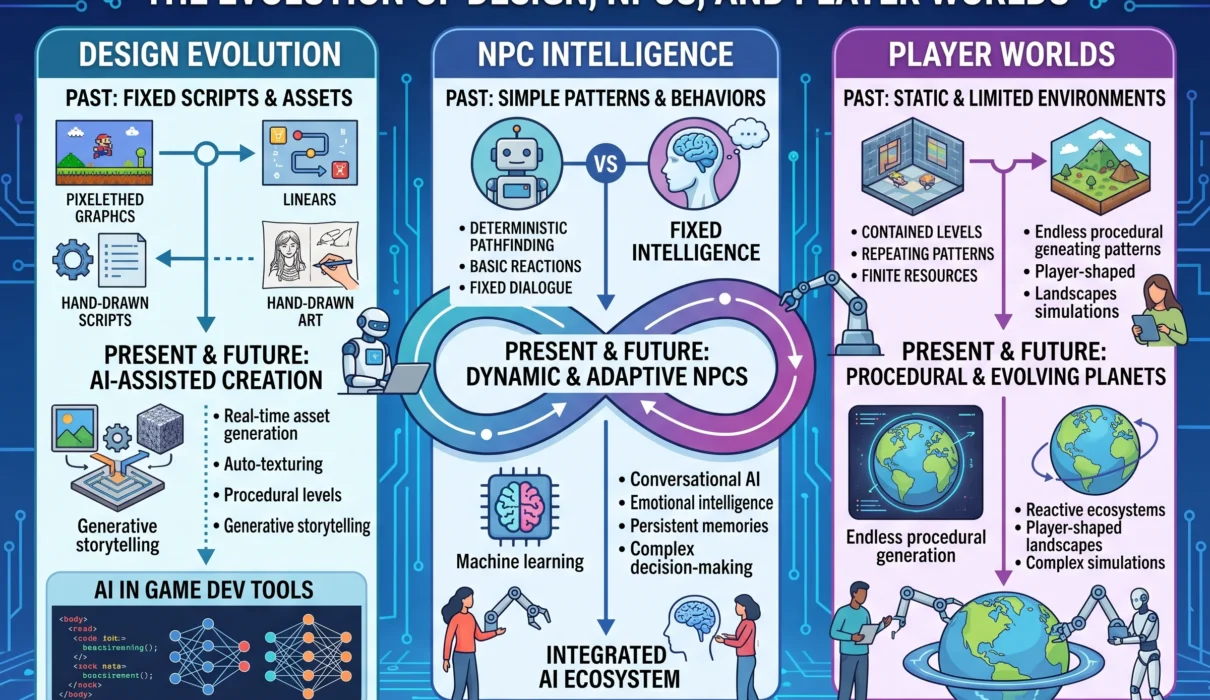
Historically, “game AI” was an illusion crafted through static scripts, finite-state machines, and deterministic decision trees. An enemy guard did not “think”; it cycled through predetermined states—Patrol, Investigate, Attack—triggered by basic line-of-sight checks. If a player found a blind spot in the logic, the illusion broke.
Today, artificial intelligence gaming has moved far beyond hard-coded conditional statements. Neural networks, large language models (LLMs), diffusion architectures, and deep reinforcement learning (RL) are restructuring the entire gaming pipeline. From automated level architecture and dynamic, unscripted non-player characters (NPCs) to self-testing QA bots and personalized difficulty scaling, AI game development is redefining how virtual worlds are built, populated, and experienced.
This comprehensive guide analyzes the concrete technologies powering modern gaming AI, examining how generative content, cognitive characters, automated testing pipelines, and real-time personalization are reshaping the future of interactive entertainment.
1. The Architectural Shift: Classic Game AI vs. Modern Machine Learning
To understand how modern artificial intelligence is transforming games, one must distinguish between traditional heuristic logic and contemporary deep learning models.
THE EVOLUTION OF GAME AI LOGIC:

CLASSIC HEURISTIC PARADIGM (1980–2020):
[ Hard-Coded If/Else Trees ] ──► [ Finite State Machine (FSM) ] ──► [ Fixed Scripted Output ]
• Deterministic: Identical inputs always yield identical behavior
• Brittle: Fails gracefully only if edge cases are manually anticipated
• Zero Adaptation: Cannot learn, evolve, or generate novel solutions

MODERN DEEP LEARNING ARCHITECTURE (Current Era):
                               ┌──► Small Language Models (SLMs) (Contextual Dialogue)
[ Deep Neural Networks & RL ] ─┼──► Reinforcement Learning Policies (Emergent Tactics)
                               └──► Diffusion & NeRF Models (Real-Time Asset Synthesis)
• Non-Deterministic: Generates context-aware, emergent behaviors
• Resilient: Generalizes across unexpected player strategies
• Dynamic: Continuously adapts to player psychology and telemetry
The Limits of Classic Heuristics
For decades, game designers relied on three primary mathematical frameworks:
- Finite State Machines (FSMs): Simple structural graphs where entities transition between fixed states based on hard inputs (e.g., Health < 20% → Retreat).
- Behavior Trees: Hierarchical branching logic that evaluates preconditions to select actions, popularized by titles like Halo 2. While more expressive than FSMs, behavior trees still require designers to manually script every conceivable branch.
- A Pathfinding:* The gold standard for spatial navigation. While computationally efficient for finding the shortest vector across a navigation mesh (NavMesh), standard A* does not evaluate tactical nuance, enemy suppression lines, or dynamic cover usage without heavy layer overlays.
The Modern Machine Learning Foundation
Contemporary AI game development utilizes neural network inference running either on local consumer hardware (via dedicated NPUs and Tensor Cores) or through low-latency edge servers. Rather than executing manual rules written by a programmer, these models learn optimal behaviors by analyzing millions of gameplay frames or undergoing self-play reinforcement cycles. The result is emergent gameplay: systems that surprise both the player and the developers who designed them.
2. Generative Content and AI-Assisted World Building
Modern AAA games demand staggering asset fidelity. Creating a realistic open-world game requires thousands of unique 3D models, photorealistic PBR (physically based rendering) textures, voice lines, motion-capture animations, and ambient soundscapes. Production budgets regularly exceed $200 million, with development cycles stretching past six to seven years. Generative AI serves as a critical force multiplier to break this production bottleneck.
+---------------------------+-----------------------------------+------------------------------------------+
| Asset Pipeline Stage      | Generative AI Technology          | Production Impact                        |
+---------------------------+-----------------------------------+------------------------------------------+
| **Terrain & Biomes**      | Neural procedural generation &    | Synthesizes square kilometers of geology,|
|                           | erosion simulation models         | drainage basins, and natural biomes      |
+---------------------------+-----------------------------------+------------------------------------------+
| **Texture Synthesis**     | Diffusion-based PBR generators    | Converts text/photo prompts into seamless|
|                           | (Albedo, Normal, Roughness, AO)   | 8K tiling materials with physical depth  |
+---------------------------+-----------------------------------+------------------------------------------+
| **3D Mesh Reconstruction**| Neural Radiance Fields (NeRFs) &  | Transforms multi-view 2D concept art     |
|                           | 3D Gaussian Splatting             | into textured, clean-topology 3D assets  |
+---------------------------+-----------------------------------+------------------------------------------+
| **Motion & Rigging**      | Video-to-motion diffusion &       | Auto-rigs skeletal meshes and predicts   |
|                           | neural kinematics predictors      | realistic inertia without physical mocap |
+---------------------------+-----------------------------------+------------------------------------------+
From Traditional PCG to Neural Procedural Generation
Traditional Procedural Content Generation (PCG)—relied on by classics like Diablo, Minecraft, and No Man’s Sky—uses mathematical algorithms like Perlin noise, Voronoi diagrams, and L-systems. While effective for generating random arrangements, standard PCG frequently produces nonsensical layouts, repetitive textures, and jarring structural seams.
Neural Procedural Generation replaces random seeds with deep generative models trained on real-world geography, architectural blueprints, and level design principles:
- Hydrological and Geological Realism: AI systems simulate millions of years of rainfall, hydraulic erosion, and tectonic fault lines in seconds, generating mountain passes, river deltas, and cave networks that follow genuine geological logic.
- Architectural Coherence: When generating an urban city block or medieval dungeon, generative models understand functional flow. Buildings feature logical staircases, structural weight-bearing supports, escape routes, and purposeful clutter placement, drastically cutting down the manual clean-up required by environment artists.
Dynamic Texture Synthesis and Photogrammetry Acceleration
Texturing 3D environments historically required scanning real-world objects via photogrammetry (capturing hundreds of overlapping photos) followed by hours of manual cleanup in digital sculpting tools.
- Generative diffusion models can synthesize complete PBR texture stacks (Albedo, Normal, Roughness, Metallic, Height, and Ambient Occlusion maps) directly from simple natural-language prompts or single reference images.
- These textures are natively tileable, seamless, and mathematically calibrated for modern physically based rendering engines like Unreal Engine and Unity, allowing small indie teams to achieve environment fidelity that previously required massive art departments.
3. Cognitive Non-Player Characters (NPCs) and Generative Dialogue
The most noticeable and emotionally resonant application of artificial intelligence gaming is the transformation of the non-player character. For decades, speaking with an NPC meant clicking through rigid dialogue trees with pre-recorded voice files. Once the script ran out, the character became an inanimate prop.
THE COGNITIVE NPC RUNTIME PIPELINE:

[ Player Voice Input / In-Game Action ]
                   │
                   ▼
[ Automatic Speech Recognition (ASR) & Natural Language Parser ]
                   │
                   ▼
[ Context & Lore Retrieval: RAG Engine ]
  • Character Backstory & Core Motivations
  • Emotional State (Affection, Suspicion, Fear)
  • Episodic World Memory (Player's Past Deeds)
                   │
                   ▼
[ Low-Latency Small Language Model (SLM) Inference ]
                   │
                   ▼
[ Real-Time Neural Speech Synthesis & Procedural Facial Lip-Sync ]
Architecture of an Intelligent NPC
To integrate a cognitive NPC into a living game world without breaking immersion or game balance, studios deploy a multi-tiered architecture:
- Retrieval-Augmented Generation (RAG) for Lore Guardrails: Unconstrained LLMs are prone to hallucinations, potentially breaking character or revealing game spoilers. RAG systems ground the NPC’s language model inside an encrypted vector database containing the game’s exact lore, character relationships, and allowable knowledge states. If a player asks a medieval blacksmith about smartphones, the RAG filter ensures the character reacts with genuine period-accurate confusion rather than breaking the fourth wall.
- Episodic and Semantic Memory Modules: Modern NPCs maintain persistent, long-term memory graphs. If a player helps an NPC’s sibling in Chapter 1, steals a healing potion from their counter in Chapter 2, or hesitates during a crucial dialogue choice, that history is vectorized and injected into the model’s context window. Hours later, the character’s demeanor, pricing, and narrative trust adjust organically.
- Procedural Facial Animation and Audio Generation: Generating dynamic dialogue is useless if the character’s face remains frozen. Modern systems pair real-time text-to-speech (TTS) engines with audio-driven facial rigging. The synthesized audio waveform drives skeletal facial bones and blendshapes in real time, matching phonetic lip-sync, eyebrow arches, and eye darting to the emotional tone of the generated sentence.
The Balance Between Scripted Narrative and Emergent Dialogue
Game writers frequently voice a legitimate concern: If dialogue is completely generated by an AI, how do you maintain cinematic quality, dramatic pacing, and emotional resonance?
The solution adopted by leading narrative studios is a hybrid narrative framework:
- Critical Path (Golden Path): Core story missions, pivotal character deaths, and cinematic climaxes remain tightly written, directed, and voiced by professional human actors to preserve artistic intent.
- Ambient and Secondary Interactions: Side quests, ambient shopkeepers, tavern patrons, and enemy combatants are powered by bounded AI models. This ensures the world feels reactive, alive, and unscripted during exploration without derailing the main authorial storyline.
4. Deep Reinforcement Learning: Revolutionizing Enemy Tactics
While generative models handle language and visuals, deep reinforcement learning (DRL) is redefining combat design and tactical AI.
+---------------------------+-----------------------------------+------------------------------------------+
| Combat Domain             | Reinforcement Learning Method     | In-Game Tactical Manifestation           |
+---------------------------+-----------------------------------+------------------------------------------+
| **Flanking & Suppression**| Multi-Agent PPO (Proximal Policy  | Enemies lay down continuous covering     |
|                           | Optimization)                     | fire while squadmates flank sightlines   |
+---------------------------+-----------------------------------+------------------------------------------+
| **Adaptive Counter-Play** | Adversarial self-play training    | Bosses identify and punish repetitive    |
|                           | against diverse player styles     | player exploits (e.g., jump-attack spam) |
+---------------------------+-----------------------------------+------------------------------------------+
| **Dynamic Movement**      | Physics-based neural locomotion   | Characters stumble, catch balance, and   |
|                           | (eliminates canned animations)    | navigate uneven terrain dynamically      |
+---------------------------+-----------------------------------+------------------------------------------+
How Reinforcement Learning Trains Enemy AI
In reinforcement learning, an AI agent is placed inside the game engine and given an objective (e.g., Defeat the player while minimizing squad casualties). The agent is rewarded for successful actions and penalized for failure:
$$\text{Objective:} \quad \max_{\pi} \mathbb{E} \left[ \sum_{t=0}^{T} \gamma^t R(s_t, a_t) \right]$$
Where $\pi$ represents the agent’s action policy, $s_t$ is the game state, $a_t$ is the action taken, $\gamma$ is a discount factor, and $R$ is the reward function.
Through cloud-accelerated headless simulations, the agent plays the equivalent of hundreds of years of combat in a few days. It discovers advanced, cooperative strategies without a designer having to script a single movement vector:
- Emergent Squad Coordination: Enemies naturally learn to use covering fire, pin down player positions, coordinate flashbang throws, and protect wounded comrades.
- The “Fun” Calibration Problem: The greatest challenge with RL-driven enemy AI is not making it smart—it is keeping it beatable. An AI trained via unconstrained reinforcement learning quickly develops superhuman aim, instantaneous reaction times, and mathematically unbeatable strategies that frustrate human players. Developers intentionally constrain the AI’s input bandwidth, simulate human reaction delays (150ms–250ms), introduce artificial aim variance, and train models explicitly to execute dramatic, cinematic maneuvers rather than cold, optimal kills.
5. Automated Quality Assurance and Bug Hunting
Video game testing is one of the most labor-intensive, repetitive aspects of software development. As open-world games have grown exponentially in scale and physical complexity, manual human testing alone can no longer identify every collision tear, quest-breaking sequence break, or performance bottleneck before launch.
THE AUTOMATED AI TESTING WORKFLOW:

[ Game Build Compiled Nightly ]
               │
               ▼
[ Swarm of 500+ Headless DRL Testing Bots Deployed ]
               │
       ┌───────┴───────┬───────────────┐
       ▼               ▼               ▼
[ Collision Prowlers ] [ Quest Breakers ] [ Performance Monitors ]
Jump at every wall     Attempt absurd   Track frame drops, VRAM
boundary to find       dialogue/event   leaks, and draw-call spikes
out-of-bounds tears    sequences        across hardware profiles
       │               │               │
       └───────┬───────┴───────────────┘
               ▼
[ Consolidated Telemetry & Automated JIRA Bug Tickets Logged for Engineers ]
Autonomous Headless QA Bots
Modern studios deploy swarms of headless (no graphics rendered) AI bots that run through new game builds overnight:
- Boundary and Geometry Testing: Reinforcement learning agents are instructed to find geometry exploits. They systematically jump, roll, and vault against every square meter of a game map to discover collision gaps that would allow players to fall out of the world or glitch through locked walls.
- Logic and Sequence Breaking: In complex RPGs with hundreds of non-linear quests, testing every potential sequence of quest turn-ins, dialogue choices, and NPC assassinations is mathematically impossible for human QA teams. AI agents test millions of absurd permutations (e.g., Accept Quest A → Kill NPC B → Trigger Event C while carrying Item D), instantly flagging script locks and broken story progressions.
- Automated Performance Profiling: Automated agents navigate complex environments across hundreds of emulated PC hardware configurations, logging real-time telemetry on frame-time spikes, GPU memory leaks, and draw-call bottlenecks directly to the engineering team’s issue tracker.
6. Personalization, Dynamic Difficulty, and Telemetry
The one-size-fits-all game design model is fading. Every player brings a unique combination of reflexes, strategic intuition, and frustration tolerance to a game. Gaming AI enables real-time adaptation, ensuring players remain in the psychological state of “flow”—the sweet spot between boredom and overwhelming frustration.
                   THE GAMEPLAY FLOW STATE
                             ▲
                             │
     ANXIETY / FRUSTRATION   │      / [ DYNAMIC AI ADJUSTMENT ]
     (Game is too punishing) │     /  • Subtly drops enemy aggression
                             │    /   • Spawns health in next crate
                             │   /    • Eases parry timing windows
    ─────────────────────────┼──/─────────────────────────────►
                             │ /
         BOREDOM             │/       [ DYNAMIC AI ADJUSTMENT ]
     (Game is too trivial)   /        • Introduces elite enemy archetypes
                            /         • Tightens resource scarcity
                           /          • Accelerates attack cadence
Modern Dynamic Difficulty Adjustment (DDA)
Early dynamic difficulty adjustment systems were heavy-handed; players quickly noticed if enemies suddenly lost half their health or stopped attacking. Modern AI in gaming implements subtle, multi-variable DDA:
- Biometric and Behavioral Telemetry: Systems track input cadence, camera panning velocity, reload frequency, and death locations.
- Micro-Adjustments Beneath Perception: Rather than visibly reducing enemy health bars, the AI makes imperceptible changes: widening parry timing windows by 20 milliseconds, subtly adjusting enemy flanking paths to give the player a clearer line of sight, or steering an elusive item into the next loot container to sustain momentum.
Personalized Audio and Visual Atmospheres
Beyond difficulty, machine learning algorithms dynamically score games to match the player’s internal emotional state:
- Neural Music Adaptation: Instead of simply crossfading between static “Exploration” and “Combat” audio tracks, generative music models modulate tempo, instrument layering, and harmonic dissonance in real time based on how close the player is to death, the intensity of combat, or the revelation of a narrative secret.
- Tailored Accessibility Filters: Machine learning vision models analyze high-contrast needs, color-blindness profiles, or motor impairment patterns, adjusting UI contrast, font sizing, and input-smoothing curves automatically for each individual player.
7. The Developer and Industry Perspective: Economic and Ethical Realities
The rapid integration of artificial intelligence into game development brings critical industry challenges, legal questions, and ethical debates that studios must navigate with care.
KEY INDUSTRY CHALLENGES:

[ INTELLECTUAL PROPERTY & COPYRIGHT ]
• Generative models trained on copyrighted concept art and audio
• Legal ownership of dynamically synthesized game assets and code

[ WORKFORCE TRANSITION & LABOR IMPACT ]
• Shifting junior artist and entry-level QA roles toward AI tool orchestration
• Studio unionization and contract stipulations regarding voice/motion cloning

[ HARDWARE CONSTRAINTS & COMPLIANCE ]
• Local NPU memory consumption vs. ongoing cloud inference server costs
• Player privacy protection regarding continuous biometric and voice telemetry
1. Intellectual Property and Asset Provenance
Generative image, audio, and code models require vast training datasets. Studios face genuine legal and commercial risks if proprietary game assets are produced using foundational models trained on copyrighted art without permission. Major platform holders and publishers are increasingly establishing strict clean-room AI policies, requiring internal models to be trained exclusively on assets the studio owns or licenses explicitly.
2. Preserving the Human Element and Artistic Vision
Video games are not merely software products; they are works of human art, emotional expression, and authorial voice.
- Players value the deliberate, bespoke craftsmanship of handcrafted levels, thoughtful level design, and nuanced vocal performances by human actors.
- When generative systems are deployed indiscriminately to churn out endless low-effort filler, players push back against what is perceived as “soulless” procedural bloat.
- The most successful deployments treat AI as an amplification tool for human creators—automating repetitive technical chores (such as UV unwrapping, collision baking, and localized lip-syncing) so human artists, writers, and directors can focus on creative vision.
3. Voice Actor and Performance Rights
The ability of neural audio models to clone human voices with terrifying accuracy has led to major labor disputes across the games industry. Modern developer agreements increasingly mandate explicit consent, strict scope limitations, and residual compensation structures, ensuring that actors maintain control over their digital likenesses and vocal identities.
8. What Lies Ahead: The Next Decade of AI in Video Games
As on-device neural processing units (NPUs) become standard hardware in PCs, home consoles, and mobile devices, the next era of gaming will unlock experiences that were previously computational impossibilities.
THE FUTURE OF GAMING HORIZON:

1. LIVING, PERSISTENT VIRTUAL WORLDS
   • NPCs pursue independent lives, careers, and social conflicts off-screen
   • Factions wage wars, build infrastructure, and alter economies with zero player intervention

2. FULLY CONVERSATIONAL, MULTIMODAL GAMEPLAY
   • Players interact using completely natural voice dialogue, physical gestures, and facial expressions
   • The game world understands nuance, sarcasm, hesitation, and tactical whispering

3. ZERO-LATENCY NEURAL RAY RECONSTRUCTION
   • Real-time graphics pipelines render full-path-traced photorealism from minimal samples
   • Physics, fluid dynamics, and destruction are calculated via neural surrogate models
Fully Reactive, Self-Authoring Universes
Imagine an open-world RPG where every village, faction, and companion operates under an interconnected web of cognitive models. If you never visit a border town, that town does not sit frozen in time waiting for your arrival.
Local factions trade, wage political campaigns, suffer economic crises, and resolve feuds dynamically. When you finally arrive forty hours into your playthrough, the world reflects the genuine, unscripted history of what occurred in your absence.
Multimodal Natural Play
The boundaries of traditional game controllers will continue to soften. Games will seamlessly listen to the volume and tone of your voice, recognize the micro-expressions on your face via eye-tracking cameras, and interpret complex strategic commands spoken naturally into a microphone: “Cover the rear doorway while I reload, and call out when the patrol turns around.” The AI squad executes the maneuver with tactical precision.
Conclusion: An Evolutionary Leap for Interactive Media
Artificial intelligence is not replacing the magic of game development; it is expanding the canvas of what interactive entertainment can achieve.
By eliminating the rigid constraints of static scripts and tedious production pipelines, AI in gaming provides developers with the creative bandwidth to build worlds of unprecedented scale, depth, and responsiveness. For players, it promises the ultimate realization of the medium’s foundational dream: a virtual world that truly listens, adapts, remembers, and responds to every choice you make.
