


 By
By For nearly two decades, enterprise cloud strategy followed a straightforward playbook: migrate on-premises workloads into centralized hyperscaler data centers, transition from virtual machines to containerized microservices, and optimize operational expenditure through elastic auto-scaling. The cloud was an infinite, abstracted utility—a clean API layer masking the complexities of physical hardware.
That model has reached its architectural limit.
In cloud computing 2026, the industry faces an unprecedented physical and computational reality. The rapid proliferation of foundation models, multi-agent systems, multimodal generative engines, and high-frequency edge analytics has transformed modern cloud infrastructure. Compute is no longer an invisible, boundless commodity. It is physically constrained by municipal power grids, thermal dissipation ceilings, microchip manufacturing pipelines, and network transit latencies.
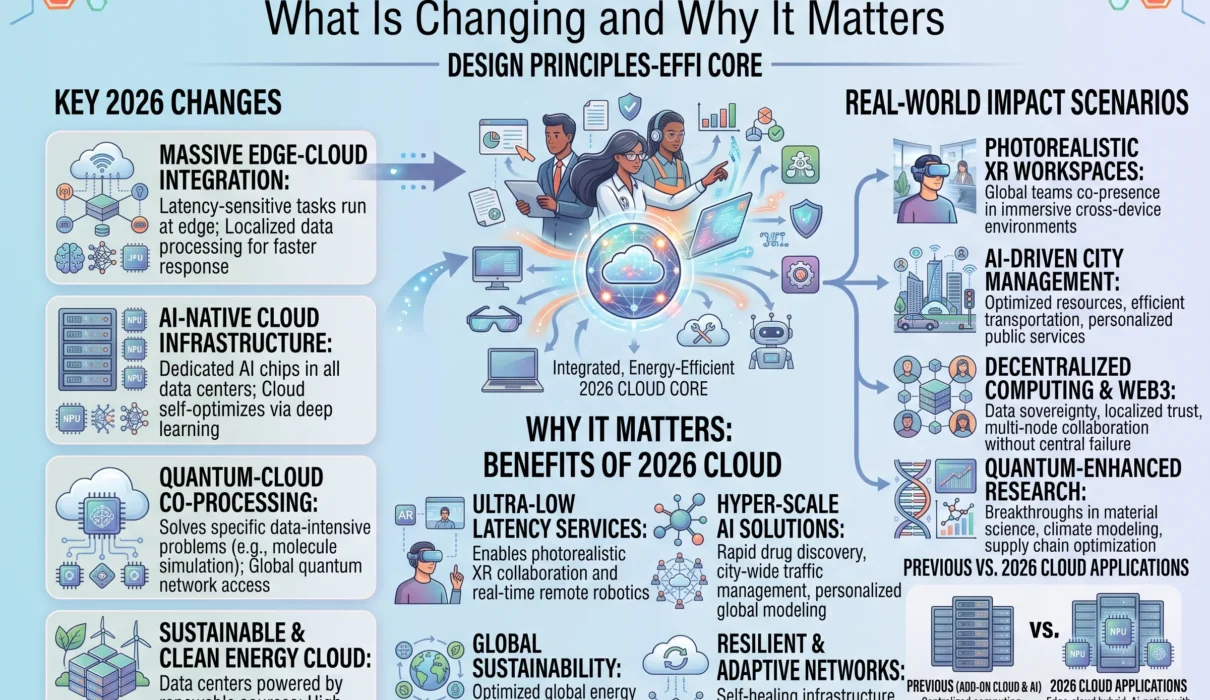
As a result, modern cloud technology is undergoing a profound structural restructuring. The cloud of 2026 is no longer just a centralized pool of virtualized servers. It has evolved into a distributed, heterogeneous, and energy-aware computing fabric—spanning gigawatt-scale AI supercomputing campuses, localized micro-edge nodes, multi-cloud management layers, and direct-to-chip liquid cooling systems.
Understanding the dynamics of this transformation across cloud platforms, AI infrastructure, edge topologies, and data centers is essential for technical architects, engineering leaders, and enterprise strategists navigating the modern compute landscape.
THE EVOLUTION OF CLOUD ARCHITECTURE

Classic Cloud Era (2010–2022):
┌────────────────────────────────────────────────────────┐
│ Centralized Hyperscaler Data Centers                   │
│ • Homogeneous x86 CPU Virtual Machines                │
│ • Air-Cooled 5kW–15kW Server Racks                     │
│ • Abstracted Centralized Storage (S3, EBS)             │
│ • Latency-tolerant Web, Mobile, and SaaS Microservices │
└────────────────────────────────────────────────────────┘
                           │
                           ▼
Cloud Computing in 2026:
┌────────────────────────────────────────────────────────────────────────┐
│ Heterogeneous, Distributed, & Energy-Bound Computing Fabric            │
├────────────────────┬────────────────────┬──────────────────────────────┤
│ GIGAWATT AI HUBS   │ HYBRID / MULTI-    │ EDGE COMPUTING NODES         │
│ • High-density     │ CLOUD MESH         │ • Sub-10ms localized         │
│   liquid cooling   │ • Unified FinOps   │   inference runtimes         │
│ • Dedicated SMR /  │ • Dynamic workload │ • 5G-Advanced & Wi-Fi 7      │
│   nuclear power    │   orchestration    │ • Factory & city sensors     │
│ • HBM3e / HBM4     │ • Sovereignty &    │ • Localized zero-copy data   │
│   tensor clusters  │   GDDR compliance  │   aggregation                │
└────────────────────┴────────────────────┴──────────────────────────────┘
1. The AI Infrastructure Shockwave: Re-Architecting the Cloud
The most disruptive catalyst transforming cloud services is the sheer physical scale of artificial intelligence. Where standard web enterprise workloads scale horizontally across thousands of low-power CPU cores, AI workloads require massive, tightly synchronized arrays of accelerators performing parallel linear algebra.
In 2026, AI is no longer a peripheral software feature hosted on shared cloud instances; it is the primary workload reshaping physical data centers.
The Shift from Training Clusters to Inference Pipelines
While the initial generative AI boom focused on training frontier foundational models, inference now accounts for roughly 80% to 90% of total enterprise compute consumption in 2026.
This shift alters hardware requirements:
- Training demands massive, tightly coupled GPU/TPU clusters sharing unified memory over high-bandwidth fabrics for weeks at a time.
- Inference requires continuous, predictable, low-latency execution distributed geographically close to end users.
To support sustained inference loads, hyperscalers are deploying specialized inference accelerators (such as custom ASICs like Google TPUs, AWS Inferentia, and Microsoft Maia) alongside merchant GPUs. These chips are optimized for low-bit integer operations (INT8, INT4, and FP8), delivering higher throughput per watt and protecting cloud operators from escalating power bills.
                     THE AI WORKLOAD TRANSITION IN 2026

  2023–2024 Baseline:                      2026 Production Reality:
  ┌──────────────────────────────────┐     ┌──────────────────────────────────┐
  │ Training Workloads Dominant      │     │ Sustained Inference Dominant     │
  │ • Periodic, burst-compute clusters│    │ • Continuous, global 24/7 draw   │
  │ • Mega-cluster synchronization   │ ──► │ • Distributed edge-cloud routing │
  │ • Focus: Raw PetaFLOPS throughput│     │ • Focus: Cost/Token & Tokens/Watt│
  └──────────────────────────────────┘     └──────────────────────────────────┘
Ultra-High Bandwidth Networking Fabrics
In an AI supercomputer, computing capacity is throttled by network interconnect speeds. If thousands of accelerators must sync gradient updates or share activation states, a standard enterprise network switch creates severe latency bottlenecks.
Modern AI cloud infrastructure operates on lossless, ultra-high-speed network fabrics:
- Standardizing on 800 Gbps and 1.6 Tbps optical transceivers inside the data center rack.
- Universal adoption of Remote Direct Memory Access (RDMA) protocols—specifically InfiniBand and RoCEv2 (RDMA over Converged Ethernet). These protocols bypass host CPUs and operating system networking stacks entirely, allowing GPUs in different server chassis to read and write directly to each other’s memory buffers with sub-microsecond latency.
2. The Physical Crisis: Power Grids, SMRs, and Direct Liquid Cooling
For decades, software engineers designed cloud systems without considering municipal utility grids. In 2026, power availability is the single greatest bottleneck limiting cloud expansion.
According to industry projections, global data center electricity consumption has surged past 1,000 terawatt-hours (TWh). A modern enterprise data center campus no longer requires 30 to 50 megawatts (MW); hyperscale AI campuses now demand between 200 MW and 1 gigawatt (GW) of dedicated electrical capacity—equivalent to the power consumed by hundreds of thousands of residential homes.
                      DATA CENTER ENERGY SOURCING IN 2026

  Municipal Utility Grid ──(Capacity Deficit / Transmission Delays)──► Hard Grid Cap
                                                                            │
  NEW INFRASTRUCTURE STRATEGY: "BRING YOUR OWN POWER (BYOP)"               │
  ┌─────────────────────────────────────────────────────────────────────────┴┐
  │ Hyperscaler Co-Located Generation Assets                                 │
  ├────────────────────────────────────┬────────────────────────────────────┤
  │ Small Modular Reactors (SMRs)      │ Utility-Scale Solar + Battery BESS │
  │ • 50MW–300MW dedicated nuclear     │ • Hundreds of MW daytime capture   │
  │ • Zero-carbon baseload electricity │ • 4–8 hour grid stabilization      │
  ├────────────────────────────────────┼────────────────────────────────────┤
  │ Behind-the-Meter Natural Gas       │ Advanced Geothermal Energy         │
  │ • Rapid 18-month deployment bridge │ • Next-gen horizontal drilling     │
  │ • Paired with carbon offset quotas │ • Consistent 24/7 clean baseload   │
  └────────────────────────────────────┴────────────────────────────────────┘
The Transition to Small Modular Reactors (SMRs) and Clean Baseload
Because traditional electrical utilities often require five to ten years to construct transmission lines and approve grid interconnections, hyperscale cloud providers have entered the energy sector directly.
Cloud giants are executing long-term power purchase agreements (PPAs) with nuclear power plants, restarting dormant reactors, and funding the commercialization of Small Modular Reactors (SMRs). SMRs offer factory-fabricated, modular nuclear power generating 50 to 300 MW per unit. By placing SMRs and dedicated microgrids “behind the meter,” data center operators secure clean, continuous, 24/7 electrical baseloads insulated from public grid volatility.
The End of Air Cooling: Direct-to-Chip and Immersion Systems
For thirty years, data centers were cooled by circulating chilled air across server aisles. This method worked when server racks drew 5 to 15 kW of power.
Modern AI racks—such as high-density GPU nodes—draw between 40 kW and 140 kW+ per rack, with emerging next-generation architectures approaching 300 kW. Air lacks the thermal capacity to dissipate this heat density; moving enough air would require fans spinning so fast they would consume prohibitive amounts of electricity and damage delicate electronics through physical vibration.
COOLING METHOD EFFICIENCY vs. DENSITY

Traditional Air Cooling:
[Chilled Air Circulation] ──► Up to 15–20 kW / rack (PUE: 1.3 – 1.6)
* Physically incapable of cooling modern high-density AI silicon.

Direct Liquid Cooling (DLC):
[Direct-to-Chip Cold Plates] ──► 40 to 150 kW / rack (PUE: 1.03 – 1.10)
* Closed-loop fluid circuits pull heat straight from GPU/CPU heat spreaders.

Immersion Cooling:
[Dielectric Fluid Bath] ──► 100 to 200+ kW / rack (PUE: 1.02 – 1.05)
* Entire chassis submerged in non-conductive fluid; maximum thermal density.
In 2026, liquid cooling has moved from an exotic, high-performance computing niche to an absolute operational requirement for new cloud data centers.
Facilities are deploying Direct-to-Chip Liquid Cooling (DLC), where closed-loop dielectric fluids or treated water circulate through micro-channeled copper cold plates bolted directly to the processor silicon.
This transition has driven Power Usage Effectiveness (PUE) down to near-unity levels (1.03–1.1), slashing cooling energy overhead by up to 30% and enabling waste-heat recycling into regional district heating systems.
3. Hybrid and Multi-Cloud in 2026: Pragmatism Over Dogma
In the late 2010s, industry analysts predicted that all enterprise IT would eventually migrate into public clouds. That monolithic vision has been replaced by pragmatic architectural realism.
In 2026, hybrid cloud and multi-cloud strategies are the universal enterprise standard, utilized by nearly 90% of large organizations.
┌────────────────────────────────────────────────────────────────────────┐
│                   THE ENTERPRISE HYBRID TOPOLOGY                       │
├─────────────────────┬────────────────────┬─────────────────────────────┤
│ Deployment Layer    │ Primary Workloads  │ Strategic Justification     │
├─────────────────────┼────────────────────┼─────────────────────────────┤
│ Dedicated On-Prem / │ Core financial     │ Strict regulatory data      │
│ Private Cloud       │ ledgers, static    │ sovereignty, predictable    │
│                     │ enterprise databases│ baseline cost control      │
├─────────────────────┼────────────────────┼─────────────────────────────┤
│ Primary Hyperscaler │ Global consumer web│ Dynamic auto-scaling,       │
│ (AWS / Azure / GCP) │ apps, microservices│ global CDN distribution,    │
│                     │ and managed APIs   │ developer productivity      │
├─────────────────────┼────────────────────┼─────────────────────────────┤
│ Secondary AI Cloud  │ Heavy batch model  │ Specialized GPU pricing,    │
│ (Specialized Cloud) │ training, fine-    │ capacity redundancy,        │
│                     │ tuning, and evals  │ avoiding vendor lock-in     │
├─────────────────────┼────────────────────┼─────────────────────────────┤
│ Local Edge Nodes    │ Sub-10ms inference,│ Bandwidth optimization,     │
│                     │ video segmentation │ offline resilience          │
└─────────────────────┴────────────────────┴─────────────────────────────┘
Enterprises have matured beyond single-vendor lock-in. Several key factors drive this hybrid posture:
1. Cloud Repatriation and FinOps Governance
As cloud bills expanded into primary corporate operating expenses, the practice of Cloud FinOps (Financial Operations) evolved from basic tagging to automated cost engineering.
Organizations realized that running predictable, high-volume, static database workloads in public clouds incurs a steep financial premium. In 2026, companies practice strategic workload repatriation: moving steady-state foundational workloads onto modern, owned on-premises colocation hardware, while keeping bursty, user-facing, and experimental applications in public clouds.
2. Multi-Cloud Workload Portability
Using a single cloud provider creates operational vulnerabilities: regional outages, sudden API price hikes, and proprietary architectural lock-in.
Modern engineering stacks prioritize portability:
- Containerization and orchestration layers (Kubernetes, OpenShift) operate uniformly across cloud boundaries.
- Cross-cloud service meshes abstract provider-specific networking rules.
- Dynamic traffic managers route requests between AWS, Azure, GCP, and specialized GPU clouds based on real-time spot pricing, regional latency, and spot instance availability.
3. Data Sovereignty and Regulatory Balkanization
Global data privacy frameworks (such as the EU AI Act, GDPR, and sovereign cloud mandates in the Middle East and Asia-Pacific) prohibit personal telemetry and algorithmic processing from leaving regional borders.
Cloud providers have responded by deploying sovereign cloud regions—physically isolated infrastructure operated exclusively by local entities, guaranteeing that data storage, encryption keys, and computational inference comply with jurisdictional statutes.
4. Edge Computing: Decentralizing the Cloud Perimeter
As centralized data centers grapple with power constraints and physical transit latency, computing power is moving rapidly toward the network perimeter. Edge computing has emerged as the essential counterbalance to centralized hyperscalers.
                     THE LATENCY & BANDWIDTH EQUATION

  [Factory Sensor / Camera] ──(1,500 miles)──► Centralized Cloud Datacenter
  Latency: 80ms – 250ms | Incurs heavy bandwidth egress fees | Network drop = System Stop

  [Factory Sensor / Camera] ──(50 feet)────► On-Site Micro-Edge Gateway
  Latency: Sub-5ms | Zero outbound bandwidth fees | 100% Operational Offline
The cloud cannot process everything. When an autonomous mobile robot navigates a manufacturing floor, a camera scans an assembly line for microscopic defects, or an autonomous vehicle makes a collision-avoidance maneuver, transmitting gigabytes of raw sensor data across the public internet introduces unacceptable latency.
The Symbiosis of Cloud and Edge
Edge computing does not replace the cloud; it completes it. The two topologies operate in a continuous hybrid feedback loop:
- Local Edge Execution (Millisecond Scale): Edge gateways and micro-data centers situated inside factories, retail hubs, cell towers, and hospital wards process raw sensory data locally. They run lightweight, quantized AI models to make instant operational decisions (e.g., stopping an industrial lathe or flagging an anomalous EKG reading).
- Metadata Aggregation: Instead of streaming raw 4K video feeds or terabytes of sensor noise to the cloud, edge nodes extract structured metadata—summaries, anomaly reports, and error timestamps—reducing network bandwidth demands by over 90%.
- Centralized Cloud Optimization: The hyperscaler cloud ingests this curated metadata across millions of edge devices, aggregating telemetry to train larger foundation models, evaluate business trends, and push updated weights back to the edge.
Supported by the commercial rollout of 5G-Advanced and Wi-Fi 7, edge devices can establish deterministic, sub-10 millisecond wireless connections to local micro-edge servers, making physical environments responsive to digital computing.
5. Next-Generation Cloud Platforms: From Virtual Machines to Autonomous Agents
The software abstraction layers running on cloud infrastructure have undergone a generational shift.
               THE EVOLUTION OF CLOUD DEPLOYMENT PRIMITIVES

  Phase 1: Hardware Virtualization (2006–2014)
  [Hypervisors] ──► Virtual Machines (EC2, Droplets) ──► Heavy Guest OS overhead

  Phase 2: Containerization & Microservices (2015–2022)
  [Docker / Kubernetes] ──► Shared OS Kernels ──► 100ms startup times

  Phase 3: WebAssembly & Ephemeral Micro-VMs (2023–Present)
  [Wasm / Firecracker] ──► Sub-millisecond spin-up ──► True Zero-Idle Compute

  Phase 4: Agentic Orchestration Mesh (2026 Production Standard)
  [Dynamic Intent] ──► Multi-Agent Task Routing ──► Automated Tool Sandboxing
For decades, the basic unit of cloud computing progressed from physical boxes to Virtual Machines (VMs), and from VMs to containers. In 2026, the unit of execution is evolving into ephemeral WebAssembly runtimes and autonomous multi-agent meshes.
WebAssembly (Wasm) and Sub-Millisecond Cold Starts
While containers (Docker) solved portability, they still carry operating system overhead. A container image can measure hundreds of megabytes and require hundreds of milliseconds to spin up in serverless environments.
Modern cloud platforms use WebAssembly (Wasm) alongside lightweight virtualization technologies like AWS Firecracker:
- Wasm binaries compile code into compact, sandboxed bytecodes that spin up in under 5 milliseconds.
- Compute engines can instantiate a sandboxed runtime, execute a user-requested micro-task (like running an AI tool call or transforming an API payload), and terminate the environment instantly—enabling genuine, down-to-the-millisecond billing models without idle memory waste.
Agentic Cloud Infrastructure
Cloud platforms in 2026 do not merely host code; they manage the operational coordination of autonomous AI agents.
Modern platforms provide native cloud primitives for:
- Agent State Persistence: Long-term memory stores that track intermediate reasoning states across multi-day autonomous workflows.
- Secure Tool Registries: Controlled, sandboxed micro-containers where agents can execute arbitrary generated code, call authenticated third-party APIs, and query internal databases without risking host network security.
- Deterministic Guardrails: Native infrastructure firewalls that inspect agent outputs for prompt injections, hallucinated configurations, and data leakage before database writes are committed.
6. Cybersecurity in 2026: Zero Trust and the Post-Quantum Horizon
The migration to distributed, hybrid, and AI-driven cloud environments has dissolved the traditional corporate network perimeter.
In 2026, securing cloud technology requires navigating two distinct threats: the vulnerabilities of agentic software systems and the impending cryptographic disruption of quantum computing.
                      MODERN CLOUD DEFENSE ARCHITECTURES

     Identity-Centric Zero Trust                 Post-Quantum Cryptography (PQC)
    ┌───────────────────────────┐               ┌───────────────────────────────┐
    │ Every microservice, user, │               │ Upgrading TLS, SSH, and VPN   │
    │ and autonomous agent must │ ────────────► │ handshakes to lattice-based   │
    │ verify identity, context, │               │ algorithms (ML-KEM / ML-DSA)  │
    │ and ephemeral permissions.│               │ to counter "Store Now,        │
    └───────────────────────────┘               │ Decrypt Later" operations.    │
                                                └───────────────────────────────┘
Identity as the Modern Perimeter
When applications are scattered across multi-cloud regions, on-premises racks, and edge gateways, physical IP boundaries are irrelevant. Modern cloud security relies on Identity-First Zero Trust:
- Trust is never granted implicitly based on physical or network location.
- Every transaction, API call, and container spin-up requires mutual TLS (mTLS) authentication and fine-grained, short-lived OAuth credentials.
- Autonomous Agent Governance: AI agents acting on behalf of employees are assigned strictly scoped, ephemeral identity tokens that prevent privilege escalation and contain automated actions to pre-approved data zones.
The Post-Quantum Cryptography (PQC) Transition
The computing industry has initiated one of the largest cryptographic upgrades in history. While fault-tolerant quantum computers capable of breaking RSA-2048 and Elliptic Curve Cryptography (ECC) remain on the horizon, malicious actors actively engage in “Store Now, Decrypt Later” attacks—harvesting encrypted enterprise cloud communications today to decrypt them once quantum systems arrive.
Major cloud providers have begun standardizing on Post-Quantum Cryptography (PQC):
- Migrating public cloud load balancers, virtual private clouds (VPCs), and managed database endpoints to NIST-standardized lattice-based algorithms (such as ML-KEM for key encapsulation and ML-DSA for digital signatures).
- Implementing hybrid classical-quantum cryptographic tunnels to maintain legacy compliance while protecting long-term enterprise assets from quantum decryption.
7. Comparative Strategic Matrix: The 2026 Cloud Ecosystem
Navigating modern cloud infrastructure requires understanding the trade-offs across different deployment models:
| Metric | Centralized Hyperscale Cloud | Specialized AI / GPU Cloud | Hybrid / Private Colocation | Distributed Edge Computing |
| Primary Use Case | Web applications, SaaS, global data lakes, APIs | Large-scale AI training, high-volume batch inference | Regulatory compliance, steady-state core databases | Real-time robotics, computer vision, local sensor analytics |
| Typical Latency | 30ms to 120ms+ | 50ms to 200ms+ (Batch oriented) | 10ms to 40ms | Sub-5ms to 15ms |
| Energy & Cooling | Transitioning to liquid; SMRs and clean baseload | High-density direct liquid cooling standard (100kW+/rack) | Air and hybrid retrofits; power-constrained | Low-power passive/chassis; milliwatt to kilowatt scale |
| Cost Profile | Pay-as-you-go elastic; premium on steady compute | Hourly compute-leasing; lower cost-per-token | High upfront CapEx; lowest long-term steady-state OpEx | Mixed CapEx/OpEx; optimizes network egress savings |
| Data Privacy | Shared multi-tenant; sovereign cloud regions available | Multi-tenant sandboxed; ephemeral storage | Highest isolation; complete hardware physical control | High physical locality; raw data never traverses internet |
8. Strategic Blueprint: How Organizations Must Adapt in 2026
To avoid runaway infrastructure bills, operational instability, and vendor lock-in, organizations must rethink their technical architectures for this new cloud reality.
┌────────────────────────────────────────────────────────────────────────┐
│                   ENTERPRISE CLOUD ROADMAP FOR 2026                    │
├─────────────────────┬──────────────────────────────────────────────────┤
│ Architectural Focus │ Immediate Tactical Execution                     │
├─────────────────────┼──────────────────────────────────────────────────┤
│ Workload Placement  │ Audit applications; migrate predictable baseline │
│ Optimization        │ workloads to owned/colocated hybrid servers;     │
│                     │ keep dynamic, bursty workloads in public cloud.  │
├─────────────────────┼──────────────────────────────────────────────────┤
│ AI Infrastructure   │ Transition production inference from high-cost   │
│ Cost Engineering    │ frontier GPUs to specialized low-bit ASICs,      │
│                     │ quantized SLMs, and local edge runtimes.         │
├─────────────────────┼──────────────────────────────────────────────────┤
│ Edge-Cloud Hybrid   │ Deploy micro-edge gateways to process raw media  │
│ Integration         │ and high-frequency telemetry on-site, routing    │
│                     │ only structured metadata to the central cloud.   │
├─────────────────────┼──────────────────────────────────────────────────┤
│ Cryptographic &     │ Audit enterprise TLS, SSH, and data stores;      │
│ Zero-Trust Security │ implement NIST-standard Post-Quantum algorithms  │
│                     │ and strict scoped identity controls for agents.  │
└─────────────────────┴──────────────────────────────────────────────────┘
- Establish a Disciplined Workload Placement Strategy: The era of “cloud-first at all costs” is over. Implement workload placement discipline: profile application resource usage, separate steady-state baselines from variable workloads, and deploy each component where it is most operationally and financially viable.
- Optimize for Cost-per-Token and Tokens-per-Watt: Move beyond evaluating compute solely by CPU core counts or raw gigabytes of RAM. Establish real-time tracking for token economics, model inference latencies, and power consumption across all deployed generative capabilities.
- Decentralize Media and Sensor Processing: Stop piping raw, high-bandwidth data streams across external networks to the central cloud. Invest in edge computing gateways capable of performing local filtering, inference, and semantic summarization at the point of data capture.
- Transition to Post-Quantum and Identity-Centric Security: Begin upgrading infrastructure to support post-quantum cryptographic primitives. Ensure that every autonomous agent, microservice, and third-party connector operates under strict, short-lived, least-privilege identity credentials.
The Distributed Future of Compute
The narrative that defined the first generation of cloud computing—that all digital computation would disappear into an invisible, homogeneous utility—has evolved.
In 2026, cloud computing is grounded in physical realities. It is shaped by the thermodynamics of liquid cooling plates, the megawatts supplied by regional power grids, the speed of photons traveling through optical transceivers, and the necessity of processing real-world data at the edge.
The organizations that thrive in this era will not be those that treat the cloud as a distant, boundless server room. Success belongs to the architects who master the entire computing continuum: orchestrating workloads across hyperscale AI clusters, localized edge nodes, sovereign enterprise enclaves, and specialized silicon.
The cloud has not diminished in importance—it has broken out of the data center and expanded into the world around us.
