


 By
By For nearly three decades, the basic covenant between internet users and search engines remained unchanged: a user entered keywords into a box, and the search engine returned a ranked index of ten blue hyperlinks accompanied by short metadata snippets. Finding an answer was an active, manual effort. Users scanned page titles, opened multiple browser tabs, skimmed walls of text, dodged aggressive display advertisements, and synthesized disjointed information on their own.
That model has permanently broken down.
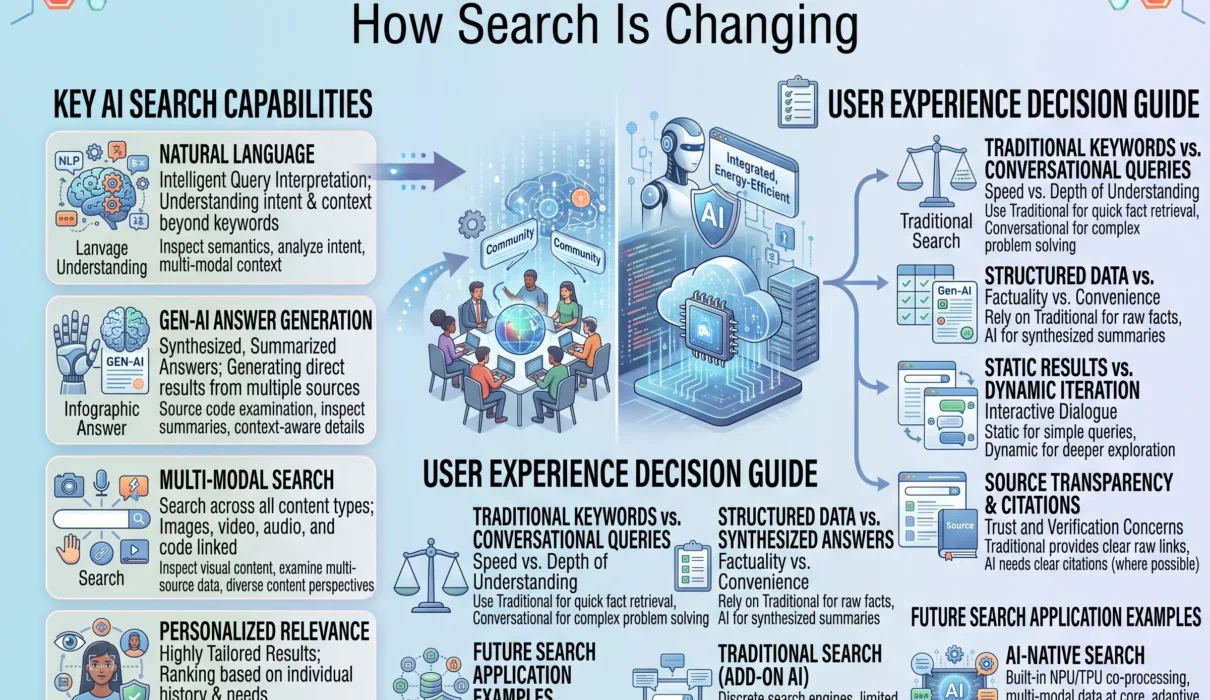
The rise of AI search engines represents the most radical rethinking of information discovery since the invention of the web crawler. Modern search is no longer an indexing directory that points you toward where an answer might live; it has become an answer engine that synthesizes information, evaluates conflicting perspectives, and presents actionable answers directly to the user.
Powered by natural language understanding, Retrieval-Augmented Generation (RAG), and real-time web retrieval, AI-powered search is dismantling traditional search engine optimization (SEO), upending zero-click dynamics, and transforming user behavior from keyword guessing into multi-turn conversational exploration.
1. What Are AI Search Engines? The Shift from Links to Answers
At its core, an AI search engine is an information retrieval system that combines the real-time crawling and indexing capabilities of traditional search with the synthesis, contextual reasoning, and natural language generation of Large Language Models (LLMs).
TRADITIONAL KEYWORD SEARCH vs. AI ANSWER ENGINE

Traditional Keyword Search:
[User Query] ──► [Inverted Index / PageRank] ──► [Ten Blue Links & Snippets]
                                                        │
                                                        └─ User opens 5 tabs, reads,
                                                           filters ads, and synthesizes.

AI Search Engine (RAG-Driven):
[Conversational Query] ──► [Semantic Intent & Retrieval] ──► [Reranker & Context Filter]
                                                                     │
                                                                     ▼
[Direct Natural Language Answer with Verified Citations] ◄── [LLM Synthesis Engine]
To understand why this shift matters, consider how traditional search engines contrast with modern conversational platforms:
| Operational Dimension | Traditional Search Engines (Google, Bing) | AI-Powered Search Engines (Perplexity, ChatGPT Search, Gemini) |
| Primary User Output | Ranked index of external URLs and sponsored ads | Direct, synthesized answers with embedded inline citations |
| Query Mechanism | Keyword fragmentation (“best laptop photo editing under 1500”) | Natural language intent (“I need an ultrabook under $1,500 that handles 4K video”) |
| Search Interaction | Isolated single-turn transactions | Multi-turn conversational dialogue with contextual memory |
| Information Processing | Extracted snippet matches keyword strings | Synthesized cross-source reconciliation of facts, pros, and cons |
| Click-Through Dynamic | Traffic directed outward to publisher websites | Informational answers resolved on-page (Zero-Click Default) |
| Monetization Engine | Pay-per-click (PPC) auctions and display ads | Hybrid subscription models, sponsored citation sources, and native commerce |
Where conventional search acts as a librarian pointing toward shelves in a library, an AI search engine reads the books, cross-references conflicting chapters, and delivers a concise executive briefing tailored to your specific constraints.
2. Under the Hood: How AI-Powered Search Works (The RAG Pipeline)
A common misconception is that AI search engines simply query an LLM’s internal memory. If an LLM answers purely from its static pre-trained weights, it hallucinates plausible-sounding falsehoods and has no knowledge of current events.
To deliver factual, up-to-date results, modern AI search systems rely on Retrieval-Augmented Generation (RAG) coupled with semantic vector search.
THE REAL-TIME RETRIEVAL-AUGMENTED GENERATION (RAG) PIPELINE

1. Query Expansion & Semantic Intent Parsing
   "Are heat pumps worth it in Maine winters?"
   ├── Deconstructs into sub-queries:
   │   ├── "heat pump minimum operating temperature HSPF2 ratings"
   │   ├── "Maine electricity rates vs heating oil costs 2026"
   │   └── "Efficiency Maine rebate qualification criteria"
   │
   ▼
2. Live Web Crawling & Multi-Index Retrieval
   Retrieves top 20–50 candidate HTML documents, news feeds, and PDFs
   │
   ▼
3. Chunking & Semantic Vector Re-Ranking
   Breaks content into passages; cross-encoder scores relevance against intent
   │
   ▼
4. Context Window Grounding & Multi-Source Synthesis
   Passes highest-scoring text chunks into LLM with strict grounding instructions
   │
   ▼
5. Output Generation with Deterministic Inline Citations
   Produces structured narrative with hyperlinked footnote anchors [1], [2], [3]
1. Query Expansion and Sub-Task Decomposition
When you submit an ambiguous or complex query to an AI search engine, the system rarely runs a single keyword lookup.
Instead, a query-transformation model analyzes the underlying intent and breaks the prompt into multiple focused sub-queries. A question like “Compare the total cost of ownership between an electric vehicle and a hybrid over five years for someone driving 15,000 miles annually” triggers parallel retrieval pipelines for current electricity tariffs, gas price averages, insurance benchmarks, and vehicle depreciation curves.
2. Semantic Retrieval and Dense Vector Embeddings
Traditional search relies heavily on inverted indexes and lexical matching algorithms like BM25—matching the specific words in your query to words on a page.
AI search engines map content into high-dimensional vector spaces using embedding models:
- Rather than looking for identical words, vector search identifies conceptual proximity.
- A query about “treating a persistent hacking dry cough” matches medical articles discussing “antitussive therapies for non-productive bronchitis”, even if the original search words never appear in the text.
3. Re-Ranking and Context Pruning
Retrieving fifty web pages yields tens of thousands of words—far too much noisy data to pass directly into a language model’s context window without risking factual degradation or high latency.
A specialized neural cross-encoder (re-ranker) evaluates individual text chunks, discarding sponsored fluff, navigation menus, and repetitive filler. It isolates the most informative, authoritative passages and passes them to the synthesis model.
4. Grounded Synthesis and Citation Mapping
The core reasoning model receives the curated source passages alongside strict system instructions: “Answer the user prompt using only the provided facts. For every factual assertion, append a numerical citation anchored directly to the exact source chunk.”
The model drafts a coherent response, inserting hyperlinked citation footnotes throughout the prose. If the retrieved documents do not contain the answer, the model is instructed to state that the information is unavailable rather than fabricating an answer.
3. Conversational Search: From Keywords to Multi-Turn Exploration
For decades, search was an exercise in linguistic compromise. Humans adapted their speech patterns to appease search algorithms, typing fragmented phrases like “flight baggage policy delta international economy” instead of asking natural questions.
Conversational search reverses this dynamic: the computer adapts to human communication.
CONVERSATIONAL SEARCH JOURNEY

Turn 1: Broad Initial Discovery
User: "What are the best lightweight hiking boots for wide feet?"
AI Engine: [Synthesizes top 4 options, highlighting wide toe boxes and Vibram soles with citations]

Turn 2: Contextual Constraint Layering
User: "Which of those are 100% waterproof and under $180?"
AI Engine: [Remembers prior 4 boots, filters out non-waterproof option and $210 option, compares remaining two]

Turn 3: Specific Local Intent
User: "Are there any retailers in downtown Denver that carry the first one in size 11?"
AI Engine: [Executes localized inventory check, returns store addresses and current stock status]
The Power of Stateful Context
Traditional search engines treat every search query as an isolated event. If you search for “best hybrid suvs” and then follow up with “do they qualify for federal tax credits?”, a traditional search engine often fails to connect the pronoun “they” to your previous query without explicit manual query manipulation.
AI search engines maintain conversational state:
- Pronoun Resolution & Anaphora: The engine understands what “it”, “they”, or “the second option” refers to based on conversational history.
- Progressive Constraint Filtering: Users can layer complex requirements step-by-step—filtering by budget, brand values, dietary restrictions, or geographic proximity—without retyping their foundational criteria.
- Clarifying Proactivity: When an inquiry is broad or ambiguous, modern AI search engines actively suggest logical follow-up questions, surface blind spots, or ask clarifying questions to narrow down intent before generating recommendations.
4. The Anatomy of AI-Generated Answers and Verified Citations
The defining visual and functional component of AI search engines is the synthesized answer block—exemplified by platforms like Perplexity AI, ChatGPT Search, and Google’s AI Overviews.
┌────────────────────────────────────────────────────────────────────────┐
│                   STRUCTURE OF AN AI-GENERATED ANSWER                  │
├────────────────────────────────────────────────────────────────────────┤
│ [DIRECT SUMMARY BLOCK]                                                 │
│ Direct, 2-3 sentence answer resolving the core query immediately.       │
│                                                                        │
│ [STRUCTURED SYNTHESIS & KEY COMPARISONS]                               │
│ • Key Takeaway A: Explains mechanism with footnote citation [1].       │
│ • Key Takeaway B: Reconciles conflicting expert studies [2][3].        │
│                                                                        │
│ ┌──────────────────────┬──────────────────────┬──────────────────────┐ │
│ │ Feature Comparison   │ Option X             │ Option Y             │ │
│ ├──────────────────────┼──────────────────────┼──────────────────────┤ │
│ │ Price & Value        │ $499 [1]             │ $650 [4]             │ │
│ │ Performance Rating   │ 92/100 [2]           │ 96/100 [3]           │ │
│ └──────────────────────┴──────────────────────┴──────────────────────┘ │
│                                                                        │
│ [CAROUSEL OF VERIFIED CITATIONS]                                       │
│ ┌───────────────┐ ┌───────────────┐ ┌───────────────┐ ┌──────────────┐ │
│ │ [1] NYT Wire   │ │ [2] RTINGS    │ │ [3] ConsumerRpt│ │ [4] TechRdr │ │
│ └───────────────┘ └───────────────┘ └───────────────┘ └──────────────┘ │
└────────────────────────────────────────────────────────────────────────┘
The Double Role of Citations
In an AI search engine, citations serve two distinct purposes:
- User Verification and Hallucination Auditing: Citations allow users to verify claims instantly. Clicking a footnote takes the user directly to the cited source passage, confirming that the model did not invent the statistic, quote, or recommendation.
- Attribution and Publisher Visibility: Citations represent the primary distribution mechanism for content creators in an AI-first web. Rather than winning traffic through keyword density, publishers earn visibility by providing high-authority, verifiable source material that AI retrieval pipelines select for synthesis.
Why Direct Answers Outperform Blue Links
Direct synthesis resolves a longstanding flaw of traditional search: synthesizing fragmented data.
If a consumer searches for “Can I take ibuprofen while taking amoxicillin?”, a traditional search engine provides links to various health portals, forums, and drug manufacturer pages. The user has to read through side effects, dosage warnings, and medical jargon across multiple sites to find a clear answer.
An AI search engine analyzes verified medical sources, synthesizes the consensus—noting that the two medications generally do not interact adversely, while highlighting specific contraindications for kidney conditions—and cites reputable clinical authorities directly.
The user gets an immediate, comprehensive answer in seconds rather than spending ten minutes parsing search results.
5. Changing User Behavior: The Rise of Zero-Click Search
The shift to direct answers is causing a massive change in how consumers interact with search engines: the rise of zero-click search.
                     THE ZERO-CLICK SEARCH REALITY

  Traditional Search Funnel:
  [Search Query] ──► [SERP with Links] ──► [Clicks to Website] ──► Consumes Site Content
                                                  ▲
                                                  └─ 50% to 60%+ Click-Through Rate

  AI-Driven Search Funnel:
  [Search Query] ──► [AI-Synthesized Answer] ──► Intent Resolved Instantly (Zero-Click)
                                                  │
                                                  └─ Only 5% to 15% click external links
The Data Behind the Zero-Click Shift
Industry analytics show that between 58% and 65% of all web searches now conclude without the user ever clicking an external website link. When Google AI Overviews or standalone conversational search tools answer a query, the click-through rate (CTR) to traditional organic listings below the summary drops significantly.
Users click through to source websites only under specific conditions:
- Deep Verifiable Research: When researching a high-stakes medical, legal, or major financial purchase, users click primary citations to audit the underlying data.
- Transactional Intent: When the user is ready to complete an action—buying a product, booking a hotel room, or downloading software.
- Entertainment & Personal Voice: Users seeking community perspectives, raw personal experiences, or long-form storytelling still seek out human-authored blogs, video essays, and vertical community forums like Reddit.
For simple informational queries (“What is the capital of Australia?”, “How to calculate compound interest formula”, “When does Daylight Saving Time begin?”), the era of clicking through to an ad-cluttered article to read a three-sentence answer is over.
6. The Death of Traditional SEO and the Rise of GEO
For a quarter of a century, digital marketing was governed by traditional Search Engine Optimization (SEO). Marketers reverse-engineered ranking signals: matching keywords in H1 tags, building backlinks, and formatting articles to satisfy search algorithms.
In the era of AI search engines, traditional SEO is giving way to Generative Engine Optimization (GEO) and Answer Engine Optimization (AEO).
TRADITIONAL SEO vs. GENERATIVE ENGINE OPTIMIZATION (GEO)

Traditional SEO Tactics:
[Target Keyword] ──► Keyword Density + H2 Scraping + Backlink Authority ──► Rank Position #1

Generative Engine Optimization (GEO):
[Direct Knowledge Extraction]
  ├── Structured Data & Semantic Schema (JSON-LD)
  ├── Information Gain: Unique original statistics, testing data, and direct quotes
  ├── High Semantic Density: Direct answers provided in the first 20% of text
  └── Entity Authority: Recognized as a primary source across diverse independent indexes
How to Optimize for AI Search Engines
Unlike traditional algorithms that evaluate link graphs and keyword matches, AI retrieval engines prioritize information density, factual extractability, and source authority.
┌────────────────────────────────────────────────────────────────────────┐
│                   THE GEO OPTIMIZATION BLUEPRINT                       │
├─────────────────────┬──────────────────────────────────────────────────┤
│ Optimization Pillar │ Tactical Execution Requirement                   │
├─────────────────────┼──────────────────────────────────────────────────┤
│ Information Gain    │ Publish proprietary survey data, primary         │
│ & Original Research │ research, lab test benchmarks, and expert quotes.│
│                     │ AI models ignore content that repeats common text.│
├─────────────────────┼──────────────────────────────────────────────────┤
│ Answer-First Content│ Place clear, 60–80 word direct answers           │
│ Architecture        │ immediately beneath descriptive H2 headers.      │
│                     │ Make definitions easily extractable for RAG.│
├─────────────────────┼──────────────────────────────────────────────────┤
│ Semantic Schema &   │ Implement deep Schema.org structured data        │
│ Entity Recognition  │ (TechArticle, Dataset, Product, FAQPage) to help │
│                     │ AI parsers understand facts without ambiguity.  │
├─────────────────────┼──────────────────────────────────────────────────┤
│ Multi-Platform      │ Build authority across external platforms:       │
│ Presence            │ Wikipedia, Reddit, LinkedIn, and tier-1 media.   │
│                     │ LLMs cross-reference entities across sources.    │
└─────────────────────┴──────────────────────────────────────────────────┘
- Maximize Information Gain: AI engines are designed to avoid redundancy. If your article simply rephrases what ten other websites already say, retrieval re-rankers drop it. Content must contain original data, proprietary research, unique expert commentary, or hands-on testing data to earn citations.
- Adopt the Answer-First Structure (Inverted Pyramid): Do not hide the core answer behind 800 words of background history. Provide a direct, factual 60-to-80-word answer in the first paragraph. Follow up with detailed context, comparative tables, and nuanced explanations.
- Optimize for Passage-Level Extraction: AI search engines retrieve chunked passages, not full URLs. Each section of an article should function as a self-contained, context-rich knowledge unit with clear nouns, explicit entity naming, and structured data tables.
7. The Landscape: Who Is Winning the AI Search War?
The AI search market is not a single platform; it is a competitive ecosystem spanning search incumbents, conversational assistants, and specialized research engines.
┌────────────────────────────────────────────────────────────────────────┐
│                   THE AI SEARCH ENGINE ECOSYSTEM                       │
├─────────────────────┬────────────────────┬─────────────────────────────┤
│ Platform Category   │ Key Players        │ Primary Market Advantage    │
├─────────────────────┼────────────────────┼─────────────────────────────┤
│ Search Incumbents   │ Google (AI Overviews &│ Massive global web index,   │
│                     │ AI Mode), Bing     │ existing distribution across│
│                     │ Copilot            │ billions of consumer devices│
├─────────────────────┼────────────────────┼─────────────────────────────┤
│ Specialized Answer  │ Perplexity AI,     │ Citation-first architecture,│
│ Engines             │ Genspark           │ deep research modes, zero ad│
│                     │                    │ clutter, and pro workflows  │
├─────────────────────┼────────────────────┼─────────────────────────────┤
│ Conversational AI   │ ChatGPT Search,    │ Massive conversational base,│
│ Platforms           │ Anthropic Claude,  │ multi-modal reasoning, and  │
│                     │ Google Gemini      │ agentic workflow execution  │
└─────────────────────┴────────────────────┴─────────────────────────────┘
1. Google (AI Overviews & AI Mode): The Defending Giant
Google still processes tens of billions of queries every week. Its strategy has focused on defending its search dominance by integrating AI Overviews directly into traditional search results.
- Strengths: Unrivaled web crawling infrastructure, real-time localized mapping and business directories, unmatched shopping graphs, and instant distribution across Android and Chrome.
- Weaknesses: Caught in the classic “Innovator’s Dilemma.” Answering queries with direct AI answers reduces clicks on sponsored search ads—the primary engine of parent company Alphabet’s corporate revenue.
2. Perplexity AI: The Citation-First Challenger
Perplexity pioneered modern conversational search, positioning itself as a clean alternative to ad-cluttered search pages.
- Strengths: Academic rigor, clear inline citations, transparent source filtering, specialized focus modes (searching exclusively academic papers, GitHub repositories, or Reddit), and interactive follow-up paths.
- Weaknesses: Smaller independent web index; relies on third-party search APIs and indexing pipelines to gather candidate documents before synthesis.
3. ChatGPT Search (OpenAI): The Interface Powerhouse
OpenAI expanded its massive conversational chatbot base into real-time web search.
- Strengths: Seamless conversational interface, strong contextual memory, and a massive user base that uses ChatGPT as their default browser homepage.
- Weaknesses: Variable citation visibility across answers; requires deliberate user navigation to transition between general creative tasks and web search retrieval.
8. Limitations, Controversies, and the Threat to Open Web Publishing
While AI search engines offer clear benefits for consumers, they introduce serious economic, ethical, and legal challenges for the digital publishing ecosystem.
                      THE OPEN-WEB PUBLISHING CRISIS

  Publishers spend capital creating original reporting, testing, and guides.
                                   │
                                   ▼
  AI search engines crawl and scrape that content without human traffic referrals.
                                   │
                                   ▼
  Zero-Click AI answers resolve user needs; publisher ad revenue and subscriptions decline.
                                   │
                                   ▼
  Publishers downsize or erect aggressive paywalls, starving the web of fresh data.
1. The Threat to the Web Publishing Business Model
For twenty-five years, the open web was funded by a simple trade: publishers made informative content accessible for free, search engines indexed it, users clicked through, and publishers monetized that attention via display advertising, affiliate links, or newsletter subscriptions.
AI search engines break this cycle. By scraping publisher content to synthesize answers directly on the search results page, they capture user attention while denying the publisher page views and ad impressions.
If creators and journalistic outlets cannot monetize their work, they face cutbacks or are forced to put content behind paywalls—starving future AI models of high-quality training and retrieval data.
2. Hallucinations and the “Illusion of Authority”
When a language model speaks with confidence, users often assume its answers are verified facts.
However, RAG systems can still experience hallucinations:
- Misattribution: Citing a reputable source for a claim that the source never actually made.
- Context Collisions: Combining two unrelated facts from different web pages to create a false, misleading conclusion.
- Sourcing Flawed Information: If the top-ranking web documents contain subtle factual errors or corporate PR spin, the AI model synthesizes that incorrect consensus without independent verification.
In high-stakes domains—such as legal counsel, medical diagnoses, and financial planning—relying blindly on an AI summary without checking the underlying primary sources introduces significant risk.
3. The Scraping and Copyright Legal Battleground
The legal status of AI search is being actively contested in global courts. Publishers have filed copyright infringement lawsuits against AI search companies, arguing that scraping copyrighted articles to build commercial answer engines without compensation violates fair use doctrines.
In response, AI companies are negotiating multi-million-dollar content licensing deals with major media groups, creating a tiered web where licensed authoritative sources are prioritized for citations while independent sites risk being left out.
9. The Future of Search: What Comes Next?
The evolution of search is far from complete. As AI models become faster, multimodal reasoning matures, and agentic architectures scale, the search experience will continue to evolve:
                    THE MULTI-DECADE SEARCH HORIZON

  1990s – 2010s: Directory & Retrieval Era
  "Find me pages that mention these exact keywords."

  Present Era: Synthesis & Answer Engine Era
  "Answer this specific question by synthesizing reliable sources."

  Future Era: Autonomous Agentic Execution Era
  "Plan, research, evaluate, book, and execute this multi-step goal."
1. Agentic Search: From Answering to Execution
The next frontier is agentic search. Future search engines will not stop at giving you an answer; they will execute multi-step workflows across the web on your behalf.
- Instead of merely showing you the best flight options, an agentic search engine will cross-reference your personal calendar, track real-time airline prices, authenticate your loyalty accounts, navigate seat selection maps, and present you with an itinerary ready for one-click payment.
2. Truly Multimodal Discovery
Search is expanding beyond typed text.
- Users can point their smartphone camera or smart glasses at a complex mechanical engine or a broken plumbing fixture and ask: “What valve is leaking, why is it vibrating, and how do I replace it?”
- The search engine will parse the live video feed, isolate the component, retrieve the manufacturer’s technical schematic, and project animated repair instructions directly across the user’s field of view in real time.
3. Hyper-Personalized Knowledge Graphs
Future search platforms will integrate with your personal data enclaves—securely indexing your emails, calendar commitments, document notes, and past research.
When you search for “Should I accept this consulting offer?”, the system will evaluate the contract compensation against your current salary, project your tax liability based on your geographic location, and cross-reference your personal financial goals without sending private data to public training sets.
The New Reality of Finding Information
The transformation of search engines is not an incremental update—it is an architectural reinvention of how humanity accesses knowledge.
The era of typing fragmented keywords into a blank input box and sifting through pages of blue links is fading into computing history. Modern discovery belongs to AI search engines: intelligent systems capable of parsing complex human intent, synthesizing disparate data across the web, citing authoritative sources, and presenting clear, structured answers in seconds.
For consumers, this evolution delivers unprecedented speed, clarity, and research productivity.
For publishers, businesses, and digital creators, it demands an immediate strategic pivot: discarding outdated keyword-stuffing tactics and embracing Generative Engine Optimization grounded in original research, deep factual authority, and structured data.
The search box is no longer just an index to the web. It has become an active, conversational partner—and the way we navigate the digital world will never be the same.
