


 By
By The Creative Paradigm Shift
The global creative landscape is experiencing its most seismic operational transition since the invention of desktop publishing in the late 1980s. When tools like Aldus PageMaker and Adobe Illustrator replaced manual drafting boards, wax paste-ups, and mechanical typography machines, skeptics warned that visual craft would diminish into generic sameness. Instead, digital design software drastically expanded human artistic expression, accelerated commercial output, and unlocked entirely new digital professions.
Today, AI design tools are driving a comparable revolution—at an exponentially faster pace.
Generative artificial intelligence has moved beyond crude diffusion experiments and chaotic prompt-based toys. It has matured into high-precision, production-grade AI design software capable of parsing brand guidelines, generating scalable vector layouts, engineering production-ready design systems, and generating personalized visual assets on demand.
For designers, agencies, and enterprise brands, this shift represents a fundamental realignment:
- The Old Paradigm: Execution-heavy, manual assembly where 70% of creative energy was consumed by mechanical production tasks—clipping masks, resizing banners, generating stock mockups, and manually populating data fields.
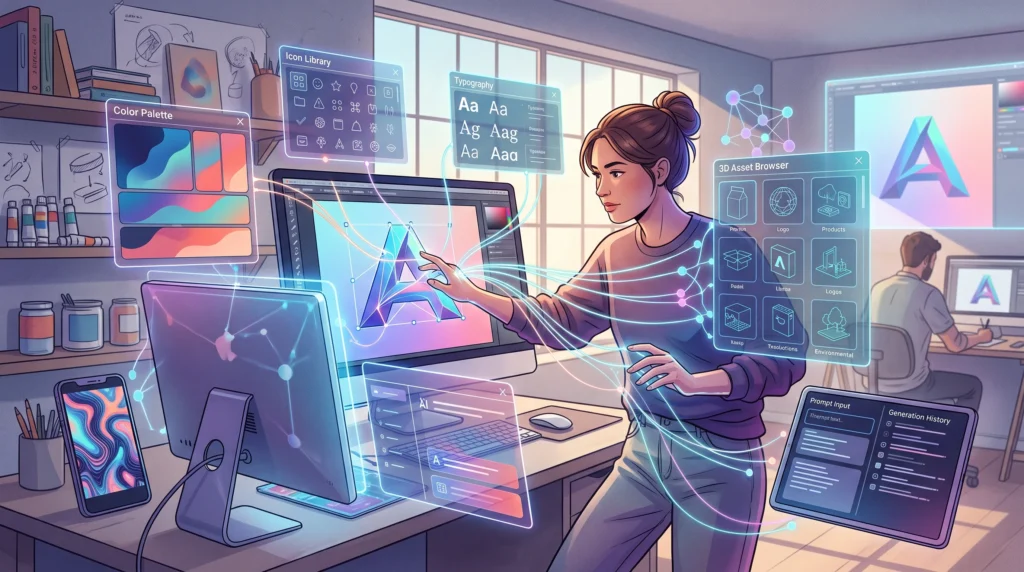
- The Modern AI Paradigm: Direction-heavy, iterative curation where human creatives act as creative directors, orchestrating neural pipelines, defining conceptual parameters, and leveraging generative design engines to explore hundreds of viable creative directions in minutes.
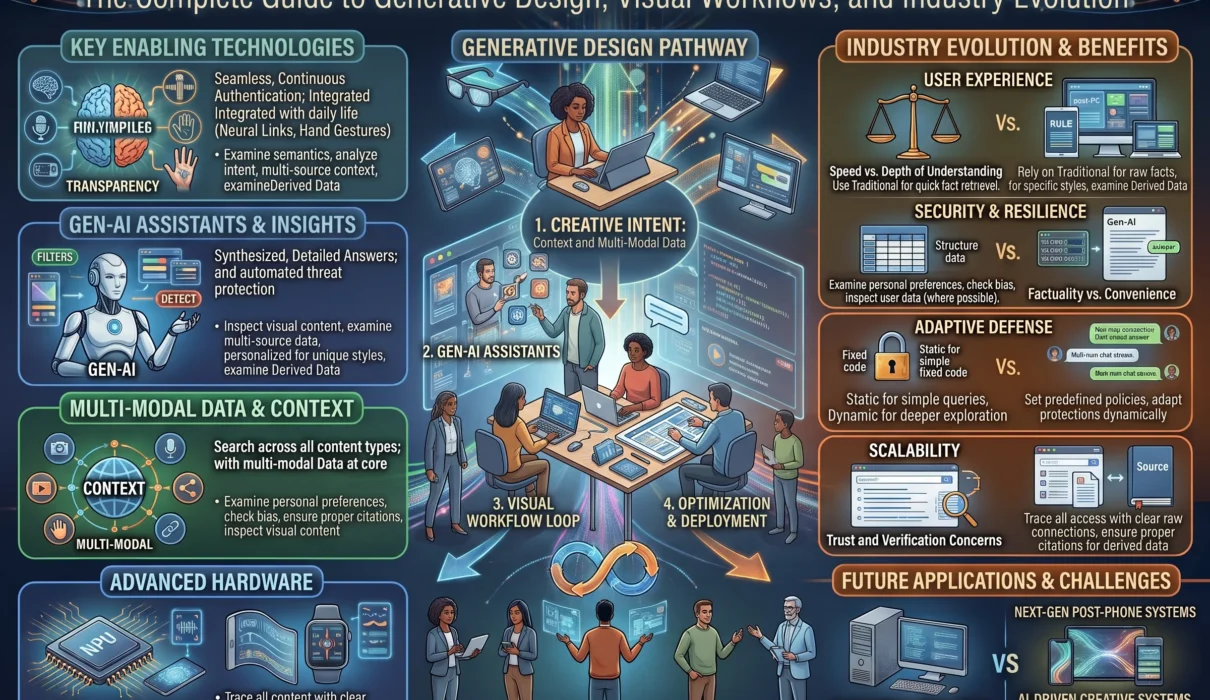
This comprehensive guide unpacks how AI graphic design tools are transforming five core disciplines: Generative Imagery, Automated Layouts, Brand Identity Systems, Intelligent Presentations, and End-to-End Creative Workflows.
1. Deconstructing Generative Design: How AI Design Tools Actually Function
To strategically deploy modern creative AI, one must first demystify the underlying technical architecture. The term “generative design” historically referred to algorithmic, rule-based parametric systems used in architecture and industrial engineering. In the modern era of AI design tools, it represents the convergence of deep learning architectures trained on billions of visual and linguistic parameters.
                  THE MODERN AI DESIGN ARCHITECTURE
  ┌────────────────────────────────────────────────────────┐
  │ 1. Diffusion Models (Latent Diffusion, Flow Matching)   │
  │    • Converts gaussian noise into photorealistic assets│
  │    • Guided by textual embeddings and cross-attention  │
  ├────────────────────────────────────────────────────────┤
  │ 2. Multimodal LLMs & Vision-Language Models (VLMs)     │
  │    • Interprets spatial composition, UX hierarchy, copy│
  │    • Translates plain text into structured layout code │
  ├────────────────────────────────────────────────────────┤
  │ 3. Structural Conditioning (ControlNet, IP-Adapters)   │
  │    • Enforces strict spatial wireframes, depth maps,   │
  │      edge detection (Canny), and character consistency │
  ├────────────────────────────────────────────────────────┤
  │ 4. Vector & Latent Canvas Engines                      │
  │    • Converts raster neural outputs into scalable SVGs,│
  │      Figma auto-layout components, and DOM elements    │
  └────────────────────────────────────────────────────────┘
From Stochastic Text-to-Image to Controllable Creative Pipelines
Early iterations of diffusion models were notoriously unpredictable. A designer prompting for an editorial photo of a perfume bottle had little control over camera angles, shadow falloff, or typographic placement.
Modern AI design software overcomes this through multi-tiered conditioning:
- Spatial Control (ControlNet & Line-Art Guidance): Rather than relying solely on text descriptions, designers input rough black-and-white wireframes, depth maps, or pose skeletons. The neural network generates visual textures strictly constrained within the artist’s predefined geometric boundaries.
- Style Reference & Identity Adapters (IP-Adapters & LoRAs): Designers can train lightweight Low-Rank Adaptation (LoRA) models or inject reference image vectors into the model’s latent cross-attention layers. This guarantees that every generated image strictly matches an established brand palette, lighting style, and art direction.
- Latent Inpainting and Outpainting: Instead of regenerating whole scenes, artists mask specific rectangular regions to modify micro-elements—such as swapping a model’s jacket, altering lighting reflections on glassware, or expanding an aspect ratio from 1:1 to 16:9 for a hero banner without altering the primary subject.
2. Generative Imagery: Beyond Stock Photography and Manual Illustration
Commercial design has always faced a persistent bottleneck: visual asset production. Creative teams traditionally relied on two compromises:
- Scouring stock photography marketplaces for generic, overused stock assets that diluted brand distinctiveness.
- Committing massive budgets and weeks of lead time to physical studio photoshoots and 3D rendering pipelines.
Generative image engines inside modern AI design tools eliminate this friction by turning visual ideation into a dynamic, real-time creative loop.
Traditional Asset Pipeline:
Brief ──► Stock Research ──► Licensing ──► Photoshop Retouching ──► Final Asset
(Duration: 3–7 business days | High cost | Low originality)

AI-Augmented Asset Pipeline:
Brief ──► Spatial Wireframe ──► Brand LoRA Engine ──► Inpainting / Upscale ──► Asset
(Duration: 20–45 minutes | Low marginal cost | 100% bespoke)
Key Breakthroughs in Commercial Image Generation
A. Precise Typography and In-Image Text Rendering
One of the historical limitations of generative image models was their inability to produce legible text, often yielding unreadable glyphs. Modern models (such as Imagen 3, Midjourney v6, and FLUX) integrate advanced visual-language tokenizers capable of rendering sharp, stylistically integrated headlines, packaging labels, and signage directly onto 3D surfaces with accurate perspective distortion and ambient occlusion.
B. Camera, Lighting, and Lens Parameters
Designers can now define optical physics parameters within natural-language prompts or slider interfaces:
- Focal Length & Aperture: Specifying an
85mm f/1.4 lensproduces creamy bokeh for executive portraits, while24mm tilt-shiftcreates expansive architectural visualizations. - Lighting Schemas: Prompting for “diffused softbox rim lighting with 4500K warm fill” directs the neural diffusion process to simulate studio lighting environments, eliminating post-production relighting hurdles.
C. Hyper-Targeted Commercial Retouching
Tools integrated into standard platforms (like Adobe Photoshop’s Generative Fill powered by Adobe Firefly) enable non-destructive commercial compositing:
- Background Expansion: Extending a vertical editorial photograph into an ultra-wide panoramic billboard while maintaining perspective geometry.
- Object Replacement: Removing unwanted background clutter or swapping seasonal wardrobe elements across international advertising campaigns without tedious manual clone-stamping.
3. Dynamic Layouts & Automated UI/UX: Algorithmic Composition
While image generation captures public attention, the most transformative business impact of AI design tools occurs within layout generation, responsive typography, and interface design.
Designing responsive user interfaces or complex multi-page editorial publications requires rigorous spatial math, visual hierarchy calibration, and compliance with layout grids. AI layout generators convert abstract design constraints into functional, adaptive interfaces.
                   THE AI-DRIVEN LAYOUT LIFECYCLE
                                  │
     ┌────────────────────────────┼────────────────────────────┐
     ▼                            ▼                            ▼
Component Synthesis         Responsive Refactoring       Content Population
AI scans brand tokens       Layout models analyze        Dynamic engines swap
and generates modular       screen breakpoints,          real-world contextual
cards, navigation bars,     automatically rearranging    copy and localized
and content blocks.         elements to preserve intent. imagery on the fly.
The Transition from Static Artboards to Semantic Layouts
Modern UI tools like Figma, Galileo AI, and v0 by Vercel use Multimodal Large Language Models (MLLMs) that understand the semantic structure of web interfaces. Rather than outputting flat pixel mockups, these tools generate living code:
- Natural Language to Component Trees: A designer can prompt:“Generate a responsive SaaS analytics dashboard showing churn rate, daily active users, an expandable data table with sortable columns, and a clean modern aesthetic using our design system’s tokens.”The AI tool does not merely paint an image; it constructs a hierarchical DOM tree with native CSS Grid, Flexbox auto-layouts, semantic typography hierarchies, and accessible contrast ratios.
- Automated Design Token Adaptation: If the user updates the master color variable from navy blue to electric violet, an AI engine assesses every dependent layout element, automatically recalculating background-to-text contrast ratios to guarantee WCAG AA accessibility compliance without manual spot-checking.
- Synthetic User Flow Simulation: Emerging generative UX software can simulate thousands of synthetic user personas navigating a proposed wireframe, flagging layout bottlenecks, confusing visual hierarchies, and dead-end conversion funnels before a single line of backend production code is deployed.
4. AI in Brand Identity and Design Systems: Maintaining Consistency at Scale
For corporate enterprises, the biggest threat posed by unmanaged AI adoption is brand dilution. When decentralized marketing teams create marketing collateral using consumer-grade AI tools without governance, brand colors shift, logos distort, and typography standards deteriorate.
In response, specialized AI branding tools have emerged to enforce rigorous brand governance while enabling localized, scalable creativity.
                         THE AI BRAND GOVERNANCE HUB
  ┌────────────────────────────────────────────────────────────────────────┐
  │                           CENTRAL BRAND CORE                           │
  │  • Hex / Pantone Palettes    • Vector Logo Geometries                  │
  │  • Strict Kerning Rules      • Voice, Tone & Lexicon Matrix            │
  └───────────────────────────────────┬────────────────────────────────────┘
                                      │
              ┌───────────────────────┴───────────────────────┐
              ▼                                               ▼
    Creative Branch A (Social)                      Creative Branch B (Print)
  • Dynamic multi-format banner                   • High-res vector packaging
    variations within brand rules.                  mockups with CMYK compliance.
The Anatomy of an AI-Driven Design System
Modern enterprise AI design software acts as a guardian of brand integrity through several key capabilities:
- Vector Geometry Protection: Unlike pixel-based diffusion models that blur fine lines, AI brand engines use vector neural networks that preserve SVG bezier curves, ensuring corporate logos are never distorted or modified.
- Multi-Channel Localization: Global brands must adapt creative campaigns across hundreds of regions, languages, and cultural contexts. AI design software takes a core approved key visual, automatically translates headline typography, adjusts layout geometry to accommodate text expansion (such as German vs. English line lengths), swaps contextual photographic elements to match local demographics, and packages assets in every required aspect ratio.
- Dynamic Style Guide Queries: Rather than expecting human designers to memorize 200-page brand guidelines, designers can query the AI system directly:
- “Can this secondary button color be used over a photography background?”
- The engine verifies the visual rules in real time, auto-correcting opacity or suggesting an approved alternate token.
5. Intelligent Presentations & Visual Storytelling: Ending the “Blank Slide” Crisis
The business presentation remains the foundational medium for corporate decision-making, fundraising, and strategic alignment. Yet creating high-impact slide decks has historically consumed millions of employee hours in formatting, bullet-point alignment, and manual layout adjustments.
Generative AI design software specialized for presentations (such as Gamma, Beautiful.ai, and Tome) treats visual storytelling as a cohesive computational system.
Traditional Deck Creation:
Copy Outline ──► Blank PowerPoint ──► Manual Alignment ──► Search Stock Art ──► Re-format
(6 to 12 Hours | Visual inconsistency | High cognitive fatigue)

AI Presentation Pipeline:
Document / Prompt ──► Structural Parsing ──► Visual Rhythm Engine ──► Interactive Polish
(5 to 15 Minutes | Perfect typography scale | Unified visual theme)
Architectural Capabilities of Modern AI Deck Builders
- Document-to-Deck Synthesizers: Users can feed raw quarterly earnings reports, product requirement documents (PRDs), or academic papers directly into an AI engine. The system parses the underlying narrative, extracts key metrics, writes concise headline copy, and builds visually balanced slide layouts.
- Adaptive Content Restructuring: If you add three new case study examples to a slide in a traditional presentation tool, the layout breaks, requiring manual resizing of every text box. AI layout tools treat slides as fluid containers: adding an element causes the surrounding typography, icon containers, and image dimensions to dynamically rebalance according to responsive design rules.
- Data Visualization Generation: Raw CSV data or spreadsheet rows are automatically transformed into branded charts, scatter plots, and infographics that match the presentation’s visual identity, eliminating tedious cross-application manual charting.
6. Transforming Creative Workflows: From Solo Design to Enterprise Scale
The true power of AI design tools lies not in replacing human creativity, but in compressing the feedback loop between imagination and iteration.
              THE ACCELERATED CREATIVE PRODUCTION FUNNEL
                                   ▲
                                   │  Ideation Phase
                                   │  • 100+ Visual Moodboards in 10 mins
                                   │  • AI Style Exploration & Palettes
                                   │
                                   ┼─────────────────────────────────────
                                   │  Production Phase
                                   │  • Parametric Layout Synthesis
                                   │  • Automated Vector Scaling
                                   │
                                   ┼─────────────────────────────────────
                                   │  Distribution Phase
                                   │  • Instant Omnichannel Resizing
                                   │  • Localized Translations & Proofing
                                   ▼
The Strategic Workflow in Action
Consider how an agency or corporate marketing team produces a global product launch campaign today compared to the traditional methodology:
| Workflow Stage | Traditional Manual Methodology | AI-Augmented Workflow | Efficiency Multiplier |
|---|---|---|---|
| 1. Moodboarding & Concepting | Pulling existing Pinterest/Behance links; searching stock libraries for 2 days. | Generating 50 unique, custom visual concepts using targeted diffusion prompts in 30 minutes. | 10x Faster |
| 2. Copy & Layout Pairing | Writing placeholder “Lorem Ipsum”; redesigning layouts once final copy arrives. | Real-time generation of contextual copy and layout together, with auto-adjusting text containers. | 4x Faster |
| 3. Asset Production | Renting studio space; hiring photographers, models, stylists; weeks of retouching. | Direct generation of bespoke high-res product renders, realistic mockups, and stylized backdrops. | 15x Faster |
| 4. Asset Resizing & Localization | Junior designers manually resizing 120 ad variations across Instagram, TikTok, Display, and Print. | One-click programmatic outpainting and responsive smart-reflow to output all dimensions in seconds. | 25x Faster |
| 5. Quality Assurance & Brand Audit | Manual checklists, cross-referencing brand books, spot-checking color codes. | Automated vision-model audits that scan every deliverable for compliance, contrast, and layout balance. | 8x Faster |
7. Comparative Analysis: Leading AI Design Software Categories
To navigate the expanding ecosystem of AI design tools, creators must select tools aligned with their specific production needs:
+-------------------------------------------------------------------------------------------------------+
| Category                | Top Platforms                 | Primary Strengths                           |
+-------------------------------------------------------------------------------------------------------+
| Generative Raster Art   | Midjourney, FLUX,             | Unmatched artistic fidelity, realistic      |
| & Photography           | Adobe Firefly, Imagen         | textures, cinematic camera controls         |
+-------------------------------------------------------------------------------------------------------+
| Vector & Iconography    | Recraft, Adobe Illustrator    | Scalable SVGs, clean bezier anchor paths,   |
| Systems                 | (Text to Vector), Vectorizer  | production-ready print & web graphics       |
+-------------------------------------------------------------------------------------------------------+
| UI/UX & Dynamic Layout  | Figma (AI Suite), Galileo AI, | Rapid wireframing, automated design system  |
| Engines                 | v0 by Vercel, Uizard          | mapping, code-ready component outputs       |
+-------------------------------------------------------------------------------------------------------+
| Presentation & Deck     | Gamma App, Beautiful.ai,      | Fluid responsive formatting, rapid document |
| Builders                | Tome                          | synthesis, dynamic data visualizations      |
+-------------------------------------------------------------------------------------------------------+
| Enterprise Asset Scale  | Canva (Magic Studio), Photoroom,| Batch background removal, programmatic     |
| & Retouching            | Adobe Express                 | omnichannel resizing, brand kit governance  |
+-------------------------------------------------------------------------------------------------------+
8. Ethical, Legal, and Strategic Considerations in AI-Driven Design
As organizations integrate AI design tools into commercial pipelines, design leadership must navigate complex legal and ethical questions.
                      THE ETHICAL DESIGN MATRIX
  ┌──────────────────────┬──────────────────────┬──────────────────────┐
  │ Copyright & IP Risk  │ Authenticity & Trust │ Environmental Cost   │
  ├──────────────────────┼──────────────────────┼──────────────────────┤
  │ Sourcing models with │ Disclosing synthetic │ Evaluating inference │
  │ verified training    │ imagery; avoiding    │ server compute load  │
  │ datasets and clear   │ deceptive deepfakes  │ and efficiency       │
  │ commercial indemnity.│ or dark patterns.    │ across workloads.    │
  └──────────────────────┴──────────────────────┴──────────────────────┘
1. Intellectual Property & Commercial Indemnity
Enterprise legal teams must verify how training datasets are compiled. Platforms trained on unvetted web scrapes present potential copyright liabilities for enterprise use.
In response, enterprise-grade tools like Adobe Firefly train models exclusively on licensed content (such as Adobe Stock) and public-domain assets, providing corporate indemnification against copyright infringement claims. Organizations must establish clear internal policies outlining which tools are approved for client-facing commercial deliverables.
2. The Value of Authenticity and Human Craft
As the marginal cost of producing visual imagery approaches zero, the volume of generic, synthetic digital content will surge. When anyone can generate a high-gloss image in seconds, polished visuals alone will no longer guarantee competitive differentiation.
The strategic counter-movement: Value will concentrate around deep conceptual thinking, raw human authenticity, tactile craft, physical print, and distinct brand point of view. AI tools handle the execution and mechanics, but human designers provide the empathy, taste, cultural context, and storytelling that make visual communication memorable.
9. The Future of Design: The Next Frontier of Generative AI
Where is the next generation of generative design headed? Over the next three to five years, several emerging technologies will redefine creative software:
               THE NEXT HORIZON OF GENERATIVE CREATIVITY
                                  │
     ┌────────────────────────────┼────────────────────────────┐
     ▼                            ▼                            ▼
3D Neural Reconstruction    Real-Time Latent Interaction   Zero-UI Autonomous
(NeRFs / 3D Gaussians)      (Instant Canvas Feedback)      Design Agents
Direct conversion of 2D     Sub-millisecond inference      Autonomous pipelines that
sketches into textured,     allowing live brush updates    A/B test live web layouts
rigged 3D meshes for games  during painting and digital    based on real-time user
and spatial environments.   illustration work.             conversion telemetry.
A. 3D Generative Synthesis and Spatial Computing
With the rise of spatial computing headsets and real-time 3D game engines, AI design tools are expanding from 2D canvases into volumetric space. Emerging systems convert single text prompts or 2D concept sketches into fully textured, quad-mesh 3D objects with physical PBR materials, drastically reducing 3D modeling production times for industrial design, retail packaging, and game design.
B. Real-Time Latent Canvas Rendering
Latency in generative models is dropping toward real-time speeds (sub-50 milliseconds). Instead of typing a text prompt and waiting for a server queue, designers can paint with a digital brush on an interactive canvas while an AI inference engine continuously reinterprets the strokes in real time. The designer adjusts a slider, and the lighting changes instantly, creating a fluid, interactive workflow between human input and machine generation.
C. Autonomous Design Agents and Continuous Optimization
The ultimate evolution of design software is the transition from passive software tools to autonomous creative agents. These agents can:
- Continuously monitor live e-commerce conversion rates.
- Identify drop-off points within checkout flows.
- Autonomously generate four new subtle layout, typography, and micro-interaction variants based on brand design tokens.
- Deploy an automated A/B test, assess analytical performance, and implement the winning layout without requiring manual production sprints.
Conclusion: Embracing the Role of the AI-Augmented Creative Director
Are AI design tools going to replace human graphic designers?
The short answer is no. However, designers who strategically leverage AI tools will rapidly replace those who refuse to adapt.
Design has never been solely about mastery over the pen tool, the airbrush, or the layer mask. Those are mechanical execution skills. True design is about empathy, communication, strategic problem-solving, and human emotion. It is the discipline of translating a complex human need into a compelling visual language that builds trust, conveys understanding, and inspires action.
By handling repetitive, manual production overhead, generative design and AI graphic design software free creatives from production tedium. They elevate every practitioner into the role of a creative director—empowering designers to spend less time clicking anchor points and more time cultivating ideas, refining concepts, and crafting high-impact digital experiences.
The future of creative work is not human versus machine. It is the skilled human designer, armed with intelligent algorithms, working at the very height of their creative potential.
Actionable Next Steps for Modern Designers and Teams:
- Audit Your Current Time Sinks: Identify repetitive manual tasks in your weekly workflow (asset resizing, background cutouts, stock research) and test dedicated AI tools to handle them.
- Master Text-and-Spatial Prompting: Move beyond basic text prompts. Learn to condition generative engines using ControlNet line-art, depth maps, and style references for reliable, repeatable results.
- Build an AI Brand Governance Strategy: Establish clear guidelines for your team or agency, choosing tools with verified training data and commercial legal protections.
- Focus on Concept and Human Empathy: Double down on core visual principles—typography, visual hierarchy, narrative structure, and user research. Software changes quickly, but foundational design thinking remains timeless.
