

 By
By Open Source AI vs Closed AI: What Developers Should Know
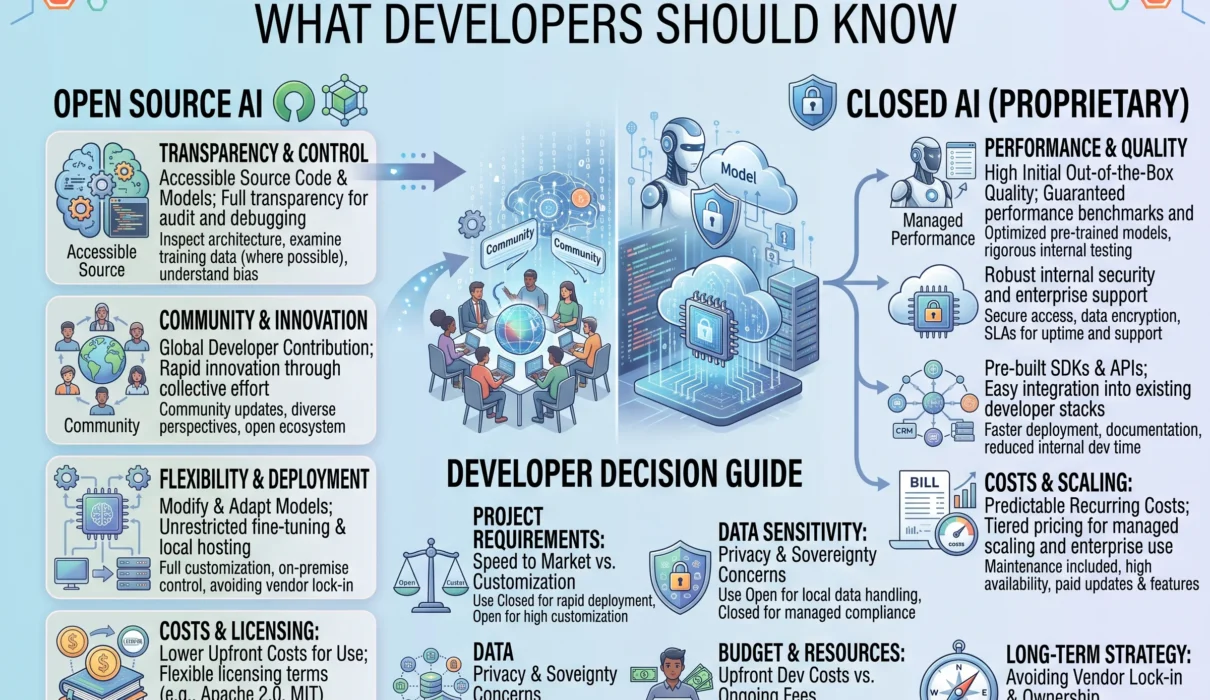
Every architectural decision in modern software engineering eventually collides with a foundational choice: do you consume proprietary intelligence behind a hosted API, or do you download model weights, manage your own inference runtimes, and control the entire machine learning stack?
The debate between open source AI and closed-source proprietary systems is often framed as a philosophical clash between transparency and commercial polish. For practicing developers, platform architects, and engineering leaders, the reality is far more pragmatic. The choice dictates system latency, operational expenditure, data sovereignty, regulatory exposure, and long-term product defensibility.
Building production systems requires evaluating both paradigms across five critical pillars: model availability, customization depth, infrastructure overhead, licensing constraints, and practical production trade-offs.
1. Architectural Definitions: Moving Beyond the False Binary
Before comparing architectures, developers must unpack what the industry casually labels “open source.” In traditional software, open source is governed by well-understood definitions: you inspect, compile, modify, and redistribute the human-readable source code under an Open Source Initiative (OSI)-approved license like MIT, Apache 2.0, or GPL.
In machine learning, software does not compile deterministically from code alone; it emerges from the interaction of code, compute, training pipelines, and massive datasets.
                     THE SPECTRUM OF MODEL OPENNESS

  [CLOSED / PROPRIETARY]
  • Hosted API access only (OpenAI GPT-4o, Anthropic Claude 3.5, Google Gemini)
  • Zero access to weights, architectures, training datasets, or system prompts

  [OPEN WEIGHTS]
  • Downloadable parameter matrices (Meta Llama 3, Mistral, Alibaba Qwen, DeepSeek)
  • Run anywhere, fine-tune locally; training data & pipelines remain proprietary

  [TRUE OPEN-SOURCE AI (OSI / OSAID Standard)]
  • Open model parameters and weights
  • Complete data provenance / disclosure and pre-processing pipeline code
  • Full training and inference codebase released under permissive licenses (e.g., OLMo)
The Three Tiers of Model Access
- Closed-Source (API-Only) Models: The model resides entirely behind an opaque REST or WebSocket endpoint managed by a hyperscaler or research lab. You send tokens in; you receive tokens out. You have zero visibility into weight configurations, internal routing (such as Mixture-of-Experts architectures), hidden system prompts, or quantization levels applied dynamically to save cloud provider compute.
- Open-Weights Models: The developers publish the learned parameter matrices (the floating-point weights) alongside the inference code. You can download the checkpoint files (
.safetensors), inspect the model architecture, run inference on your own hardware, and fine-tune layers. However, the exact raw training data, filtering recipes, and synthetic generation mixtures are rarely disclosed. Prominent examples include Meta’s Llama family, Mistral’s open releases, Alibaba’s Qwen series, and DeepSeek-V3/R1. - Fully Open-Source AI (OSAID Compliant): As defined by the Open Source Initiative’s Open Source AI Definition (OSAID v1.0), true open-source AI requires transparency across four components: model architecture code, training pipeline code, downloadable weights, and comprehensive information regarding the training dataset sufficient to recreate an equivalent system. Projects like the Allen Institute for AI’s (AI2) OLMo and EleutherAI’s Pythia represent this class.
For the remainder of this guide, “open source AI” primarily refers to the broad ecosystem of open-weights and open-source models that developers can download, host, modify, and run independently of a third-party managed API.
2. Model Availability: The Frontier vs. The Commodity
For years, a massive performance gulf separated closed commercial models from their open counterparts. If an enterprise needed complex multi-step reasoning, advanced agentic orchestration, or state-of-the-art code generation, closed commercial endpoints were the only viable path.
That capability gap has narrowed into near-parity for the vast majority of software engineering use cases.
┌────────────────────────────────────────────────────────────────────────┐
│                   CAPABILITY & AVAILABILITY MATRIX                     │
├─────────────────────┬────────────────────┬─────────────────────────────┤
│ Architectural Vector│ Closed-Source AI   │ Open-Source AI / Open Weights│
├─────────────────────┼────────────────────┼─────────────────────────────┤
│ Frontier Reasoning  │ Leading edge;      │ Competitive open reasoning  │
│                     │ rapid iterations   │ models (DeepSeek-R1,        │
│                     │ via massive cloud  │ Qwen-QwQ, Llama variants)   │
│                     │ training clusters  │ approaching commercial benchmarks
├─────────────────────┼────────────────────┼─────────────────────────────┤
│ Multimodal Native   │ Highly mature      │ Rapidly advancing vision/   │
│ Ingestion           │ voice, vision,     │ audio models (Qwen2-VL,     │
│                     │ and video streams  │ Whisper, Pixtral, Llama Vision)
├─────────────────────┼────────────────────┼─────────────────────────────┤
│ Context Windows     │ 128k to 2M+ tokens │ 32k to 1M+ tokens via       │
│                     │ managed server-side│ YaRN, RoPE scaling, and     │
│                     │ with prompt caching│ native long-context weights │
├─────────────────────┼────────────────────┼─────────────────────────────┤
│ Service Availability│ Subject to vendor  │ 100% deterministic SLA      │
│ & Rate Limits       │ outages, rate caps,│ governed by your own        │
│                     │ and silent updates │ infrastructure provisioning │
└─────────────────────┴────────────────────┴─────────────────────────────┘
The Closed Advantage: Massive Frontier Scale
Proprietary vendors spend hundreds of millions of dollars per training run, aggregating multi-modal datasets and scaling synthetic post-training pipelines at a volume few individual enterprises can match. For raw, unstructured frontier tasks—such as multi-lingual creative synthesis, complex legal interpretation across ambiguous multi-jurisdiction edge cases, or deep scientific analysis—frontier closed systems remain exceptionally strong.
Furthermore, closed models offer managed operational simplicity. Features like server-side prompt caching, automatic context routing, and hosted retrieval pipelines mean teams can prototype and deploy an application in an afternoon without writing a single line of GPU infrastructure code.
The Open Advantage: Deterministic Availability and Anti-Fragility
Closed APIs introduce a fundamental vulnerability: provider dependency.
- Silent Drift: Proprietary vendors continuously update, re-align, and quantize hosted checkpoints behind existing API routes to optimize their own serving costs. An API prompt pipeline that returned precise, structured JSON on Tuesday can begin failing parsing tests on Thursday because the provider quietly swapped out the underlying model mixture.
- Rate Limits and Regional Outages: When an API provider suffers an outage or institutes sudden token-per-minute rate restrictions across high-tier accounts, your application halts entirely.
- Deprecation Lifecycles: Proprietary providers routinely deprecate older model versions on short notice. If your production pipeline relies on a specific model artifact, you are forced to re-evaluate and re-engineer your prompt chains against newer, differently aligned versions.
With open source AI models, availability is deterministic. When you download a specific model checkpoint (e.g., a specific FP16 or quantized GGUF/AWQ build), that artifact is immutable. It will produce consistent behavior indefinitely on your hardware. You control the rate limits, concurrency ceilings, and lifecycle guarantees.
3. Customization Depth: Prompting vs. True Weight Adaptation
How deeply does your application need to adapt to your domain? This question represents the sharpest technical dividing line between closed and open AI systems.
                      THE CUSTOMIZATION PYRAMID

                       ▲
                      / \   Full Architectural Retraining
                     /---\  (Open Source Only: Custom Tokenizers, Pre-training)
                    /     \
                   /-------\  Full-Weight Fine-Tuning & Parameter Merging
                  /         \ (Open Source: Mergekit, DeepSpeed, SFT)
                 /-----------\
                /             \ Parameter-Efficient Fine-Tuning (PEFT)
               /---------------\ (Open Source: LoRA, QLoRA; Limited Closed APIs)
              /                 \
             /-------------------\ Retrieval-Augmented Generation (RAG)
            /                     \ (Closed APIs & Open Systems)
           /-----------------------\
          /                         \ System Prompting & Few-Shot In-Context
         /───────────────────────────\ (Closed APIs & Open Systems)
The Ceiling of Closed Model Customization
When working with closed APIs, adaptation is largely limited to the outer edges of the model:
- In-Context Prompting: Stuffing instructions, dynamic context, and few-shot examples into the active context window. This consumes precious context space and incurs per-token inference costs on every invocation.
- Retrieval-Augmented Generation (RAG): Searching a vector database and injecting relevant chunks into the prompt context. While effective for knowledge retrieval, it does not alter the model’s underlying reasoning mechanics, linguistic tone, or syntactic structure.
- Hosted Fine-Tuning: Some proprietary providers allow fine-tuning through web consoles or endpoints. However, you are uploading proprietary training pairs to external servers, you cannot inspect the adjusted weights, you cannot export the resulting artifact, and you pay an ongoing financial premium to query your fine-tuned model via their API.
The Unlimited Depth of Open-Source Customization
With an open source LLM, developers have access to the model’s computational graph and parameter weights, unlocking deep customization techniques:
- Parameter-Efficient Fine-Tuning (PEFT / LoRA / QLoRA): Instead of retraining all parameters, Low-Rank Adaptation (LoRA) freezes the base model and injects trainable rank-decomposition matrices into the Transformer attention layers. You can train a domain-specific LoRA adapter on your internal code repository or customer logs using a single high-end workstation GPU in a few hours, producing an artifact measuring just 20MB to 100MB that dynamically slots onto the base model.
- Full-Weight Domain Continual Pre-Training: If your enterprise operates in a highly specialized lexicon (e.g., semiconductor lithography, complex financial options modeling, internal enterprise DSLs), standard models suffer from tokenization bloat and poor vocabulary coverage. With open models, you can expand the tokenizer, run continuous pre-training on billions of domain tokens, and fundamentally teach the model new vocabulary and technical syntax.
- Model Merging (Mergekit): The open-source community pioneered the ability to mathematically combine multiple fine-tuned models without retraining. Using techniques like SLERP (Spherical Linear Interpolation), DARE, and TIES, developers can merge a model specialized in Python programming with another specialized in medical analysis, creating a hybrid model inheriting the strengths of both at zero computational training cost.
- Direct Alignment and Uncensoring (DPO / KTO / ORPO): Closed models enforce universal, aggressive safety alignment that frequently triggers false-positive refusals on benign enterprise tasks (such as analyzing legal evidence, auditing malware signatures, or parsing clinical pathology reports). With open models, engineering teams can apply Direct Preference Optimization (DPO) to align the system strictly to their corporate policies without dealing with vendor-mandated refusal behaviors.
4. Infrastructure and Economics: The True Total Cost of Ownership (TCO)
The financial comparison between closed and open AI models is widely misunderstood.
A common misconception is that open-source models are “free” because the weights are downloadable without an upfront license fee. In reality, open source AI trades variable operational expenditure (OpEx) for compute infrastructure, memory management, and engineering maintenance overhead.
                     COST BREAKDOWN OVER INFERENCE VOLUME

  Total Cost
      │                                                / (Closed API:
      │                                               /   Linear scaling per token)
      │                                              /
      │                                             /
      │                       CROSSOVER POINT      /
      │                             ▼             /
      │─────────────────────────────X────────────/── (Self-Hosted Open Source:
      │                            / \          /     High fixed hardware/dev cost,
      │                           /   \        /      near-zero marginal token cost)
      │                          /     \      /
      │                         /       \    /
      │                        /         \  /
      └───────────────────────/───────────\/────────────────────────
                              Inference Volume (Tokens / Month)
The Cost Mechanics of Closed APIs
Closed models charge exclusively on consumption: a metered rate per million prompt tokens and per million completion tokens.
- Pros: Zero upfront capital expenditure (CapEx), zero hardware maintenance costs, zero infrastructure engineering salaries, and automatic scaling from zero to thousands of concurrent requests.
- Cons: The marginal cost of every query remains fixed. If your application scales to millions of active users generating tens of millions of tokens daily, API costs increase in direct linear lockstep. High-throughput applications, long-context RAG pipelines, and automated multi-agent loops can rapidly run up five- or six-figure monthly cloud bills.
The Cost Mechanics of Self-Hosted Open Models
Hosting an open source AI architecture requires provisioning dedicated hardware—either on-premises or via cloud GPU rentals (such as AWS, Azure, RunPod, or Lambda Labs).
┌────────────────────────────────────────────────────────────────────────┐
│               INFERENCE HARDWARE PROVISIONING EXAMPLES                 │
├───────────────────┬───────────────────┬────────────────────────────────┤
│ Model Size        │ Precision Format  │ Minimum Hardware Required      │
├───────────────────┼───────────────────┼────────────────────────────────┤
│ 8B Parameters     │ FP16 (Unquantized)│ 1x NVIDIA RTX 4090 / A5000     │
│ (e.g., Llama 3 8B)│ (~16GB VRAM)      │ (24GB VRAM)                    │
├───────────────────┼───────────────────┼────────────────────────────────┤
│ 8B Parameters     │ INT4 (Quantized)  │ Consumer Laptop / Modern NPU   │
│                   │ (~5.5GB VRAM)     │ (16GB Unified RAM)             │
├───────────────────┼───────────────────┼────────────────────────────────┤
│ 70B Parameters    │ FP16 (Unquantized)│ 2x to 4x NVIDIA A100 / H100    │
│ (e.g., Llama 70B) │ (~140GB VRAM)     │ (80GB VRAM each via NVLink)    │
├───────────────────┼───────────────────┼────────────────────────────────┤
│ 70B Parameters    │ INT4 / AWQ        │ 1x to 2x NVIDIA A100 (80GB) or │
│                   │ (~40GB VRAM)      │ 2x RTX 4090 with system offload│
└───────────────────┴───────────────────┴────────────────────────────────┘
The economics of self-hosting involve distinct cost drivers:
- Hardware Provisioning: You pay for GPU capacity whether it is serving user requests or sitting idle. If your traffic is bursty, unpredictable, or low-volume, running a reserved $3/hour GPU instance can be far more expensive than paying $0.002 per API call.
- Modern Inference Engine Optimization: Running open models no longer requires naive, slow Python scripts. Modern serving engines (such as vLLM, TGI, and TensorRT-LLM) leverage PagedAttention, continuous batching, and kernel fusion to achieve massive serving concurrency. A single server running dual 80GB GPUs can serve thousands of concurrent requests with sub-20ms inter-token latencies.
- The Crossover Point: For high-throughput, steady-state production applications (e.g., continuous code completion, real-time customer support triage, high-volume internal document parsing), self-hosted open-source models achieve an economic crossover point. Once monthly volume exceeds tens of millions of tokens, the fixed cost of a dedicated GPU instance becomes dramatically cheaper than pay-per-token commercial APIs—often reducing serving costs by 70% to 90%.
5. Licensing, Compliance, and Legal Landmines
In conventional software development, engineering teams run automated license scanners in their CI/CD pipelines to flag copyleft code (like GPL-3.0) and prevent IP contamination. In machine learning, licensing is significantly more complex and fractured.
                   THE AI LICENSING CONTINUUM

  PERMISSIVE (True OSS)         MODIFIED / COMMERCIAL CAPS       PROPRIETARY / RESTRICTIVE
  ┌───────────────────────┐     ┌───────────────────────┐        ┌───────────────────────┐
  │ Apache 2.0 / MIT      │     │ Custom Community Terms│        │ OpenRAIL / Commercial │
  │ • DeepSeek-R1 (MIT)   │ ──► │ • Meta Llama License  │  ──►   │ • Banned use cases    │
  │ • Mistral (Some models│     │   (700M MAU threshold)│        │ • Downstream derived  │
  │   Apache 2.0)         │     │ • Qwen Research Terms │        │   model restrictions  │
  └───────────────────────┘     └───────────────────────┘        └───────────────────────┘
The Pitfalls of “Open-Washing”
Many models casually branded as “open source” carry restrictive legal terms that prevent them from qualifying under standard open-source definitions:
- User Threshold Restrictions: Meta’s Llama community licenses grant broad commercial rights, but include a specific clause: if an application or service has more than 700 million monthly active users (MAU) in the month the model is released, the commercial entity must request a separate, explicit license from Meta. While irrelevant to most startups, this clause is a deal-breaker for global telecommunications and consumer tech giants.
- Competitive Restrictions: Many licenses prohibit using the model or its outputs to train or improve other competitive artificial intelligence models. If you use Model A to generate synthetic data to distill into a smaller Model B, you may violate the terms of service of Model A.
- OpenRAIL and Responsible AI Licenses: Licenses such as OpenRAIL-M attach behavioral and domain restrictions to model use (e.g., banning use in military contexts, biometric surveillance, healthcare diagnosis without certified oversight, or automated legal evaluation). Furthermore, these restrictions are often legally designed to follow derived models and downstream adaptations, binding your engineering team to continuous behavioral compliance audits.
- Truly Permissive Models: Models released under standard Apache 2.0 or MIT licenses provide the greatest legal safety. They allow unrestricted commercial exploitation, proprietary modification, private distribution, and model merging without user threshold caps or field-of-use restrictions.
Copyright, Training Data, and Regulatory Exposure
When using closed APIs, legal liability is often addressed via enterprise commercial contracts: vendors like Microsoft, Google, and OpenAI offer copyright indemnification clauses protecting enterprise customers from third-party copyright claims stemming from generated outputs.
When self-hosting an open model, indemnification falls entirely on your organization. If an open model was trained on contested, copyrighted material, and your application outputs copyrighted code or media verbatim, your organization bears direct legal responsibility. Organizations operating under strict compliance regimes (e.g., healthcare, financial trading, critical infrastructure) must audit the training provenance of their models or prioritize systems like AI2’s OLMo that provide completely transparent, auditable training datasets.
6. Security, Privacy, and Data Sovereignty
For regulated industries and security-conscious software systems, architectural decisions are governed by data security and compliance requirements.
CLOSED API ARCHITECTURE (Data Leaves Perimeter)
[Corporate Internal Network] ──(Encrypted Internet Transit)──► [Third-Party Cloud Provider]
• Potential for metadata leakage                               • Stored in third-party caches
• Subject to remote vendor subpoenas                           • Processing occurs on shared infrastructure

OPEN-SOURCE SELF-HOSTED (Zero Data Egress / Air-Gapped)
┌────────────────────────────────────────────────────────────────────────┐
│ PRIVATE SECURE ENCLAVE (Virtual Private Cloud / On-Prem Data Center)   │
│                                                                        │
│ [Internal Database] ──► [Local vLLM Cluster] ──► [Internal Application]│
│                                                                        │
│ ❌ ZERO EXTERNAL CALLS • COMPLIANT WITH HIPAA, GDPR, SOC 2, ITAR       │
└────────────────────────────────────────────────────────────────────────┘
The Closed API Security Posture
When integrating a closed model, your data leaves your infrastructure perimeter. Even when utilizing enterprise agreements with verified Zero Data Retention (ZDR) clauses:
- Data travels over public network backbones.
- Requests reside temporarily in third-party volatile memory and intermediate gateway caches during inference.
- Enterprise security officers must trust the vendor’s internal access controls, multi-tenant isolation architectures, and administrative privilege boundaries.
For many standard web and mobile applications, standard enterprise API agreements provide adequate protection. But for high-assurance environments, third-party data transit is often non-compliant.
The Open Source Air-Gapped Advantage
Self-hosting an open source AI model provides true data sovereignty:
- Complete Air-Gapping: Models can run on internal hardware completely disconnected from the public internet. Defense applications, clinical hospital networks, critical industrial control systems (SCADA), and proprietary banking core ledgers can execute deep language processing without transmitting a single data packet outside their physical data center.
- Compliance by Architecture, Not Contract: You do not need to rely on a vendor’s legal promises or third-party SOC 2 compliance reports. Your security posture is guaranteed by architectural design: your network firewalls physically block external egress.
- Mitigating Supply Chain Attacks: Because you control the model weights file directly, you can run security scans to verify cryptographic hashes (
SHA-256), inspect model serialization formats to prevent arbitrary remote code execution (e.g., standardizing on.safetensorsover dangerous pickle files), and audit every layer of the serving stack.
7. The Practical Decision Framework: When to Choose Which
No engineering organization should be dogmatically committed to one paradigm. The most effective systems utilize a pragmatic, task-specific evaluation framework.
                         DECISION LOGIC FOR MODEL SELECTION

  Does the workload involve highly sensitive, regulated, or air-gapped data?
  ├── YES ──► Deploy OPEN-SOURCE AI (Self-hosted on private VPC / on-prem)
  └── NO
       │
       ▼
  Do you require deep architectural customization, custom tokenizers, or LoRAs?
  ├── YES ──► Deploy OPEN-SOURCE AI (Fine-tuned via PEFT/SFT runtimes)
  └── NO
       │
       ▼
  Is monthly inference volume high (>50M tokens/mo) and relatively predictable?
  ├── YES ──► Benchmark OPEN-SOURCE AI (Self-hosted vLLM cluster for TCO savings)
  └── NO
       │
       ▼
  Are you prototyping, building dynamic MVPs, or demanding frontier reasoning?
  └── YES ──► Integrate CLOSED-SOURCE API (Fast time-to-market, zero infra overhead)
When to Build on Closed APIs
- Rapid Prototyping and MVPs: When validating product-market fit, building proof-of-concepts, or launching an early-stage product, the speed of integration matters most. Writing API client calls lets you ship in days without setting up GPU instances or fine-tuning models.
- Frontier Reasoning Tasks: Complex, multi-turn analytical reasoning, high-dimensional strategy synthesis, and ambiguous natural-language evaluations that exceed the parameter capacities of locally deployable models.
- Extremely Bursty or Low-Volume Workloads: Applications where queries occur sporadically. Paying pennies per active user transaction is far more cost-effective than keeping a dedicated $1,500/month GPU node running at 5% utilization.
- Zero Infrastructure Engineering Teams: If your startup or department lacks specialized Machine Learning Operations (MLOps) engineers, managing raw GPU clusters, load balancing, dynamic batching, and quantization runtimes will create severe organizational drag.
When to Build on Open-Source Models
- Data Sovereignty and Regulatory Constraints: Healthcare, defense, intelligence, financial transactions, and any domain governed by strict compliance mandates (HIPAA, GDPR, ITAR, CCPA) prohibiting data sharing with third parties.
- High-Throughput, Steady-State Production: Enterprise applications with high, continuous transaction volumes—such as real-time code autocomplete, automated customer support resolution, internal knowledge-base search, and continuous data extraction.
- Low Latency & On-Device Processing: Edge applications, smart devices, local desktop tools (such as developer IDEs), and mobile apps that must run offline, eliminate network latency, or execute directly on consumer silicon and NPUs.
- Deep Domain Adaptation: Workflows that require custom vocabulary, strict structural conformity, specialized technical notation, or unique tonal alignments achievable only through fine-tuning, continuous pre-training, or parameter merging.
- Platform Independence and Risk Mitigation: Enterprise applications where relying on a third-party vendor’s pricing models, uptime SLAs, or sudden Terms of Service changes represents an unacceptable existential risk to the business.
8. The Industry Consensus: The Hybrid Architectural Mesh
The modern software engineering landscape is converging on a collaborative hybrid AI architecture. Rather than debating open versus closed as a binary choice, sophisticated engineering platforms use both systems strategically within a tiered routing framework.
┌────────────────────────────────────────────────────────────────────────┐
│                   THE TIERED HYBRID INFERENCE MESH                     │
├────────────────────────────────────────────────────────────────────────┤
│                                                                        │
│                       [Inbound User Request]                           │
│                                 │                                      │
│                                 ▼                                      │
│                 ┌───────────────────────────────┐                      │
│                 │    Semantic Intent Router     │                      │
│                 │ (Calculates Complexity & PII) │                      │
│                 └───────────────┬───────────────┘                      │
│                                 │                                      │
│         ┌───────────────────────┴───────────────────────┐              │
│         ▼                                               ▼              │
│  [HIGH COMPLEXITY / NON-PII]                     [STANDARD / SENSITIVE]│
│  • Edge-case analytical logic                    • PII & financial data│
│  • Ambiguous multi-step planning                 • High-volume parsing │
│  • Complex multi-language synthesis              • Low-latency routing │
│         │                                               │              │
│         ▼                                               ▼              │
│  ┌──────────────────────────────┐              ┌──────────────────────┐│
│  │   FRONTIER CLOSED API        │              │  SELF-HOSTED OPEN    ││
│  │   (Cloud Managed Endpoint)   │              │  SOURCE CLUSTER      ││
│  │   • Highest dynamic reasoning│              │  • Fine-tuned LoRA   ││
│  │   • Zero infrastructure      │              │  • Air-gapped VPC    ││
│  │   • Pay-per-token pricing    │              │  • vLLM / Zero Egress││
│  └──────────────────────────────┘              └──────────────────────┘│
│                                                                        │
└────────────────────────────────────────────────────────────────────────┘
In a production hybrid architecture:
- The Ingestion & Triage Layer: Inbound requests pass through a fast, lightweight semantic router (often an open-source 1B–3B parameter Small Language Model running locally in under 10 milliseconds).
- Privacy Classification: If the request contains personally identifiable information (PII), proprietary source code, or confidential patient telemetry, the router automatically isolates the query within an internal, air-gapped open-source model cluster.
- Complexity & Cost Cascading: Routine tasks—such as classification, data extraction, JSON formatting, and basic text editing—are routed to optimized, fine-tuned open-source models running on owned GPU capacity. The task completes with minimal latency at near-zero marginal cost.
- Frontier Escalation: Only the small fraction of queries (often 5% to 15%) that demand high-level strategic reasoning, complex creative problem-solving, or multi-modal synthesis are escalated to external closed frontier APIs.
Strategic Implementation Checklist for Developers
To optimize your AI architecture, approach your selection methodically:
- Map Your Data Flows: Identify whether your target data contains regulatory boundaries (HIPAA, GDPR, internal IP). If data egress is prohibited, your decision is made: prioritize self-hosted open-weights models.
- Prototype on APIs First: Even if your eventual goal is self-hosting, use closed APIs to validate feature mechanics, build baseline evals, and prove product-market fit without investing upfront engineering time in MLOps pipelines.
- Build Golden Evaluation Datasets: Create an automated evaluation suite of 100 to 500 domain-specific prompt/response pairs. When evaluating open alternatives, test candidate models against your evaluation bench using programmatic metrics and LLM-as-a-Judge rubrics.
- Audit Model Licenses Carefully: Check the exact legal terms of every model checkpoint. Verify whether your commercial distribution plans comply with user threshold limits (such as Llama’s 700M MAU clause) or behavioral restrictions in OpenRAIL licenses.
- Standardize on Unified Inference Interfaces: Architect your application logic using provider-agnostic SDKs and client interfaces (such as the standard OpenAI-compatible API schema supported by vLLM, Ollama, and LiteLLM). This decouples your core business code from underlying models, allowing you to swap between closed APIs and open-source models with a single environment variable change.
The choice between open-source AI and closed-source AI is not a matter of ideological loyalty. It is a technical calculation of risk, cost, speed, and agency. By matching the structural strengths of both paradigms to the specific layers of your technology stack, you build an architecture that is cost-effective today, resilient tomorrow, and adaptable to whatever technological breakthroughs emerge next.