

 By
By 1. What Is an Emergency Fund and How Does It Work?
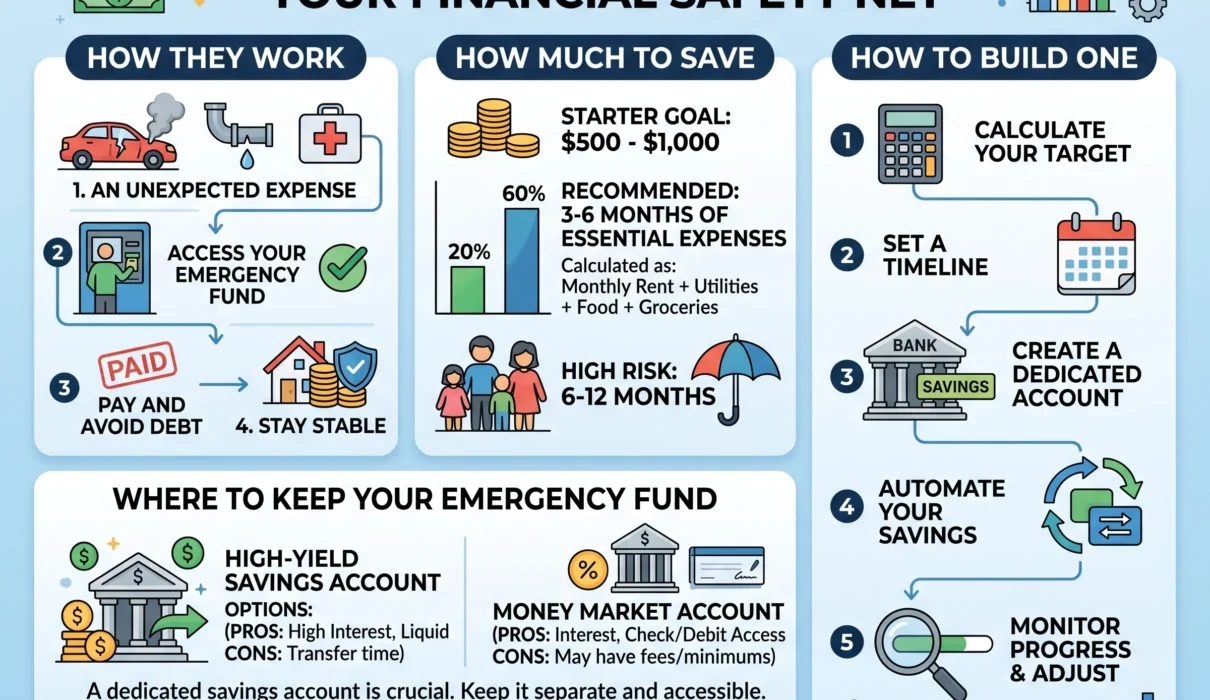
An emergency fund is a pool of liquid, readily accessible cash earmarked exclusively for genuine, unforeseen financial emergencies. It does not exist to fund holiday gifts, seasonal vacations, or planned car maintenance; those belong in dedicated sinking funds.
THE BUFFER MECHANISM:

[Sudden Emergency: $2,500 Car Transmission Repair]
                       │
       ┌───────────────┴───────────────┐
       ▼                               ▼
  WITHOUT A SAFETY NET             WITH AN EMERGENCY FUND
  - High-APR credit card balance   - Cash transfer within 24 hours
  - Interest compounds at 20%+     - Zero interest or added debt
  - Disrupted retirement investing - Investment contributions remain untouched
  - Elevated anxiety and stress    - Baseline financial stability intact
The primary objective of emergency savings is capital preservation and liquidity, not aggressive growth. While investments in equities or index funds outpace inflation over decades, their short-term volatility makes them unsuitable for emergencies. Forcing a liquidation during a market downturn locks in paper losses when you can least afford them.
2. Determining Your Emergency Fund Target
The common rule of thumb recommends saving 3 to 6 months of living expenses, but the ideal size depends on your income stability, household obligations, and risk exposure.
Crucially, this figure is calculated using baseline living expenses (needs)—not your gross salary or full discretionary budget. If you earn $6,000 per month but your core obligations (rent, food, utilities, minimum debt service) total $3,200, a 3-month target is $9,600, not $18,000.
| Personal Situation | Recommended Runway | Primary Risk Factors |
| Dual-Income, Salaried, No Dependents | 3 Months | Low income volatility; dual safety net if one job ends |
| Single Earner or Single Parent | 6 Months | High vulnerability to a single point of income disruption |
| Freelancer, 1099 Contractor, or Commission | 6 to 9 Months | Irregular cash flows; extended gaps between client invoices |
| Business Owner or Sole Breadwinner with Dependents | 9 to 12 Months | High fixed overhead; responsibility for multiple dependents |
The Three-Question Stress Test for Expenses
When calculating baseline monthly expenses, audit your recurring costs using this framework:
- Survival Essentials: Rent or mortgage, basic groceries, electric/water/gas utilities, necessary medications, and minimum loan obligations.
- Paired Adjustments: Reduced mobile phone data or minimum transit passes needed for essential travel.
- Immediate Freezes: Streaming services, dining out, personal shopping, and gym memberships that you would pause instantly if income stopped.
3. Modeling Your Safety Net and Cash Flow
Visualizing your cash flow allows you to determine how much surplus is available each month to direct into your emergency fund.
Assuming a net take-home income of $4,500 per month, the interactive planner below illustrates a baseline budget where fixed essentials total $2,250 (Needs) and variable lifestyle costs total $1,350 (Wants), leaving a healthy $900 monthly surplus to fund your emergency reserves:
4. Where to Keep Your Emergency Fund
Keeping your emergency savings in the right vehicle ensures it is protected against both depreciation and daily temptation.
+-----------------------------------+--------------------+----------------------+------------------------------------+
| Account Vehicle                   | Liquidity / Access | Yield Profile        | Best Suited For                    |
+-----------------------------------+--------------------+----------------------+------------------------------------+
| **High-Yield Savings (HYSA)**     | High (1–2 days)    | Competitive Variable | Primary 3–6 month emergency fund   |
+-----------------------------------+--------------------+----------------------+------------------------------------+
| **Money Market Account (MMA)**    | High (Debit card)  | Competitive Variable | Emergency funds requiring instant  |
|                                   |                    |                      | point-of-sale check/debit access   |
+-----------------------------------+--------------------+----------------------+------------------------------------+
| **Short-Term CDs / T-Bill Ladder**| Moderate (Matures) | Fixed Return         | Secondary reserve beyond 6 months  |
+-----------------------------------+--------------------+----------------------+------------------------------------+
| **Checking Account (Standard)**   | Immediate          | Near Zero            | Day-to-day bill-pay operations only|
+-----------------------------------+--------------------+----------------------+------------------------------------+
The Separation Rule
Do not leave your emergency fund in your everyday checking account. When emergency cash is co-mingled with spending money, psychological boundaries blur, leading to slow leaks for non-essential purchases.
Opening an account at an FDIC- or NCUA-insured institution separate from your day-to-day bank creates a healthy 24- to 48-hour transfer barrier. This buffer is fast enough to handle urgent invoices, but deliberate enough to deter impulse withdrawals.
5. How to Build an Emergency Fund Gradually: A 3-Stage Blueprint
Amassing thousands of dollars can feel intimidating. Approaching the goal in structured milestones prevents burnout and builds momentum.
Phase 1: The Starter Buffer ($1,000 to $2,000)
Focus on building a rapid $1,000 to $2,000 cushion first. This modest buffer shields you from routine hiccups—like a minor tire puncture, emergency dental co-pay, or broken household appliance—so you can tackle high-interest revolving debt without backsliding.
Phase 2: The Core 3-Month Runway
Once high-interest credit card debt is resolved, redirect all liberated cash-flow payments toward expanding your emergency fund to 3 months of baseline living costs. Automate transfers on payday so savings happen before discretionary spending occurs.
Phase 3: The Full 6-Month Safety Net
Continue building toward 6 months if your household relies on a single income, works in a volatile industry, or supports dependents. Once fully funded, cap the account and direct your monthly surplus toward tax-advantaged retirement accounts, index investments, or major life milestones.
6. Rules of Engagement: When to Use the Fund
Establishing strict rules of engagement protects your reserves from being drained by non-emergencies. Before withdrawing funds, apply the Emergency Filter:
IS THIS EXPENSE:
1. Unexpected?    (You could not have planned or scheduled it in advance)
       AND
2. Urgent?        (Delaying payment causes severe financial, health, or legal harm)
       AND
3. Necessary?     (It is required for basic living, health, shelter, or employment)
- Valid Emergency: Medical co-pay, essential car repair needed to commute to work, emergency plumbing repair, sudden job termination.
- Not an Emergency: Holiday gift shopping (use a sinking fund), semi-annual car insurance premium (use a sinking fund), ticket sales for a favorite band, upgrade to a newer smartphone.
If you must draw down your emergency fund, treat replenishing it as your top financial priority in subsequent monthly budgets until the safety net is restored.
Action Plan to Start Your Fund
- Calculate Your 1-Month Baseline: Add up your bare-bones housing, food, transportation, and minimum debt payments.
- Open a Dedicated HYSA: Establish a separate account paying a competitive yield, isolated from your daily checking.
- Automate a Starter Transfer: Schedule an automated transfer of $100 to $250 on your upcoming payday to establish the habit.