

 By
By Computing has arrived at an unprecedented structural crossroads. For over half a century, technology followed a clear, linear trajectory: semiconductor transistors shrank along Moore’s Law, microprocessors clocked faster cycle speeds, operating systems centralized data in local files, and businesses eventually migrated everything into elastic cloud data centers. The relationship between human beings and machines was deterministic: code followed explicit instructions ($X \rightarrow Y$), software sat passively inside 2D desktop windows, and user interaction required manual typing or mouse clicks.
That era has permanently broken down.
Today, computing is transitioning from passive calculation to autonomous action, from deterministic scripts to probabilistic reasoning, and from flat glass displays into spatial, ambient, and physical environments. We are not experiencing an incremental upgrade cycle; we are navigating a systemic rewiring of the entire technology stack.
Physical constraints—thermal dissipation limits, semiconductor reticle walls, gigawatt power caps, and data transit latencies—are forcing software and hardware to co-evolve. Meanwhile, foundational breakthroughs in multimodal machine learning, quantum error correction, and biological sensor fusion are redefining what computers can achieve.
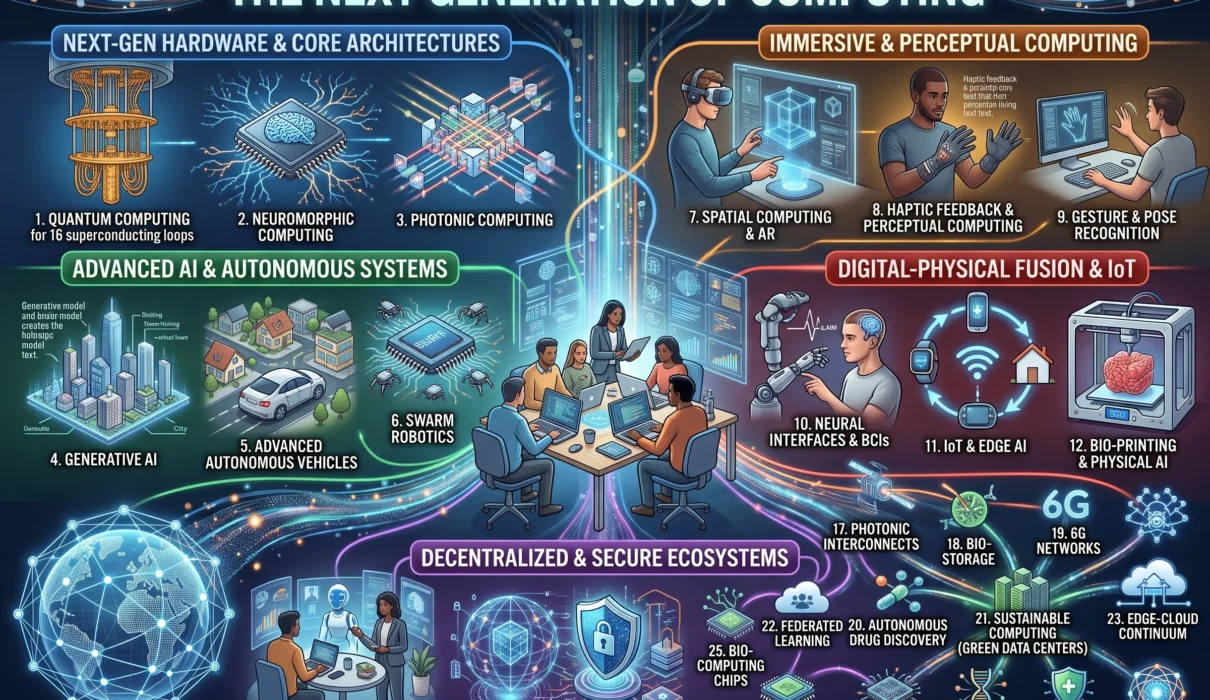
To make sense of this tectonic transformation, this comprehensive pillar analysis categorizes the 30 technology trends that could define the next generation of computing. Across artificial intelligence, semiconductor physics, cloud architecture, cybersecurity, and physical machines, these developments will shape how technology is built, deployed, and experienced in technology trends 2026 and beyond.
THE NEXT-GENERATION COMPUTING LANDSCAPE
┌────────────────────────────────────────────────────────────────────────┐
│ 1. ARTIFICIAL INTELLIGENCE & COGNITIVE SYSTEMS                         │
│    Autonomous Agents • Physical AI • Multimodal VLAs • GEO             │
├────────────────────────────────────────────────────────────────────────┤
│ 2. SILICON, CHIPS & COMPUTING HARDWARE                                 │
│    NPUs • Chiplets & CoWoS • HBM • Silicon Photonics • Analog Compute  │
├────────────────────────────────────────────────────────────────────────┤
│ 3. INFRASTRUCTURE, DATA CENTERS & CONNECTIVITY                         │
│    Direct Liquid Cooling • Nuclear SMRs • Wi-Fi 7 • D2D Satellite      │
├────────────────────────────────────────────────────────────────────────┤
│ 4. SOFTWARE ENGINEERING & MODERN ARCHITECTURES                         │
│    AI-Native Apps • Wasm Micro-VMs • Intent UIs • LLM Evals            │
├────────────────────────────────────────────────────────────────────────┤
│ 5. CYBERSECURITY, IDENTITY & PRIVACY                                   │
│    Zero Trust • Passkeys • Post-Quantum Cryptography • C2PA Provenance │
├────────────────────────────────────────────────────────────────────────┤
│ 6. HUMAN-COMPUTER INTERFACES & PHYSICAL COMPUTING                      │
│    Spatial Displays • Micro-OLED • Smart Glasses • Neuromorphic Silicon│
└────────────────────────────────────────────────────────────────────────┘
Pillar 1: Artificial Intelligence & Cognitive Systems
The conversation around artificial intelligence has moved beyond conversational chatbots that answer text prompts. Artificial intelligence has become an active, execution-oriented layer spanning software, networks, and physical machinery.
                      THE PARADIGM SHIFT IN AI

  Generative Phase (2022–2024):
  [User Prompt] ──► [Central Cloud LLM] ──► [Text / Image Output]
  * Passive, conversational, stateless, confined to digital screens.

  Autonomous & Embodied Phase (2026 and Beyond):
  [High-Level Goal] ──► [Multi-Agent Swarm] ──► [Perceive & Reason]
                              │
                              ├─► Tool Calls, APIs, Sandboxed Code Exec
                              └─► Physical Action (Robotic Actuation, Edge NPU)
1. Autonomous AI Agents and Multi-Agent Orchestration
The primary development in enterprise automation is the shift from single-turn language models to autonomous AI agents. Rather than waiting for turn-by-turn prompts, an agent is assigned a high-level operational objective (e.g., “Audit Q3 cloud spending across all AWS accounts, open Jira tickets for cost spikes, and draft an executive briefing”).
Single-agent systems hit performance ceilings when handling complex tasks, which is why organizations are deploying Multi-Agent Systems (MAS). In a multi-agent framework, specialized nodes divide labor: an Orchestrator Agent decomposes the task into dependency graphs, worker agents handle research and code execution in parallel, and an adversarial Critic Agent validates outputs against compliance standards before committing changes.
2. Physical AI (Embodied Intelligence)
AI is breaking out of software runtimes and entering the physical world. Highlighted across forward-looking technology outlooks, physical AI merges foundation models with mechatronics, tactile sensing, and classical physics.
Unlike traditional industrial robots that execute blind, hardcoded coordinate loops, physical AI systems use Vision-Language-Action (VLA) models to perceive unstructured environments in real time. They grasp unfamiliar objects, dynamically balance across uneven surfaces, and adapt when components shift out of alignment—bringing generalized intelligence to manufacturing plants, logistics hubs, and operating rooms.
3. Generative Engine Optimization (GEO) & AI Search
The three-decade-old covenant of search engines—typing keywords into a box and scrolling through ten blue links—has broken down. Modern discovery is driven by AI search engines that use Retrieval-Augmented Generation (RAG) to synthesize direct, conversational answers with inline citations.
Because 60% or more of informational searches now conclude as zero-click interactions, traditional Search Engine Optimization (SEO) is evolving into Generative Engine Optimization (GEO). Digital publishers and enterprises must optimize for information gain, structured semantic schemas, and extractable data passages so neural re-rankers choose their content as verifiable source material.
4. Small Language Models (SLMs) and On-Device Model Distillation
While multi-hundred-billion parameter models push the boundaries of frontier research, production enterprise systems are migrating toward compact Small Language Models (SLMs) in the 1B to 8B parameter range.
Through knowledge distillation, parameter pruning, and low-bit quantization (INT4 and INT8), these compact models match the targeted reasoning and code-generation capabilities of older frontier models at a fraction of the computational overhead. They run on-device inside client hardware, slashing API inference fees to zero while delivering sub-15ms response times.
5. Domain-Specific Language Models (DSLMs)
General-purpose foundational models are broad generalists; they often struggle with the specialized jargon, regulatory requirements, and technical edge cases of niche industries. Organizations are turning toward Domain-Specific Language Models trained or continuously pre-trained on proprietary corpora: clinical pathology datasets, legal jurisprudence across international boundaries, or internal semiconductor CAD manuals. DSLMs minimize hallucinations, reduce context token bloat, and provide higher accuracy for regulated industries.
Pillar 2: Silicon, Chips & Advanced Hardware Architecture
As artificial intelligence scales, general-purpose processors are being complemented by domain-specific silicon. Hardware design is no longer just about shrinking transistor gate lengths; it is about packaging, memory bandwidth, and parallel matrix efficiency.
┌────────────────────────────────────────────────────────────────────────┐
│                   HETEROGENEOUS COMPUTING MATRIX                       │
├──────────────┬──────────────────┬──────────────────┬───────────────────┤
│ Processor    │ Architectural    │ Primary          │ Typical Power     │
│ Class        │ Focus            │ Workload         │ Profile           │
├──────────────┼──────────────────┼──────────────────┼───────────────────┤
│ CPU          │ Low-latency      │ OS, compiling,   │ 15W – 300W+       │
│              │ sequential logic │ relational DBs   │                   │
├──────────────┼──────────────────┼──────────────────┼───────────────────┤
│ GPU          │ High-throughput  │ Model training,  │ 250W – 1000W+     │
│              │ parallel vectors │ batch inference  │                   │
├──────────────┼──────────────────┼──────────────────┼───────────────────┤
│ NPU          │ Fixed systolic   │ Always-on edge,  │ 1W – 15W          │
│              │ tensor arrays    │ quantized SLMs   │ (Ultra-efficient) │
├──────────────┼──────────────────┼──────────────────┼───────────────────┤
│ Quantum QPU  │ Unitary quantum  │ Molecular sim,   │ Cryogenic millik. │
│              │ transformations  │ factorization    │ or optical setup  │
└──────────────┴──────────────────┴──────────────────┴───────────────────┘
6. The Rise of the Neural Processing Unit (NPU)
The Central Processing Unit (CPU) and Graphics Processing Unit (GPU) have been joined by a third core processor: the Neural Processing Unit (NPU).
NPUs are domain-specific integrated circuits designed around the mathematical primitives of deep learning: multidimensional matrix multiplications and convolutions executed at low bit-widths.
By using systolic arrays—grids of Multiply-Accumulate (MAC) units where data streams directly between calculating cells without constant register round-trips—NPUs process trillions of operations per second while drawing only 2 to 10 watts. This silicon efficiency enables laptops, smartphones, and edge devices to run ambient AI tasks without draining batteries or generating heavy heat.
7. AI PCs and Unified Memory Architecture (UMA)
The personal computer is undergoing its most significant structural redesign since the introduction of graphical user interfaces. An authentic AI PC is defined by a hardware baseline: an NPU delivering at least 40 to 45+ TOPS (Trillion Operations Per Second) paired with Unified Memory Architecture (UMA) and a minimum of 16GB to 32GB of shared high-speed RAM.
Under UMA, the CPU, GPU, and NPU read and write to the same physical pool of memory with zero-copy overhead. When an on-device model processes a live webcam stream or transcribes voice audio, the data never has to traverse an external PCIe bus, slashing latency and preserving mobile battery life.
8. The Memory Wall and High Bandwidth Memory (HBM3e / HBM4)
In modern computing, the primary performance bottleneck is rarely raw compute throughput (FLOPS); it is the speed at which data travels from memory to processing cores—a physical limitation known as the Memory Wall.
THE VON NEUMANN MEMORY BOTTLENECK VS. 3D-STACKED HBM

Standard DDR5 Bus:
[Compute Die] ══════ Long PCB Traces (Narrow Bus, High Latency) ══════ [DRAM Module]
* Memory bandwidth caps around 80–120 GB/s; compute cores sit starved of weights.

High Bandwidth Memory (HBM3e / HBM4):
┌────────────────────────────────────────────────────────────────────────┐
│  ┌──────────────────┐               ┌───────────────────────────────┐  │
│  │ Compute Logic    │               │ 3D-Stacked DRAM Layers        │  │
│  │ (GPU / AI ASIC)  │               │ Linked via Through-Silicon    │  │
│  │                  │               │ Vias (TSVs)                   │  │
│  └────────┬─────────┘               └───────────────┬───────────────┘  │
│           │                                         │                  │
│  ═════════╧═════════════════════════════════════════╧════════════════  │
│      Silicon Interposer (Thousands of Ultra-Dense Wires: 8+ TB/s)      │
└────────────────────────────────────────────────────────────────────────┘
To prevent matrix accelerators from sitting idle waiting for parameters, high-end AI processors rely on High Bandwidth Memory (HBM).
By stacking DRAM dies vertically using Through-Silicon Vias (TSVs) and mounting them onto a shared silicon interposer alongside the compute die, HBM pushes memory bandwidth past 8 to 10 terabytes per second (TB/s), keeping multi-billion-parameter models continuously fed with data.
9. Chiplets and Advanced 2.5D/3D Packaging (CoWoS)
Manufacturing massive, monolithic silicon dies has hit the physical reticle limit (typically ~858 mm²). Fabricating single dies near that boundary results in poor manufacturing yields and high costs.
The semiconductor industry has transitioned to chiplet architectures:
- Smaller, specialized modular dies—compute tiles, memory controllers, and I/O blocks—are manufactured independently across optimized process nodes.
- These modular components are stitched together using advanced packaging technologies, such as TSMC’s Chip-on-Wafer-on-Substrate (CoWoS) and Intel’s Foveros 3D packaging.
- The combined components behave logically as a single, high-yield processor while circumventing physical manufacturing ceilings.
10. Silicon Photonics & Optical Interconnects
Moving electrical signals across copper traces at hundreds of gigabits per second generates heat and suffers from signal degradation over distances as short as a few centimeters.
Silicon photonics integrates microscopic lasers, optical modulators, and waveguides directly into the silicon packaging. By transmitting data using pulses of light rather than electrical current, optical interconnects reduce communication energy consumption by up to 80% while enabling sub-nanosecond data transfers between processors in distributed AI clusters.
11. Neuromorphic Computing & Spiking Neural Networks
Traditional computers operate on a continuous global clock: transistors switch and consume electricity billions of times per second, even when no new data has arrived.
Neuromorphic computing mimics the biological brain:
- Chips (like Intel’s Loihi architecture) run Spiking Neural Networks (SNNs) that are event-driven: artificial neurons consume power only when incoming sensory signals cross an activation threshold.
- Compute and synaptic memory are co-located in the same physical circuits, resolving the von Neumann memory wall.
- Neuromorphic silicon delivers up to a 100x leap in energy efficiency for edge sensing, allowing micro-drones, prosthetics, and acoustic sensors to operate for months on small batteries.
12. In-Memory Analog Computing (Memristor Crossbars)
Rather than shuttling data between separate processing and memory chips, in-memory computing executes linear algebra directly inside the memory array itself.
Using arrays of memristors or resistive RAM (ReRAM), these chips adjust electrical resistance to execute matrix multiplication using basic laws of physics (Ohm’s Law $I = V/R$ and Kirchhoff’s Current Law). Matrix math is calculated instantly in the analog domain at a fraction of the power consumed by digital logic gates.
3. Infrastructure, Data Centers & Connectivity
The physical infrastructure supporting modern computing is undergoing an energy-driven transformation. Compute density is no longer governed solely by software ambition; it is dictated by thermodynamics, utility grids, and high-frequency wireless protocols.
                      THE DATA CENTER INFRASTRUCTURE CRISIS

  Legacy Enterprise Data Center:
  [Air Cooling Chillers] ──► 5 kW to 15 kW Server Racks ──► Exhaust
  * Relies on moving air. Hits a thermal dissipation wall above 20 kW/rack.

  Modern Hyperscale AI Facility:
  [Fluid Distribution Units] ──► Direct-to-Chip Cold Plates ──► 80 kW to 140 kW+ Racks
                                                                     │
  Power Sourcing: Co-located Small Modular Nuclear Reactors (SMRs) ◄─┘
13. High-Density Direct-to-Chip Liquid Cooling
For three decades, data centers stayed cool by circulating air across raised floors. This approach worked when enterprise server racks consumed 5 to 15 kilowatts (kW) of power.
Modern AI compute racks draw between 40 kW and 140 kW+ per rack, with next-generation architectures pushing toward 300 kW. Air lacks the physical thermal capacity to cool silicon operating at these power densities.
High-density facilities have standardized on Direct-to-Chip Liquid Cooling (DLC):
- Dielectric fluids or treated water circulate through micro-channeled copper cold plates mounted directly to the processors.
- Systems achieve Power Usage Effectiveness (PUE) ratios below 1.1, cutting facility cooling energy by up to 30% while enabling waste heat to be recycled into district heating networks.
14. Small Modular Reactors (SMRs) and “Behind-the-Meter” Power
Hyperscale computing campuses demand between 200 megawatts and over 1 gigawatt (GW) of dedicated electrical capacity. Because municipal utility grids often require five to ten years to build transmission lines and approve interconnections, cloud providers have entered the energy sector directly.
Technology companies are executing long-term power purchase agreements (PPAs) with nuclear operators and funding the deployment of Small Modular Reactors (SMRs). SMRs deliver factory-fabricated, modular nuclear power generating 50 to 300 MW per unit. Placed “behind the meter” directly adjacent to data centers, SMRs provide clean, continuous, 24/7 electrical baseloads insulated from public grid constraints.
15. Wi-Fi 7 (IEEE 802.11be) & Multi-Link Operation
The rollout of Wi-Fi 7 represents an architectural shift from “best-effort” wireless connectivity to deterministic, ultra-low-latency transmission.
While theoretical throughput jumps to 46 Gbps, the practical feature transforming connected homes is Multi-Link Operation (MLO):
- Older multi-band routers forced devices to lock onto a single band (2.4 GHz, 5 GHz, or 6 GHz).
- Wi-Fi 7 client devices aggregate multiple frequency bands simultaneously, transmitting data packets concurrently across 5 GHz and 6 GHz airwaves.
- If localized interference disrupts one band, packets reroute dynamically through the other without buffering or packet loss, delivering Ethernet-like stability for competitive gaming, local cloud VR streaming, and dense smart homes.
16. Direct-to-Device (D2D) Satellite Networks
The concept of the geographic cellular “dead zone” is being phased out. Next-generation mobile modems (compliant with 3GPP Release 17/18/19 Non-Terrestrial Network standards) connect directly to Low Earth Orbit (LEO) satellite constellations (such as Starlink Direct-to-Cell and AST SpaceMobile).
Using high-gain beamforming phased-array antennas in space, satellites communicate directly with standard, unmodified smartphones on Earth. Voice calls, text messaging, and emergency data services function in remote deserts, oceanic shipping lanes, or mountainous regions without requiring specialized satellite dishes.
17. Edge-Cloud Symbiosis and Micro-Edge Gateways
The historical debate between centralized cloud computing and local edge processing has converged on a hybrid balance.
Centralized hyperscaler clouds manage large-scale foundational model training, petabyte-scale data lakes, and complex multi-tenant enterprise databases. Meanwhile, localized micro-edge gateways deployed inside factories, hospital surgical suites, and retail hubs process raw, high-bandwidth sensory data on-site.
These edge nodes run quantized inference in sub-5ms loops, strip out unneeded data noise, and upload only structured metadata summaries to the central cloud—cutting network egress fees by up to 90%.
4. Software Engineering & Modern Application Paradigms
The software development lifecycle (SDLC), data storage formats, and application runtimes are evolving to support probabilistic reasoning alongside deterministic business logic.
                     CONVENTIONAL vs. AI-NATIVE SOFTWARE

  Traditional SaaS (System of Record):
  [User Intent] ──► [Manual UI Menu Clicks] ──► [Relational SQL Database Write]
  * Brittle, rules-based logic; human operates as a manual data-router.

  AI-Native Platform (System of Action):
  [Natural Intent] ──► [Reasoning Orchestration] ──► [Vector / Graph Memory]
                             │
                             ├─► Synthesizes dynamic, intent-driven UI components
                             └─► Autonomous execution via sandboxed API tool calls
18. AI-Native Software Architectures
For the first wave of the AI boom, enterprise platforms bolted conversational chat widgets onto existing relational databases.
AI-native software is architected around machine learning models from day one:
- Rather than relying solely on normalized SQL tables, AI-native platforms structure information around domain ontologies and semantic vector spaces.
- The software acts as a system of action rather than a passive record-keeper: it parses unstructured files, decomposes multi-step goals, accesses authenticated APIs, and carries out complex workflows autonomously.
19. WebAssembly (Wasm) and Sub-Millisecond Ephemeral Micro-VMs
Traditional cloud containers (like Docker) are powerful, but their operating system overhead introduces cold-start latencies of several seconds.
Modern cloud-native platforms rely on WebAssembly (Wasm) and lightweight micro-virtual machines (like AWS Firecracker):
- Wasm compiles application code into isolated bytecodes that spin up in under 5 milliseconds.
- When an AI agent needs to run a programmatic tool call or analyze a financial dataset, the cloud platform instantiates an isolated sandbox, runs the execution safely, and terminates the environment instantly—enabling true zero-idle serverless economics.
20. The Death of the Static GUI: Generative & Intent-Driven UIs
For forty years, graphical user interfaces (GUIs) forced humans to navigate rigid software taxonomies: menus, sub-menus, dropdown filters, and modal boxes.
Modern applications are transitioning to intent-driven computing:
- Users state their desired business outcome through voice, text, or file inputs.
- The software evaluates the context and dynamically synthesizes the user interface on the fly—rendering a custom interactive comparison table, a reactive data slider, or an editable Kanban board tailored to the user’s immediate question.
- The interface transforms from a fixed administrative panel into an adaptive workspace.
21. From Unit Tests to LLM Evals (Model-Graded Evaluation)
In classical programming, software quality assurance was deterministic: assert add(2, 2) == 4.
Because language models operate probabilistically, their phrasing, token counts, and structural explanations legitimately vary across runs. Asserting an exact string match causes automated tests to fail continuously, while asserting that an output is merely non-empty lets severe logical regressions slip into production.
Software teams have established AI Evals (Evaluations) as a standard engineering discipline:
- CI/CD pipelines run candidate prompts and pipeline updates across golden datasets containing hundreds of representative real-world test cases.
- Testing suites deploy LLM-as-a-Judge architectures—using advanced reasoning models to grade candidate outputs across standardized rubrics: semantic accuracy, factual grounding, tone compliance, and hallucination absence.
- Code deployments depend on verified statistical confidence thresholds rather than binary pass/fail assertions.
5. Cybersecurity, Identity & Cryptographic Sovereignty
As autonomous software agents gain write-access to enterprise infrastructure and foundation models synthesize hyper-realistic media, the cybersecurity attack surface has expanded dramatically.
                      THE MODERN IDENTITY & TRUST PERIMETER

  TRADITIONAL CREDENTIAL DEFENSE (Broken):
  [User] ──► Plaintext Password + SMS OTP ──► Intercepted via Phishing Reverse-Proxies

  ZERO TRUST & PASSKEY DEFENSE (Cryptographically Bound):
  [User] ──► FIDO2 Private Key locked in Hardware TPM ──► Signed Challenge Nonce
             • Origin-bound to exact browser URL; mathematically immune to phishing.

  DATA RECONSTRUCTION DEFENSE:
  [Enterprise Traffic] ──► Upgraded to NIST Lattice-Based Cryptography (ML-KEM)
                           • Defends against "Store Now, Decrypt Later" quantum attacks.
22. Zero Trust Security Architecture (NIST SP 800-207)
The medieval “castle-and-moat” security model—where external threats are kept out by firewalls, but internal users on the VPN are granted broad trust—has collapsed.
Modern enterprise defense is built on Zero Trust Security:
- Never Trust, Always Verify: Every transaction, user, and background microservice is authenticated and authorized continuously using all available telemetry signals (identity, device health, geolocation, behavior).
- Least-Privilege & Micro-Segmentation: Broad VPN access is replaced by Zero Trust Network Access (ZTNA). Remote workers access only the specific application they are authorized to use through outbound micro-tunnels, rendering the rest of the internal corporate network dark and invisible to lateral port scanning.
23. Passwordless Authentication & FIDO2 Passkeys
For sixty years, computer security relied on shared secrets: passwords. Human beings cannot memorize dozens of unique high-entropy strings, resulting in credential reuse, phishing breaches, and infostealer compromises.
Passkeys (built on the FIDO2 and WebAuthn standards) replace shared secrets with asymmetric public-key cryptography:
- A private key is generated inside the device’s hardware-backed Secure Enclave or TPM and never leaves the physical silicon.
- The public key is stored on the server; even if the service provider suffers a total database breach, stolen public keys are useless to an attacker.
- Origin Binding: When authenticating, the browser cryptographically verifies the domain in the address bar. If an attacker lures a user to a cloned phishing site, the authenticator recognizes the domain mismatch and refuses to sign the challenge, making passkeys mathematically immune to credential-harvesting attacks.
24. Post-Quantum Cryptography (PQC Migration)
While large-scale, fault-tolerant quantum computers capable of breaking RSA-2048 and Elliptic Curve Cryptography (ECC) remain under active development, threat actors are actively executing “Store Now, Decrypt Later” (SNDL) campaigns. Hostile adversaries harvest encrypted enterprise communications and sensitive government traffic today, banking on decrypting it retroactively once cryptanalytically relevant quantum computers arrive.
Organizations are executing migrations to NIST-standardized Post-Quantum Cryptography (PQC) algorithms:
- Upgrading key encapsulation to ML-KEM (FIPS 203) and digital signatures to ML-DSA (FIPS 204).
- These algorithms are built on module-lattice mathematics that run efficiently on standard classical computers, but cannot be broken in polynomial time by quantum algorithms.
25. Synthetic Media Provenance (C2PA Standards)
The spread of hyper-realistic deepfake video, cloned executive voices, and synthetic images has broken the historical assumption that video and audio represent objective physical reality.
Because forensic detection algorithms are locked in an adversarial arms race against generative models, the industry is standardizing on Cryptographic Content Provenance:
- Spearheaded by the Coalition for Content Provenance and Authenticity (C2PA), cameras, smartphones, and creative editing software embed tamper-evident cryptographic metadata (“Content Credentials”) into media files at the point of capture.
- If an image is generated or altered using AI tools, the cryptographic manifest records that provenance trail. If an attacker tampers with the pixels or strips the metadata, the cryptographic hash breaks, alerting social platforms and news organizations that the asset’s authenticity is unverified.
6. Human-Computer Interfaces, Spatial & Physical Computing
The way human beings interact with digital data is shifting away from flat monitors toward spatial environments, context-aware wearables, and embodied machines.
THE EVOLUTION OF PERSONAL INTERFACES

Flat Glass Era:
[Human Hand] ──► Taps 6-inch capacitive smartphone screen or moves desktop mouse

Spatial & Ambient Mesh:
┌────────────────────────────────────────────────────────────────────────┐
│ AMBIENT PERSONAL COMPUTING FABRIC                                      │
├────────────────────┬────────────────────┬──────────────────────────────┤
│ SPATIAL GLASSES    │ SMART HEARABLES    │ BIOMETRIC RINGS              │
│ Micro-OLED / Waves │ Neural beamforming │ Palmar PPG capillary arrays  │
│ Eye-Gaze + Pinch   │ Voice translation  │ Continuous autonomic metrics │
└────────────────────┴────────────────────┴──────────────────────────────┘
26. Spatial Computing & Volumetric Mixed Reality
Computing is breaking free from two-dimensional window frames. Spatial computing merges digital interfaces with physical architecture, world-locking interactive applications, 3D CAD digital twins, and collaborative workspaces to physical rooms.
Using stereoscopic passthrough cameras, LiDAR sensors, and Micro-OLED silicon backplanes delivering over 3,000 pixels per inch (PPI), modern mixed reality headsets project sharp digital canvases across volumetric space.
By pairing inward-facing infrared eye-tracking with resting micro-finger pinches, users navigate complex multi-window systems using gaze selection, making physical monitors optional for knowledge work.
27. AI Wearables: Eyewear, Hearables, and Smart Rings
Wearable technology is evolving past basic fitness trackers into an ambient cognitive mesh:
- Multimodal Smart Glasses: Lightweight frames equip users with open-ear directional audio, beamforming microphones, and point-of-view cameras, allowing local vision models to answer visual questions (“What valve should I turn to isolate this pipe?”) hands-free.
- Biometric Smart Rings: Leveraging capillary density on the palmar side of the finger, smart rings provide continuous photoplethysmography (PPG) and temperature telemetry, using baseline machine learning models to detect viral illness onset 48 hours before physical symptoms materialize.
- Smart Hearables: Next-generation earbuds act as context-aware audio nodes, utilizing directional neural beamforming to isolate the voice of the person standing directly in front of the wearer while providing sub-second conversational translation across foreign languages.
28. Bipedal Humanoid Robotics
Driven by breakthroughs in embodied AI and high-torque electromechanical actuators, general-purpose humanoid robots have moved from staged research demonstrations to structured industrial factory floors.
Automakers and logistics fulfillment centers are deploying humanoids to perform ergonomic material handling, kit automotive chassis parts, and move totes between storage racks.
By adopting Quasi-Direct Drive (QDD) actuators, these machines achieve mechanical compliance: their joints yield naturally upon physical contact, allowing 150-pound bipedal robots to work safely alongside human teams in facilities designed for human ergonomics.
29. Matter and Thread in the Autonomous Smart Home
The smart home has moved past the era of fragmented proprietary apps, brittle routines, and cloud-dependent voice switches.
The commercialization of the Matter standard provides a universal, local application language that allows smart devices from Apple, Google, Amazon, and Samsung to communicate directly across shared local networks.
Paired with Thread—an IPv6-based, low-power, self-healing mesh radio network—and local mmWave radar sensors, modern homes track occupancy down to human respiration without optical cameras, coordinating energy management, heating, and lighting automatically without sending private data to external cloud brokers.
30. Fault-Tolerant Quantum Computing & Logical Qubits
The final frontier defining the next era of computing is the transition from noisy experimental quantum devices (NISQ) to fault-tolerant quantum computing.
Quantum computers do not process data as classical binary bits (0 or 1); they manipulate complex probability waves using qubits in superposition and entanglement.
The industry is demonstrating verified Quantum Error Correction (QEC): distributing quantum data across topological lattices of physical qubits to create stable logical qubits.
While quantum computers will not replace personal computers, fault-tolerant quantum processors will act as specialized accelerators—simulating complex molecular chemistry, designing novel room-temperature catalysts, and optimizing global supply chains far beyond the mathematical limits of classical supercomputers.
The Strategic Blueprint: Navigating the Next Era of Computing
The convergence of these 30 technology trends presents technical leaders, developers, and organizations with a mandate to modernize their infrastructure, operational workflows, and security postures.
┌────────────────────────────────────────────────────────────────────────┐
│                   ENTERPRISE TECHNOLOGY READINESS ROADMAP              │
├─────────────────────┬──────────────────────────────────────────────────┤
│ Architectural Focus │ Immediate Tactical Execution Priority            │
├─────────────────────┼──────────────────────────────────────────────────┤
│ 1. Data Foundation  │ Structure enterprise ontologies; deploy hybrid   │
│    & AI Readiness   │ vector-relational databases to ground AI agents. │
├─────────────────────┼──────────────────────────────────────────────────┤
│ 2. Crypto-Agility   │ Audit public-key infrastructure; begin phased    │
│    & Zero Trust     │ migration to NIST Post-Quantum standards (ML-KEM)│
│                     │ and enforce phishing-resistant FIDO2 passkeys.   │
├─────────────────────┼──────────────────────────────────────────────────┤
│ 3. Compute Topology │ Implement workload placement discipline: run     │
│    Optimization     │ steady-state data on hybrid/edge systems; use    │
│                     │ public cloud for burst compute and fine-tuning.  │
├─────────────────────┼──────────────────────────────────────────────────┤
│ 4. Multimodal &     │ Stop designing exclusively for 2D flat windows;  │
│    Physical Prep    │ build application logic that supports spatial,   │
│                     │ voice, gestural, and digital twin environments.  │
└─────────────────────┴──────────────────────────────────────────────────┘
- Build a Clean Semantic Data Layer: Autonomous AI agents, small language models, and predictive systems depend entirely on the quality of the underlying data. Eliminate undocumented internal knowledge silos, standardize business logic on clean OpenAPI specifications, and construct domain ontologies that ground machine reasoning in verified enterprise truth.
- Enforce Cryptographic Agility and Identity Defense: Passwords and legacy perimeter networks are liabilities. Transition internal workforces to phishing-resistant FIDO2 passkeys, dismantle broad VPN concentrators in favor of Zero Trust Network Access (ZTNA), and ensure enterprise encryption tunnels are crypto-agile to support post-quantum lattice algorithms.
- Decouple Applications for Tiered, Heterogeneous Compute: Avoid locking software into single-vendor public clouds. Architect software around modular micro-runtimes (WebAssembly), open-weights models, and tiered execution: running latency-sensitive, privacy-critical micro-tasks on local client NPUs, heavy rendering on edge nodes, and large-scale data aggregation on cloud infrastructure.
- Prepare for Physical and Spatial Interfaces: Software development is expanding beyond the desktop browser. Engineering teams must adapt their design languages to accommodate multimodal interaction: natural speech, gaze tracking, real-world 3D scene graphs (OpenUSD), and spatial audio positioning.
Computing Beyond the Screen
The story of personal computing has been a continuous process of breaking down barriers between human intent and machine execution.
We moved from mechanical punch cards to command-line prompts, from command lines to graphical windows, and from mice to mobile touchscreens. Yet throughout this journey, computing remained an external destination: a box we sat down in front of, a glass slab we tapped with our thumbs, or an isolated service we called over the internet.
The technology trends reshaping the next generation of computing are removing those remaining barriers.
By pairing autonomous agents with specialized AI hardware, anchoring digital data into physical reality through spatial computing, grounding intelligence in real-world mechanics via physical AI, and securing infrastructure through Zero Trust and post-quantum cryptography, technology is becoming an ambient, intelligent fabric.
The future of computing will not be measured by the size of our screens or the clock speed of a single chip. It will be defined by how seamlessly, safely, and intelligently digital systems understand the physical world—empowering humanity to navigate reality with amplified capability, agency, and insight.