

 By
By For nearly three decades, enterprise network security was built around a medieval architectural concept: the castle-and-moat.
Organizations dug a digital moat around their private infrastructure using hardware firewalls, virtual private networks (VPNs), and demilitarized zones (DMZs). Anyone standing outside the moat was deemed an untrusted threat. However, once a user, laptop, or server crossed the drawbridge by entering a valid username and password, the internal network extended nearly unfettered trust. Once inside the perimeter, an authenticated entity could move laterally across subnets, ping internal databases, access file shares, and inspect internal services with minimal friction.
That defensive model has completely collapsed.
The dissolution of the traditional office, the rapid migration of corporate workloads to multi-cloud environments, the rise of remote and hybrid workforces, and the weaponization of automated identity-theft campaigns have rendered static perimeters obsolete. There is no longer an “inside” to trust or an “outside” to wall off.
This operational reality gave rise to zero trust security.
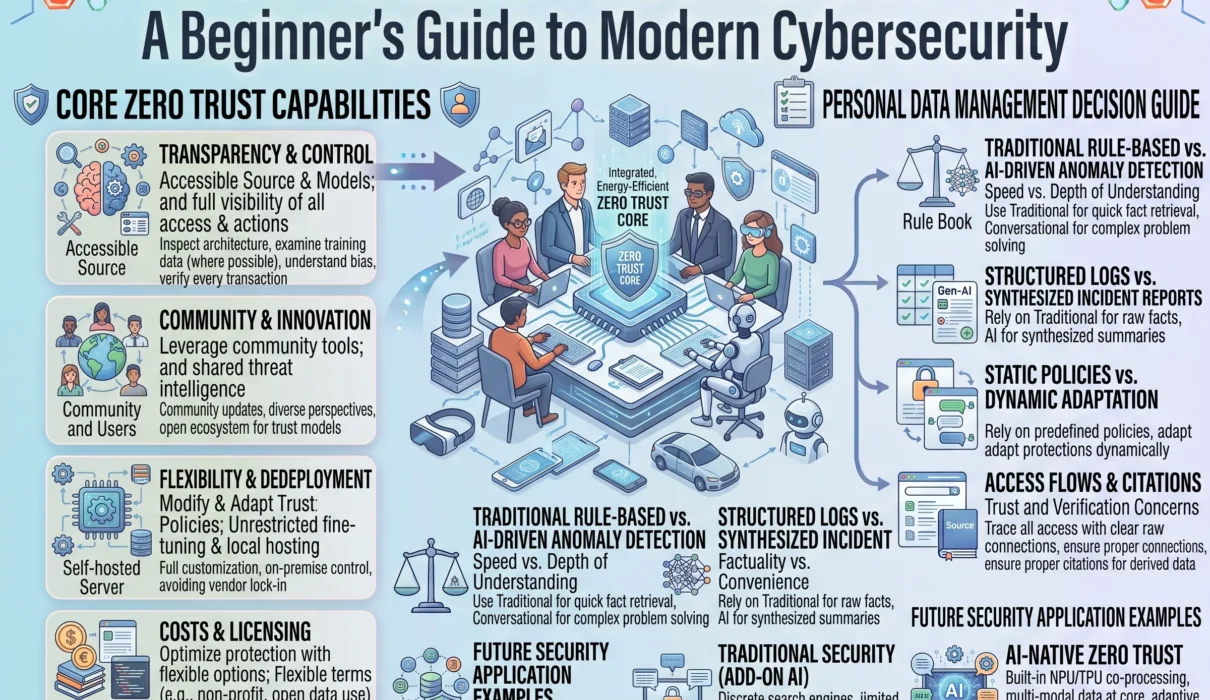
Zero Trust is not a single software product, a standalone appliance, or a vendor subscription. It is an end-to-end architectural philosophy for modern cybersecurity built on a simple, uncompromising premise: never trust, always verify.
Whether a connection request originates from an executive laptop in a corporate headquarters or an anonymous IP address across the globe, zero trust evaluates every transaction as if the network has already been breached.
                    THE SECURITY PARADIGM SHIFT

  CASTLE-AND-MOAT (Perimeter Security):
  [Untrusted World] ════► [FIREWALL / VPN] ════► [TRUSTED INTERNAL NETWORK]
                                                        │
                                                        ├─ Full lateral access
                                                        ├─ Implicit trust granted
                                                        └─ Single breach compromises all

  ZERO TRUST ARCHITECTURE:
  [Any User / Device / Service] ──► [Continuous Policy Engine] ──► [Explicit Micro-Perimeter]
                                              │
                                              ├─ Authenticate identity continuously
                                              ├─ Validate device health & posture
                                              ├─ Grant least-privilege access only
                                              └─ Assume breach at every hop
Understanding how zero trust architecture operates, how it redefines authentication and authorization, and how it transforms network security is essential for engineering leaders, IT professionals, and security practitioners striving to protect modern enterprises.
1. The Core Philosophy: “Never Trust, Always Verify”
Coined conceptually by Stephen Paul Marsh in 1994 and formalized into enterprise network design by Forrester Research analyst John Kindervag in 2010, Zero Trust dismantles the concept of default trust in computing systems.
In a traditional setup, trust is a binary property tied to physical network topology. If your device possesses an IP address on the internal corporate subnet 10.0.0.0/8, the network assumes you belong there.
Zero Trust replaces implicit topological trust with explicit, dynamic, risk-based verification.
┌────────────────────────────────────────────────────────────────────────┐
│                   THE THREE PILLARS OF ZERO TRUST                      │
├─────────────────────┬──────────────────────────────────────────────────┤
│ Fundamental Rule    │ Core Operational Requirement                     │
├─────────────────────┼──────────────────────────────────────────────────┤
│ 1. Verify Explicitly│ Always authenticate and authorize based on all   │
│                     │ available data points (identity, device, context)│
├─────────────────────┼──────────────────────────────────────────────────┤
│ 2. Use Least-       │ Limit user access with Just-In-Time (JIT) and    │
│    Privilege Access │ Just-Enough-Access (JEA), protecting data/assets │
├─────────────────────┼──────────────────────────────────────────────────┤
│ 3. Assume Breach    │ Minimize blast radius, segment access, encrypt   │
│                     │ end-to-end, and leverage analytics for visibility│
└─────────────────────┴──────────────────────────────────────────────────┘
Pillar 1: Verify Explicitly
Every access attempt—regardless of who is making it, what device they are holding, or where they are physically sitting—must be continuously authenticated and authorized using every available telemetry signal. A single successful login at 9:00 AM does not grant permission to query internal microservices at 2:00 PM without re-evaluating risk, context, and posture.
Pillar 2: Use Least-Privilege Access
Entities must be granted only the minimum level of access necessary to complete their immediate task, and no more. By combining Just-In-Time (JIT) access provisioning with Just-Enough-Access (JEA) controls, organizations eliminate standing administrative privileges. If a software engineer needs to troubleshoot a production database, access is provisioned ephemerally for ninety minutes, tightly scoped to a specific query layer, and revoked automatically upon completion.
Pillar 3: Assume Breach
Zero Trust operates under the assumption that adversaries already possess valid corporate credentials and maintain an active foothold inside the network. Security teams design systems to minimize the blast radius—ensuring that if an attacker compromises a single endpoint or an employee account, the architecture prevents them from moving laterally to access sensitive source code, customer records, or financial infrastructure.
2. Why the Castle-and-Moat Architecture Failed
To understand why modern enterprises are aggressively re-architecting around Zero Trust, we must examine the architectural vulnerabilities that caused the perimeter model to fail.
THE ANATOMY OF A PERIMETER BREACH (The Lateral Movement Trap)

1. External Phishing / Infostealer Credential Compromise
   Attacker steals VPN credentials for a Junior Marketing Associate.
   │
   ▼
2. VPN Ingress (Drawbridge Lowered)
   Attacker authenticates via corporate VPN; gains an internal `10.x.x.x` IP address.
   │
   ▼
3. Broad Subnet Reconnaissance
   Network grants implicit trust; attacker scans local subnet for open SMB/RDP ports.
   │
   ▼
4. Privilege Escalation & Lateral Movement
   Exploits unpatched internal print server, steals Domain Admin hash from memory.
   │
   ▼
5. Catastrophic Exfiltration
   Accesses primary customer database and deploys enterprise-wide ransomware.
1. The Disintegration of the Corporate Perimeter
Before the cloud revolution, enterprise IT was self-contained. Applications ran in a company-owned data center, employees sat at physical desks wired into local Ethernet switches, and company-issued desktop towers rarely left the facility.
Today, enterprise workloads are scattered across multi-cloud environments (AWS, Azure, GCP) and hundreds of software-as-a-service (SaaS) platforms (Salesforce, Microsoft 365, GitHub, Workday). Employees access internal systems from corporate laptops, personal smartphones, home Wi-Fi networks, and public airport hotspots. There is no physical parameter left to surround with a firewall.
2. The Credential Theft Epidemic and “Living off the Land”
Adversaries rarely “hack” their way into enterprise infrastructure using cinematic brute-force code; they log in using valid credentials.
Through credential stuffing, session token hijacking, infostealer malware logs, and sophisticated phishing campaigns, attackers acquire legitimate employee usernames and passwords. When an adversary presents valid credentials to a traditional VPN gateway, the castle-and-moat perimeter welcomes them inside.
Once inside, the attacker executes a “Living off the Land” (LotL) strategy—using native administrative tools (PowerShell, WMI, Remote Desktop Protocol) to map internal infrastructure, locate sensitive databases, and siphon data without triggering traditional antivirus alarms.
3. The Insider Threat and Supply Chain Vulnerabilities
Perimeter security provides zero protection against malicious insiders, compromised contractors, or third-party supply chain vulnerabilities. When solar monitoring systems, file transfer utilities, or IT management platforms inside the firewall are compromised, their location inside the “trusted zone” allows threat actors to compromise thousands of downstream targets unimpeded.
3. The NIST Zero Trust Architecture (SP 800-207) Framework
To move Zero Trust from an abstract corporate slogan into a standardized engineering discipline, the National Institute of Standards and Technology (NIST) published Special Publication 800-207. The NIST SP 800-207 document defines the formal reference architecture governing how modern zero trust architecture evaluates and controls every transaction.
┌────────────────────────────────────────────────────────────────────────┐
│               NIST SP 800-207 ZERO TRUST LOGICAL ARCHITECTURE          │
├────────────────────────────────────────────────────────────────────────┤
│                                                                        │
│   [Subject / User]                [Policy Engine (PE)]                 │
│         │                                  ▲                           │
│         │ (Requests Access)                │ (Makes Decision)          │
│         ▼                                  ▼                           │
│  ┌──────────────┐                 ┌──────────────────┐                 │
│  │ Policy       │◄───────────────►│ Policy           │                 │
│  │ Enforcement  │ (Control Plane) │ Administrator    │                 │
│  │ Point (PEP)  │                 │ (PA)             │                 │
│  └──────┬───────┘                 └──────────────────┘                 │
│         │                                                              │
│         │ (Data Plane: Encrypted Session Only)                         │
│         ▼                                                              │
│  [Target Enterprise Resource: API, Database, VM, SaaS]                 │
│                                                                        │
└────────────────────────────────────────────────────────────────────────┘
The NIST framework divides the Zero Trust architecture into three core logical components acting across a split Control Plane and Data Plane:
1. The Policy Enforcement Point (PEP)
The PEP is the gatekeeper deployed directly in front of enterprise resources. It is responsible for terminating client connections, inspecting inbound traffic, intercepting access requests, and enforcing security decisions handed down from the control plane. A PEP can manifest as an API gateway, a reverse proxy, a host-based agent running on an operating system, or a cloud access security broker (CASB).
2. The Policy Engine (PE)
The Policy Engine is the brain of the Zero Trust system. It is responsible for making the ultimate decision to grant, deny, or revoke access to a specific enterprise resource. The PE does not rely on static credentials; it queries enterprise policies and ingests real-time telemetry inputs (threat intelligence, identity stores, behavior analytics, continuous posture checks) to mathematically evaluate the risk of each individual request.
3. The Policy Administrator (PA)
The Policy Administrator acts as the operational conduit between the brain (Policy Engine) and the gatekeeper (Policy Enforcement Point). Once the Policy Engine determines that an access request is legitimate, the PA generates the ephemeral cryptographic credentials, updates firewall rules, or configures session tokens, commanding the PEP to establish a temporary, encrypted communication channel between the user and the requested resource.
4. Authentication vs. Authorization: The Modern Identity Paradigm
In traditional software systems, authentication and authorization were frequently conflated into a single checkpoint. You provided a password and a one-time code at login (Authentication: Who are you?), and the application unlocked a broad suite of read/write dashboard permissions (Authorization: What are you allowed to do?).
In a Zero Trust framework, identity is the new security perimeter, and authentication is decoupled from continuous authorization.
AUTHENTICATION vs. AUTHORIZATION IN ZERO TRUST

Authentication (AuthN): "Prove Your Identity"
[User / Service] ──► FIDO2 Passkey / WebAuthn ──► "Identity Confirmed: Alex, Lead Dev"

                             │
                             ▼
Continuous Authorization (AuthZ): "Evaluate Every Single Action"
Alex requests: `SELECT * FROM production_customers_table;`
  │
  ├─ Policy Check: Does Alex's role have active DB write access? ──► NO
  ├─ Posture Check: Is Alex's laptop compliant with disk encryption? ──► YES
  ├─ Location Check: Is this query originating from an anomalous IP? ──► NO
  └─ Context Check: Is there an approved, active Jira change ticket? ──► YES
  │
  ▼
DECISION: Grant Just-In-Time READ access for 15 minutes; log query hash.
Identity and Access Management (IAM) as the Foundational Layer
In the absence of a physical network boundary, your identity provider (IdP)—such as Okta, Microsoft Entra ID, Ping Identity, or Google Workspace—serves as the centralized control plane.
Every entity requesting access—whether an executive, a contractor, a background cron job, or a microservice container—must possess a cryptographically verifiable digital identity.
Phishing-Resistant Multi-Factor Authentication (MFA)
Traditional MFA methods (SMS text messages, voice calls, and standard mobile push notifications) are increasingly compromised by modern attack techniques like SIM-swapping, adversary-in-the-middle (AiTM) reverse proxy frameworks, and MFA-fatigue bombing.
Zero Trust requires phishing-resistant authentication protocols:
- FIDO2 and WebAuthn (Passkeys): Utilizes asymmetric public-key cryptography where private keys remain locked inside hardware secure enclaves (TPM chips or physical hardware security keys like YubiKeys). Authentication is cryptographically bound to the specific browser domain name, preventing malicious cloned login portals from harvesting authentication tokens.
- Certificate-Based Authentication (CBA): Direct mutual TLS (mTLS) handshakes where both the client and the server present cryptographically signed X.509 certificates to verify identity before a single byte of application data is exchanged.
Dynamic, Context-Aware Authorization (ABAC vs. RBAC)
Traditional Role-Based Access Control (RBAC) assigns static permissions based on job titles: All engineers have access to the staging servers; all finance staff have access to the billing portal. This model is too rigid and broad for modern security; if an engineer’s laptop is compromised, the attacker inherits all associated engineering access rights.
Zero Trust adopts Attribute-Based Access Control (ABAC) and Policy-Based Access Control (PBAC):
Authorization is calculated dynamically at runtime by evaluating contextual attributes:
- User Attributes: Role, department, training clearance, employment status.
- Resource Attributes: Sensitivity classification (Public, Confidential, Highly Restricted), data owner, compliance scope (PCI-DSS, HIPAA, GDPR).
- Environmental Attributes: Time of day, geographical location, threat intelligence indicators, network transit security.
- Device Posture Attributes: Operating system version, disk encryption state (BitLocker/FileVault), active Endpoint Detection and Response (EDR) agent status, hardware jailbreak/root indicators.
If an authenticated developer attempts to access a code repository from an unmanaged, personal tablet running an outdated operating system over public coffee-shop Wi-Fi, the Zero Trust policy engine automatically restricts access—either denying the connection entirely or forcing the session into an isolated, read-only browser sandbox.
5. The Core Pillars of Zero Trust Implementation
A comprehensive zero trust architecture extends verification and protection across every operational tier of modern enterprise computing.
┌────────────────────────────────────────────────────────────────────────┐
│                   THE SIX ZERO TRUST DEFENSE PILLARS                   │
├──────────────┬─────────────────────────────────────────────────────────┤
│ Pillar       │ Architectural Controls & Capabilities                   │
├──────────────┼─────────────────────────────────────────────────────────┤
│ 1. Identity  │ Phishing-resistant MFA, continuous adaptive risk scoring│
├──────────────┼─────────────────────────────────────────────────────────┤
│ 2. Devices   │ Hardware root-of-trust, automated posture validation    │
├──────────────┼─────────────────────────────────────────────────────────┤
│ 3. Networks  │ Micro-segmentation, Zero Trust Network Access (ZTNA)    │
├──────────────┼─────────────────────────────────────────────────────────┤
│ 4. Workloads │ Immutable container sandboxing, service-to-service mTLS │
├──────────────┼─────────────────────────────────────────────────────────┤
│ 5. Data      │ Automated discovery, data loss prevention, ubiquitous   │
│              │ encryption at rest and in transit                       │
├──────────────┼─────────────────────────────────────────────────────────┤
│ 6. Analytics │ Centralized XDR, automated SOAR playbooks, anomaly UEBA │
└──────────────┴─────────────────────────────────────────────────────────┘
1. Devices (Validating the Machine)
You cannot establish trust with a user if the machine they are operating is compromised. Zero Trust treats devices as untrusted endpoints until verified.
- Mobile Device Management (MDM) platforms and EDR agents evaluate hardware health before access is authorized.
- The system checks whether local firewalls are active, whether full-disk encryption is enabled, and whether the system has been patched against recently disclosed vulnerabilities.
- If an endpoint begins exhibiting suspicious process spawning or memory-dump behaviors, its trust score plummets, and the Policy Enforcement Point terminates active corporate sessions.
2. Networks: Micro-Segmentation and ZTNA
Zero Trust fundamentally transforms network security by replacing legacy Virtual Private Networks with Zero Trust Network Access (ZTNA).
LEGACY VPN vs. ZERO TRUST NETWORK ACCESS (ZTNA)

Legacy VPN Gateway (Network-Level Access):
[Remote User] ──► [VPN Concentrator] ──► [Placed Directly on Corporate Subnet]
                                                │
                                                ├─ Can scan all IP addresses
                                                └─ Visible to all subnet resources

Zero Trust Network Access (Application-Level Access):
[Remote User] ──► [ZTNA Outbound Connector] ──► [Target Application ONLY]
                                                       │
                                                       ├─ No IP network assignment
                                                       ├─ Dark to the rest of the network
                                                       └─ Other resources remain invisible
- The Problem with VPNs: A VPN provides broad network-level access. Once authenticated, the user’s computer becomes a physical extension of the corporate intranet, allowing bidirectional communication with hundreds of internal systems.
- The ZTNA Paradigm: ZTNA provides narrow application-level access. The user is never placed onto the network itself. Instead, lightweight outbound-only software connectors sit directly in front of individual applications, establishing micro-tunnels brokered through a cloud security platform.
- Dark Infrastructure: Internal applications possess no public IP addresses and reject direct inbound pings, rendering corporate infrastructure completely invisible to external port scanners and automated reconnaissance bots.
3. Workloads (Securing Microservices and APIs)
Modern cloud applications do not run as monolithic binaries; they run as dynamic distributed microservices across Kubernetes clusters and serverless functions.
- Zero Trust applies the principle of least privilege to east-west (service-to-service) network traffic.
- Microservices must not communicate simply because they reside inside the same Virtual Private Cloud (VPC).
- Service meshes (such as Istio or Linkerd) enforce mutual TLS (mTLS) between microservices, requiring every API call to present a cryptographically signed cryptographic identity (e.g., SPIFFE/SPIRE standards) to verify authorization before processing requests.
4. Data (Ubiquitous Encryption and Governance)
Data is the ultimate asset adversaries seek to compromise. Zero Trust focuses controls directly around the data layer:
- Continuous discovery tools automatically scan enterprise databases, object storage buckets (Amazon S3), and collaboration platforms to catalog and label sensitive information (PII, intellectual property, financial ledgers).
- Data is encrypted universally—both in transit (via TLS 1.3) and at rest (using AES-256 with customer-managed cryptographic keys).
- Modern architectures increasingly implement Data Loss Prevention (DLP) engines that inspect outbound traffic payloads to prevent unauthorized exfiltration.
6. Real-World Walkthrough: A Day in the Life of a Zero Trust Transaction
To visualize how Zero Trust functions in practice, consider what happens when a Remote Product Manager attempts to access an internal corporate product analytics portal.
                     A ZERO TRUST ACCESS TRANSACTION

  [Remote Product Manager]
             │
             ├─ 1. Submits identity credentials via FIDO2 Passkey
             ├─ 2. Local EDR agent sends cryptographic health report
             │
             ▼
  ┌────────────────────────────────────────────────────────────────────────┐
  │ CLOUD ZERO TRUST POLICY ENFORCEMENT BROKER                             │
  ├────────────────────────────────────────────────────────────────────────┤
  │ Telemetry Evaluation Pipeline:                                         │
  │ • Identity Check: Credentials valid; FIDO2 MFA passed.                 │
  │ • Geolocation Context: IP originating from London, UK (Matches history)│
  │ • Device Posture: BitLocker encrypted; EDR active; zero malware flags. │
  │ • Privilege Scope: User holds Product Manager role; authorized.       │
  │ • Risk Engine: Risk Score = 0.02 (Low / Safe).                         │
  └──────────────────────────────────┬─────────────────────────────────────┘
                                     │
                                     ▼
  [Brokers Outbound-Only TLS Micro-Tunnel to Internal Analytics Portal]
  User interacts with product dashboard. Entire session monitored for anomalies.
                                     │
                      (User connects to an open airport Wi-Fi)
                                     │
                                     ▼
  [Posture Shifts: Device Risk Score spikes; EDR detects unencrypted network]
  Policy Engine automatically downgrades session: Revokes file-download rights.
- Step 1: The Request: The employee navigates to
analytics.internal.company.com. Their browser requests access through a localized Zero Trust edge proxy. - Step 2: Signal Ingestion: Before routing a single packet to the application, the Policy Engine collects real-time telemetry:
- Identity Signals: Has the user authenticated with a phishing-resistant FIDO2 passkey within the last eight hours?
- Device Posture Signals: Does the laptop maintain an approved serial number? Is the operating system patched? Is the corporate EDR agent running and communicating healthy heartbeats?
- Contextual Signals: Is the request arriving from a country where the employee lives? Is the IP address flagged on global threat intelligence feeds? Does the time of access fit standard behavioral baselines?
- Step 3: The Evaluation & Access Grant: The Policy Engine evaluates the signals against enterprise access policies. The risk score falls well within safe boundaries. The Policy Administrator instructs the broker to establish a temporary, encrypted application-layer micro-tunnel directly to the analytics portal. The underlying network remains completely invisible to the user’s laptop.
- Step 4: Continuous Posture Verification: Two hours later, the employee unplugs their laptop, drives to an airport, and connects to an unencrypted public Wi-Fi network. While working, their device’s EDR agent flags a suspicious background network-probing attempt from an adjacent device on the local network.
- Step 5: Dynamic Remediation: The shift in environmental risk telemetry is immediately reported to the Policy Engine. Rather than waiting for the employee’s session to expire hours later, the system acts dynamically: it immediately terminates the existing session, alerts the SOC, and requires the employee to confirm biometric authentication while restricting their access permissions to read-only mode until they reconnect via a secured network.
7. Common Misconceptions and Implementation Challenges
Transitioning from a legacy perimeter architecture to Zero Trust is an operational journey. Organizations frequently stumble due to foundational misconceptions and organizational anti-patterns.
┌────────────────────────────────────────────────────────────────────────┐
│                   ZERO TRUST MYTHS vs. REALITIES                       │
├─────────────────────┬──────────────────────────────────────────────────┤
│ The Common Myth     │ The Operational Reality                          │
├─────────────────────┼──────────────────────────────────────────────────┤
│ "Zero Trust means   │ Zero Trust removes blind network trust; it does  │
│  you don't trust    │ not mean treating your staff as untrustworthy.   │
│  your employees."   │ It protects user identities from exploitation.   │
├─────────────────────┼──────────────────────────────────────────────────┤
│ "Zero Trust is a    │ No single vendor can sell you a complete Zero    │
│  product you can    │ Trust system. It is an architectural strategy    │
│  buy and deploy."   │ integrating IAM, endpoints, and micro-networks.  │
├─────────────────────┼──────────────────────────────────────────────────┤
│ "Zero Trust makes   │ When properly implemented, Zero Trust eliminates │
│  productivity slow  │ clunky VPN logins in favor of seamless, single-  │
│  and frustrating."  │ sign-on access to isolated application portals.  │
├─────────────────────┼──────────────────────────────────────────────────┤
│ "Zero Trust is only │ Complex legacy on-premises databases and custom  │
│  for cloud-native   │ monolithic software can be bridged into Zero     │
│  modern startups."  │ Trust architectures using modern reverse proxies.│
└─────────────────────┴──────────────────────────────────────────────────┘
Challenge 1: The Legacy Application Dilemma
Modern SaaS tools and cloud-native microservices easily integrate with modern identity protocols (SAML 2.0, OIDC, OAuth 2.0). However, many established enterprises still rely on legacy on-premises applications, ancient Windows file servers (SMB), or custom line-of-business software that relies on hardcoded IP addresses or legacy Kerberos/NTLM authentication.
The Solution: Organizations bridge legacy software into Zero Trust frameworks using Application Connectors and Identity-Aware Proxies (IAPs). These proxies sit on-premises adjacent to the legacy servers, handle modern federated authentication in the cloud, translate modern identity assertions into local legacy headers, and deliver access without exposing the underlying server to the wider corporate network.
Challenge 2: Cultural Friction and User Resistance
If an enterprise implements Zero Trust poorly—bombarding employees with multi-factor authentication prompts every fifteen minutes or blocking access to daily tools without clear explanations—users will attempt to circumvent security controls.
The Solution: The best Zero Trust implementations improve the end-user experience. Replacing cumbersome, slow, disconnect-prone VPN clients with seamless Zero Trust Network Access (ZTNA) gateways allows employees to click an application link and gain access instantly, shifting friction away from human workers and onto background algorithmic verification.
8. Strategic Blueprint: How Organizations Can Transition
Zero Trust cannot be implemented overnight. A successful transition follows a phased, progressive maturity model that secures critical enterprise assets without halting daily operations.
┌────────────────────────────────────────────────────────────────────────┐
│                   ZERO TRUST IMPLEMENTATION ROADMAP                    │
├─────────────────────┬──────────────────────────────────────────────────┤
│ Strategic Horizon   │ Tactical Implementation Deliverable              │
├─────────────────────┼──────────────────────────────────────────────────┤
│ Phase 1: Identity & │ • Consolidate directories into a cloud IdP.      │
│ Credential Hygiene  │ • Mandate phishing-resistant MFA (FIDO2).        │
│ (Months 1–3)        │ • Eliminate shared administrative credentials.   │
├─────────────────────┼──────────────────────────────────────────────────┤
│ Phase 2: Visibility │ • Inventory all hardware endpoints and assets.   │
│ & Endpoint Posture  │ • Deploy unified EDR agents across all laptops.  │
│ (Months 4–6)        │ • Enforce strict MDM device health policies.     │
├─────────────────────┼──────────────────────────────────────────────────┤
│ Phase 3: ZTNA &     │ • Identify top 10 most critical internal apps.   │
│ Micro-Segmentation  │ • Deprecate broad corporate VPN access in favor  │
│ (Months 7–12)       │   of application-specific ZTNA connectors.       │
├─────────────────────┼──────────────────────────────────────────────────┤
│ Phase 4: Automated  │ • Connect identity, endpoint, and cloud logs     │
│ Context & Response  │   into a unified XDR / SIEM platform.            │
│ (Months 13+)        │ • Automate session revocation for high-risk flags│
└─────────────────────┴──────────────────────────────────────────────────┘
Step 1: Inventory Your Protect Surface (The DAAS Elements)
Traditional cybersecurity focuses on securing the expanding “attack surface.” Zero Trust inverts this focus by prioritizing the Protect Surface, encapsulated by the DAAS framework:
- Data: What is our most sensitive intellectual property, customer data, and financial information?
- Applications: Which software tools and APIs execute business operations?
- Assets: Which physical servers, laptops, cloud virtual machines, and mobile devices interact with sensitive data?
- Services: Which underlying background infrastructure services (DNS, Active Directory, DHCP, CI/CD runners) keep the enterprise operational?
By mapping your Protect Surface, you identify the exact boundaries where micro-perimeters and Policy Enforcement Points must be deployed first.
Step 2: Map the Transaction Flows
You cannot secure what you do not understand. Examine how data legitimately moves across your organization:
- Which specific services does the accounting software need to talk to?
- Which databases does the customer support dashboard query?
- Who needs access to the production Kubernetes cluster?
Documenting these workflows allows engineers to write precise, restrictive access policies rather than relying on broad subnet permissions.
Step 3: Implement Zero Trust Network Access (ZTNA) Incrementally
Do not attempt to dismantle your entire corporate VPN architecture at once. Begin by identifying your highest-risk or most frequently accessed applications:
- Deploy a ZTNA connector in front of that specific application.
- Move a pilot group of remote employees to ZTNA access.
- Monitor traffic, refine access policies, and verify that the user experience is smooth.
- Systematically migrate applications one by one, reducing VPN access until the legacy VPN infrastructure can be shut down entirely.
Step 4: Establish Continuous Monitoring and Automated Containment
A Zero Trust architecture produces rich, structured telemetry. Because every access request, device health check, and authorization evaluation passes through a centralized control plane, security teams possess end-to-end visibility:
- Feed identity access logs, EDR telemetry, and ZTNA traffic into a centralized Extended Detection and Response (XDR) platform.
- Configure automated containment playbooks: if an employee’s risk score spikes due to an anomalous brute-force signature or malware execution, configure your Identity Provider to automatically revoke all active session tokens and quarantine the device from accessing enterprise applications.
Security in a World Without Boundaries
The era of trusting users simply because they sit inside an office building or connect through an internal network is over.
The threats confronting modern organizations—automated credential attacks, living-off-the-land techniques, sophisticated social engineering, and distributed supply chain compromises—have proved that static physical perimeters are obsolete.
Zero Trust security is the architectural answer to a world without boundaries.
By grounding every computing transaction in continuous, explicit verification, enforcing the principle of least privilege, and designing systems that assume breach by default, Zero Trust transforms cybersecurity from a brittle, reactive barrier into an adaptive, resilient operational framework.
In modern cybersecurity, security is not measured by the strength of your walls. It is defined by how effectively you verify, govern, and protect every individual identity, device, and piece of data within your ecosystem—every second of every day.