

 By
By The modern digital workplace has reached an inflection point. For nearly three decades, enterprise software followed a predictable, fragmented paradigm: workers operated as manual orchestrators between disconnected tools, copying customer data from emails into CRMs, transcribing meetings into task boards, and toggling across dozens of browser tabs to keep projects moving. Productivity was measured by how quickly employees could push data through rigid graphical user interfaces.
That model has collapsed under its own complexity.
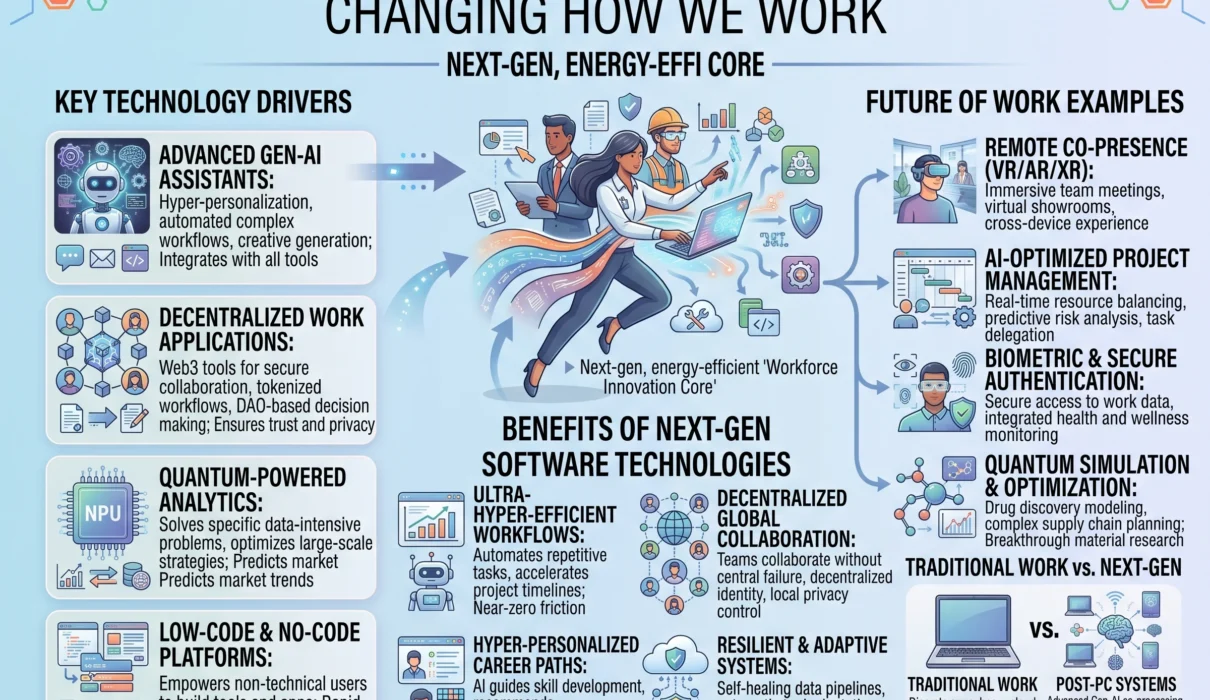
Today, a wave of new software technology is fundamentally transforming how organizations collaborate, make strategic decisions, and build products. We have shifted away from passive software that merely records data toward proactive, context-aware systems that anticipate needs and execute workflows autonomously.
From multimodal AI assistants and autonomous agent swarms to real-time generative collaboration canvases, modern productivity software is transitioning from a passive utility into an active digital colleague.
Understanding the architectural foundations of this transformation—and identifying which future software capabilities deliver genuine operational velocity rather than marketing hype—is critical for leaders navigating the modern enterprise.
                 THE PARADIGM SHIFT IN ENTERPRISE SOFTWARE

  TRADITIONAL SOFTWARE (Record-Keeper)
  [User Intent] ──► [Manual UI Clicks] ──► [Static Database Record]
                         │
                         └─ Data sits isolated; requires human trigger.

  INTELLIGENT SOFTWARE (Execution Engine)
  [High-Level Goal] ──► [Autonomous Agent Mesh] ──► [Contextual Synthesis]
                               │                           │
                               ▼                           ▼
                        [Tool Execution]           [Proactive Action]
                        (APIs, Webhooks)         (Updated CRM, Closed Tasks)
1. The Anatomy of Modern Intelligent Software
To understand why this software wave is different, we must examine the architectural layers that separate modern intelligent software from legacy SaaS platforms.
Traditional SaaS products are fundamentally relational databases paired with customized front-end interfaces. They excel at deterministic CRUD (Create, Read, Update, Delete) transactions. If a salesperson lands an enterprise contract, they manually click through input fields to update the record. The software does not understand what the contract represents, why the client agreed to the purchase, or what downstream delivery risks exist.
Modern AI software operates on a fundamentally different, cognitive stack:
┌────────────────────────────────────────────────────────────────────────┐
│                   THE INTELLIGENT SOFTWARE STACK                       │
├────────────────────────────────────────────────────────────────────────┤
│ 1. ADAPTIVE GENERATIVE UI                                              │
│    Interfaces that assemble on the fly based on intent, not rigid menus│
├────────────────────────────────────────────────────────────────────────┤
│ 2. REASONING & ORCHESTRATION LAYER                                     │
│    Agentic frameworks (ToT, ReAct) decomposing high-level directives   │
├────────────────────────────────────────────────────────────────────────┤
│ 3. ENTERPRISE SEMANTIC MEMORY (RAG & KNOWLEDGE GRAPHS)                 │
│    Vector stores & relational caches mapping company tribal knowledge  │
├────────────────────────────────────────────────────────────────────────┤
│ 4. DETERMINISTIC TOOL & API EXECUTION                                  │
│    Sandboxed runtimes, webhooks, and authenticated REST/GraphQL calls  │
└────────────────────────────────────────────────────────────────────────┘
- The Dynamic Interface Layer: Modern applications are discarding static menus in favor of generative user interfaces. Instead of requiring a user to locate buried filter menus, the interface synthesizes context-specific controls—a custom comparison table, a reactive data slider, or an editable Kanban board—tailored to the user’s active prompt.
- The Orchestration Core: The application relies on reasoning-tuned models to break down high-level business goals into sequential sub-tasks.
- The Semantic Memory Fabric: Using continuous Retrieval-Augmented Generation (RAG) and hybrid vector-relational databases, intelligent applications cross-reference internal documents, Slack threads, Jira tickets, and meeting recordings to ground outputs in enterprise truth.
- Deterministic Action Engines: Instead of stopping at conversational text, intelligent software executes actions through structured function calls: provisioning cloud instances, running Python data scripts in isolated WebAssembly micro-containers, and generating signed invoices.
2. Next-Generation AI Assistants: The Rise of Autonomous Coworkers
The initial wave of workplace AI assistants introduced conversational chatbots that drafted emails, wrote marketing outlines, or translated snippets of prose. While helpful, these systems were inherently reactive: they required explicit turn-by-turn prompting and operated in complete isolation from internal company tools.
Modern AI assistants have evolved into autonomous digital coworkers.
                     REACTIVE COPILOT vs. AUTONOMOUS AGENT

  [Reactive Assistant]  User: "Summarize this PDF." ──► Model outputs text. (Done)

  [Autonomous Agent]    User: "Resolve delinquent invoices for Tier-1 accounts."
                               │
                               ▼
                        [1. Queries Stripe API for unpaid balances > 30 days]
                        [2. Checks Zendesk to verify no open billing disputes]
                        [3. Drafts tailored reminder referencing contract terms]
                        [4. Schedules Slack alerts for assigned Account Execs]
                        [5. Flags accounts requiring human manager sign-off]
Contextual Awareness Across Enterprise Silos
The core failure of early digital assistants was their inability to reference broader operational context. If an assistant does not know that a customer sent an angry email three hours ago, automated outreach can damage client relations.
New software platforms maintain unified enterprise context graphs. They continuously ingest company communications across Slack, Microsoft Teams, email threads, Google Workspace, and project boards.
When a team member prepares for a sales negotiation or a sprint planning session, modern assistants automatically compile a situational dossier:
- Key project milestones achieved over the last quarter.
- Active blockers flagged across commit histories and tickets.
- Critical personnel shifts, sentiment changes, and outstanding budget approvals.
Asynchronous Meeting Intelligence
Meetings have historically been massive productivity sinks, consuming hours of focus while producing scattered notes that rarely translate into aligned action.
Advanced meeting software has moved beyond raw speech-to-text transcription. Modern intelligent collaboration engines automatically:
- Identify specific speakers and map voiced commitments to individual Jira or Linear tickets.
- Flag unaddressed disagreements or unresolved ambiguities during strategic debates.
- Deliver localized meeting synopses to absent stakeholders, highlighting only the specific portions of the conversation relevant to their department or deliverables.
3. Intelligent Automation and Agentic Orchestration
For the past decade, enterprise workflow automation was dominated by Robotic Process Automation (RPA) and standard trigger-action tools like Zapier and Make. These tools were valuable, but they were fragile: if an API endpoint changed, an email format altered slightly, or a web element moved three pixels to the left, the automated script hard-failed.
Agentic automation replaces brittle conditional scripts with adaptive cognitive logic.
                     TRADITIONAL RPA vs. AGENTIC AUTOMATION

  Traditional RPA:
  Trigger ──► Step A (Parse Field) ──► Step B (Write Row) ──► Error? ──► Hard Crash

  Agentic Automation:
  Goal ──► Perceive Environment ──► Formulate Plan ──► Execute Tool
                  ▲                                         │
                  │              (Detects Schema Change)    │
                  └──────── Adaptive Self-Correction ◄──────┘
Modern intelligent automation systems operate via recursive reasoning loops, such as ReAct (Reason + Act) and dynamic plan-and-solve architectures:
| Automation Dimension | Legacy RPA / Trigger-Action | Agentic AI Automation |
| Logic Foundation | Hardcoded, deterministic rules | Dynamic reasoning models (LLMs) |
| Data Ingestion | Strictly structured inputs (JSON/CSV) | Messy, unstructured (PDFs, Audio, Scans) |
| Adaptability | Crashes on unhandled edge cases | Self-reflects, retries, and adapts paths |
| Tool Integration | Fixed webhooks and screen scrapers | Dynamic API selection and function calls |
| Human Supervision | All-or-nothing execution | Human-in-the-Loop confidence thresholds |
Multi-Agent Workflows in Production
Rather than deploying a single, overloaded AI model to manage an entire operational process, modern software deploys specialized Multi-Agent Systems (MAS):
- The Coordinator Agent: Analyzes an incoming operational goal, decomposes the task into dependency graphs, and delegates assignments.
- The Research Agent: Queries internal documentation, data warehouses, and public search engines to gather verified information.
- The Code/Execution Agent: Generates and runs programmatic scripts to process datasets, run calculations, or update external systems.
- The Critic/Compliance Agent: Audits the outputs of the worker agents against enterprise security guidelines, legal regulations, and formatting standards before changes are committed.
By decoupling tasks across specialized agent nodes, organizations achieve higher process reliability while reducing compounding error rates.
4. Modern Collaboration Tools: The End of Static Documents
For decades, digital workplace collaboration mirrored the physical office: we authored static documents, sent static slide decks as attachments, and discussed them via asynchronous email chains. Even cloud tools like Google Docs and Microsoft 365 initially replicated the physical paper page on a digital screen.
Modern collaboration software is abandoning the document model entirely. Workspaces are transforming into living, multimodal knowledge canvases.
                THE EVOLUTION OF WORKPLACE COLLABORATION

  Era 1: File-Centric (1990s–2000s)
  [Local Word/Excel File] ──Email Attachment──► [Version Conflicts (v2_final_FINAL)]

  Era 2: Cloud-Sync (2010s)
  [Cloud Collaborative Document] ──► Real-Time Multiplayer Typing (Google Docs)

  Era 3: Dynamic Knowledge Mesh (Modern)
  [Infinite Semantic Canvas] ◄──► Live Databases + AI Orchestration + Real-Time Logic
Unified Knowledge Operating Systems
Platforms like Notion, Linear, Coda, and specialized enterprise command centers have merged documents, relational databases, and task execution into fluid operating environments:
- Database-Document Fluidity: A paragraph in a project outline can transform into a prioritized roadmap ticket, pull live revenue figures from Snowflake, and embed a reactive Figma design frame without leaving the canvas.
- Contextual Multiplayer: Modern collaborative canvases monitor concurrent edits in real time, intelligently resolving conflicting contributions and suggesting cross-functional dependencies across marketing, design, and engineering teams.
Real-Time Generative Ideation Canvases
Visual collaboration platforms like Miro, FigJam, and Canva have evolved beyond static whiteboards. Teams now use generative spatial workspaces to brainstorm and design:
- Designers sketch rough wireframes with a digital stylus, and on-canvas AI models synthesize them into fully editable, production-ready vector components and React code in real time.
- Strategy teams drop customer feedback transcripts onto a canvas, and clustering algorithms automatically synthesize thousands of unstructured notes into thematic journey maps, highlighting customer pain points and revenue opportunities.
5. Next-Generation Cloud Software and Data Infrastructures
The rapid rollout of data-intensive, intelligent applications has exposed the limitations of traditional cloud hosting architectures. Standard monolithic hosting setups were never designed to manage massive embedding queries, dynamic model serving, and distributed token streaming.
A new wave of cloud software infrastructure is emerging to power the next generation of business tools.
┌────────────────────────────────────────────────────────────────────────┐
│               MODERN ENTERPRISE DATA & CLOUD TOPOLOGY                  │
├────────────────────┬────────────────────┬──────────────────────────────┤
│  HYBRID DATA MESH  │  SERVERLESS RUNTIME│    SECURITY PERIMETER        │
├────────────────────┼────────────────────┼──────────────────────────────┤
│ Relational SQL     │ Edge micro-VMs     │ Zero-Trust Access            │
│ Vector Embeddings  │ (Wasm / Firecracker│ Confidential enclaves        │
│ Graph Databases    │ sub-millisecond)   │ Local air-gapped models      │
└────────────────────┴────────────────────┴──────────────────────────────┘
The Hybrid Vector-Relational Data Mesh
AI applications require both structured facts (e.g., Is customer X’s account active?) and semantic relationships (e.g., Which past support tickets are conceptually similar to this new issue?).
Modern data platforms unify these capabilities. Instead of forcing engineering teams to manage disconnected database systems—running PostgreSQL for customer tables, Pinecone for vector embeddings, and Neo4j for relationship graphs—modern cloud platforms integrate vector indexing and graph traversals directly alongside relational engines (such as pgvector and hybrid multi-modal data engines).
This allows applications to execute complex, grounded semantic queries with enterprise-grade consistency guarantees.
WebAssembly (Wasm) and Micro-Edge Runtimes
Traditional cloud containers (like Docker) are powerful, but spinning them up can introduce cold-start latencies measuring several seconds.
Modern productivity platforms rely on WebAssembly (Wasm) and lightweight micro-virtual machines (such as Firecracker). These runtimes can spin up securely isolated execution sandboxes in under 10 milliseconds.
When a user in a financial modeling tool requests an automated analysis of a million spreadsheet rows, the software spins up an isolated sandbox right at the edge network closest to the user, runs the Python calculations safely, and shuts down instantly—delivering local-speed performance without compromising cloud security.
6. Software Development Transformed: How Engineers Build Today
No sector of knowledge work has been more directly transformed by new software technology than software development itself. The modern developer’s daily workflow has shifted from manual syntax typing to architectural design, verification, and agent supervision.
                     CONVENTIONAL vs. AGENTIC SOFTWARE DELIVERY

  Conventional SDLC:
  Jira Ticket ──► Human Writes Code ──► Manual Testing ──► PR Review ──► CI Deploy

  Agentic SDLC:
  Jira Ticket
      │
      ▼
  ┌───────────────────────────────────────────────────────────────────────┐
  │ AGENTIC CODING RUNTIME (e.g., Cursor, Claude Code, GitHub Copilot)    │
  │ • Clones repository, parses multi-file dependencies, writes feature   │
  │ • Runs localized test suite; reads compiler errors; self-debugs logic │
  │ • Submits pull request with architectural rationale & test coverage   │
  └───────────────────────────────────┬───────────────────────────────────┘
                                      │
                                      ▼
                      Human Staff Engineer: Code Audit & Verification
Beyond Autocomplete to Agentic Coding
First-generation developer assistants provided inline token autocomplete, suggesting the next few characters or lines of code.
Modern software development tools operate as full-stack engineering agents:
- Multi-File Context Awareness: Advanced environments index entire code repositories, understanding how a database schema change in a PostgreSQL migration file impacts backend Go handlers, frontend React state wrappers, and GraphQL schemas simultaneously.
- Autonomous Test Synthesis & Self-Healing: Coding agents write exhaustive unit and integration test suites, intentionally testing edge cases like malformed payloads and race conditions. If an automated build fails in the CI pipeline, diagnostic agents read the error logs, identify the faulty commit, apply a patch, verify that tests pass, and draft a pull request for human review.
This efficiency dividend allows small, focused engineering groups to design, build, and maintain platforms that previously required dozens of specialized developers.
7. Security, Governance, and Trust in the Age of Intelligent Apps
Deploying intelligent, autonomous software across enterprise workflows introduces security challenges that legacy firewalls and static identity access management tools cannot address.
When software possesses the agency to read private emails, query production databases, and trigger financial transactions, security architecture must evolve from implicit perimeter trust to continuous verification.
                      THE ENTERPRISE AI THREAT SURFACE

  Indirect Prompt Injection:
  [Untrusted Inbound Data] ──► Injected Instruction Overrides Model Logic

  Privilege Escalation:
  [Autonomous Agent] ──► Unbounded API Token ──► Unauthorized Data Exfiltration

  Data Sovereignty Leaks:
  [Enterprise Inputs] ──► Public Cloud LLM ──► Stored in Third-Party Training Data
To deploy modern software technologies safely, leading enterprises enforce three core security architectures:
1. Zero Trust Architecture and Scoped Agent Credentials
Organizations must never grant an autonomous assistant unrestricted administrative credentials.
Intelligent tools must operate under the Principle of Least Privilege (PoLP):
- Dynamic, ephemeral OAuth tokens that expire after specific tasks are completed.
- Strict functional separation: an agent tasked with customer sentiment analysis is provisioned with read-only access to Zendesk tickets and is physically barred from accessing payment processing or database write APIs.
2. Guardrails Against Indirect Prompt Injection
The most persistent vulnerability facing intelligent software is indirect prompt injection—where adversarial instructions hidden inside external data (such as a customer email, a vendor invoice, or an untrusted web page) hijack the system’s reasoning loop.
Modern software security layers deploy deterministic guardrails that sanitize inputs and validate outputs. Untrusted external data is segregated from system instructions, ensuring the model treats third-party inputs strictly as passive data rather than executable directives.
3. Data Privacy and Confidential Enclaves
To protect proprietary enterprise data from leaking into public training datasets, organizations are establishing clear boundaries:
- Enforcing Zero Data Retention (ZDR) enterprise agreements with foundation model providers.
- Deploying open-weight language models inside secure, self-hosted cloud enclaves or on local on-device hardware (NPUs and AI PCs) where proprietary code and confidential files never traverse external networks.
8. Strategic Blueprint: How Organizations Can Prepare
Adopting modern productivity software is not merely an IT procurement exercise; it requires rethinking operational workflows, data architecture, and workforce culture.
Organizations that simply layer AI assistants on top of fragmented, undocumented processes will only amplify operational chaos.
┌────────────────────────────────────────────────────────────────────────┐
│                   SOFTWARE MODERNIZATION ROADMAP                       │
├─────────────────────┬──────────────────────────────────────────────────┤
│ Strategic Pillar    │ Key Tactical Priority                            │
├─────────────────────┼──────────────────────────────────────────────────┤
│ Clean Data Meshes   │ Standardize internal schemas, eliminate data     │
│                     │ silos, and document APIs with clear specs.       │
├─────────────────────┼──────────────────────────────────────────────────┤
│ Progressive         │ Start with human-in-the-loop approvals before     │
│ Autonomy            │ granting full autonomous execution rights.       │
├─────────────────────┼──────────────────────────────────────────────────┤
│ Tool Consolidation  │ Replace disconnected single-purpose apps with    │
│                     │ unified, multi-modal knowledge workspaces.       │
├─────────────────────┼──────────────────────────────────────────────────┤
│ Cultural Reskilling │ Train knowledge workers in verification, task    │
│                     │ decomposition, and strategic orchestration.      │
└─────────────────────┴──────────────────────────────────────────────────┘
1. Clean and Structure Your Internal Data Layer
Intelligent software is only as effective as the underlying data it references. If your enterprise documentation is scattered across outdated Google Drive folders, locked inside private inboxes, and burdened with broken links, your AI tools will produce inaccurate, hallucinated outputs.
Prioritize data hygiene: establish single sources of truth, maintain clean API documentation (such as OpenAPI schemas), and deprecate legacy knowledge silos.
2. Adopt a Progressive Autonomy Framework
When deploying agentic automation, avoid jumping directly to unattended autonomy:
- Stage 1 (Assistive): The software generates recommendations or drafts; a human manually executes every action.
- Stage 2 (Supervised): The software executes routine tasks autonomously but escalates high-impact decisions (e.g., expenditures over $1,000, database alterations, public messaging) to human operators for explicit approval.
- Stage 3 (Autonomous with Guardrails): The system operates autonomously within strict, mathematically monitored boundaries, notifying human managers only when anomalous behaviors are detected.
3. Reskill Teams for Strategic Orchestration
As generative tools commoditize the routine creation of text, code, and basic designs, competitive advantage shifts toward workers who excel at:
- System Architecture & Problem Framing: Clearly articulating the parameters of a business problem so software tools can execute it accurately.
- Critical Verification: Auditing outputs with deep domain expertise to catch subtle flaws that automated systems miss.
- Cross-Disciplinary Synthesis: Connecting insights across engineering, product design, marketing, and legal domains to ship meaningful business outcomes rapidly.
The New Reality of Work
The rise of new software technology is not about replacing human ingenuity; it is about eliminating the digital busywork that has stifled it for decades.
For thirty years, knowledge workers spent their days acting as human bridges between disconnected digital systems: copying rows, drafting routine updates, formatting presentations, and managing administrative overhead.
The convergence of AI assistants, autonomous workflow engines, collaborative canvases, and intelligent cloud platforms is removing that operational friction.
As software transitions from passive tools to proactive collaborators, organizations face a clear choice: continue running organizations as manual data-routing hubs, or build modern, agentic workflows that turn strategic ambition into automated execution.
The future of work has arrived—and it is powered by software that works with us, adapts to us, and amplifies our capacity to build.