

 By
By For more than half a century, the fundamental nature of writing computer software remained remarkably consistent. A human engineer conceptualized system architecture, opened an Integrated Development Environment (IDE), and manually typed characters, line by line, translating business requirements into formal programming syntax. If a bug appeared, that same engineer spent hours reading stack traces, inserting print statements, and scanning memory dumps.
That era of purely manual code authoring has permanently broken down.
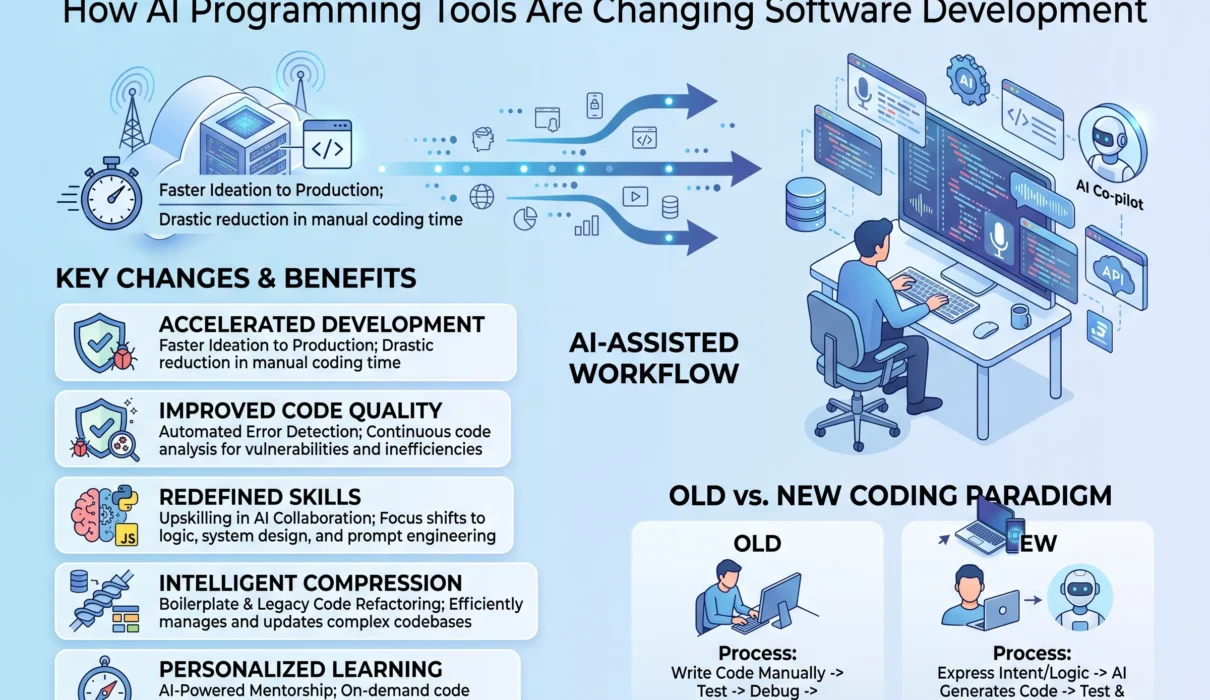
We are witnessing an unprecedented architectural shift in how digital systems are designed, constructed, maintained, and verified. Modern AI coding tools are moving beyond line-level tab-completions into autonomous agentic systems capable of orchestrating multi-file codebases, planning database migrations, diagnosing production regressions, and writing comprehensive test suites.
This shift is redefining the software development lifecycle (SDLC). The modern developer is no longer a manual syntax typist; they are evolving into a system architect, an AI orchestrator, and a code reviewer.
Understanding how AI programming works, how AI developer tools operate across every phase of engineering, and how the developer workflow is adapting to this reality is essential for any engineering team striving to remain competitive.
1. The Evolution of AI-Assisted Programming
To understand where coding assistants are heading, we must examine how the underlying technology developed over four distinct generations.
THE EVOLUTION OF AI PROGRAMMING ENVIRONMENTS

Generation 1 (Rule-Based):
[AST Parsing / LSP] ──► Static Type Checking ──► Primitive Autocomplete (Ctrl+Space)

Generation 2 (Statistical & Early LLM):
[Single-Line Prediction] ──► Token Completion ──► Inline Boilerplate Suggestions

Generation 3 (Context-Aware IDEs):
[Multi-File Context] ──► RAG over Git Repos ──► In-Editor Chat & Multi-Line Edits

Generation 4 (Agentic & Orchestrated):
[CLI / Autonomous Agents] ──► Shell Execution ──► Self-Debugging ──► Automated PRs
Generation 1: Deterministic Autocompletion (Language Server Protocol)
Before deep learning models entered software engineering, developer tooling relied strictly on deterministic parsing. Language servers constructed Abstract Syntax Trees (ASTs) in real time. When a developer typed user., the IDE introspected the compiled object class to display accessible methods, properties, and typed interfaces. While accurate, these tools had zero semantic understanding of user intent; they were mechanical dictionaries for code syntax.
Generation 2: Autoregressive Token Completion
The rollout of first-generation AI assistants (such as the original implementations of GitHub Copilot and Tabnine) introduced transformer-based next-token prediction to the editor. By training on billions of lines of public code, these models treated source code as structured natural language. They predicted single lines or small blocks of repetitive boilerplate (e.g., standard for loops, HTTP fetch requests, or serialization logic). However, they were restricted to tiny context windows, had zero knowledge of external project files, and frequently hallucinated non-existent APIs.
Generation 3: Context-Aware In-Editor Orchestrators
As context windows expanded to hundreds of thousands of tokens and Retrieval-Augmented Generation (RAG) became standard, tools like Cursor, Windsurf, and modern enterprise Copilot extensions revolutionized developer workflows.
These AI developer tools ingest the entire workspace: active file buffers, git diffs, project directory trees, dependency manifests, and linting configurations. Instead of merely guessing the next line, they permit natural-language directives across multiple files simultaneously: “Refactor our authentication middleware to use standard JWT validation and update the associated API route handlers.”
Generation 4: Autonomous Agentic Runtimes (CLI & Headless Execution)
Today, the industry is entering the agentic era, pioneered by tools like Anthropic’s Claude Code, OpenAI Codex runtimes, and Devin-style autonomous workflows.
These systems do not stay confined to an editor chat sidebar. They operate directly within developer shells and CI/CD pipelines. Given an issue ticket, an agent reads the codebase, formulates a plan, runs shell commands, triggers test runners, reads compiler errors, modifies multiple files, re-runs tests until they pass, and drafts a complete git pull request.
+------------------+-----------------------------+---------------------------------+
| Generation       | Primary Paradigm            | Developer Interaction Model     |
+------------------+-----------------------------+---------------------------------+
| Gen 1 (Static)   | AST & Type Inspection       | Manual trigger (Ctrl + Space)   |
| Gen 2 (Token)    | Autoregressive Next-Token   | Inline Tab-to-accept            |
| Gen 3 (Context)  | Repository RAG & In-IDE     | Conversational Prompting & Diff |
| Gen 4 (Agentic)  | Autonomous Terminal Loops   | Objective-Validation & Review   |
+------------------+-----------------------------+---------------------------------+
2. Code Generation and the Reality of “Vibe Coding”
The most prominent feature of modern AI coding tools is automated synthesis. Where developers once spent days setting up database schemas, writing CRUD endpoints, and wiring API clients, AI systems generate end-to-end features in minutes.
This dynamic gave rise to the industry phenomenon known as “vibe coding”—a workflow where an engineer (or non-technical product builder) describes what they want in natural language and lets generative systems write, arrange, and debug the underlying software.
NATURAL-LANGUAGE DIRECTIVE:
"Create a resilient rate-limiting middleware in Go using Redis token buckets,
supporting sliding windows, IP fallback, and custom HTTP 429 headers."
                                │
                                ▼
┌───────────────────────────────────────────────────────────────────┐
│                     AI ENGINE SYNTHESIS LAYER                     │
│  • Employs sliding-window Lua scripts for atomic Redis updates    │
│  • Configures exponential backoff retry algorithms                │
│  • Enforces non-blocking thread execution                         │
│  • Generates idiomatic Go struct interfaces and unit mocks        │
└───────────────────────────────────────────────────────────────────┘
The Architectural Depth of Modern Generation
Early code generation was notorious for producing toy examples—single functions devoid of error handling, security checks, or structural scalability. Contemporary foundation models approach code generation with architectural context:
- Idiomatic Design Patterns: Rather than writing generic code, modern engines adopt the established patterns of the target repository. If a repository uses clean architecture with dependency injection in TypeScript, the AI mirrors that structure instead of dumping raw imperative code into a single file.
- Atomic Context Stitching: When generating a backend route, the tool checks existing database schemas, imports authenticated session wrappers, references existing validation libraries (e.g., Zod, Pydantic), and outputs production-grade code that matches the project’s formatting rules.
- Cross-Language Translation and Porting: Engineering teams are migrating legacy enterprise codebases (such as ancient COBOL mainframes, Python 2 services, or legacy Java 8 microservices) into modern languages like Rust, Go, or TypeScript. AI programming tools analyze business logic, decouple it from legacy runtimes, and rewrite it with modern concurrency models and static type safety.
3. Intelligent Debugging and Root-Cause Analysis
Software debugging has traditionally been one of the most mentally taxing aspects of engineering. Tracking down transient memory leaks, distributed microservice race conditions, and esoteric dependency conflicts can stall feature releases for days.
Modern AI developer tools have fundamentally shifted debugging from brute-force triage to automated semantic analysis.
                     CONVENTIONAL vs. AI-DRIVEN DEBUGGING

  [Traditional]  Stack Trace ──► Manual Log Grep ──► Web Search ──► Trial & Error Edit

  [AI-Driven]    Production Alert
                        │
                        ▼
                 ┌────────────────────────────────────────────────────────┐
                 │ Diagnostic Agent ingests:                              │
                 │ 1. Distributed trace logs (OpenTelemetry)             │
                 │ 2. Recent git blame & commit diffs                    │
                 │ 3. Memory & CPU telemetry                              │
                 └──────────────────────────┬─────────────────────────────┘
                                            │
                                            ▼
                 Locates off-by-one race condition in Redis caching layer.
                 Applies patch, runs regression suite, drafts hotfix PR.
How AI Diagnostic Systems Work
Instead of passively waiting for a developer to paste an error message into a chat window, modern debugging workflows connect directly to runtime environments:
- Log and Trace Ingestion: Tools parse unstructured terminal logs, correlate distributed traces across microservices, and filter out noisy operational warnings to isolate the exact line and state where the error occurred.
- Temporal Context Mapping: The tool evaluates the active bug against the repository’s git commit history. It identifies which specific commit introduced the regression, evaluates the original author’s intent, and detects unintentional side effects.
- Autonomous Error Reproduction: Advanced coding agents write reproduction scripts. When presented with an intermittent bug, the agent constructs a minimal reproduction test, executes it locally in a sandboxed shell, verifies that it reproduces the exact crash, modifies the source code, and proves the fix by demonstrating that the reproduction script now passes.
4. Automated Testing and Test-Driven Development (TDD)
Writing tests is widely acknowledged as essential for enterprise software reliability, yet it remains one of the most frequently skipped or rushed phases of development. Developers routinely test the “happy path” while neglecting edge cases, boundary errors, and network failure modes.
AI programming tools have transformed testing from a manual chore into an automated byproduct of development.
┌────────────────────────────────────────────────────────────────────────┐
│                     THE AI TESTING SUITE LIFECYCLE                     │
├─────────────────────┬──────────────────────────────────────────────────┤
│ Test Strategy       │ Automated Implementation                         │
├─────────────────────┼──────────────────────────────────────────────────┤
│ Unit Testing        │ Synthesizes table-driven unit tests; mocks       │
│                     │ external DB/API calls with realistic fixtures.   │
├─────────────────────┼──────────────────────────────────────────────────┤
│ Edge-Case Fuzzing   │ Injects boundary violations: null bytes, integer │
│                     │ overflows, malformed UTF-8, and network drops.   │
├─────────────────────┼──────────────────────────────────────────────────┤
│ Integration Testing │ Orchestrates Docker-based container services and │
│                     │ executes end-to-end API payload verifications.   │
├─────────────────────┼──────────────────────────────────────────────────┤
│ Regression Guard    │ Analyzes git pull requests to generate targeted  │
│                     │ tests covering recently modified code branches.  │
└─────────────────────┴──────────────────────────────────────────────────┘
Inverting the Cost of Test-Driven Development
Historically, strict Test-Driven Development (TDD)—writing tests before writing implementation code—carried a high initial development cost. AI coding tools lower this friction:
- Interface-First Spec Generation: An engineer defines an abstract interface or API schema.
- Automated Suite Synthesis: The AI generates dozens of test cases covering expected inputs, empty collections, unauthorized access attempts, and unexpected disconnections.
- Implementation Scaffolding: The engineer uses the AI assistant to synthesize business logic that satisfies the test suite, ensuring high test coverage from the very first commit.
Furthermore, AI tools excel at mutation testing. The AI deliberately injects bugs into your application code (such as swapping operators, modifying return values, or bypassing conditionals) to verify whether your existing test suites actually catch the synthetic errors. If a mutation survives without triggering a test failure, the AI writes the missing assertion to close the gap.
5. Living Documentation and Automated Knowledge Transfer
One of the greatest points of friction inside engineering organizations is outdated documentation. Code evolves rapidly under continuous delivery, while README files, Swagger API schemas, and architectural diagrams inevitably lag behind.
This documentation debt creates steep onboarding curves for new hires, leads to duplicated engineering efforts, and fosters tribal knowledge silos where only one or two senior engineers understand how legacy systems operate.
                      CONTINUOUS DOCUMENTATION ENGINE

        Commit / PR Event
                │
                ▼
  ┌───────────────────────────────┐
  │ Dynamic Code Diff Extraction  │
  └─────────────┬─────────────────┘
                │
                ▼
  ┌───────────────────────────────┐
  │   LLM Semantic Parser         │ ──► Identifies changed API parameters, schemas,
  └─────────────┬─────────────────┘     and architectural dependencies
                │
                ├────────────────────────────────┬───────────────────────────────┐
                ▼                                ▼                               ▼
     [Auto-Updated OpenAPI]           [Generated Mermaid.js]          [Slack / Jira Release]
     Keeps API docs in sync           Updates architecture diagrams   Summarizes changes for PMs
From Static Markdown to Living Architectural Knowledge
AI programming tools are transforming documentation from static text into automated, real-time context engines:
- In-Line Documentation & Docstrings: Assistants automatically synthesize typed, standard-compliant docstrings (JSDoc, Sphinx, GoDoc) that accurately reflect function arguments, return types, thrown exceptions, and side effects.
- Automated Architecture Diagrams: Tools parse codebase dependency graphs and generate dynamic diagrams using syntax engines like Mermaid.js or PlantUML. When a microservice architecture changes, the visual system diagrams update automatically in the CI pipeline.
- Contextual Codebase Querying: Instead of relying on a human mentor to explain how an undocumented payment gateway operates, a newly onboarded engineer can query the codebase directly: “Walk me through how an invoice is marked as delinquent, and show me every database table and message queue touched during that transaction.” The tool responds with code references, architectural flowcharts, and links to relevant commits.
6. The Changing Developer Workflow: From Typist to Orchestrator
The cumulative impact of these technologies is not merely that developers write code faster. It is that the fundamental nature of the job has changed.
The software developer’s daily workflow is shifting from manual execution to strategic direction and verification.
LEGACY WORKFLOW (PRE-AI):
┌──────────────┐     ┌──────────────┐     ┌──────────────┐     ┌──────────────┐
│  Requirements│ ──► │  Manual Code │ ──► │ Manual Unit  │ ──► │ Manual PR    │
│  Analysis    │     │  Authoring   │     │  Testing     │     │  Review      │
│  (15% Time)  │     │  (55% Time)  │     │  (20% Time)  │     │  (10% Time)  │
└──────────────┘     └──────────────┘     └──────────────┘     └──────────────┘

AI-AUGMENTED WORKFLOW:
┌──────────────┐     ┌──────────────┐     ┌──────────────┐     ┌──────────────┐
│ Architecture │ ──► │ AI Prompt &  │ ──► │ Automated    │ ──► │ Critical Code│
│  & System    │     │ Agentic Tool │     │ Validation & │     │ Review & QA  │
│  Design      │     │ Orchestration│     │ Mutation Test│     │ & Security   │
│  (35% Time)  │     │  (15% Time)  │     │  (20% Time)  │     │  (30% Time)  │
└──────────────┘     └──────────────┘     └──────────────┘     └──────────────┘
The New Core Competencies of Software Engineers
Because writing raw syntax is increasingly commoditized, the skills that define a top-tier software engineer have transformed:
- System Architecture and Boundary Design: AI agents excel at implementing tasks within clear boundaries. However, deciding where those boundaries lie—how microservices communicate, where state is managed, how data consistency is preserved, and how systems scale—remains the responsibility of human engineers.
- Objective Formulation & Task Decomposition: Vague instructions produce fragmented, buggy code. The best developers possess exceptional clarity of thought: the ability to deconstruct a massive enterprise requirement into unambiguous, verifiable technical specs that an AI agent can execute without drifting.
- Rigorous Code Auditing and Verification: The developer’s primary task is shifting from author to code editor and auditor. Engineers must scan AI-generated pull requests with a critical eye, identifying subtle race conditions, unoptimized database queries, security anti-patterns, and logical edge cases that automated linting tools miss.
- Domain and Business Alignment: Software does not exist in a vacuum; it exists to solve real-world operational problems. Understanding user empathy, business constraints, regulatory compliance, and market nuances is something no automated tool can infer from a repository alone.
7. The Dark Side of AI Coding: Risks, Bottlenecks, and Realities
Despite massive productivity gains, the unchecked adoption of AI coding tools introduces technical, legal, and operational challenges. Organizations that adopt these tools without guardrails often encounter serious bottlenecks.
                     THE AI SOFTWARE QUALITY PARADOX

     Increased Code Velocity ──────────► Massive Pull Request Influx
               │                                      │
               ▼                                      ▼
     Superficial Approvals   ◄────────── Reviewer Cognitive Fatigue
               │
               ▼
     Compounding Technical Debt & Hidden Security Vulnerabilities
1. The Code Quality Paradox and Technical Debt
AI tools make it easy to generate vast quantities of code. However, more code does not equal better software.
When developers use generative tools without deep comprehension, they often introduce architectural bloat—checking in hundreds of lines of code to solve a problem that an experienced engineer could have resolved with an existing library function or a concise refactor. Over time, codebases can become bloated, difficult to navigate, and burdened with unmaintainable dependencies.
2. Silent Regressions and Hallucinated Dependencies
Language models operate probabilistically. They can confidently invent libraries that do not exist, recommend deprecated API configurations, or introduce subtle logic bugs that pass simple unit tests while breaking under production concurrency.
A particularly dangerous attack vector is AI Package Hallucination (Slopsquatting). An AI model hallucinating a non-existent package name (e.g., import auth_validator_v2) creates an opportunity for malicious actors. Attackers register that exact hallucinated package name on public package registries (like npm or PyPI) and inject malware, which is then pulled down by developers who blindly accept the AI’s suggestions.
3. Reviewer Fatigue and PR Floods
When an engineering team’s code generation velocity surges, the code review pipeline becomes a severe bottleneck. Senior engineers find themselves overwhelmed by dozens of massive pull requests every day.
Faced with reviewing thousands of lines of syntactically clean, plausible-looking AI code, reviewers suffer from cognitive fatigue—increasing the likelihood that critical security bugs, leaky database queries, or broken access controls slip straight into production.
4. Intellectual Property, Licensing, and Security Compliance
AI models are trained on massive corpora of public code, which carry diverse open-source licenses (MIT, Apache, GPL, AGPL).
- License Contamination: If an assistant suggests code that reproduces verbatim snippets from a copyleft GPL-licensed repository, incorporating that snippet into proprietary enterprise software can trigger serious legal and compliance disputes.
- Data Leakage: Pushing proprietary corporate code, proprietary API keys, or sensitive customer configurations through consumer-grade AI endpoints exposes organizations to severe data-privacy violations.
8. Strategic Blueprint: Building an AI-Native Engineering Culture
To harness the speed of AI developer tools while safeguarding code quality, organizations must move beyond informal “vibe coding” and establish structured engineering guardrails.
┌────────────────────────────────────────────────────────────────────────┐
│               ENTERPRISE AI CODING GOVERNANCE MATRIX                   │
├─────────────────────┬──────────────────────────────────────────────────┤
│ Strategic Layer     │ Operational Execution                            │
├─────────────────────┼──────────────────────────────────────────────────┤
│ Automated Security  │ Mandatory CI scanners for hardcoded secrets, AST │
│ & Dependency Audits │ validation, and SAST vulnerability analysis.     │
├─────────────────────┼──────────────────────────────────────────────────┤
│ Zero-Retention      │ Enforce enterprise API agreements guaranteeing   │
│ Privacy Enclaves    │ private code is never retained or used to train. │
├─────────────────────┼──────────────────────────────────────────────────┤
│ Strict "Human-in-   │ Prohibit merging AI code without human review;   │
│ the-Loop" Standards │ require PR authors to explain architectural flow.│
├─────────────────────┼──────────────────────────────────────────────────┤
│ Observability &     │ Track bug turnaround, PR cycle times, and escape │
│ Velocity Metrics    │ defect rates—not just raw lines of code pushed.  │
└─────────────────────┴──────────────────────────────────────────────────┘
1. Shift Security Left with Automated CI/CD Guardrails
Do not rely on human reviewers to catch security vulnerabilities in AI-generated code. Upgrade your automated continuous integration pipelines:
- Run automated Secret Scanners (e.g., TruffleHog, Gitleaks) to block commits containing accidentally pasted credentials.
- Enforce rigorous Static Application Security Testing (SAST) and dynamic dependency scanners (e.g., Snyk, SonarQube) to catch insecure patterns before code reaches human review.
- Run license compliance engines that flag incoming code mirroring known open-source repositories.
2. Mandate the “Author Explains” Protocol
Establish an organizational engineering standard: If you check in AI-generated code, you are 100% accountable for its execution, security, and maintenance.
During code reviews, developers must be capable of explaining every line, architectural decision, and edge-case handling mechanism in their PR. If a developer cannot clearly articulate why an AI-suggested algorithm was chosen, the pull request should not be approved.
3. Measure Value by Business Impact, Not Code Volume
Measuring developer productivity by lines of code written has always been flawed; in the era of generative AI, it is completely meaningless. High code volume often correlates with technical debt, not business value.
Instead, measure engineering performance using modern delivery metrics:
- Change Failure Rate (CFR): Does the rate of production incidents increase as AI generation increases?
- Mean Time to Recovery (MTTR): Are teams resolving production bugs faster using AI diagnostic tools?
- Cycle Time: How quickly does an idea progress from a validated product requirement to production deployment?
The Next Decade of Software Creation
The debate over whether AI will replace software engineers misses the point.
AI is not eliminating developers; it is eliminating the mundane, repetitive, and mechanical aspects of programming. It is removing the barrier between architectural imagination and production execution.
A single engineer today wields the development capability that once required an entire team. Small, agile product groups can design, implement, test, and maintain complex global software platforms that would have been financially or operationally impossible a decade ago.
The developers and engineering organizations that thrive in this era will not be those who resist these tools out of tradition, nor those who blindly trust AI outputs without verification.
The future belongs to the orchestrators—the engineers who combine deep architectural judgment, rigorous verification standards, and mastery over modern AI coding tools to build reliable, high-performance software at the speed of thought.