

 By
By For more than a decade, consumer wearable technology followed a predictable blueprint: strap a miniature touchscreen to your wrist, count steps, mirror smartphone notifications, and display resting heart rate graphs. While useful for fitness tracking, these devices remained tethered accessories—essentially satellite screens for the smartphone resting in your pocket.
That passive paradigm has reached its expiration date.
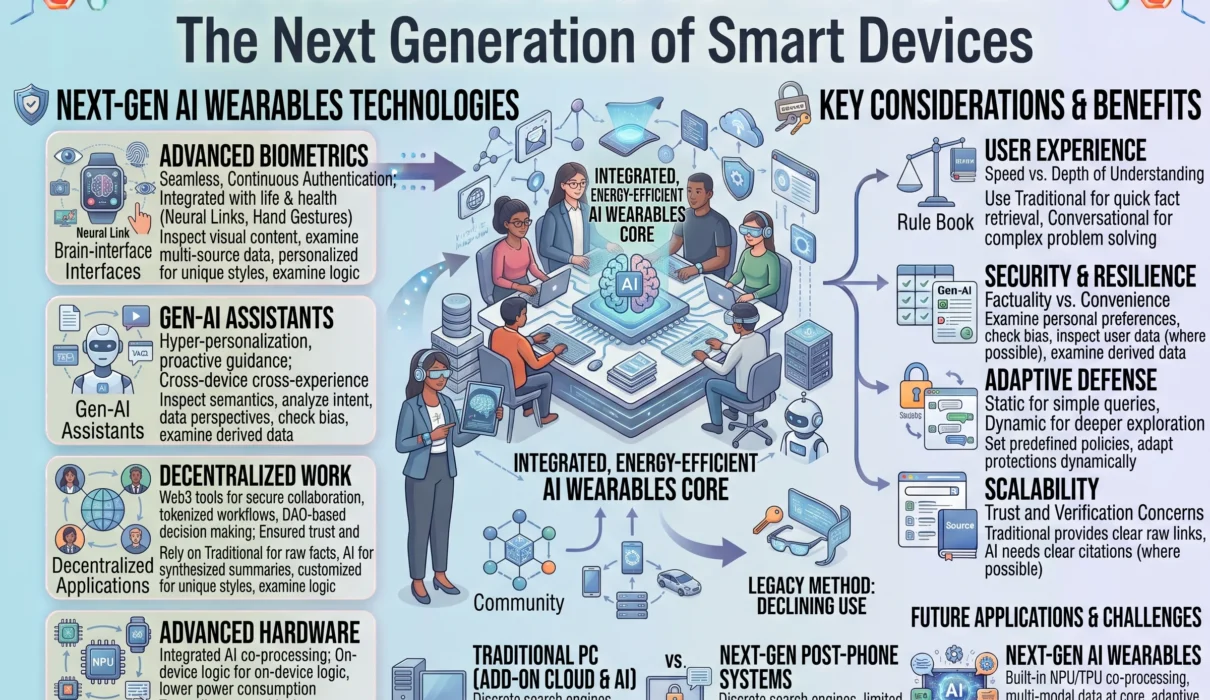
We are witnessing an architectural shift toward AI wearables. Rather than functioning as notification mirrors, smart wearables are evolving into autonomous, context-aware digital companions. Powered by dedicated on-device neural processing units (NPUs), multimodal sensor fusion, and ambient artificial intelligence, this hardware class operates continuously across our visual field, ear canals, and skin.
From lightweight AI glasses that analyze what you see in real time to biometric smart rings that forecast metabolic strain days in advance, wearable technology is dismantling the traditional screen-first computing model. Computing is no longer a destination you sit down at or a glass rectangle you retrieve from your pocket. It is transforming into an ambient layer that senses your physiology, perceives your environment, and augments your cognition.
Smart glasses projecting real-time visual HUD overlays. Source : Omdia – Informa
1. What Are AI Wearables? The Transition to Ambient Computing
An AI wearable is a body-adjacent computing device equipped with sensors, localized neural execution silicon, and persistent connectivity, engineered to deliver continuous context-aware intelligence without requiring manual touchscreen navigation.
                 TRADITIONAL WEARABLES vs. AI WEARABLES

  [Traditional Smartwatch]
  Sensor ──► Raw Metric Logged ──► Wait for User to Check Screen ──► Passive Record

  [AI-Native Wearable]
  Multimodal Fusion ──► Edge Neural NPU ──► Contextual Synthesis ──► Proactive Audio/HUD Action
  (PPG + Temp + Vision)   (Continuous Inference)  (Predicts Fatigue/Blockers) (Delivers Assistance)
The difference between legacy smart wearables and modern AI-native hardware lies in how intelligence is orchestrated:
| Operational Dimension | Legacy Wearables (Smartwatches / Bands) | Next-Generation AI Wearables |
|---|---|---|
| Primary Interaction | Touchscreen swipes, digital crowns, haptic buzzes | Multimodal: Natural voice, gaze tracking, micro-gestures, and sub-vocal intent |
| Data Processing | Static thresholds (e.g., alert if HR > 120 bpm at rest) | Machine learning trend analysis, predictive baseline forecasting |
| Contextual Awareness | Blind to user environment and visual surroundings | Multimodal: Point-of-view cameras, directional beamforming, spatial audio |
| Hardware Form Factor | Dominantly wrist-bound digital displays | Fractured mesh: Eyewear, biometric rings, hearables, clip-on sensor pods |
| Operational Role | Reactive notification mirror and log recorder | Proactive ambient assistant and predictive health shield |
The concept driving this hardware shift is ambient computing: technology so integrated into your daily environment and physical posture that it operates invisibly in the background, stepping forward with assistance only when relevant and fading away the moment the task is complete.
2. AI Glasses: The Frontline of Multimodal Vision and Audio
Smart glasses have emerged as the fastest-growing form factor in the AI wearable ecosystem. By mounting sensors directly onto the human head, glasses share your optical point-of-view and auditory perspective, unlocking multimodal capabilities that wristbands and smartphones cannot replicate.
THE THREE SUB-ARCHITECTURES OF MODERN AI GLASSES

1. Camera-Free Audio AI Eyewear:
[Temple Microphones] ──► Directional Audio / Voice LLM ──► Real-Time Whisper Translation
* Zero workplace recording friction; indistinguishable from prescription glasses.

2. Multimodal Vision Glasses (No Display):
[Outward Camera + Mic] ──► Visual Transformer Model ──► Open-Ear Spatial Audio Feedback
* "What building is this?", "Read this sign in Spanish", "Identify this botanical leaf".

3. Full Optical AR Display Glasses:
[Micro-OLED / Waveguide] ──► Transparent Lens HUD ──► Heads-Up Navigation & Teleprompter
* True spatial computing overlay floating in direct field of view.
The category has stratified into three distinct hardware architectures, each solving specific engineering, social, and battery trade-offs:
1. Camera-Free Audio AI Glasses
Pioneered by products designed to navigate corporate and educational environments, this sub-tier eliminates outward-facing camera lenses entirely.
- The Architecture: Outwardly indistinguishable from designer prescription eyewear, these frames embed beamforming microphone arrays, bone-conduction or open-ear micro-speakers, and low-power Bluetooth transceivers directly into the temple stems.
- Compliance & Social Comfort: By removing cameras, these glasses bypass workplace recording restrictions, gym photography bans, and public surveillance concerns.
- The Utility: Users receive discreet audio briefings, continuous real-time conversational translation across foreign languages, and meeting transcription that converts verbal discussions into structured task summaries directly in your project management tools.
2. Camera-Equipped Multimodal Vision Glasses
Represented by high-volume platforms like the Ray-Ban Meta series and emerging competitors across Asia-Pacific, this architecture incorporates ultra-compact 12MP camera modules alongside directional audio:
- Visual Question-Answering (VQA): Instead of typing a search query, a user looks at a complex plumbing manifold or an unfamiliar plant and asks: “What valve should I turn to isolate the hot water line?” The on-device vision-language model parses the video frame, identifies the hardware, and delivers step-by-step instructions through the temple speakers.
- Hands-Free POV Capture: High-fidelity video and spatial audio capture from natural eye level, removing the barrier of holding a phone between you and real-world experiences.
- Privacy Controls: To navigate social acceptance, modern frames embed hardware-interrupted privacy LEDs that illuminate brightly whenever sensor capture occurs, preventing covert recording.
3. Transparent Waveguide AR Display Glasses
The technological peak of the category projects visual data directly onto the lens surface using diffractive optical waveguides and Micro-OLED or MicroLED light engines:
- Heads-Up Navigation: Turn-by-turn walking and cycling arrows float in your field of view, aligned with street corners, eliminating the need to look down at a phone while moving.
- Real-Time Teleprompting: During public speaking or video meetings, key notes, bullet points, and live translations float transparently in your peripheral vision, maintaining eye contact with your audience.
3. Biometric Smart Rings: Invisible, Continuous Health Tracking
While smart glasses capture external environmental context, smart rings have revolutionized internal physiological tracking.
By migrating continuous biometric sensing from the wrist to the base of the finger, smart rings achieve signal-to-noise ratios that wristwatches struggle to match.
Internal micro-sensors inside a titanium biometric smart ring. Source : Netmeds
Why the Finger Outperforms the Wrist
The palmar side of the finger is physiologically superior for non-invasive biometric monitoring:
- Capillary Proximity: Arteries run close to the surface of the finger, protected from the muscular interference, bone density obstructions, and tendon movements that distort wrist-based optical sensors.
- Signal Clarity: Photoplethysmography (PPG) sensors measuring light absorption through blood vessels yield cleaner pulse waveforms, enabling precise calculations of resting heart rate, pulse wave velocity, and Heart Rate Variability (HRV).
- Sleep Compliance: Massive wristwatches with bright screens are physically intrusive to sleep with. Lightweight titanium smart rings (weighing under 4 grams) provide continuous, non-distracting nocturnal tracking, driving widespread consumer adoption in sleep architecture analysis.
                     BIOMETRIC SENSOR FUSION IN SMART RINGS

  [Triple-Wavelength Optical PPG] ──► Heart Rate & HRV (Millisecond Precision)
  [Negative Temperature Thermistors] ──► Peripheral Body Temp Deviations (+/- 0.05°C)
  [3D Accelerometer & Gyroscope] ──► Sleep Architecture & Circadian Rest Dynamics
                                           │
                                           ▼
                 ┌────────────────────────────────────────────────────────┐
                 │ PREDICTIVE HEALTH INFERENCE ENGINE                     │
                 ├────────────────────────────────────────────────────────┤
                 │ • Illness Onset: Flags viral strain 48 hrs pre-symptom │
                 │ • Recovery Index: Calculates central nervous recovery  │
                 │ • Menstrual Cycle: Tracks phase shifts via basal temp  │
                 └────────────────────────────────────────────────────────┘
Modern biometric rings (such as the Oura Ring 4, Ultrahuman Ring Air, and Samsung Galaxy Ring) leverage machine learning models trained on baseline physiological trends:
- Early Illness Detection: By cross-referencing subtle nocturnal skin temperature deviations (+0.3°C to +0.8°C above baseline) with declining HRV and elevated resting heart rates, algorithms alert users to impending immune or viral strain 24 to 48 hours before physical symptoms materialize.
- Metabolic and Circadian Optimization: Continuous trend tracking maps individual circadian rhythms, recommending targeted sleep, hydration, and recovery intervals tailored to central nervous system fatigue rather than generic calendar rules.
4. Smart Hearables: Real-Time Audio Intelligence and Sub-Vocal Control
Audio devices are undergoing an evolution from passive entertainment speakers into smart hearables—context-aware audio nodes sitting at the entrance to the human auditory canal.
                THE TRANSFORMATION OF THE EAR CANAL INTERFACE

  Legacy Earbuds (Audio Transducer):
  [Phone Audio Stream] ──► Bluetooth AAC/SBC ──► Speaker Driver (Passive Listening)

  Modern AI Hearable (Biometric Audio Node):
  ┌────────────────────────────────────────────────────────────────────────┐
  │ 1. Inward-Facing Microphones: Acoustic Isolation & Biometric Ear Pulse │
  │ 2. Directional Beamforming: Neural Noise Cancellation & Voice Focus    │
  │ 3. On-Chip NPU: Real-Time Bidirectional Speech Translation Pipeline   │
  │ 4. Surface Electromyography: Sub-vocal neuromuscular command sensing   │
  └────────────────────────────────────────────────────────────────────────┘
1. Real-Time Conversational Translation
By pairing low-latency wireless audio codecs with cloud and on-device language models, hearables serve as live translators:
- An interlocutor speaks in Mandarin, German, or Portuguese.
- The outward-facing microphones capture the acoustic frequencies, filter environmental noise, and stream the audio through a translation model.
- The user hears natural, synthesized speech in their native language with sub-second latency, maintaining conversational rhythm.
2. Acoustic Transparency and Directional Voice Isolation
Using neural beamforming networks, modern hearables monitor incoming sound waves across micro-spatial arrays:
- In a crowded, reverberant conference hall or restaurant, the hearable isolates the acoustic signature of the person standing directly in front of the wearer, dynamically attenuating surrounding ambient chatter and background noise while amplifying speech frequencies.
3. In-Ear Health Monitoring and Biometrics
The ear canal offers an insulated, stable environment for biometric tracking:
- Inward-facing sensors read core body temperature without environmental air interference.
- Advanced hearables monitor photoplethysmography (PPG) at the temporal artery, providing continuous heart rate readings during high-impact athletics where arm movements distort wrist measurements.
5. Next-Gen Health Sensors: From Wellness Gimmicks to Clinical Cleared Defenses
For years, the technology industry marketed consumer wearables with vague disclaimers: “For general wellness and fitness purposes only; not intended for medical diagnosis.”
That legal wall is crumbling. The convergence of clinical-grade sensor accuracy, long-term observational dataset training, and regulatory clearance (such as FDA 510(k) clearances and De Novo classifications) is transforming consumer wearables into legitimate diagnostic and preventative medical devices.
┌────────────────────────────────────────────────────────────────────────┐
│                   CLINICAL-GRADE WEARABLE HEALTH MATRIX                │
├─────────────────────┬────────────────────┬─────────────────────────────┤
│ Diagnostic Vector   │ Sensor Technology  │ Clinical Relevance          │
├─────────────────────┼────────────────────┼─────────────────────────────┤
│ Cardiac Arrhythmia  │ Single/Multi-Lead  │ Detects Atrial Fibrillation │
│ & Conduction Flaws  │ ECG Electrodes     │ (AFib) and premature beats  │
├─────────────────────┼────────────────────┼─────────────────────────────┤
│ Continuous Glucose  │ Subcutaneous Micro-│ Needle-free interstitial    │
│ Monitoring (CGM)    │ needles & Optical  │ glucose tracking for non-   │
│                     │ Bio-impedance      │ insulin diabetes & metabolic│
├─────────────────────┼────────────────────┼─────────────────────────────┤
│ Sleep Apnea & Blood │ Multi-Wavelength   │ Flags nocturnal desaturation│
│ Oxygen Saturation   │ SpO2 Reflectance   │ and respiratory disruptions │
├─────────────────────┼────────────────────┼─────────────────────────────┤
│ Cuffless Blood      │ Pulse Transit Time │ Continuous hypertension     │
│ Pressure Tracking   │ (PTT) + Optical PPG│ monitoring without inflatable│
│                     │ Waveform Analysis  │ arm cuffs                   │
└─────────────────────┴────────────────────┴─────────────────────────────┘
1. Cuffless Blood Pressure Monitoring
Hypertension is one of the world’s most pervasive, asymptomatic health risks. Traditional blood pressure monitoring requires an uncomfortable, inflatable arm cuff that captures only single, isolated moments in time.
Next-generation smartwatches and rings use Pulse Transit Time (PTT) algorithms:
- Sensors measure the exact millisecond delay between the electrical heart contraction (detected via ECG electrodes) and the arrival of the physical blood pulse wave at the finger or wrist (detected via optical PPG).
- Because pulse transit speed directly correlates with arterial stiffness and arterial pressure, deep neural networks calculate continuous systolic and diastolic blood pressure readings throughout the day and night without requiring a physical cuff.
2. The Frontier of Continuous Glucose Monitoring (CGM)
Managing metabolic health has historically required invasive finger-stick blood tests or continuous glucose patches utilizing subcutaneous filiform needles inserted into the arm:
- Micro-Needle Forearm Patches: Devices (such as Biolinq Shine) utilize shallow, microscopic sensors that sample interstitial fluid just beneath the surface of the skin, delivering autonomous, pain-free glucose and lactate tracking for non-insulin type 2 diabetes management.
- Optical and Raman Spectroscopy (The Holy Grail): Researchers and consumer hardware manufacturers are developing non-invasive optical glucose tracking: shining specific infrared laser wavelengths through the skin to measure the absorption spectrum of glucose molecules directly. While rigorous regulatory clinical clearances remain ongoing, commercial pilots are steadily advancing toward consumer deployment.
6. The Engineering Hurdle: The Battery, Thermal, and Silicon Trilemma
Building an AI wearable is one of the most brutal engineering disciplines in modern computing.
Unlike a smartphone that can house a 5,000 mAh battery, copper heat spreaders, and a 6.7-inch glass display, a pair of smart glasses or a smart ring operates within severe physical constraints.
                      THE WEARABLE ENGINEERING TRILEMMA

        Thermal Dissipation (Skin Temp)         Battery Chemistry (Capacity)
       ┌───────────────────────────────┐       ┌─────────────────────────────┐
       │ Hardware rests against human  │       │ Rings: 15–30 mAh            │
       │ skin. Max surface temperature │ ────► │ Glasses: 100–250 mAh        │
       │ cannot exceed 40–42°C without │       │ Hours, not days, of active  │
       │ causing discomfort/burns.     │       │ video/NPU processing.       │
       └───────────────────────────────┘       └─────────────────────────────┘
                                       │
                                       ▼
                       Compute Ceiling & Weight Constraints
                      ┌──────────────────────────────────────┐
                      │ Must weigh under 50g (Glasses)       │
                      │ or under 5g (Rings) to remain        │
                      │ comfortable for all-day wear.        │
                      └──────────────────────────────────────┘
1. The Thermal Barrier
Silicon chips generate heat during high-load processing. While a laptop can spin up a fan and a smartphone can dissipate thermal energy across a large metal chassis, a wearable rests directly against sensitive human skin.
If a smart ring or the temple of a pair of smart glasses exceeds 40°C to 42°C, it causes thermal discomfort and potential low-temperature skin burns. Consequently, processors must run in brief, ultra-efficient bursts rather than sustained high-wattage computing cycles.
2. The Weight-to-Battery Trade-Off
A pair of everyday prescription eyeglasses weighs between 25 and 40 grams. If smart glasses pack heavy batteries into the temples and reach 75 or 80 grams, they slide down the wearer’s nose, cause pressure headaches, and become unusable for all-day wear.
With battery capacities constrained to a modest 150 to 250 mAh in smart glasses and a microscopic 15 to 30 mAh in smart rings, devices cannot run continuous live camera streaming or wireless cellular data without exhausting their batteries in under two hours.
3. The Heterogeneous Architectural Solution
To survive within these physical limitations, the AI wearable ecosystem adopts a split-compute architecture:
- Tier 1 (Sub-Milliwatt Microcontroller on Wearable): Handles basic sensor polling (accelerometers, PPG timers) and keyword wake-word spotting.
- Tier 2 (Localized NPU Inference): When an action is triggered, lightweight, low-bit quantized models run locally on specialized wearable SoCs (e.g., Qualcomm Snapdragon Wear/AR platforms) drawing minimal power.
- Tier 3 (Smartphone / Edge Offloading): High-bandwidth tasks—such as rendering complex spatial augmented reality or running multi-agent deep research—are offloaded wirelessly via low-latency Bluetooth or Wi-Fi to the paired smartphone resting in your pocket.
7. The Threat Surface: Privacy, Surveillance, and Data Sovereignty
As computing devices migrate onto our faces, hands, and bodies, they create unprecedented cybersecurity and privacy challenges.
A smartphone can be placed face-down on a desk or stored in a pocket. A pair of smart glasses with camera modules and directional microphones continuously captures the visual and auditory environment around the wearer.
                     THE WEARABLE SURVEILLANCE PARADOX

  [Wearer Point of View]
  ├── Continuous POV Camera ──► Captures Bystanders, Screens, Door Passcodes
  ├── Directional Mics     ──► Ingests Private Third-Party Conversations
  └── Biometric Sensors    ──► Gathers Neurological, Cardiac, & Stress State
                                       │
                                       ▼
  [Data Sovereignty Dilemma]
  Is this data processed locally inside an encrypted Secure Enclave, or
  streamed to ad-monetized cloud servers to build behavioural profiling dossiers?
1. Bystander Consent and the Social Contract
When an individual wears camera-equipped smart glasses in public spaces, bystanders are subjected to potential non-consensual recording and facial recognition scanning.
Even with visible LED recording indicators, distinguishing between active recording, passive spatial mapping, and stand-by modes is difficult for third parties.
This friction has prompted regulatory scrutiny under the EU AI Act and GDPR regarding incidental data capture of non-users in public spaces.
2. The Intimacy of Biometric Exploitation
Biometric indicators gathered by smart rings, hearables, and watches are fundamentally different from basic search histories:
- Heart rate variability, pupil dilation, skin temperature, and galvanic skin response reveal emotional arousal, psychological stress, menstrual cycles, and cognitive focus.
- If an advertising conglomerate or data broker obtains access to continuous physiological telemetry, they can determine the exact emotional state of a user in real time—targeting marketing, political persuasion, or financial offerings when an individual is cognitively fatigued or emotionally vulnerable.
3. Securing Wearable Architecture
To establish trust, the next generation of smart wearables must adhere to strict Zero-Trust hardware design:
- On-Device Cryptographic Enclaves: Biometric baseline data and local vector embeddings must be encrypted at rest and locked to device hardware using Trusted Platform Modules (TPMs) or Secure Enclaves.
- Strict Local Processing (Zero Data Egress): Routine tasks like voice recognition, local step tracking, and sleep phase calculations must run on local silicon without transmitting data packets over external networks.
- Tamper-Proof Hardware Indicators: Recording LEDs must be hardwired in series with the camera sensor’s physical power rail—ensuring that if the LED is cut, disconnected, or disabled, the camera sensor is physically starved of electrical current and cannot operate.
8. Summary Comparison: The Modern AI Wearables Ecosystem
To navigate the expanding ecosystem of next-generation smart devices, consider how each major form factor addresses specific user needs and technical constraints:
| Hardware Form Factor | Primary Sensors & I/O | Best Use Cases | Battery Endurance | Primary Engineering Bottleneck |
|---|---|---|---|---|
| Camera-Equipped AI Glasses | POV Cameras, Open-Ear Audio, Microphones | Visual question answering, POV video, hands-free calling | 4 to 12 hours (Burst use) | Thermal limits against temples; bystander privacy |
| Audio-Only Smart Glasses | Beamforming Mics, Directional Audio, IMU | Meeting transcription, live language translation, discreet audio | 10 to 16 hours (All-day) | Acoustic leakage in quiet rooms; zero visual output |
| Biometric Smart Rings | Multi-Wavelength PPG, Temp Thermistors, 3D Accelerometer | Sleep architecture, early illness alerts, recovery index | 4 to 8 days | Extreme size limits (15–30 mAh battery); no display |
| Next-Gen Smartwatches | Optical PPG, Multi-Lead ECG, PTT Blood Pressure, Display | Fitness coaching, standalone cellular calls, clinical screening | 1 to 3 days (Model dependent) | Heavy physical bulk during sleep; screen distractions |
| Smart Hearables | In-Ear PPG, Neural Beamforming Mics, Speaker Driver | Conversational translation, noise isolation, sub-vocal control | 5 to 8 hours (Per charge) | Ear-canal fatigue; miniature battery enclosures |
9. The Horizon: How Wearables Will Merge into a Personal Mesh
The future of wearable technology will not be won by a single device replacing all others.
Instead, computing is converging on a Personal Area Network (PAN)—a multi-device ambient mesh where specialized form factors share context and divide labor seamlessly.
                     THE PERSONAL AMBIENT WEARABLE MESH

                           ┌───────────────────────┐
                           │ SMARTPHONE HUB IN     │
                           │ POCKET / BAG          │
                           │ • Heavy Tensor Compute│
                           │ • Long-Range Cellular │
                           │ • Primary Storage     │
                           └───────────┬───────────┘
                                       │
            ┌──────────────────────────┼──────────────────────────┐
            ▼                          ▼                          ▼
  ┌───────────────────┐      ┌───────────────────┐      ┌───────────────────┐
  │ AI GLASSES        │      │ BIOMETRIC RING    │      │ SMART HEARABLES   │
  │ • Visual POV Input│      │ • Internal Health │      │ • Private Audio   │
  │ • Heads-Up Vision │      │ • Continuous Pulse│      │ • Voice Synthesis │
  │ • Gaze Tracking   │      │ • Micro-Gestures  │      │ • Real-time Trans │
  └───────────────────┘      └───────────────────┘      └───────────────────┘
In this ambient ecosystem:
- Your smart ring tracks your internal autonomic nervous state, sleep architecture, and metabolic recovery.
- Your smart glasses act as your visual interface—reading real-world text, recognizing objects, and projecting lightweight heads-up navigation onto your retinas.
- Your hearables deliver directional audio, private conversational translation, and acoustic focus.
- Your smartphone or pocket edge node sits quietly in your bag or pocket, supplying high-density battery power, heavy neural processing, and multi-gigabit cellular connectivity to the entire wearable perimeter.
Technology That Gets Out of the Way
The history of personal computing has been a steady march toward intimacy: from the room-sized mainframe shared by a university department, to the personal desktop tower in the home office, to the laptop on our knees, to the smartphone in our palms.
AI wearables represent the final phase of this migration: computing that moves directly onto our bodies.
By replacing the friction of manual touchscreen navigation with ambient perception, multimodal vision, real-time voice intelligence, and predictive biometric monitoring, the next generation of smart devices ceases to be an external distraction.
The goal of wearable technology is not to pull our attention deeper into an artificial digital world—it is to eliminate digital friction entirely. By allowing technology to quietly observe, understand, and augment our human capabilities from the background, AI wearables enable us to look up, engage with our physical environments, and navigate reality with amplified intelligence.