

 By
By For nearly two decades, the modern smartphone has maintained a predictable physical silhouette: a rigid, rectangular glass-and-aluminum slab dominated by a capacitive touch display. Year after year, upgrade cycles followed an incremental formula—slightly narrower bezels, modest clock-speed bumps, an extra camera sensor, and marginal battery gains.
That era of incremental refinement has permanently broken down.
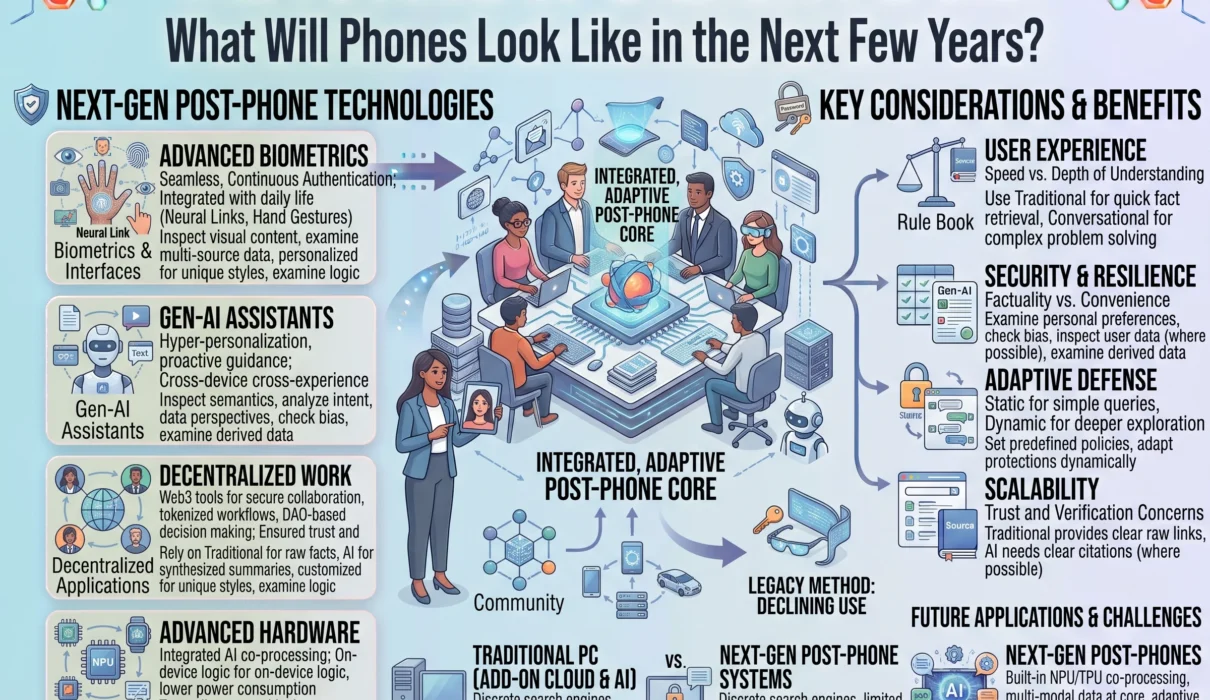
We are witnessing the most radical architectural transformation in mobile history. The future of smartphones is no longer defined by raw megapixels or peak gigahertz. Instead, it is being reshaped by the convergence of on-device AI, transformative physical form factors like multi-fold and rollable displays, computational photography driven by generative neural models, direct-to-device satellite networks, and intent-driven, post-app operating systems.
The phone is shedding its identity as a passive handheld portal of isolated apps. It is evolving into a context-aware, multimodal agent—an intelligent orchestrator that senses your environment, anticipates operational needs, and bridges the physical and digital worlds.
1. The Death of the Static Glass Slab: Foldables, Tri-Folds, and Rollables
The physical chassis of mobile technology is undergoing its greatest disruption since the departure of the physical QWERTY keyboard. Rigid glass is giving way to dynamic, deformable substrates that blur the line between phone, tablet, and workstation.
THE FORM FACTOR EVOLUTION IN MOBILE HARDWARE

Phase 1: The Rigid Monolith (2007–2020)
┌─────────────────────────────────┐
│ Rigid 16:9 / 19.5:9 Glass Slab  │  • Fixed screen geometry
│ Fixed internal volume           │  • Static display area
└─────────────────────────────────┘
                │
                ▼
Phase 2: The Dual-Fold Era (2020–2025)
┌──────────────┬──────────────────┐
│ Narrow Cover │ Square Interior  │  • Book-style and Clamshell flips
│ Display      │ Flexible OLED    │  • Mechanical hinge vulnerability
└──────────────┴──────────────────┘
                │
                ▼
Phase 3: The Adaptive Geometry Era (2026 and Beyond)
┌───────────┬───────────┬─────────┐   OR   ┌───────────────────────────►
│ Panel 1   │ Panel 2   │ Panel 3 │        │ Motorized Spindle Rollable
│ (Dual-Hinge Z-Fold / Tri-Fold)  │        │ Expands 6.5" ──► 8.8" dynamically
└───────────┴───────────┴─────────┘        └───────────────────────────►
From Fragile Novelty to Mainstream Durability
Early foldable smartphones suffered from prominent display creases, delicate plastic screen layers, and mechanical hinge failures. Those engineering hurdles have largely been solved through material science breakthroughs:
- Zero-Crease Teardrop Hinges: Advanced kinematics allow the flexible OLED panel to tuck into a waterdrop-shaped curve inside the chassis when closed, eliminating mechanical stress focal points and eradicating the visible surface crease.
- Ultra-Thin Glass (UTG) with Self-Healing Polymers: Modern flexible displays incorporate chemically tempered UTG layered with elastomeric polymers that resist scratches and distribute impact forces evenly across the substrate.
- IP68/IP69 Environmental Sealing: Micro-bristles, water-repellent nanocoatings, and hermetically sealed internal hinge enclosures now protect moving mechanical components from fine dust and high-pressure water submersion.
The Shift to “Wide-Fold” and Tri-Fold Form Factors
The industry has abandoned the awkward, ultra-tall and narrow cover screens that plagued early book-style foldables. The market has standardized on wide-fold architectures: outer cover screens now match standard 20:9 flagship phone dimensions, ensuring the device feels natural when closed, while opening into an expansive tablet canvas for deep work and media consumption.
Beyond single-hinge devices, tri-fold (dual-hinge) smartphones and rollable displays represent the next commercial frontier. A tri-fold device uses a dual-hinge “Z” or inward-folding configuration to pack a full 10-to-11-inch workstation canvas into a device that slips into a jacket pocket.
Simultaneously, rollable smartphones eliminate hinges entirely: utilizing motorized internal micro-spindles, a flexible OLED panel smoothly unfurls horizontally from within the chassis at the touch of a sensor, expanding a standard 6.5-inch phone into an 8.5-inch widescreen monitor without increasing chassis thickness.
2. On-Device AI and Dedicated NPUs: Moving Past the Chatbot
For the first wave of consumer artificial intelligence, phones operated as thin terminals. Every conversational query, photo enhancement, or text summary traveled across cellular towers to remote hyperscaler data centers.
In next generation smartphones, intelligence has shifted locally onto client silicon.
                    THE SHIFT TO LOCAL EDGE INFERENCE

  LEGACY CLOUD-BOUND AI PIPELINE:
  [Phone Screen] ──(4G/5G Network Latency: 300ms–2s)──► [Remote Cloud Server Rack]
  • High data-egress risk • Complete offline failure • Cloud subscription costs

  MODERN ON-DEVICE AI PIPELINE:
  ┌────────────────────────────────────────────────────────────────────────┐
  │ SECURE MOBILE SILICON PERIMETER (Heterogeneous System-on-Chip)         │
  │                                                                        │
  │ [Microphone / Camera / Sensors]                                        │
  │        │ (Zero-copy unified memory bus)                                │
  │        ▼                                                               │
  │ [Neural Processing Unit (NPU)] ──► INT4 / INT8 Hardware Matrix Engine  │
  │        │                           (45 to 60+ Dedicated NPU TOPS)      │
  │        ▼                                                               │
  │ [Local Small Language Models (SLMs) & Vision Transformers]             │
  │        │                                                               │
  │        ▼                                                               │
  │ [Instant Contextual Action] (Sub-15 millisecond execution, 100% offline│
  └────────────────────────────────────────────────────────────────────────┘
The NPU Hardware Metric: 45 to 60+ TOPS
Modern mobile system-on-chips (SoCs)—such as Qualcomm Snapdragon platforms, Apple A-series and M-series processors, Google Tensor architectures, and MediaTek Dimensity chips—allocate massive silicon real estate to dedicated Neural Processing Units (NPUs).
These processors are benchmarked in TOPS (Trillion Operations Per Second). Next-generation mobile silicon features NPUs delivering between 45 and 60+ TOPS, hardwired for low-precision tensor operations (INT8, INT4, and FP8).
While running a complex model on a mobile CPU or GPU would rapidly deplete battery reserves, an NPU performs trillions of matrix multiplications while drawing just 1.5 to 4 watts, allowing background AI processes to run continuously without thermal throttling.
The Rise of Mobile Small Language Models (SLMs)
Giant frontier models spanning hundreds of billions of parameters cannot fit inside a smartphone’s RAM. To solve this, researchers developed knowledge distillation and quantization:
- Highly compressed, high-density Small Language Models (SLMs)—such as models in the 2-billion to 7-billion parameter range—are compressed into INT4 representations requiring just 2GB to 4GB of unified system RAM.
- These local models power zero-latency, private features: real-time live-call translation across dozens of languages, audio transcribing with automated speaker diarization, document summarization, and contextual photo search—all operating seamlessly in airplane mode with zero data transmitted over the internet.
3. The Death of the App Grid: The Rise of the Agentic Operating System
Since the launch of the original iPhone in 2007, human-mobile interaction has remained tethered to a rigid visual taxonomy: the application grid.
Finding an answer or booking a service requires a manual sequence: unlock the phone, locate an app icon, tap to launch, navigate internal menus, authenticate, execute an action, close the app, open another app, copy data across, and repeat.
Smartphone technology is dismantling this app-centric paradigm in favor of an Agentic Operating System.
                 THE HUMAN-MOBILE INTERACTION SHIFT

  THE LEGACY APP PARADIGM:
  [User Intent] ──► Unlock ──► Find App A ──► Tap ──► Copy Data ──► Find App B ──► Paste
  (User acts as the manual data-bridge between disconnected software silos)

  THE AGENTIC OS PARADIGM:
  [User Intent via Voice, Gaze, or Proactive Context]
            │
            ▼
  ┌────────────────────────────────────────────────────────────────────────┐
  │ SYSTEM-LEVEL ON-DEVICE AI ORCHESTRATOR                                │
  ├────────────────────────────────────────────────────────────────────────┤
  │ 1. Parses multimodal intent and cross-references personal calendar     │
  │ 2. Queries ride-share API, airline status, and navigation routing      │
  │ 3. Resolves scheduling conflict; provisions reservation automatically  │
  │ 4. Generates single, unified interactive action card on lockscreen     │
  └────────────────────────────────────────────────────────────────────────┘
From “Apps” to Dynamic Micro-Services
In an agentic mobile environment, applications lose their rigid visual boundaries and become API-driven capability modules:
- Instead of interacting with individual apps for Uber, United Airlines, Google Calendar, and WhatsApp, you issue a high-level goal: “My flight to Chicago tomorrow got pushed back two hours. Adjust my airport pickup, reschedule my dinner reservation, and notify Sarah on messaging.”
- The underlying operating system agent parses the instruction, queries local contextual memory to identify the relevant parties and flight numbers, calls the underlying services through structured function calls, reconciles the timing, and presents a single, unified confirmation card for biometric approval.
Contextual Ambient Awareness
The phone of the future will not wait for you to prompt it. Using continuous sensor fusion—accelerometers, ambient light sensors, Bluetooth proximity beacons, biometric health monitors, and gaze tracking—the device maintains an awareness of your situational context:
- If you walk up to an international transit terminal, your boarding pass, passport QR code, and gate transit map appear automatically on the lock screen without a click.
- If you are in an intense meeting or your biometric sensors indicate high stress, notifications are filtered, summarized, and batched by an on-device triage agent, allowing only urgent family or executive contacts to interrupt your focus.
4. Next-Generation Mobile Cameras: Computational Physics and Generative Optics
For over a decade, smartphone camera competition was a physical arms race: cramming larger glass lens elements, periscope telephoto prisms, and larger physical sensors into increasingly massive camera bumps.
Physics, however, cannot be cheated indefinitely. A smartphone chassis measuring 7 to 9 millimeters cannot house the physical focal length and glass aperture of a full-frame mirrorless camera lens.
To transcend physical optical boundaries, the future of mobile imaging belongs to computational physics and generative reconstruction.
                   THE MODERN NEURAL IMAGING PIPELINE

  Photons Hit Lens ──► Quad/Octa-Bayer Sensor ──► Raw Sensor Mosaic Array
                                                        │
                                                        ▼
  ┌────────────────────────────────────────────────────────────────────────┐
  │ MULTI-FRAME NEURAL IMAGE SIGNAL PROCESSOR (ISP)                        │
  ├────────────────────────────────────────────────────────────────────────┤
  │ 1. Instantaneous Burst: Captures 8–15 bracketed underexposed RAW frames│
  │ 2. Sub-Pixel Alignment: Corrects micro-handshake vibrations via gyro   │
  │ 3. Semantic Segmentation: Separates skin, hair, fabric, foliage, sky   │
  │ 4. Neural Radiance Reconstruction: Fills missing optical noise gaps    │
  └──────────────────────────┬─────────────────────────────────────────────┘
                             │
                             ▼
  [Generative Tone Mapping & Physically Accurate Depth-of-Field Bokeh]
Semantic Neural Segmentation and Real-Time Synthesis
Traditional cameras process an entire image frame uniformly: applying global adjustments to contrast, exposure, and white balance.
Modern computational imaging breaks the visual frame into discrete semantic layers:
- The Neural ISP identifies individual components within milliseconds: human skin tones, hair strands, eyes, clothing textiles, architecture, background foliage, and sky clouds.
- Each semantic layer is optimized independently in real time: skin tones receive accurate subsurface scattering corrections without altering background foliage saturation; fine strands of hair are isolated for natural optical depth-of-field blurring; and the sky is balanced to prevent highlights from blowing out.
Liquid Lenses, Metasurfaces, and Periscope Telephotos
Hardware is simultaneously evolving to reduce the size of the camera module:
- Metalenses (Optical Metasurfaces): Flat, nanostructured surfaces that bend and focus light across a flat microscopic plane using sub-wavelength silicon pillars, replacing bulky stacks of curved plastic and glass lens elements and paving the way for completely flush camera designs.
- Liquid Lens Technology: Miniature fluid cells that adjust their curvature and focal length instantaneously using tiny electrical currents (electrowetting). A single liquid lens camera module can dynamically switch from macro photography (focusing at 2 centimeters) to wide-angle landscape and telephoto zoom within milliseconds, eliminating the need for three separate camera lenses.
- Continuous Variable Optical Zoom: Replacing stepped multi-camera systems (1x, 3x, 5x) with true miniaturized mechanical periscope assemblies that slide physical lens elements internally, providing continuous, lossless optical zoom from 3x to 10x within a single sensor housing.
5. Ubiquitous Connectivity: Direct-to-Device Satellite and 5G-Advanced
For fifty years, mobile phones have been held hostage by cellular tower geography. Step into a remote wilderness park, board a plane, drive through a mountainous corridor, or venture offshore, and the device is severed from the digital world.
The future of smartphones eliminates the concept of the “dead zone” through Direct-to-Device (D2D) satellite connectivity.
                     TERRESTRIAL & NON-TERRESTRIAL INTEGRATION

   [Next-Gen Smartphone with 3GPP Rel. 17/18/19 Modem]
          │
          ├── Urban / Suburban ──► Terrestrial 5G-Advanced / 6G Micro-Cells
          │                        (Sub-1ms latency, 10Gbps+ peak throughput)
          │
          └── Remote / Wilderness ──► Low Earth Orbit (LEO) Satellite Constellation
                                      (Starlink, AST SpaceMobile, Kuiper)
                                      (Direct connection without external satellite dish)
Direct-to-Cell LEO Satellite Networks
Early satellite smartphone features were restricted to static emergency text alerts: the user had to hold the phone flat toward the sky and wait minutes for a low-bandwidth message to transmit to a geostationary satellite.
Next-generation mobile modems (compliant with 3GPP Release 17, 18, and 19 Non-Terrestrial Network standards) connect directly to modern Low Earth Orbit (LEO) satellite constellations (such as Starlink Direct-to-Cell and AST SpaceMobile):
- Voice, Data, and Text Everywhere: Modern satellite networks communicate directly with standard, unmodified smartphone cellular antennas using specialized beamforming arrays in space.
- Zero Infrastructure Dependency: Even in the middle of an ocean, deep inside a remote canyon, or following an earthquake that collapses terrestrial utility grids, next-generation smartphones maintain continuous cellular connectivity for voice calls, messaging, and basic data streaming.
The Bridge to 6G: Sub-Millisecond Latency
While 5G focused on expanding raw download speeds, 5G-Advanced (5.5G) and emerging 6G networks (projected for the late 2020s and early 2030s) prioritize deterministic sub-millisecond latencies and unified network-sensing:
- Integrated Sensing and Communication (ISAC): Cellular antennas do not merely transmit data; they function like micro-radar arrays, detecting the motion, gesture, and physical presence of humans in a room without cameras.
- Seamless Edge Handoffs: Network latency drops below 1 millisecond, enabling heavy rendering tasks (like photorealistic spatial computing graphics or multi-agent simulations) to split processing between the local NPU and nearby micro-edge edge nodes without perceptible lag.
6. Battery Chemistry and Power: The Solid-State Revolution
Every technological leap—brighter displays, multi-gigabit modems, and continuous neural computing—demands energy. For twenty years, lithium-ion battery chemistry has struggled to keep pace, forcing manufacturers to build thicker chassis or implement aggressive background software throttling.
We are reaching the transition from liquid electrolyte lithium-ion to Silicon-Carbon Anodes and Solid-State Batteries.
┌────────────────────────────────────────────────────────────────────────┐
│                   BATTERY TECHNOLOGY GENERATIONAL LEAP                 │
├─────────────────────┬────────────────────┬─────────────────────────────┤
│ Battery Technology  │ Energy Density     │ Primary Consumer Advantage  │
├─────────────────────┼────────────────────┼─────────────────────────────┤
│ Traditional Lithium-│ 650–750 Wh/L       │ Low manufacturing cost;     │
│ Ion (Graphite Anode)│                    │ highly volatile electrolyte │
├─────────────────────┼────────────────────┼─────────────────────────────┤
│ Silicon-Carbon (Si/C│ 800–900 Wh/L       │ 15–25% higher capacity      │
│ Composite Anode)    │                    │ in ultra-thin form factors  │
├─────────────────────┼────────────────────┼─────────────────────────────┤
│ Solid-State Battery │ 1,000–1,200+ Wh/L  │ Non-flammable, charges in   │
│ (Solid Electrolyte) │                    │ minutes, multi-day capacity│
└─────────────────────┴────────────────────┴─────────────────────────────┘
Silicon-Carbon Anodes (The Immediate Leap)
Traditional lithium-ion cells use graphite anodes, which have hit their theoretical energy storage capacity limits.
Flagship smartphones are standardizing on Silicon-Carbon composite anodes:
- Silicon can store significantly more lithium ions than graphite.
- By incorporating nanoscale carbon matrices that contain silicon’s natural thermal expansion during charge cycles, manufacturers achieve 15% to 25% higher battery capacities within identical physical dimensions.
- A smartphone that previously maxed out at 5,000 mAh can pack 6,000 to 6,500 mAh into a slimmer enclosure.
Solid-State Batteries (The Endgame)
The ultimate shift in energy storage replaces volatile, flammable liquid electrolytes with solid ceramic or polymer electrolyte conductors:
- Elimination of Thermal Runaway: Solid-state batteries cannot catch fire or explode from physical punctures, removing the need for bulky thermal cooling brackets inside the phone chassis.
- Ultra-Fast Charging Without Degradation: Users can charge a phone from 0% to 100% in under 12 to 15 minutes without degrading the battery’s lifespan or generating dangerous surface heat.
- Extreme Cold Tolerance: Solid-state cells do not suffer the catastrophic capacity loss that liquid lithium-ion experiences in sub-zero winter temperatures.
7. Next-Generation Interfaces: Portless, Buttonless, and Biometric
The physical exterior of the smartphone is shedding mechanical parts in a drive toward durability and minimalist design.
                     THE PORTLESS / SOLID-STATE CHASSIS

  [Seamless Unibody Enclosure (Titanium / Ceramic / Liquidmetal)]
  ├── Under-Display Acoustic Exciter ──► Screen vibrates to produce audio (No speaker grilles)
  ├── Under-Display Biometrics & Camera ──► Zero cutouts, notches, or pinholes
  ├── Solid-State Haptic Force Frames ──► Pressure sensors replace clicky buttons
  └── High-Speed Wireless & Magnetic Charging ──► Eliminates USB-C physical ports
1. The Portless and Buttonless Paradigm
Physical ports and mechanical click buttons are the primary points of mechanical wear, water ingress, and dust accumulation:
- Solid-State Haptic Touch Frames: Physical power and volume buttons are replaced by pressure-sensitive piezoelectric frames paired with linear resonant haptic actuators. Squeezing or sliding a finger along the titanium frame produces localized tactile clicks that mimic physical buttons with zero moving parts.
- The All-Wireless Transition: With magnetic wireless charging exceeding 50W to 80W and ultra-wideband (UWB) wireless data transfer protocols outpacing physical USB-C buses, manufacturers are phasing out physical USB-C ports on premium flagships—creating fully sealed unibodies capable of enduring high-depth water submersion.
2. Under-Display Everything (True Infinity Canvases)
The display of the future is an unbroken sheet of glass with zero notches, pill cutouts, or speaker grilles:
- Under-Display Cameras (UDC): Microscopic, transparent cathode and sub-pixel patterns allow camera sensors to see through the active OLED panel. Generative neural de-hazing algorithms clear up the slight optical diffusion caused by the display glass, producing selfie photos and video that rival exposed lenses.
- Acoustic Screen Exciters: Physical earpiece speaker slots are eliminated. Instead, piezoelectric exciters mounted behind the display panel vibrate the glass itself to generate directional, high-clarity sound directly into your ear during phone calls, preserving privacy from surrounding eavesdroppers.
3. Continuous Behavioral Biometrics
Unlocking your phone by staring at a sensor or touching a fingerprint scanner is an active chore. Future devices will practice continuous zero-friction authentication:
- Rather than asking for a biometric check at an initial unlock screen, the phone continuously monitors hundreds of passive behavioral telemetry markers: your unique typing cadence, gait rhythm while walking, facial angle while reading, and palm pressure patterns.
- The device remains securely unlocked as long as your unique behavioral signature is present. If you set the phone down on a table or someone snatches it from your hand, it locks the Secure Enclave instantly.
8. Summary Comparison: Traditional Flagship vs. Future Smartphone
To understand the scale of this generational transition, compare the specifications of a standard flagship from recent years with the architectural standards defining the next generation:
| System Dimension | Traditional Smartphone Flagship (2020–2024) | Next-Generation AI Smartphone (2026+) |
| Form Factor | Rigid, flat glass slab (Fixed 6.1″–6.8″) | Foldable wide-fold, multi-fold, and rollables |
| Silicon Focus | CPU single-core clock speeds & GPU 3D rendering | Dedicated NPUs with 45–60+ TOPS for continuous local AI |
| Software Model | App grid; turn-by-turn manual user navigation | Intent-driven Agentic OS; dynamic cross-app micro-services |
| Network Reach | Terrestrial 4G/5G; dependent on cell towers | Unified 5G-Advanced/6G + Direct-to-Cell LEO Satellite anywhere |
| Camera Tech | Fixed multi-camera glass modules & periscopes | Metalenses, liquid lenses, semantic neural segmentation |
| Battery & Charging | Lithium-ion graphite anode (5,000 mAh max) | Silicon-Carbon & Solid-State (6,500+ mAh, 15-min charging) |
| Physical I/O | USB-C charging port, mechanical buttons, speaker slots | Portless unibody, piezoelectric haptic frames, acoustic displays |
| Privacy Model | Cloud-bound assistant queries; remote data storage | Zero-data-egress on-device inference inside Secure Enclaves |
9. The Post-Smartphone Horizon: Will Phones Disappear?
Whenever a major technological shift occurs, industry commentators ask: Are smartphones about to be replaced by smart glasses, AI pins, or neural interfaces?
The reality is that the smartphone is not disappearing—it is becoming the centralized compute hub for the ambient ecosystem.
                     THE PERSONAL AMBIENT COMPUTE MESH

                           ┌───────────────────────┐
                           │ SMARTPHONE HUB IN     │
                           │ POCKET / BAG          │
                           │ • High-Density Battery│
                           │ • 60-TOPS NPU Silicon │
                           │ • Satellite Modem     │
                           │ • Cryptographic Vault │
                           └───────────┬───────────┘
                                       │
            ┌──────────────────────────┼──────────────────────────┐
            ▼                          ▼                          ▼
  ┌───────────────────┐      ┌───────────────────┐      ┌───────────────────┐
  │ SPATIAL GLASSES   │      │ SMART HEARABLES   │      │ BIOMETRIC RINGS   │
  │ MicroLED HUD      │      │ Spatial Audio &   │      │ Continuous Health │
  │ Video Passthrough │      │ Voice Translation │      │ & Gesture Sensors │
  └───────────────────┘      └───────────────────┘      └───────────────────┘
Lightweight smart glasses, biometric rings, and audio hearables face severe physical constraints: they cannot house large batteries, dense cooling plates, or powerful high-wattage tensor chips without becoming uncomfortably heavy and hot against human skin.
The smartphone will serve as the personal edge supercomputer:
- It will sit quietly in your pocket or bag, packing the high-density solid-state battery, the 60-TOPS neural processor, the secure biometric vault, and the multi-gigabit satellite modem.
- Lightweight smart glasses, contact lenses, and hearables will stream graphics, audio, and sensor telemetry to and from the smartphone hub via low-power, sub-millisecond wireless fabrics.
- When you need a high-bandwidth tactile interface—typing an essay, editing complex visual media, or reviewing documents—you pull out your phone, expand its foldable or rollable canvas, and work on a physical display.
The Handheld Hub of Ambient Intelligence
The smartphone is not reaching the end of its life; it is shedding its old limitations.
The transition away from rigid glass slabs, manual app navigation, cloud-bound assistants, and dead-zone cellular coverage marks the start of mobile technology’s most exciting chapter.
Powered by on-device AI, deformable foldable and rollable screens, direct-to-device satellite connectivity, and solid-state energy storage, the next generation of smartphones will cease to be passive distractions demanding our continuous manual attention.
Instead, they will function as ambient, context-aware extensions of human intent: devices that protect our data sovereignty, bridge communication anywhere on Earth, adapt their physical geometry to our workflows, and seamlessly orchestrate our digital lives.
The phone of the future will not be a window you stare into—it will be an intelligent companion that navigates the world alongside you.