

 By
By For the first wave of the artificial intelligence boom, the cloud was the only viable host. Every time you prompted an assistant, converted speech to text, or manipulated an image, your request embarked on a multi-thousand-mile round trip: digitized locally, transmitted across fiber-optic backbones, parsed inside an energy-intensive data center packed with high-wattage GPUs, and returned seconds later to your screen.
That centralized architecture solved an immediate problem—delivering frontier-scale intelligence to consumers without requiring supercomputers on their desks. But it also introduced structural friction: network latency, soaring server-side inference costs, massive power consumption, and fundamental compromises to user data privacy.
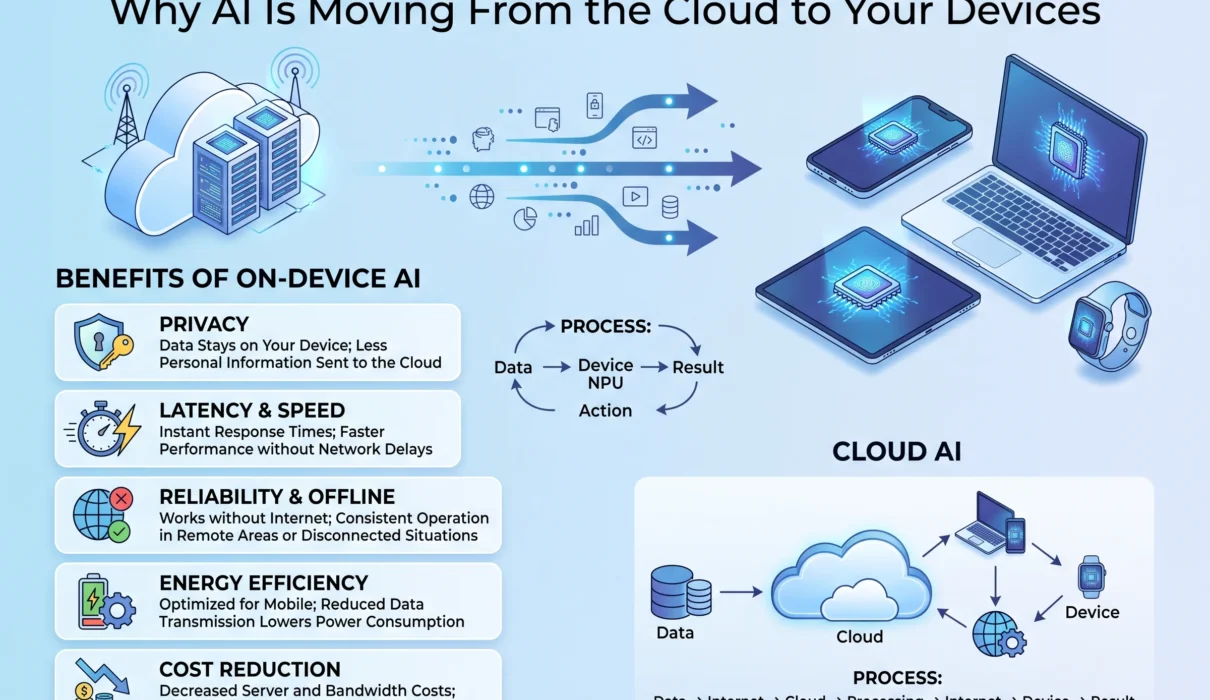
The center of gravity is now shifting. We are entering the era of on-device AI (also recognized as edge AI and local AI).
From modern silicon architectures running inside flagship AI smartphones to specialized Neural Processing Units (NPUs) built into new AI PCs and industrial edge gateways, computational intelligence is moving directly onto consumer hardware.
This transition is fundamentally changing how software is built, how personal data is safeguarded, and how devices interact with the physical world.
1. What Is On-Device AI? (Cloud vs. Edge Processing)
At its core, on-device AI refers to executing artificial intelligence models—such as Large Language Models (LLMs), Small Language Models (SLMs), diffusion generators, and computer vision systems—directly on the local hardware of a client device without offloading raw data to remote cloud servers.
CLOUD-CENTRIC AI PIPELINE:
[User Device] ──(Raw Data / Prompt)──► [Internet / ISP] ──► [Central Cloud Data Center]
                                                                    │ (Remote GPU Inference)
[User Device] ◄──────(Processed Output / Tokens)──────────── [High Latency & Cloud Costs]

ON-DEVICE (EDGE) AI PIPELINE:
┌────────────────────────────────────────────────────────┐
│ USER HARDWARE PERIMETER (Phone, PC, Edge Node)         │
│                                                        │
│ [Raw Input] ──► [Zero-Copy Unified RAM] ──► [Local NPU]│
│                                                 │      │
│ [Instant Action] ◄── [Deterministic Tokens] ◄───┘      │
└────────────────────────────────────────────────────────┘
  * Zero remote transmission
  * Operates fully offline
  * Zero recurring per-query cloud API fees
To see how this structural shift impacts end-user performance, consider the mechanical differences between cloud-native and edge-native architectures:
| System Parameter | Cloud-Hosted AI | On-Device / Edge AI |
| Inference Location | Centralized hyperscaler clusters (AWS, Azure, GCP) | Local client silicon (NPU, GPU, CPU) |
| Network Dependency | Mandatory high-bandwidth, stable internet connection | Fully operational offline; immune to network drops |
| Latency Profile | Variable (150ms to 2,000ms+ round-trip latency) | Deterministic and instantaneous (sub-15ms execution) |
| Data Privacy | PII and telemetry leave device perimeter | Zero data egress; raw telemetry never leaves device memory |
| Marginal Compute Cost | High recurring API/server inference expense | Zero marginal cloud cost per query post-purchase |
| Power Profile | Mega-watt scale centralized cooling and power | Milliwatt-to-watt scale thermal boundaries (battery-friendly) |
Rather than treating client hardware as a thin terminal displaying results calculated in remote facilities, on-device systems convert smartphones, laptops, vehicles, and smart appliances into autonomous reasoning engines.
2. Why the Shift Is Happening: The Catalysts of Local AI
Cloud infrastructure is straining under the weight of generative computing. Running continuous, multi-turn reasoning loops for hundreds of millions of simultaneous users represents an unsustainable computational and financial burden. Three primary engineering drivers are pushing intelligence toward the edge:
1. Eliminating Latency Bottlenecks
For conversational applications like drafting an essay or generating background imagery, a 700-millisecond network delay is acceptable. But for real-world interactive interfaces—eye tracking in mixed-reality headsets, frame-by-frame computational photography, real-time live-captioning during offline meetings, or collision avoidance in autonomous drones—network latency is a disqualifier.
On-device inference bypasses network round trips entirely. By routing prompts directly to local silicon via zero-copy memory pipelines, modern edge models achieve time-to-first-token responses that feel immediate.
2. The Cloud Economics Wall
Running inference for frontier models in hyperscaler data centers requires massive capital expenditure. Every single user query consumes electricity, server rack space, memory bandwidth, and cooling capacity.
For software vendors, paying third-party model providers $0.01 to $0.05 per multi-step workflow across millions of free or low-tier users rapidly destroys unit economics. Shifting daily tasks—such as semantic search, local text summarization, voice transcription, and UI autocomplete—to consumer hardware offloads operational compute costs directly to the client’s existing processor.
                     ANNUAL CLOUD INFERENCE BURDEN

  [1,000,000 Daily Active Users]
            │
            ├─► 15 Cloud Queries / Day @ $0.002 = $30,000 / day ($10.95M / year)
            │
            └─► Migrated to Local NPU = $0.00 in cloud egress / API fees
3. Energy Consumption and Global Data Center Grids
The physical infrastructure supporting hyperscaler AI is hitting regional power constraints. Modern data centers require hundreds of megawatts of electricity, placing strain on municipal power grids and water supplies used for evaporative cooling.
Distributed on-device execution leverages the billions of processors already powered, charged, and idling in users’ pockets and home offices, spreading the global computational load across the edge.
3. Privacy, Data Sovereignty, and Zero-Trust AI
In an era of enterprise surveillance and aggressive data harvesting, cloud-based AI presents severe compliance and privacy risks.
When you send a prompt to a cloud-hosted LLM, your text, source code, medical queries, or financial spreadsheets are transmitted to remote servers. Even when vendors guarantee strict zero-retention policies, data in transit remains vulnerable to man-in-the-middle attacks, subpoena requests, insider threats, and accidental caching inside distributed server clusters.
                           THE ZERO-TRUST PRIVACY PERIMETER

   [Confidential Internal File]
   [Biometric & Health Sensor] ──┐
   [Camera Stream & Mic Audio] ──┼─► [Secure Enclave / Memory Sandbox] ──► [Local NPU]
                                 │
                                 └─► [NO DATA PACKETS TRANSMITTED TO OUTSIDE WEB]
Eliminating the Data Leakage Vector
Local AI guarantees data sovereignty by design. Because data never leaves the hardware’s internal memory bus, sensitive operations remain isolated:
- Healthcare & Medical Records: Doctors can transcribe patient consultations and analyze medical histories locally without violating HIPAA or cross-border data transfer regulations.
- Corporate IP and Source Code: Software engineers and legal counsels can audit proprietary codebases, patent applications, and merger agreements without leaking confidential IP into public training data pools.
- Personal Biometrics & Ambient Data: Operating systems can continuously parse personal photos, keystrokes, GPS patterns, and voice logs to build personalized intelligence without transmitting personal life patterns to external cloud vendors.
If an attacker intercepts your network connection or if a cloud vendor suffers an infrastructure breach, your raw inputs are completely absent from the compromised servers. The safest data is the data that was never transmitted in the first place.
4. Hardware Innovations: The Rise of the NPU
Running multi-billion-parameter neural networks locally requires fundamentally different hardware than conventional general-purpose computing. For decades, processors were divided into two main categories:
- CPUs (Central Processing Units): Exceptional at low-latency sequential computing, single-threaded logic, and general operating system instructions. They struggle with massive, parallel matrix multiplications.
- GPUs (Graphics Processing Units): Designed for highly parallel graphics pipelines and matrix calculations. While capable of running AI models, GPUs draw substantial power, generate significant heat, and quickly drain mobile batteries under continuous load.
To solve this, silicon architects engineered a dedicated co-processor: the Neural Processing Unit (NPU).
┌────────────────────────────────────────────────────────────────────────┐
│                   HETEROGENEOUS SYSTEM-ON-CHIP (SoC)                   │
├───────────────────┬────────────────────────────────┬───────────────────┤
│        CPU        │              GPU               │        NPU        │
│   (Sequential)    │           (Parallel)           │  (Tensor Math)    │
│  • App Lifecycle  │ • Complex 3D Gaming            │ • INT4 / INT8 Ops │
│  • OS Scheduling  │ • Dynamic Shader Effects       │ • Matrix Multipl. │
│  • Branchy Logic  │ • Burst Graphic Computing      │ • Sustained Watts │
├───────────────────┴────────────────────────────────┴───────────────────┤
│                   UNIFIED MEMORY ARCHITECTURE (UMA)                    │
│        Zero-copy shared memory access across CPU, GPU, and NPU         │
└────────────────────────────────────────────────────────────────────────┘
Understanding NPUs and the TOPS Metric
An NPU is an application-specific integrated circuit (ASIC) optimized exclusively for the mathematical primitives of deep learning: multidimensional matrix multiplications, convolutions, and activation functions.
NPUs deliver two critical architectural advantages:
- Low-Precision Tensor Acceleration: Unlike scientific simulations that require 64-bit floating-point precision (FP64), deep learning inference runs effectively on quantized 8-bit (INT8) or 4-bit (INT4) arithmetic. NPUs are hardwired to process thousands of low-precision operations per clock cycle at microscopic energy footprints.
- Extreme Power Efficiency: While a desktop GPU consumes 250 to 450 watts under sustained AI inference, a modern mobile NPU performs tens of trillions of operations per second while drawing a fraction of that power—often between 2 and 7 watts. This allows background tasks like ambient audio transcription, eye tracking, and contextual indexing to run indefinitely without burning your hands or killing your battery.
The industry benchmarks NPU performance in TOPS (Tera Operations Per Second—trillions of operations per second). For personal computing, a baseline of 40 to 50+ NPU TOPS has emerged as the standard threshold for modern AI PC platforms. This metric ensures the chip can execute continuous real-time diffusion, vision processing, and local SLM inference concurrently alongside daily applications.
Unified Memory Architecture (UMA)
In legacy PC setups, the CPU and GPU maintained physically separated RAM pools connected over a PCIe bus. Processing an image through an AI model required copying memory from system RAM across the PCIe lane into GPU VRAM, creating thermal spikes and bandwidth bottlenecks.
Modern AI-first architectures rely on Unified Memory Architecture (UMA). The CPU, GPU, and NPU share an identical, high-bandwidth memory pool. When a camera sensor writes a frame to memory, the NPU reads and performs inference directly on that identical memory address—achieving zero-copy pipelines that eliminate latency and slash power draw.
5. Software Optimization: How Giant Models Fit on Tiny Devices
A high-end foundation model like GPT-4 or Claude 3.5 Sonnet spans hundreds of billions—or even trillions—of parameters, demanding hundreds of gigabytes of high-bandwidth memory (HBM3e) distributed across multi-million-dollar server racks.
How can meaningful artificial intelligence run within the 8GB to 16GB of shared RAM found on a consumer smartphone or thin-and-light laptop?
The answer lies in aggressive model compression, algorithmic distillation, and specialized runtime execution engines.
                     MODEL COMPRESSION PIPELINE FOR EDGE DEPLOYMENT

  [Frontier Model: 70B+ FP16] (~140GB Footprint - Requires Enterprise Cloud Server)
              │
              ▼
  ┌───────────────────────────────┐
  │   Knowledge Distillation      │ ──► Student Model learns core reasoning capabilities
  └──────────────┬────────────────┘
                 │
                 ▼
  ┌───────────────────────────────┐
  │   Quantization (FP16 ──► INT4) │ ──► Reduces 16-bit floats to 4-bit integers (75% RAM cut)
  └──────────────┬────────────────┘
                 │
                 ▼
  ┌───────────────────────────────┐
  │   Weight Pruning & Sparsity   │ ──► Cuts dormant neural connections & weights
  └──────────────┬────────────────┘
                 │
                 ▼
  [Compact Edge Model: 2B - 4B INT4] (~1.5GB - 2.5GB Footprint - Runs on Device NPU)
Quantization (Shrinking the Bit-Width)
Raw models are trained in 16-bit floating-point format (FP16) or 32-bit (FP32), where every parameter consumes 2 to 4 bytes of storage.
- INT8 Quantization: Compresses these values into 8-bit integers, halving the memory footprint with negligible loss in accuracy.
- INT4 / AWQ / GPTQ: Compresses weights down to 4-bit integers. A 7-billion parameter model that originally required 14GB to 16GB of VRAM can now run within 3.5GB to 4.5GB of local memory—fitting neatly inside consumer devices while running at high token speeds.
Knowledge Distillation (Teacher-Student Training)
Rather than simply lopping off parameters, model builders use distillation. A massive “teacher” model trains a highly compact “student” model (typically 1 to 4 billion parameters). The student model is not forced to memorize the entire trivia of the public internet; instead, it is optimized for high-density reasoning, intent classification, grammatical transformation, and structured function calling.
Low-Rank Adaptation (LoRA) and Modular Adapters
Instead of running distinct, massive models for different tasks, on-device runtimes keep a single, frozen base Small Language Model in memory. When the user switches from drafting an email to editing a photo or refactoring code, the system dynamically swaps lightweight mathematical adapter layers (LoRAs)—often measuring only 10 to 50 megabytes—on top of the base model in milliseconds, altering its capabilities without consuming additional RAM.
6. AI in Action: Smartphones, AI PCs, and the Edge Ecosystem
The transition to on-device intelligence is transforming consumer devices and industrial hardware stacks into real-time perceptual platforms.
┌────────────────────────────────────────────────────────────────────────┐
│                    THE ON-DEVICE AI ECOSYSTEM                          │
├────────────────────┬────────────────────┬──────────────────────────────┤
│   AI SMARTPHONES   │       AI PCs       │          EDGE IOT            │
├────────────────────┼────────────────────┼──────────────────────────────┤
│ • Real-time call   │ • Local semantic   │ • Computer vision on         │
│   translation      │   desktop search   │   factory floors             │
│ • Zero-latency     │ • Local document   │ • Micro-drones with          │
│   camera features  │   summarization    │   obstacle avoidance         │
│ • Ambient personal │ • Real-time video  │ • Predictive sensor          │
│   context tracking │   background blur  │   maintenance anomalies      │
└────────────────────┴────────────────────┴──────────────────────────────┘
AI Smartphones: Ambient, Context-Aware Intelligence
Modern flagship mobile platforms—such as Apple silicon (A-series chips running the Apple Intelligence pipeline), Qualcomm Snapdragon 8-series platforms, MediaTek Dimensity processors, and Google Tensor chips—allocate significant die area to neural engines:
- Live Two-Way Audio Translation: Translating phone calls between distinct languages in real time directly on the baseband/application processor, operating smoothly even in airplane mode.
- Zero-Copy Computational Photography: Camera pipelines run continuous semantic segmentation across the image frame—separating skin, hair, fabric, foliage, and sky at 60 frames per second before the image is even snapped.
- Cross-Application Contextual Awareness: On-device models index your emails, calendar, text messages, and photos locally. When you ask, “What time does my brother’s flight land, and where are we having dinner?” the phone references personal communications, queries your local calendar, and extracts the answer without uploading private logs to an external database.
AI PCs: The Reinvention of Personal Computing
The personal computer is transitioning from a document-editing workstation to an active productivity collaborator. With standards like Microsoft Copilot+ PC demanding dedicated NPU performance of at least 40 TOPS—powered by Qualcomm Snapdragon X platforms, Intel Core Ultra architectures, and AMD Ryzen AI processors—the operating system itself is becoming agentic:
- Natural-Language Semantic Retrieval: Operating systems index local documents, open browser tabs, application windows, and saved images through local embeddings. Users can retrieve lost assets by searching conversational concepts: “Find that PDF with the yellow chart I was looking at last Tuesday”.
- Local Code Generation & Data Analysis: Developers and analysts run local coding models directly in their IDEs or terminal runtimes via open-weight tools like Ollama and LM Studio—debugging proprietary software entirely air-gapped from external networks.
- Continuous Audio-Visual Enhancement: NPUs isolate human voices, filter complex background noises, track eye movement, and generate studio-grade lighting effects on live video streams with negligible battery drain.
Industrial and Autonomous Edge Computing
Beyond consumer devices, edge AI is transforming critical physical infrastructure:
- Autonomous Drones and Robotics: Micro-drones navigating GPS-denied environments rely on local computer vision models running on embedded edge processors to map terrain and evade obstacles at low latency.
- Industrial Predictive Maintenance: Vibration, acoustic, and thermal sensors deployed on high-voltage power grids and factory assembly lines run continuous anomaly detection at the sensor node, triggering shutdowns before catastrophic mechanical failures occur.
- Healthcare Implants and Wearables: Pacemakers, continuous glucose monitors, and smartwatches analyze biometric data locally, alerting users to atrial fibrillation or glycemic emergencies without depending on continuous cellular connections.
7. The Hybrid Architecture: Where Cloud and Edge Converge
The migration of AI to the edge does not mean cloud data centers are becoming obsolete. Rather, the technology industry is converging on a collaborative hybrid AI architecture.
Certain computational tasks are fundamentally ill-suited for edge hardware. Training foundational models from scratch, managing trillion-parameter deep reasoning suites, synthesizing vast cross-enterprise databases, and running heavy scientific simulations will always demand warehouse-scale computing grids.
                         THE HYBRID AI ROUTING MESH

                              [User Prompt / Task]
                                       │
                                       ▼
                       ┌───────────────────────────────┐
                       │    Local Semantic Router      │
                       │ (Evaluates Task & Complexity) │
                       └──────────────┬────────────────┘
                                      │
              ┌───────────────────────┴───────────────────────┐
              ▼                                               ▼
    [Under Complexity Bound]                       [Exceeds Local Capacity]
    • Intent classification                        • Multi-step deep research
    • Real-time voice transcription                • Creative 8K video synthesis
    • Local file search & summarization            • Massive multi-document RAG
    • PII / Private sensor analysis                • Trillion-parameter reasoning
              │                                               │
              ▼                                               ▼
    ┌──────────────────┐                           ┌─────────────────────┐
    │    LOCAL NPU     │                           │ HYBRID SECURE CLOUD │
    │ (Instant, Free,  │                           │ (Private Compute,   │
    │  Private, Zero   │                           │  Heavy Inference,   │
    │  Data Egress)    │                           │  Encrypted Enclave) │
    └──────────────────┘                           └─────────────────────┘
Dynamic Semantic Routing
In a mature hybrid architecture, client software includes a lightweight, local semantic router:
- Local Evaluation: When a user initiates an action, the device’s local model analyzes intent, required reasoning depth, context length, and data sensitivity.
- On-Device Execution: If the task is contained—such as summarizing a document, formatting an email, setting a reminder, or extracting receipt line items—it runs entirely on the local NPU. It completes instantly, uses zero cellular data, and costs nothing in cloud fees.
- Escalation to Private Cloud Clusters: If the query demands frontier capabilities—such as synthesizing multi-decade macroeconomic trends across thousands of sources or generating complex multi-agent simulations—the request is escalated to remote cloud infrastructure.
To protect user confidentiality during cloud handoffs, modern systems use confidential computing enclaves (such as Apple’s Private Cloud Compute or secure hardware virtualization environments).
Data is cryptographically signed, models run within verifiable enclaves where cloud operators have no root inspection access, and user data is wiped from volatile memory immediately after token synthesis.
8. Current Limitations and Engineering Hurdles
While the trajectory toward on-device computing is accelerating, engineers face real physical constraints when attempting to shrink complex intelligence onto mobile silicon.
                      THE THREE TRADEOFFS OF ON-DEVICE AI

        Memory Bandwidth (DRAM)               Thermal Dissipation Limits
       ┌────────────────────────┐            ┌────────────────────────┐
       │ Edge NPUs are memory-  │            │ Smartphones dissipate  │
       │ bound. Token decode    │            │ ~3-5W passively before │
       │ speed is throttled by  │ ─────────► │ hitting thermal limits │
       │ mobile LPDDR bus.      │            │ and throttling chips.  │
       └────────────────────────┘            └────────────────────────┘
                                 │
                                 ▼
                     Storage & Quantization Drift
                    ┌────────────────────────────┐
                    │ Compressing weights causes │
                    │ degradation in niche logic │
                    │ and complex reasoning.     │
                    └────────────────────────────┘
1. The Memory Bandwidth Bottleneck
Contrary to popular belief, running a language model locally is rarely throttled by raw NPU calculation throughput (TOPS). Instead, it is constrained by memory bandwidth.
During auto-regressive text generation, the processor must read every single parameter from system RAM for every generated token. While enterprise server GPUs feature high-bandwidth memory (HBM) delivering memory bandwidth of 2,000 to 3,000+ GB/s, modern smartphone and laptop memory architectures (such as LPDDR5X) operate at 60 to 150 GB/s. This physical limitation puts a ceiling on local token generation speeds for models exceeding 7 to 10 billion parameters.
2. Thermal Boundaries and Passive Cooling
A flagship server can exhaust hundreds of watts using industrial fans and liquid-cooling cold plates. A smartphone or fanless ultrabook relies on passive heat dissipation.
If a mobile NPU runs at maximum capacity for prolonged periods, device temperatures rise, forcing the operating system to throttle clock speeds down to prevent hardware damage. Consequently, edge models must be designed to run in brief, efficient bursts rather than continuous high-wattage computing cycles.
3. Degradation Under Extreme Quantization
While quantizing models down to 4-bit representation reduces storage requirements, it is not a free lunch. As models are compressed, they lose nuances in multi-step deductive logic, competitive mathematics, and long-tail domain knowledge. A 3-billion-parameter edge model can classify intents, rewrite prose, and extract syntax reliably, but it cannot match the deep reasoning of an uncompressed, frontier-scale model running across data center clusters.
9. Strategic Blueprint: How Developers and Enterprises Should Prepare
The shift toward edge intelligence requires developers, product managers, and enterprise architects to update their technical playbooks. Building software solely around remote, centralized REST API calls will increasingly put applications at a competitive disadvantage regarding latency, cost, and privacy.
┌────────────────────────────────────────────────────────────────────────┐
│                   EDGE AI TRANSITION CHECKLIST                         │
├─────────────────────┬──────────────────────────────────────────────────┤
│ Architectural Step  │ Key Operational Deliverable                      │
├─────────────────────┼──────────────────────────────────────────────────┤
│ Audit Data Flow     │ Map user workflows to separate PII-sensitive     │
│                     │ micro-tasks from heavy frontier queries.         │
├─────────────────────┼──────────────────────────────────────────────────┤
│ Standardize Runtime │ Target unified cross-platform runtimes (such as  │
│                     │ ONNX Runtime, ExecuTorch, or WebGPU/WASM).       │
├─────────────────────┼──────────────────────────────────────────────────┤
│ Adopt Quantization  │ Benchmark models under INT8 and INT4 formats to  │
│                     │ assess quality versus speed trade-offs.          │
├─────────────────────┼──────────────────────────────────────────────────┤
│ Implement Fallbacks │ Build graceful tiering: local NPU execution      │
│                     │ first, with seamless escalation to cloud.        │
└─────────────────────┴──────────────────────────────────────────────────┘
- Decouple and Decompose Features: Audit your product features. Identify tasks that do not genuinely require a multi-hundred-billion-parameter cloud model. Text clean-up, grammar correction, entity recognition, sentiment scoring, and basic search indexing should be transitioned to local execution.
- Embrace Cross-Platform ML Frameworks: Avoid locking code into proprietary, vendor-specific SDKs whenever possible. Build edge strategies on standardized runtimes—such as PyTorch’s ExecuTorch, ONNX Runtime, and WebGPU/WASM—ensuring local models deploy across Qualcomm, Apple, Intel, and AMD chips without requiring separate codebases.
- Design for Offline-First Experiences: The most compelling on-device applications are those that continue working seamlessly when users are in transit, on airplanes, or dealing with intermittent mobile connectivity. Build your user experience around offline reliability as a core feature.
- Leverage Edge Verification for Data Compliance: Highlight local processing as a major differentiator. If your enterprise software processes sensitive customer data, being able to guarantee to regulatory auditors that raw data never traverses the public internet or lands on third-party servers provides a distinct market advantage.
Intelligence Where It Belongs
The initial centralization of artificial intelligence was a necessary historical phase. Gathering massive computational power within hyperscaler facilities was the only way to prove what deep neural networks could achieve.
Now, that centralization is giving way to balance.
Just as the history of computing has cycled between centralized mainframes and personal computers, artificial intelligence is expanding from remote server farms to the devices right in front of us. Powered by dedicated NPUs, unified memory, and efficient Small Language Models, on-device AI delivers personal, immediate, and genuinely private software experiences.
The future of intelligence will not be confined to a distant data center. It will live on the hardware you carry in your pocket, use at your desk, and interact with every day.