

 By
By Artificial intelligence used to be defined by what it could analyze, classify, or predict. It recommended movies on Netflix, flagged fraudulent credit card charges, and filtered spam out of your inbox. These traditional systems—often referred to as discriminative or analytical AI—look at existing data and sort it into categories: Is this email spam or not spam? Is this image a cat or a dog?
Then came a fundamental shift.
Instead of merely analyzing existing data, modern systems began creating entirely new data from scratch. They started writing nuanced essays, generating photo-realistic images, composing music, synthesizing video footage, debugging complex codebases, and conversing like human subject-matter experts.
This creative frontier is called generative AI (generative artificial intelligence).
Whether you are a professional seeking to optimize your daily workflow, an entrepreneur planning an AI-powered product, or simply curious about how these technologies work, this comprehensive guide covers everything you need to know. We will examine the underlying mechanics of modern AI models, unpack the technologies powering text, image, video, and code generation, and explore how to apply AI tools safely and effectively in the real world.
What Is Generative AI? Core Concepts and Mechanics
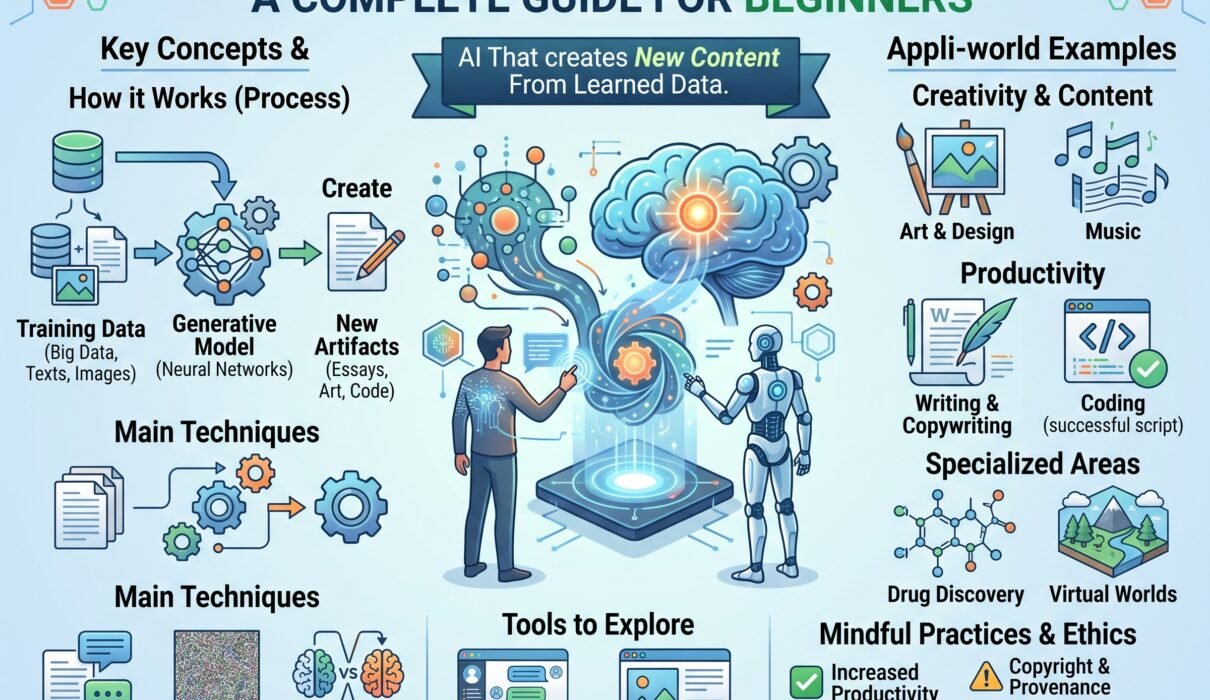
At its core, generative AI refers to deep learning systems capable of generating new content—including text, images, audio, synthetic data, code, and video—in response to human prompts.
Rather than looking up pre-written answers in a static database, a generative AI system synthesizes novel outputs by drawing upon patterns, relationships, and probabilistic structures it learned from massive datasets during training.
+-------------------------------------------------------------+
|                      ARTIFICIAL INTELLIGENCE                 |
|  Broad discipline: Building systems that mimic intelligence  |
|                                                             |
|    +---------------------------------------------------+    |
|    |                  MACHINE LEARNING                 |    |
|    |    Algorithms that improve automatically via data  |    |
|    |                                                   |    |
|    |    +-----------------------------------------+    |    |
|    |    |               DEEP LEARNING             |    |    |
|    |    |  Multi-layered artificial neural networks|   |    |
|    |    |                                         |    |    |
|    |    |    +-------------------------------+    |    |    |
|    |    |    |         GENERATIVE AI         |    |    |    |
|    |    |    |  Systems that generate new     |    |    |    |
|    |    |    |  original artifacts & data     |    |    |    |
|    |    |    +-------------------------------+    |    |    |
|    |    +-----------------------------------------+    |    |
|    +---------------------------------------------------+    |
+-------------------------------------------------------------+
Generative AI vs. Traditional (Discriminative) AI
To understand what makes generative artificial intelligence unique, consider how it differs from traditional machine learning:
| Feature | Traditional (Discriminative) AI | Generative AI |
| Primary Goal | Classify, predict, or evaluate existing inputs | Synthesize brand-new, original outputs |
| Core Question | “What category does this input belong to?” | “Given this prompt, what should come next?” |
| Data Interaction | Maps inputs to predefined labels or numbers | Learns the underlying data distribution to create new samples |
| Typical Outputs | Probabilities, scores, category labels, forecasts | Text, images, audio, video, software code |
| Representative Use Cases | Spam detection, credit scoring, medical scan diagnosis | Drafting proposals, creating concept art, generating synthetic test data |
How It Works: The Machine Learning Foundation
Generative AI does not possess sentience, consciousness, or human-style understanding. Instead, it relies on advanced machine learning principles executed at unprecedented scale:
- Massive Data Pre-training: A neural network ingests vast collections of raw data (billions of web pages, digitized books, software repositories, or image-caption pairs). During this self-supervised phase, it learns grammar, factual associations, stylistic nuances, artistic forms, and logical structures without explicit human labeling.
- Probability and Pattern Recognition: The network maps these inputs into high-dimensional vector spaces (embeddings). It learns mathematical representations of how concepts relate to one another (e.g., that “king” is to “man” as “queen” is to “woman”).
- Inference (Generation): When given a user prompt, the model calculates the most statistically probable and contextually appropriate continuation based on its internal parameters.
- Alignment and Fine-Tuning: Raw models can be unpredictable. Engineers use techniques such as Supervised Fine-Tuning (SFT) and Reinforcement Learning from Human Feedback (RLHF) to steer outputs toward helpfulness, safety, factual accuracy, and specific conversational styles.
The Engine of Text: Large Language Models (LLMs)
When most people think of generative AI, they picture conversational tools like OpenAI’s ChatGPT, Anthropic’s Claude, or Google Gemini. These applications are powered by Large Language Models (LLMs).
Raw Training Data
(Books, Web, Code)
       │
       ▼
┌───────────────────────────────┐
│     Foundation Training       │ ──► Self-Supervised Learning (Next-token prediction)
└──────────────┬────────────────┘
               │
               ▼
┌───────────────────────────────┐
│     Fine-Tuning (SFT/RLHF)    │ ──► Human Alignment (Helpful, Harmless, Honest)
└──────────────┬────────────────┘
               │
               ▼
┌───────────────────────────────┐
│       Production LLM          │ ──► Responds contextually to user prompts
└───────────────────────────────┘
The Transformer Architecture
Almost every modern state-of-the-art language model rests on a breakthrough paper published by Google researchers in 2017: “Attention Is All You Need.” This paper introduced the Transformer architecture, which replaced older recurrent neural networks (RNNs) and long short-term memory (LSTM) networks.
Traditional architectures read sentences sequentially, one word at a time. If a sentence was 50 words long, the model struggled to remember the beginning by the time it reached the end.
Transformers solved this through self-attention mechanisms:
- Parallel Processing: Instead of processing words sequentially, Transformers evaluate entire sequences simultaneously, allowing them to train on vast datasets across distributed GPU clusters.
- Contextual Attention: The model dynamically weighs the relationships between all words in a sentence, regardless of distance. In the sentence “The bank by the river was covered in moss,” the self-attention layer recognizes that “bank” refers to a shoreline rather than a financial institution because of its calculated relationship to “river” and “moss.”
Tokens and Context Windows
To work with human text, LLMs break words into smaller computational pieces called tokens:
- A token can be a whole word, a syllable, a prefix, or single characters.
- As a general rule of thumb in English, 1,000 tokens equal roughly 750 words.
The context window is the working memory buffer of an LLM during an active session. It dictates how many tokens the model can read, process, and reference at one time (including both your prompt and its response).
Early models featured modest context windows of 2,048 or 4,096 tokens—roughly enough for a short blog post. Modern architectures routinely support context windows ranging from 128,000 to over 1,000,000 tokens, enabling them to analyze entire codebases, multi-hundred-page financial prospectuses, or complete books in a single pass.
Reasoning Models and Test-Time Compute
The industry has expanded beyond standard autoregressive models that output immediate answers to reasoning-focused models (such as the OpenAI o-series, DeepSeek-R1, and Anthropic’s extended thinking capabilities).
These models allocate extra computational power during inference (often called test-time compute). Rather than immediately generating a reply, they produce an internal, step-by-step chain of thought—evaluating assumptions, verifying logic, correcting mistakes, and ruling out false conclusions before delivering their final answer. This technique has driven dramatic performance improvements in competitive mathematics, software architecture, and scientific analysis.
Visual Creativity: How AI Generates Images
Generative artificial intelligence does not assemble images by copying and pasting fragments from existing photos. Instead, it builds visual scenes from pure mathematical noise.
Text Prompt: "A ceramic coffee mug sitting on a wooden desk in morning sunlight"
                                     │
                                     ▼
[Pure Gaussian Noise] ──► [Denoising Step 1] ──► [Denoising Step 2] ──► [Final Crisp Image]
                                     ▲
                                     │
           (Conditioned by text embeddings via CLIP / Vision Transformers)
The dominant technology behind modern image generation tools—such as Midjourney, Stable Diffusion, and FLUX—is the Diffusion Model, often paired with Vision Transformers (ViTs) and multimodal latent frameworks.
The Mechanics of Diffusion Models
Diffusion models operate through a two-stage process:
- Forward Diffusion (The Training Phase): The training system takes a high-resolution image and incrementally adds random mathematical noise (Gaussian noise) over hundreds of micro-steps until the original picture is completely degraded into static.
- Reverse Diffusion (The Generation Phase): The neural network learns how to reverse that destruction. It examines a noisy image and predicts what noise needs to be subtracted to reveal the underlying structure.
When you type a prompt into an image generator:
- The text is converted into mathematical vectors using a vision-language model like CLIP.
- The system starts with an empty canvas of random visual noise.
- Guided by the text vector, the model runs the reverse diffusion process over 20 to 50 iterations, subtracting predicted noise at each step.
- Coherent shapes, lighting, textures, and details gradually emerge from the static, yielding a finished, high-resolution visual artifact.
Current Capabilities and Constraints
Modern image generators can convincingly emulate diverse artistic styles: 35mm film photography, oil paintings, isometric 3D renders, vector illustrations, and technical schematics.
However, edge cases remain challenging:
- Complex Spatial Relationships: Prompts with intricate relative positioning (e.g., “the blue ball is behind the red cube but to the left of the green cylinder”) can confuse spatial parsing.
- Micro-anatomy: While human hands, fingers, and teeth have improved significantly, high-complexity arrangements or interacting limbs can still display subtle artifacts.
- In-Image Typography: Early diffusion models could not reliably render text inside images. While modern systems handle concise text (such as signage or packaging labels) far better, long paragraphs or fine print remain error-prone.
The Next Frontier: Generative Video and World Models
Video generation is exponentially more complex than still image generation. A single second of high-definition video requires rendering 24 to 60 distinct frames that must maintain temporal consistency—meaning objects, identities, lighting, and physics must stay coherent from one frame to the next.
       Image Generation:  Spatial Coherence (2D Grid: X, Y)
       Video Generation:  Spatial + Temporal Coherence (3D Space-Time: X, Y, Time)
From 2D Pixels to Temporal Latent Spaces
Platforms like OpenAI’s Sora, Runway Gen-3, Luma Dream Machine, and Kling use Diffusion Transformers (DiT). These architectures treat video as a three-dimensional collection of spacetime patches:
- Spatial Patches: How pixels relate across the horizontal and vertical axes within a single frame.
- Temporal Patches: How those pixels transform across the timeline of sequential frames.
By training on massive libraries of video and 3D simulation data, these architectures develop rudimentary internal representations of real-world physics. They learn how cloth folds, how water splashes, how reflections shift across curved glass, and how shadows stretch as light sources move.
Real-World Video Applications
- Pre-visualization and Storyboarding: Film directors and creative agencies can prototype cinematic camera movements, scene transitions, and lighting setups without renting stages or hiring crews.
- Marketing and Advertising: Brands can produce localized, context-specific commercial b-roll at a fraction of standard production budgets.
- Game Development and Virtual Worlds: Studio artists use generative video systems to prototype character motions, dynamic backgrounds, and environmental particle effects rapidly.
Coding Assistants: Software Engineering in the Age of AI
Software engineering has emerged as one of the fastest adopters of generative AI. Because computer code follows strict grammatical, structural, and syntactic rules, language models can interpret and synthesize code with remarkable precision.
Developer Prompt / Intent
          │
          ▼
┌────────────────────────────────┐
│      AI Coding Engine          │
│  • Reads surrounding files     │
│  • Gathers context & schemas   │
│  • Predicts syntax & logic     │
└─────────┬──────────────────────┘
          │
          ├──────────────────────────────┬─────────────────────────────┐
          ▼                              ▼                             ▼
   [Inline Autocomplete]        [Test Generation]              [Automated Refactor]
   Tab-to-complete logic        Creates edge-case unit tests   Modernizes legacy syntax
Key Capabilities in Modern Engineering Workflows
Modern development environments integrate AI tools like GitHub Copilot, Cursor, and Claude Code directly into developer setups:
- Contextual Autocomplete: Predicting entire functions, algorithms, and boilerplate patterns in real time as an engineer types.
- Codebase-Wide Refactoring: Modern agents can read an entire directory structure, identify deprecated APIs or security vulnerabilities, and submit pull requests spanning multiple files simultaneously.
- Unit and Integration Test Creation: Writing exhaustive test suites covering subtle boundary conditions and edge cases that developers might otherwise skip.
- Legacy Code Modernization: Translating outdated codebases (such as COBOL, Fortran, or legacy PHP) into modern languages like Rust, TypeScript, or Go while preserving core business logic.
Beyond Keyword Search: The Rise of AI Search Engines
Traditional search engines rely on indexing web pages, matching keywords, and ranking links based on domain authority and backlink graphs. When you search for a complex topic, you receive a list of links that you must open, scan, and synthesize yourself.
Generative AI has upended this model through answer engines and conversational search systems, such as Perplexity AI, Google Search Generative Experience / AI Overviews, and Microsoft Copilot.
Traditional Search Engine:
User Query ──► Keyword Index Matching ──► List of 10 Blue Links ──► User reads & synthesizes

AI Answer Engine (RAG):
User Query ──► Live Web Retrieval ──► Synthesis via LLM ──► Direct Answer with Inline Citations
The Power of Retrieval-Augmented Generation (RAG)
To prevent models from hallucinating out-of-date information, modern search systems use an architecture called Retrieval-Augmented Generation (RAG):
- Query Processing: The system parses your natural-language question and extracts the core search intent.
- Information Retrieval: It sends targeted queries to search indexes, pulling down current, high-ranking web documents and data sources.
- Contextual Grounding: The retrieved information is injected into the LLM’s active context window alongside your original question.
- Synthesis with Citations: The model generates a coherent, natural-language summary that directly answers your question, backing up factual claims with inline citations pointing to original sources.
This approach delivers concise, direct answers to multi-layered questions (e.g., “Compare the maintenance costs and warranties of heat pumps versus gas furnaces for an older home in New England”) without requiring you to piece together findings across a dozen browser tabs.
Practical Applications: How Generative AI Is Used Across Industries
Organizations across the global economy are deploying generative artificial intelligence to automate repetitive tasks, accelerate research, and unlock operational efficiencies.
┌────────────────────────────────────────────────────────────────────────┐
│                   INDUSTRY ADOPTION SNAPSHOT                           │
├─────────────────────┬──────────────────────────────────────────────────┤
│ Marketing & Sales   │ Personalized ad copy, dynamic creative assets,   │
│                     │ lead research dossiers, sales email sequences     │
├─────────────────────┼──────────────────────────────────────────────────┤
│ Healthcare & Pharma │ Clinical documentation, drug target discovery,   │
│                     │ medical literature synthesis, patient summaries  │
├─────────────────────┼──────────────────────────────────────────────────┤
│ Financial Services  │ Regulatory filing analysis, automated reporting, │
│                     │ fraud pattern synthesis, financial modeling      │
├─────────────────────┼──────────────────────────────────────────────────┤
│ Legal & Compliance  │ Contract redlining, discovery document review,   │
│                     │ cross-jurisdiction regulatory tracking           │
├─────────────────────┼──────────────────────────────────────────────────┤
│ Education           │ Adaptive 1-on-1 tutoring, automated lesson plans,│
│                     │ interactive language practice scenarios          │
└─────────────────────┴──────────────────────────────────────────────────┘
1. Marketing and Corporate Communications
- Asset Scalability: Marketing teams can take a single strategic pillar document and translate it into multi-channel campaigns—generating ad variants, social media threads, email newsletters, and long-form articles tailored to distinct audience segments.
- Hyper-Personalization: Generating bespoke outreach messaging aligned with a prospect’s industry, tech stack, and pain points at scale.
2. Healthcare and Life Sciences
- Clinical Note Summarization: Doctors spend hours each day typing administrative notes into Electronic Health Record (EHR) systems. Generative systems listen to ambient doctor-patient conversations (with consent) and automatically produce formatted clinical summaries for physician review.
- De Novo Molecular Design: Generative models trained on chemical compound structures and protein folding dynamics design novel drug candidates with targeted binding properties, significantly shortening early-stage discovery timelines.
3. Financial Services
- Automated Earnings Analysis: Reading complex, multi-page quarterly earnings call transcripts and balance sheets, extracting key financial metrics, and summarizing operational risks in seconds.
- Customer Dispute Handling: Ingesting transaction histories and unstructured customer complaints, compiling relevant evidence, and drafting preliminary resolution letters for human review.
4. Legal Operations
- Contract Analysis: Parsing 80-page commercial vendor agreements to flag clauses that deviate from an organization’s standard indemnification, liability, or data protection terms.
- Statutory Research: Synthesizing case law and regulatory statutes across multiple jurisdictions to draft initial legal memoranda.
Critical Limitations, Risks, and Ethical Considerations
Generative AI systems offer powerful capabilities, but they also introduce distinct failure modes. Understanding their limitations is essential for using them responsibly.
                         GENERATIVE AI RISK MATRIX

          ┌───────────────────────────────────────────────────┐
          │                  Hallucinations                   │
          │ Confident generation of plausible but false facts │
          └─────────────────────────┬─────────────────────────┘
                                    │
          ┌─────────────────────────┴─────────────────────────┐
          │            Data Privacy & Security                │
          │ Unintended leakage of IP into public model caches │
          └─────────────────────────┬─────────────────────────┘
                                    │
          ┌─────────────────────────┴─────────────────────────┐
          │             Algorithmic Bias                      │
          │ Perpetuating historical disparities from data     │
          └─────────────────────────┬─────────────────────────┘
                                    │
          ┌─────────────────────────┴─────────────────────────┐
          │         Intellectual Property Issues              │
          │ Unresolved disputes regarding training data use   │
          └───────────────────────────────────────────────────┘
1. Hallucinations and Factual Accuracy
Language models operate on probability, not verification. When an LLM lacks sufficient data to answer a query accurately, it may generate an answer that sounds completely confident, grammatically flawless, yet remains entirely fabricated.
In high-stakes environments—such as medicine, structural engineering, law, and tax preparation—unverified AI outputs can introduce catastrophic errors. Critical workflows must always pair generative models with source verification and qualified human review.
2. Data Privacy, Governance, and Leakage
When employees enter proprietary data, customer records, or internal code into consumer-facing AI interfaces, that information may be stored on external servers or used to train future model iterations. Organizations must enforce clear enterprise data governance policies, including:
- Disabling model training on company inputs.
- Securing Zero Data Retention (ZDR) enterprise agreements.
- Utilizing private cloud deployments or on-premises open-weight models for sensitive data.
3. Algorithmic Bias and Representational Fairness
AI models learn from historical datasets created by humans, which inevitably contain historical biases, stereotypes, and systemic imbalances. Left unadjusted, an image generator might depict certain professions with skewed gender or racial balances, or an evaluation model might favor specific socioeconomic dialects over others. Continuous alignment, balanced dataset curation, and red-teaming are necessary to mitigate these issues.
4. Intellectual Property and Copyright Challenges
The legal landscape surrounding generative AI remains actively contested in global courts. Major questions include:
- Fair Use vs. Infringement: Is training a neural network on copyrighted books, artwork, and code protected under fair use doctrines, or does it constitute copyright infringement?
- Output Ownership: Most legal systems (including the U.S. Copyright Office) do not grant copyright protection to purely machine-generated works without substantial human authorship.
Best Practices: How to Start Using Generative AI Tools Effectively
Achieving consistent, high-quality results from generative AI requires shifting how you interact with software—moving from keyword search to structured prompt engineering and task framing.
POOR INPUT:
"Write a blog post about project management."
  │
  ▼
[Vague, generic, clichéd response filled with filler text]

STRUCTURED INPUT (ROLE-TASK-CONTEXT-FORMAT):
"You are a Senior Technical Project Manager.
Write a 500-word tactical guide on resolving scope creep in agile software teams.
Target audience: Junior engineering managers.
Include: 3 actionable negotiation scripts and a markdown table comparing change requests."
  │
  ▼
[Precise, highly applicable, professional-grade output]
The R-T-C-F Prompting Framework
When prompting text models, use the Role – Task – Context – Format (R-T-C-F) framework:
- Role: Assign the model a clear identity, persona, and level of expertise.
- Example: “Act as a veteran enterprise cloud architect specializing in AWS cost optimization…”
- Task: Clearly articulate the specific action you need performed. Use strong action verbs.
- Example: “…audit the following architecture outline and identify three sources of budget waste.”
- Context: Provide the necessary background constraints, target audience details, and project boundaries.
- Example: “Our startup has 50,000 monthly active users and an infrastructure budget capped at $2,000/month.”
- Format: Dictate the desired structure, tone, length, and style of the output.
- Example: “Present your findings as an executive summary followed by a prioritized markdown table sorted by estimated cost savings.”
Iterative Refinement and Few-Shot Prompting
- Don’t Expect Perfection on Turn One: Treat the model as a collaborative partner. If the first output is too formal, too brief, or misses a nuance, follow up with targeted critique: “Tighten the introduction, remove corporate jargon, and add a concrete numerical example to point two.”
- Provide Examples (Few-Shot Prompting): Show the model two or three samples of the exact style, tone, or format you expect before asking it to generate new content. Demonstrating your preferred pattern yields significantly better results than relying solely on abstract instructions.
The Road Ahead: Autonomous Agents and Future Trends
Generative AI is shifting from isolated generation tools into autonomous agentic systems.
                   THE EVOLUTION OF INTERFACE PARADIGMS

1. Chatbot (2022)      User asks ──► Model replies with text
         │
         ▼
2. Copilot (2024)      User works ──► Model suggests code / edits alongside human
         │
         ▼
3. Autonomous Agent    User assigns goal ──► Agent plans, calls tools, executes code,
   (Present & Beyond)                        validates output, and solves end-to-end
1. Autonomous AI Agents
Rather than waiting for turn-by-turn human prompts, an AI agent is given an open-ended objective (e.g., “Audit our AWS billing statements for anomalies over the last quarter, open Jira tickets for cost spikes, and draft a summary email to the CFO”).
The agent breaks that directive into sub-tasks, queries external APIs, browses the web, executes sandboxed code, observes the results of its actions, fixes its own errors, and completes the workflow end-to-end.
2. Native Multimodality
Early generative systems separated modalities: one model processed text, another synthesized images, and a third transcribed audio.
Next-generation foundation models are natively multimodal from the ground up. They process text, video, voice streams, and code simultaneously within a single architecture. This allows users to converse fluidly via voice, show the model live video through a phone camera, and receive contextual real-time assistance.
3. Edge AI and Small Language Models (SLMs)
While frontier models require warehouse-scale data centers packed with specialized GPUs, researchers have made striking progress with model distillation and quantization. Highly capable Small Language Models can now run locally on laptops, smartphones, and edge devices. This shift dramatically lowers operational costs, eliminates network latency, and enables strict data privacy by keeping sensitive computations directly on the user’s hardware.
Summary Checklist: Getting Started
Generative AI marks a permanent shift in how humans interact with technology. It bridges the gap between conceptual intent and tangible output, turning natural language into software code, visual art, written prose, and operational insight.
To make the most of generative artificial intelligence:
- Focus on Amplification, Not Replacement: Use generative tools to eliminate repetitive drafting, research, and formatting tasks, freeing up more time for high-level strategy, creative judgment, and critical verification.
- Always Keep a Human in the Loop: Treat AI outputs as functional first drafts. Verify factual claims, check source code, and ensure final deliverables align with your standards.
- Master Structured Communication: The quality of an AI model’s output directly reflects the clarity, context, and constraints of your input.
- Experiment Continuously: The tooling ecosystem is evolving at an unprecedented pace. Hands-on experimentation remains the single best way to understand its capabilities, navigate its limitations, and harness its potential.